

Nvidia Q1 FY2027 Earnings: Record $81.6 Billion Revenue and $91 Billion Guidance Crush Wall Street Estimates
2026/05/21 10:48:01
Introduction
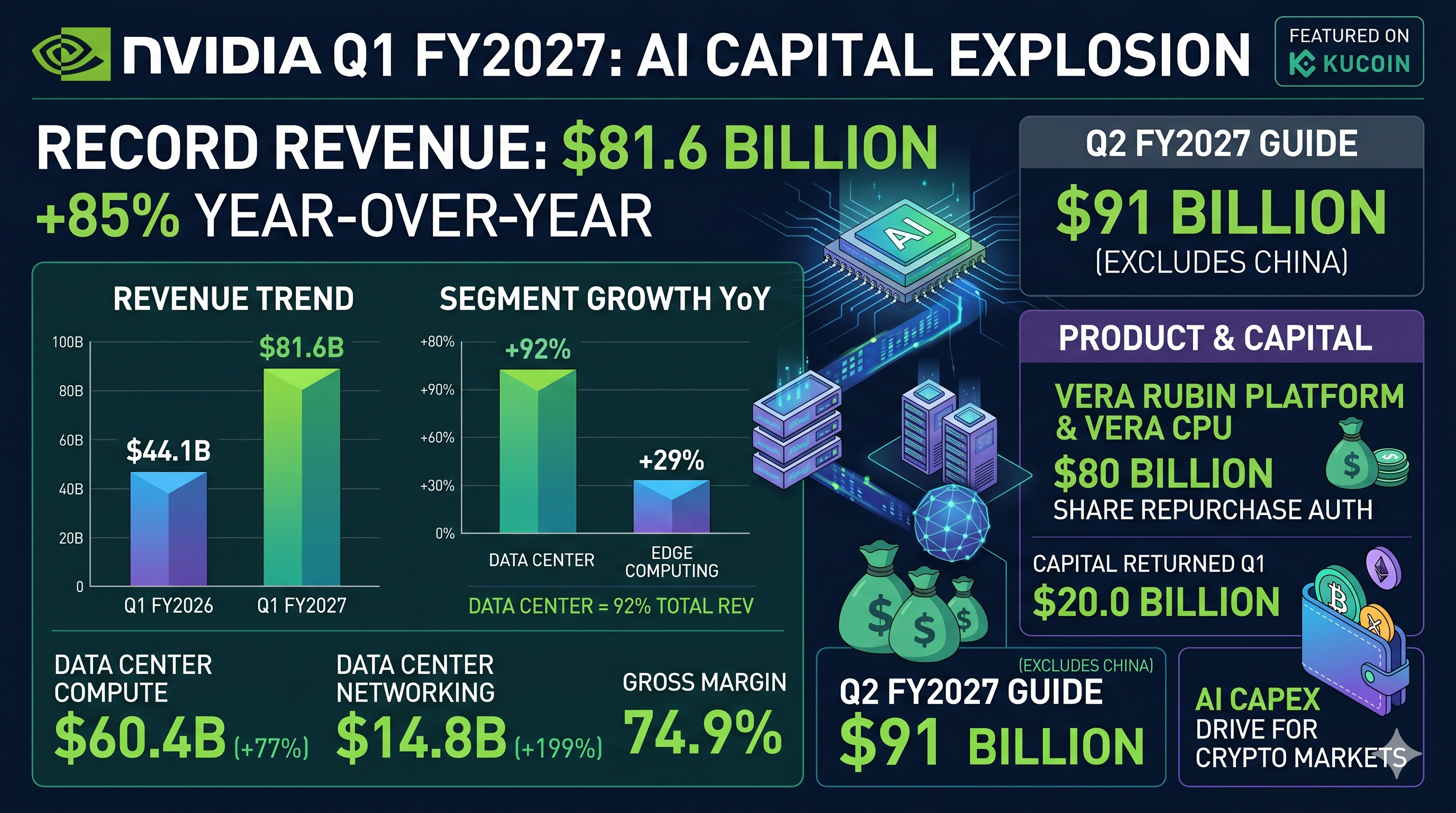
Nvidia just printed the largest single-quarter revenue figure in semiconductor history — and forecast an even bigger one ahead. NVIDIA reported record revenue for the first quarter ended April 26, 2026, of $81.6 billion, up 20% from the previous quarter and up 85% from a year ago. Both top-line and bottom-line numbers blew past consensus, and management's Q2 forecast of roughly $91 billion signaled that the AI infrastructure cycle is still accelerating rather than peaking.
For investors across equities and crypto, this matters. Nvidia's results function as the single most important real-time read on global AI capital expenditure — a flow that has historically correlated tightly with risk-asset sentiment, including Bitcoin and AI-themed tokens. Below is a complete breakdown of what Nvidia reported, what changed in guidance, and what the print means for markets in the weeks ahead.
What Did Nvidia Report in Q1 Fiscal 2027?
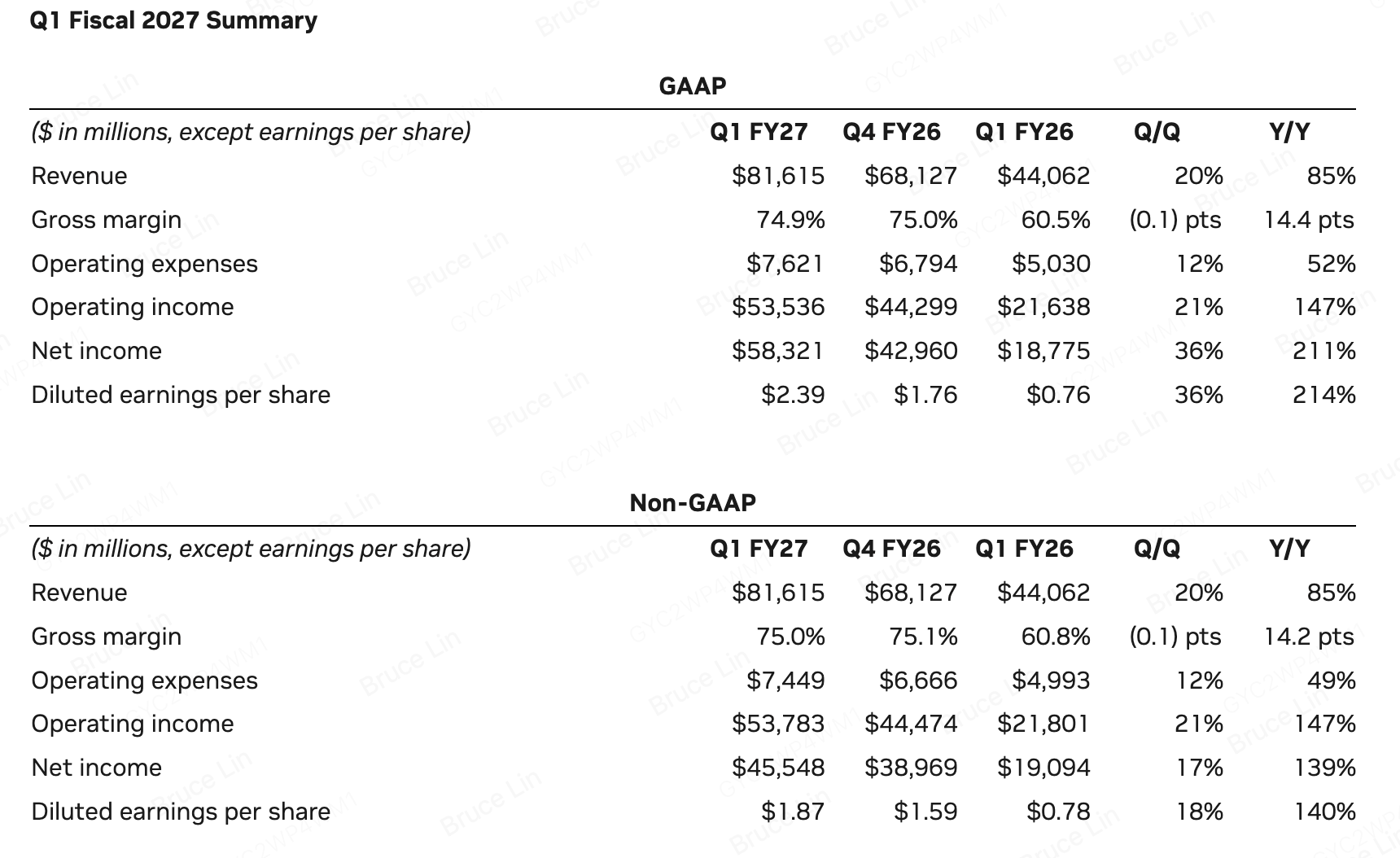
Nvidia delivered an across-the-board beat, with record revenue, record margins for the year, and a record return of capital to shareholders. According to Nvidia's official Q1 FY2027 press release, the company posted $81.6 billion in quarterly revenue with GAAP gross margins of 74.9%.
Here are the headline figures from the official release:
|
Metric
|
Q1 FY2027
|
YoY Change
|
|
Revenue
|
$81.6B
|
+85%
|
|
Data Center revenue
|
$75.2B
|
+92%
|
|
Data Center compute
|
$60.4B
|
+77%
|
|
Data Center networking
|
$14.8B
|
+199%
|
|
Edge Computing
|
$6.4B
|
+29%
|
|
GAAP gross margin
|
74.9%
|
—
|
|
GAAP diluted EPS
|
$2.39
|
—
|
|
Non-GAAP diluted EPS
|
$1.87
|
—
|
Based on Nvidia's official newsroom announcement, the quarter ended April 26, 2026, GAAP and non-GAAP gross margins were 74.9% and 75.0%, respectively, and GAAP and non-GAAP earnings per diluted share were $2.39 and $1.87, respectively.
The sequential growth story is equally striking. According to Nvidia's filing, revenue climbed 20% from the prior quarter — a $13.5 billion sequential increase on an already record base. That kind of acceleration at this scale is virtually unprecedented in large-cap technology.
How Big Was the Data Center Segment Beat?
Data Center remains the engine of the entire business, and the growth rate is still accelerating rather than rolling over. According to Nvidia's official press release, Data Center revenue hit a record $75.2 billion, up 92% from a year ago. That makes Data Center roughly 92% of total company revenue this quarter.
The internal mix shift inside Data Center is what shocked analysts:
-
Compute: Data Center compute revenue was a record $60.4 billion, up 77% from a year ago and up 18% sequentially.
-
Networking: Data Center networking revenue was a record $14.8 billion, up 199% from a year ago and up 35% sequentially.
Networking nearly tripling year-over-year is the most underrated number in the print. It confirms that Nvidia is no longer just a GPU vendor — it is selling full AI factory systems, where Spectrum-X, NVLink, and BlueField networking products travel attached to every rack-scale deployment. That bundled model is what is driving gross margins to historic levels.
Why Are Hyperscalers Still Buying So Aggressively?
Hyperscale demand is being driven by the rapid transition from generative AI to agentic AI workloads, which require dramatically more compute per task. CEO Jensen Huang framed the moment directly: "The buildout of AI factories — the largest infrastructure expansion in human history — is accelerating at extraordinary speed," and "Agentic AI has arrived, doing productive work, generating real value and scaling rapidly across companies and industries."
In short, the customer base is not just training larger models — they are now running long-horizon agents that consume tokens continuously, multiplying inference demand far beyond previous estimates.
What Is Nvidia's Q2 FY2027 Revenue Guidance?
Nvidia guided Q2 FY2027 revenue to approximately $91 billion, plus or minus 2% — well above consensus. Nvidia gave strong forward guidance, predicting $91 billion of revenue in its current fiscal second quarter, which is well above the average quarterly revenue estimate of $86.84 billion, according to LSEG.
Three details inside the guide deserve attention:
-
Margin durability: GAAP and non-GAAP gross margins are expected to remain near 74.9% and 75.0%, respectively. Management is signaling that pricing power is not eroding as Blackwell volumes scale.
-
China carve-out: NVIDIA guided Q2 FY2027 revenue at approximately $91 billion, plus or minus 2%, and the company stated that this outlook excludes any Data Center compute revenue from China. Any policy thaw on China shipments would represent pure upside not in the model.
-
Operating leverage: Operating expenses for Q2 are projected at around $8.5 billion on a GAAP basis and $8.3 billion non-GAAP. Revenue is scaling far faster than opex.
The implication is straightforward: even excluding what was once one of Nvidia's largest end markets, the company expects to grow another ~12% sequentially.
Nvidia announced one of the largest combined buyback-and-dividend actions in tech history this quarter. According to the official release, NVIDIA announced an $80.0 billion additional share repurchase authorization and increased its quarterly cash dividend from $0.01 per share to $0.25 per share.
That dividend increase represents a 25x raise on a per-share basis — an unusual move from a company still in hyper-growth mode, and a clear signal that free cash flow generation is comfortably outrunning reinvestment needs.
Capital returned during the quarter itself was also at record levels. During the first quarter of fiscal 2027, NVIDIA returned a record level of approximately $20.0 billion to shareholders in the form of shares repurchased and cash dividends, and as of the end of the first quarter, the company had $38.5 billion remaining under its share repurchase authorization. Combined with the new $80 billion authorization, the total remaining buyback capacity sits well above $100 billion.
What New Products and Platforms Did Nvidia Highlight?
Nvidia used the quarter to broaden its platform story well beyond GPUs, with three announcements standing out. The company is positioning itself across compute, networking, and now general-purpose CPUs.
The Vera Rubin Platform and Vera CPU
Nvidia introduced its next-generation Vera Rubin platform, anchored by a brand-new CPU built specifically for agentic workloads. According to the official Nvidia release, the company announced the NVIDIA Vera Rubin platform, including the NVIDIA Vera CPU — described as the world's first processor purpose-built for agentic AI.
On the earnings call, CFO Colette Kress framed this as a direct attack on the data center CPU market. Nvidia is aiming to become the "world's leading CPU supplier," Chief Financial Officer Colette Kress said on the earnings call. It's a lane currently dominated by competitors Intel and Advanced Micro Devices. The company's new Vera central processing unit "opens a brand new $200 billion tab for Nvidia," Kress said, adding that "every major hyperscale and system maker is partnering with us to get it deployed." She anticipated $20 billion in total CPU revenue this year.
Edge Computing and a New Reporting Structure
Nvidia also restructured how it reports its business. NVIDIA announced a new reporting framework splitting its business into Data Center and Edge Computing platforms. Within Data Center, it will now report Hyperscale and ACIE sub-markets separately. Edge Computing will cover PCs, game consoles, robotics, and automotive devices.
The Edge Computing segment — covering gaming, robotics, automotive, and pro visualization — generated $6.4 billion, up 29% year-over-year, confirming that the non-data-center businesses are still growing at a healthy clip even as Data Center dominates the mix.
How Did the Market React to Nvidia's Q1 FY2027 Print?
The initial market reaction was unusually muted given the size of the beat. The chipmaker's stock sank following the analyst call, on track for a fourth-straight post-earnings slide.
This pattern — where Nvidia beats expectations decisively but the stock underperforms in the immediate aftermath — has now become a recurring feature. The likely explanation: expectations are already priced extremely high, and incremental upside requires either a China reopening, a faster Rubin ramp, or a clear demand signal beyond the existing hyperscale Big Five.
For crypto markets, the macro read-through is what matters most. Strong AI capex guidance tends to reinforce risk-on sentiment, support liquidity for AI-themed tokens, and keep correlation between Nasdaq and Bitcoin elevated. A guide of $91 billion — well ahead of consensus — keeps that backdrop intact.
How to Trade Crypto on KuCoin Around Macro Catalysts Like Nvidia Earnings
KuCoin lets you position around major macro and tech catalysts with deep liquidity across spot, futures, and AI-themed altcoins. Nvidia's results frequently move the entire AI narrative inside crypto — touching tokens tied to decentralized compute, GPU networks, and AI agent infrastructure — and KuCoin offers exposure to all of these in one place.
To get started:
-
Create and verify a KuCoin account.
-
Fund your wallet via card, or stablecoin deposit.
-
Choose between spot trading for long-term positions or futures for short-term catalyst trades.
-
Use KuCoin's market data and charting tools to track correlations between Nasdaq, Nvidia, and major crypto assets. KuCoin also offers derivatives to trade NVDA/USDT.
-
Set risk limits — stop-losses on futures and position sizing on spot — before entering any catalyst-driven trade.
New users can now register at KuCoin and Get Up to 11,000 USDT in New User Rewards.

Conclusion
Nvidia's Q1 FY2027 results reset the bar for what the AI infrastructure cycle can produce at scale. Revenue of $81.6 billion, Data Center growth of 92% year-over-year, networking revenue tripling, and a $91 billion Q2 guide that excludes China together paint a picture of demand that is still expanding rather than normalizing.
The Vera CPU announcement extends Nvidia's addressable market by roughly $200 billion, while the $80 billion buyback authorization and 25x dividend hike signal extraordinary confidence in forward cash flows. Margin durability near 75% confirms that pricing power remains intact even as Blackwell volumes scale.
For traders and investors, the takeaway is clear: AI capex is still the dominant macro narrative, and it is feeding directly into risk-asset liquidity — including crypto. The muted post-earnings stock reaction reflects positioning more than fundamentals. With agentic AI driving a structural step-change in compute demand, Nvidia's print reinforces the bull case for the broader AI-and-crypto convergence trade through the rest of 2026.
Frequently Asked Questions (FAQs)
When did Nvidia report Q1 fiscal 2027 earnings?
Nvidia reported Q1 FY2027 results after the U.S. market close on Wednesday, May 20, 2026, for the quarter ended April 26, 2026. The earnings conference call was held the same afternoon at 2 p.m. Pacific time.
Did Nvidia beat earnings estimates in Q1 FY2027?
Yes, decisively. Revenue of $81.6 billion came in above the consensus estimate of roughly $80.4 billion, and non-GAAP EPS of $1.87 beat the consensus estimate of approximately $1.76 to $1.77. According to Public.com's earnings data, NVIDIA reported its most recent earnings on May 20, 2026 for Q1 2027, posting earnings per share (EPS) of $1.87, which exceeded analysts' expectations of $1.76 by 6.25%, marking a Beat.
Why does Nvidia's guidance exclude China data center compute revenue?
Nvidia has excluded China data center compute revenue from its forward guidance because U.S. export restrictions on advanced AI chips — including the H20 product line — have made shipments into the region structurally uncertain. Management treats any future Chinese contribution as upside to the base case rather than including it in the formal outlook.
What is the Nvidia Vera Rubin platform?
Vera Rubin is Nvidia's next-generation AI computing platform combining the new Vera CPU — Nvidia's first general-purpose data center CPU purpose-built for agentic AI — with Rubin-generation GPUs. It positions Nvidia to compete directly with Intel and AMD in the server CPU market, a category Nvidia estimates as a roughly $200 billion opportunity.
How does Nvidia's earnings affect cryptocurrency markets?
Nvidia earnings influence crypto primarily through risk sentiment and AI narrative flows. Strong AI capex guidance typically supports liquidity in equity markets, reinforces Nasdaq-Bitcoin correlation, and drives capital into AI-themed tokens covering decentralized compute, GPU networks, and AI agents. A beat-and-raise quarter like Q1 FY2027 generally provides a tailwind for the AI-crypto convergence trade.