

Solana Quantum Roadmap: Falcon Selected for Post-Quantum Security with Migration Already Ready
Introduction
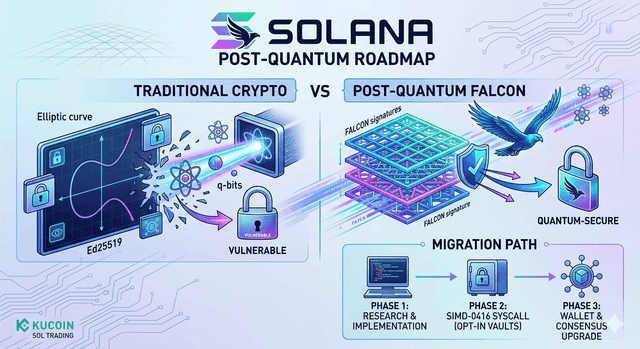
Solana has selected Falcon as its primary post-quantum signature scheme and already has a working migration plan ready to deploy, according to a roadmap unveiled in April 2026 by the Solana Foundation and core developer teams Anza and Jump Crypto's Firedancer. The announcement marks one of the most concrete quantum-preparedness strategies in the blockchain industry, directly addressing how the high-speed network will defend against future quantum computers capable of breaking current elliptic-curve cryptography.
The roadmap is not theoretical. Both core development teams have independently built initial Falcon implementations, with Firedancer producing a verification routine that is 2-3x faster than the reference standard. The Solana Foundation has also proposed SIMD-0416, a syscall that would bring Falcon verification on-chain for smart contract developers. While the foundation stresses that quantum attacks remain years away, the message is clear: Solana's post-quantum migration is researched, understood, and technically ready.
Why Quantum Computing Threatens Blockchains
Quantum computers pose a direct threat to the digital signatures that secure every blockchain transaction today. Current systems like Solana rely on elliptic-curve cryptography — specifically Ed25519 for user wallets and BLS12-381 for validator consensus. These schemes assume that deriving a private key from a public key is mathematically infeasible.
That assumption collapses under Shor's algorithm. A sufficiently powerful quantum computer could reverse-engineer private keys from publicly visible addresses, enabling attackers to forge signatures and steal funds. According to research published by Google Quantum AI in March 2026, the timeline for such capabilities is advancing faster than previously expected, prompting the crypto industry to treat quantum readiness as an urgent infrastructure priority. Google's report about quantum threat explicitly called for responsible disclosure of quantum vulnerabilities and accelerated migration planning across blockchain networks.
The risk is not immediate, but it is existential. Once large-scale quantum computers exist, any funds stored in addresses whose public keys have been revealed on-chain could be retroactively targeted. This creates a "harvest now, decrypt later" incentive structure where adversaries collect encrypted data today to decrypt once quantum hardware matures.
Why Solana Chose Falcon Over Alternatives
Falcon (Fast Fourier lattice-based compact signatures over NTRU) emerged as Solana's leading candidate because it offers the smallest signature footprint among NIST-standardized post-quantum schemes. For a network optimized for sub-second finality and high throughput, signature size directly impacts bandwidth and storage costs.
The comparison is stark. Solana's current Ed25519 signatures are 64 bytes with 32-byte public keys. Falcon-512 produces signatures of 666 bytes and public keys of 897 bytes. While roughly 10x larger than Ed25519, Falcon remains dramatically more compact than ML-DSA (Dilithium), which requires 2,420-byte signatures and 1,312-byte public keys. A scheme like Dilithium would bloat Solana's transaction packets and strain its gossip protocol. Falcon represents the pragmatic middle ground — quantum-resistant without sacrificing Solana's performance identity.
|
Scheme
|
Public Key Size
|
Signature Size
|
Verify Time vs. Ed25519
|
Status
|
|
Ed25519 (current)
|
32 B
|
64 B
|
1.00x
|
Not quantum-safe
|
|
Falcon-512 (FN-DSA)
|
897 B
|
666 B
|
0.25x
|
Leading candidate
|
|
Dilithium2 (ML-DSA-44)
|
1,312 B
|
2,420 B
|
0.80x
|
Signatures too large for Solana
|
|
SQIsign
|
65 B
|
148 B
|
~100.00x
|
Promising but unstandardized
|
Falcon's standardization was delayed by NIST due to concerns around implementation complexity and side-channel vulnerabilities. However, Solana developers emphasize that Falcon verification is integer-only and straightforward to implement securely. Signing operations occur off-chain within wallets, allowing developers to use carefully audited, integer-only implementations that mitigate side-channel risks.
Alternative schemes remain on the radar. SQIsign offers exceptionally small keys and signatures comparable to elliptic-curve sizes, but verification is currently roughly 100x slower than Ed25519. The Solana Foundation notes that if future research produces a more efficient SQIsign verification algorithm, it could become a compelling long-term candidate. For now, Falcon provides the best balance of standardization, security, and performance.
How Solana's Migration Will Work
Solana's post-quantum roadmap is phased and non-disruptive. The foundation has explicitly stated there is no immediate hard fork or mandatory migration. Instead, the plan unfolds across three parallel tracks: protocol-level preparation, on-chain developer tooling, and eventual user wallet migration.
Phase 1: Research and Implementation
Both Anza and Firedancer have already built working Falcon implementations. Firedancer's optimized verifier is 2-3x faster than the reference implementation and is undergoing security audits. This phase focuses on validating performance assumptions and ensuring the cryptography is production-ready before any protocol changes occur.
Phase 2: Developer-First Adoption
The immediate next step is SIMD-0416, a proposal to add a Falcon signature verification syscall to the Solana runtime. This would allow smart contract developers to build post-quantum vaults, multi-sig wallets, and DeFi primitives without waiting for a network-wide upgrade. Developers could opt into quantum-resistant custody today, creating a layer of protection for high-value accounts ahead of any mandatory migration.
Phase 3: Wallet and Consensus Migration
Eventually, Solana will migrate existing wallets and consensus mechanisms. The foundation has outlined a viable path for legacy wallets that avoids the "burn your coins" scenarios discussed in other blockchain communities. Because Solana's Ed25519 private keys are derived from a 32-byte seed via SHA-512, a quantum attacker could theoretically recover the derived signing secret but not the original seed itself. SHA-512 remains a quantum-resistant one-way function.
This architectural detail enables a elegant migration protocol. Existing wallet owners would generate a new Falcon keypair, then prove ownership by providing a zero-knowledge proof demonstrating possession of the original Ed25519 seed — without exposing the seed itself. This allows authorized fund migration without relying on the compromised Ed25519 signature scheme. Program Derived Accounts (PDAs), which have no private key, are inherently quantum-safe and require no action.
Consensus migration follows a similar modular approach. Solana's Alpenglow consensus uses BLS12-381 signatures for validator voting because they aggregate efficiently. A post-quantum consensus layer could adopt a different scheme optimized for aggregation — such as lattice-based multi-signature protocols like Raccoon or DOTT — while user transactions use Falcon. The consensus signature scheme can evolve independently from transaction signatures, just as Alpenglow currently uses BLS while transactions use Ed25519.
Performance Impact: Will Solana Slow Down?
The Solana Foundation has stated that any eventual migration will be manageable and unlikely to significantly impact network performance. This claim is supported by Falcon's verification profile. Falcon verification is actually faster than Ed25519 verification — roughly 4x faster according to benchmark data — which helps offset the bandwidth cost of larger signatures.
The primary challenge is not computation but data transmission. Solana's gossip network and Turbine block propagation protocol are optimized for small packets. Adding 666-byte signatures to every transaction increases network load. However, Solana's architecture already handles variable transaction sizes, and the phased rollout allows the protocol to adjust block limits and networking parameters incrementally.
Grayscale Research, in an April 2026 report, flagged Solana alongside XRP Ledger as early movers in post-quantum cryptography. The report noted that Solana's proactive stance positions it favorably relative to chains that have not yet published concrete migration plans. While some analysts have speculated that quantum upgrades could threaten Solana's speed advantage, the foundation's phased approach — enabling opt-in protections years before any mandatory switch — provides ample runway for optimization.
Ecosystem Preparations Already Underway
Solana's quantum readiness extends beyond core protocol work. Blueshift, a community research and development team, has operated a "Winternitz Vault" on Solana for over two years. This quantum-resistant primitive uses hash-based signatures (Winternitz One-Time Signatures) to provide opt-in cold storage protection without requiring protocol changes. Google Quantum AI recently cited this work as an example of practical quantum-resistant custody available today.
The existence of these community-led solutions underscores a key theme in Solana's roadmap: quantum security is not a single future event but a continuum of incremental improvements. Users and developers can begin hardening their custody practices now, reducing the attack surface even before a network-wide post-quantum transition.
Should You Trade SOL on KuCoin?
Solana's quantum roadmap directly strengthens the long-term investment thesis for SOL. While quantum computing remains a distant threat, the network's proactive migration planning — complete with working implementations and a clear technical path — reduces long-term structural risk. For traders and investors, this infrastructure resilience supports sustained ecosystem growth.
KuCoin offers comprehensive SOL trading pairs, spot markets, and futures contracts with deep liquidity. The platform provides institutional-grade security infrastructure, including multi-signature cold wallets and real-time risk monitoring, complementing Solana's own security roadmap. Whether you are accumulating SOL for long-term holdings or actively trading volatility, KuCoin's competitive fees and advanced order types provide the tools needed to execute your strategy.
New users can register on KuCoin in minutes and access SOL/USDT, and numerous altcoin pairs. With Solana's quantum-preparedness removing a key existential risk from the long-term outlook, positioning in SOL through a secure, liquid exchange like KuCoin offers a compelling entry point into one of crypto's most technically advanced Layer 1 networks.
Conclusion
Solana has moved decisively from quantum awareness to quantum readiness. By selecting Falcon as its post-quantum signature scheme, producing optimized implementations, and designing a non-disruptive migration path for existing wallets, the network has addressed the most critical technical and logistical challenges years ahead of any anticipated threat. The roadmap is phased, pragmatic, and performance-conscious — qualities essential for a chain that markets itself on speed.
The collaboration between Anza and Firedancer, the proposal of SIMD-0416 for on-chain Falcon verification, and the innovative zero-knowledge migration path for legacy wallets all demonstrate that Solana's quantum preparation is not marketing but engineering. While other blockchains debate theoretical approaches, Solana has working code and a deployable plan.
For users, developers, and investors, the takeaway is clear: Solana is building for a post-quantum future without sacrificing the present. The network will maintain its performance edge while adding cryptographic resilience that could prove invaluable as quantum computing matures. In an industry often criticized for short-term thinking, Solana's quantum roadmap represents exactly the kind of long-term infrastructure planning that separates enduring protocols from temporary trends.
FAQs
What is Falcon in the context of Solana?
Falcon is a lattice-based post-quantum digital signature scheme selected by Solana as its primary candidate to replace Ed25519. It offers the smallest signatures among NIST-standardized quantum-resistant algorithms, making it compatible with Solana's high-throughput architecture.
When will Solana complete its post-quantum migration?
The Solana Foundation has not set a firm deadline for completing the migration. The roadmap is intentionally phased, starting with developer tooling and opt-in protections, followed by eventual network-wide adoption. The foundation emphasizes that quantum attacks remain years away, providing ample time for incremental rollout.
Will I lose my SOL if I do not migrate my wallet immediately?
No. Solana has designed a migration path that allows existing wallet owners to move funds securely using zero-knowledge proofs of seed ownership, even after Ed25519 is deprecated. There is no immediate action required, and no funds are at risk in the near term.
How does Falcon affect Solana's transaction speed?
Falcon signatures are larger than Ed25519 (666 bytes vs. 64 bytes), which increases network bandwidth usage. However, Falcon verification is faster than Ed25519, and Solana's phased migration allows time to optimize networking parameters. The foundation expects no significant performance degradation.
Are other blockchains also preparing for quantum computing?
Yes, but approaches vary. Ethereum researchers have explored similar lattice-based schemes and account abstraction for migration. XRP Ledger has also been flagged by Grayscale Research as an early mover. Solana distinguishes itself by having two independent core teams (Anza and Firedancer) already produce working implementations and a concrete technical roadmap.