

Mining Farm vs. Mining Pool: Differences and Operating Principles
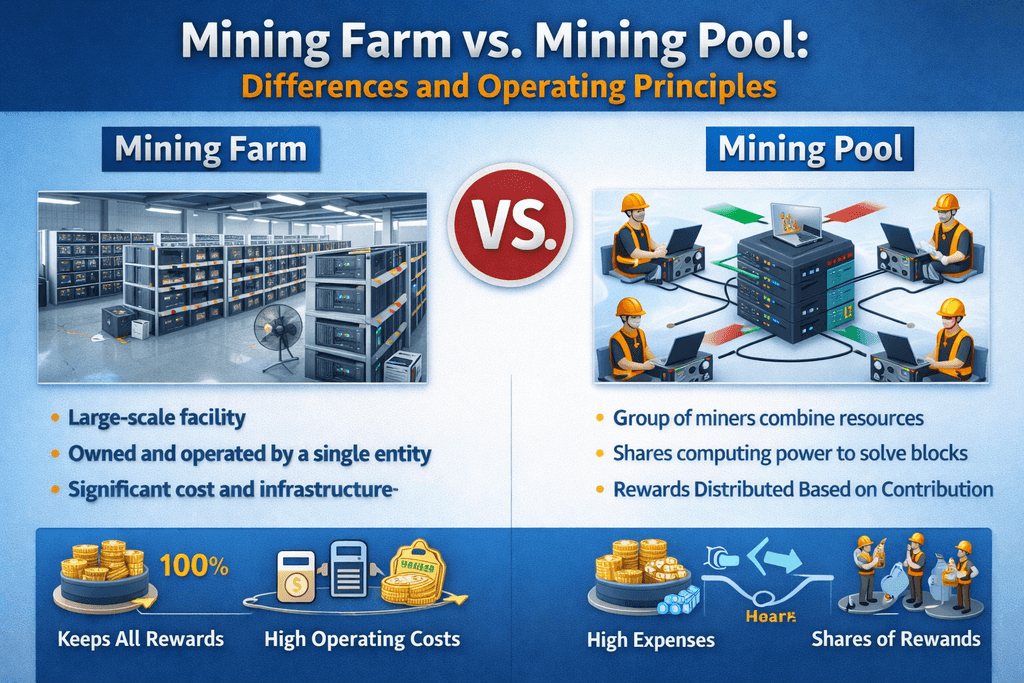
The evolution of the Bitcoin network has transformed cryptocurrency mining from a hobbyist pursuit into a multi-billion dollar industrial sector. As the difficulty of securing decentralized networks scales, understanding the infrastructure behind block production is essential for investors. This guide explores the two most critical components of this ecosystem: the physical power of the industrial facility and the logical coordination of global contributors.
In this deep dive, we will analyze the Mining Farm vs. Mining Pool: Differences to help you understand how these entities collaborate and diverge in their operating principles within the modern blockchain economy.
Key Takeaways
-
Physical vs. Logical: Mining farms are hardware-centric physical facilities designed for scale, while mining pools are software-centric coordination hubs that aggregate global hashrate.
-
The Variance Problem: Pools solve the "lottery" risk by smoothing out rewards into predictable increments, while farms mitigate "operational cost" risks through massive economies of scale and energy procurement.
-
The Symbiosis: Modern industrial mining rarely chooses one over the other; instead, massive farms connect to global pools to ensure daily cash flow stability and risk management.
Understanding the Mining Farm (The Physical Giant)
Definition: The Industrialization of Hashrate
A mining farm is a dedicated physical location—often a warehouse or a repurposed industrial site—filled with specialized computer hardware known as ASICs (Application-Specific Integrated Circuits). Unlike individual setups, a farm is an enterprise-level operation where the primary product is "hashrate," the computational power used to secure Proof-of-Work (PoW) blockchains. These facilities are the "power plants" of the crypto world, converting electricity into digital assets at an industrial scale.
Historical Evolution: From Garage Mining to Multi-Megawatt Facilities
In the early days of Bitcoin (2009–2011), "farms" were nothing more than a few CPUs or GPUs running in a bedroom or garage. As the network's difficulty increased, the "CPU era" gave way to the "GPU era," and eventually to the ASIC revolution in 2013. This transition forced miners out of residential areas due to noise and heat, leading to the birth of the first industrial-scale facilities in regions with surplus energy, such as Sichuan, China, and later Texas, USA, and Central Asia. By 2026, these facilities have evolved into multi-megawatt campuses that resemble data centers for companies like Google or Amazon, but optimized for maximum energy throughput rather than data storage.
Core Operating Principles: Power, Cooling, and Maintenance
The operating principle of a mining farm revolves around three pillars:
-
Energy Procurement: Since electricity accounts for roughly 90% of operational expenses, farms are built where power is cheapest.
-
Thermal Management: ASICs generate immense heat. Modern farms use industrial-grade HVAC systems, huge intake fans, or increasingly, immersion cooling, where hardware is submerged in a non-conductive liquid to maximize efficiency.
-
Hardware Uptime: A machine that isn't running is losing money. Farms employ specialized technicians and automated software to monitor chip health and minimize downtime.
The Economic Moat: PPA (Power Purchase Agreements) and Hardware Lifecycle
A successful farm’s "moat" isn't just the hardware; it's the Power Purchase Agreement (PPA). By signing long-term contracts with energy providers to buy excess wind, solar, or hydro power, farms lock in rates that are far below residential prices. Additionally, they must master the hardware lifecycle—knowing when to sell old miners (like the Antminer S19 series) and when to upgrade to next-generation rigs (like the S21 or beyond) to maintain a competitive "joules per terahash" (J/TH) ratio.
Understanding the Mining Pool (The Digital Collective)
Definition: The Virtual Cooperative of Shared Resources
A mining pool is a joint group of cryptocurrency miners who combine their computational resources over a network. While a farm is about the where, a pool is about the how. By pooling hashrate, the group increases the probability of successfully finding a block. When a block is found, the reward is distributed among all participants according to the amount of work they contributed.
Historical Evolution: Slush Pool and the Birth of Stratum Protocol
The concept of pooled mining was invented in 2010 by Marek Palatinus (aka Slush), founder of "Slush Pool." Before this, miners had to engage in "Solo Mining," which meant you only got paid if you personally found a block—an event that could take years for a small miner. The invention of the Stratum Protocol allowed a central server to efficiently assign work to thousands of individual miners across the globe, creating the standardized communication method used by almost all pools today.
Core Operating Principles: Task Distribution and the "Share" Mechanism
The pool's server acts as a coordinator. It connects to the blockchain, creates a "block template," and sends small pieces of the puzzle to each connected miner. To measure how much work a miner is doing, pools use a "Share" system.
-
The Target: The blockchain has a very high difficulty target.
-
The Share: The pool sets a much lower difficulty target for its members.
-
The Proof: When a miner finds a solution that meets the pool's lower target, they submit it as a "share." This proves they are working. If one of those shares happens to also meet the blockchain's high target, the pool wins the block reward.
Payout Models Explored: PPS, PPLNS, and FPPS
The way a pool distributes money is a critical Mining Pool: Difference that miners must evaluate:
-
PPS (Pay-Per-Share): The pool pays a flat rate for every valid share submitted. The pool operator takes the risk; even if the pool finds zero blocks in a day, the miners still get paid.
-
PPLNS (Pay-Per-Last-N-Shares): This only pays out when a block is found, looking back at the last "N" shares submitted. It rewards loyal miners and discourages "pool hopping."
-
FPPS (Full Pay-Per-Share): Similar to PPS, but it also includes a share of the transaction fees included in the block, which is vital in high-traffic 2026 markets.
Comparative Analysis: Differences & Commonalities
To truly understand the Mining Farm vs. Mining Pool: Differences, one must look at where they sit in the value chain. A farm is a capital-intensive physical operation (CapEx), whereas a pool is a service-oriented software operation (OpEx).
Physical Asset vs. Digital Protocol: Where the Value Resides
In a mining farm, value is stored in the physical infrastructure: the real estate, the electrical transformers, and the ASIC chips. If the network crashes, you still have a building and electrical gear. In contrast, a mining pool's value lies in its brand, its software reliability, its user base, and its liquidity. A pool owns very little hardware; it owns the "logic" that directs the hardware of others.
Centralization Risks: Hardware Geopolitics vs. Hashrate Concentration
The risks for these two entities are vastly different:
-
Farms face Geopolitical Risk: A government can raid a farm, seize hardware, or cut off the power (as seen in the 2021 China ban).
-
Pools face Concentration Risk: If a single pool (like Foundry or AntPool) controls more than 51% of the network's hashrate, it could theoretically attack the network. This "hashrate centralization" is a major talking point for 2026 decentralized governance.
The Shared Goal: Solving the Proof-of-Work Puzzle
Despite their differences, both exist to solve the same problem: generating a SHA-256 hash that is lower than the network's target. Both are incentivized by the "Block Reward" and "Transaction Fees." Without the physical power of the mining farm, the mining pool has no product to sell. Without the mining pool, the mining farm faces too much financial volatility to stay in business.
Cost Structures: OpEx/CapEx for Farms vs. Percentage Fees for Pools
A farm's costs are dominated by electricity, labor, and hardware depreciation. A pool's costs are dominated by server maintenance, cybersecurity (to prevent DDoS attacks), and the "luck insurance" it provides to PPS miners. While a farm might spend millions on a new cooling system, a pool typically only charges a 1% to 3% fee on the total rewards it distributes to its users.
2026 Outlook: The Future of Mining Infrastructure
As we move through 2026, the landscape of mining is being reshaped by climate policy, technological upgrades, and the rise of Artificial Intelligence.
The "Green" Mandate: ESG Compliance and Circular Energy Farms
In 2026, the mining farm has transitioned from an energy consumer to an energy balancer. Many modern farms are built with "Demand Response" capabilities, meaning they shut down during peak grid stress to prevent blackouts. Furthermore, "Circular Energy" is the new standard—farms are being built next to greenhouses or district heating systems, using the waste heat from ASIC miners to grow crops or heat homes in northern climates.
Stratum V2 Adoption: Decentalizing Block Construction within Pools
The biggest technical shift in mining pools for 2026 is the widespread adoption of Stratum V2. In the old version, the pool operator decided which transactions went into a block. Stratum V2 allows the individual mining farm to choose its own transactions while still participating in the pool's reward structure. This significantly reduces the censorship risk associated with centralized pools.
AI and Mining Convergence: Repurposing Farm Infrastructure for High-Performance Computing (HPC)
Many mining companies are rebranding as "HPC Infrastructure" providers. Because a mining farm already has the power and cooling, they are increasingly installing H100 or B200 GPU clusters alongside ASICs. This allow them to pivot between mining Bitcoin and training Large Language Models (LLMs) depending on which is more profitable, creating a "hybrid compute" model.
Geopolitical Shifts: The Rise of Sovereign Mining Farms in 2026
We are seeing the rise of the "State-Owned Mining Farm." Countries like Ethiopia, Bhutan, and El Salvador have integrated mining into their national energy strategy. These sovereign farms often run their own national mining pools to ensure that the wealth generated from their natural resources stays within their borders, moving away from the dominance of private pools based in the US or China.
Which Path to Choose? Solo Farm vs. Pool Participation
If you are an investor looking to enter the space in 2026, you must decide how to deploy your capital.
Calculating the Break-even: When Scale Dictates the Strategy
Solo mining is now virtually impossible unless you own a mining farm with at least 5% of the total network hashrate. For 99% of operators, joining a mining pool is the only logical choice. The "Break-even" calculation must include the pool fee, the network difficulty adjustment, and the "Halving" schedule. In 2026, with the most recent halving having reduced block subsidies, efficiency is the only way to survive.
Risk Mitigation: How Pools Protect Farm Cash Flow during "Bear" Cycles
During a bear market, the price of Bitcoin may drop below the cost of production for many farms. A mining pool acts as a buffer. By providing daily payouts (PPS), a pool allows a farm to pay its monthly electricity bill without having to gamble on the price of Bitcoin for that specific week. This "smoothing" effect is the financial glue that keeps the mining industry solvent during periods of extreme volatility.
Conclusion
In summary, while the terms are often used interchangeably by outsiders, the Mining Farm vs. Mining Pool: Differences are foundational to the crypto economy. A mining farm represents the industrial muscle—the physical hardware, cooling, and energy required to perform trillions of hashes per second. A mining pool represents the collaborative brain—the software and protocols that aggregate that muscle to ensure every participant, from a hobbyist to a sovereign state, receives a fair and stable share of the rewards. As we look toward the remainder of 2026 and beyond, the convergence of green energy, AI, and decentralized protocols like Stratum V2 will continue to refine these operating principles, making the network more resilient and efficient than ever before.
FAQ
Can a mining farm exist without a mining pool?
Yes, a mining farm can engage in "Solo Mining." However, this is extremely high-risk as the farm might go months without finding a block, making it difficult to pay recurring costs like electricity without a massive cash reserve.
How much do mining pools charge in 2026?
Most mining pools currently charge a management fee ranging from 1% to 3%. Some pools offer 0% fees for a limited time to attract hashrate, or reduced fees for mining farms that contribute massive amounts of power.
Is home mining still viable via pools?
While difficult due to noise and electricity costs, home mining is still "viable" through a mining pool because you will receive small, frequent payouts. However, without industrial-scale power rates, your mining farm expenses will likely exceed your revenue.
What is the impact of the most recent Halving on farms vs. pools?
The Halving reduces the block reward by 50%, which instantly doubles the production cost per coin. This forces mining farms to upgrade to more efficient hardware and pressures mining pools to offer more competitive payout models like FPPS to keep miners.
Which is better for a beginner: farm or pool?
A beginner should never build a mining farm due to the massive CapEx. Instead, a beginner should purchase a single ASIC or use existing GPU power and join an established mining pool to learn the operating principles with minimal risk.