

Hashrate Exodus: Inside the Survival War as Miners Shift to AI Data Centers Below $58,000 BTC
2026/06/11 17:04:00
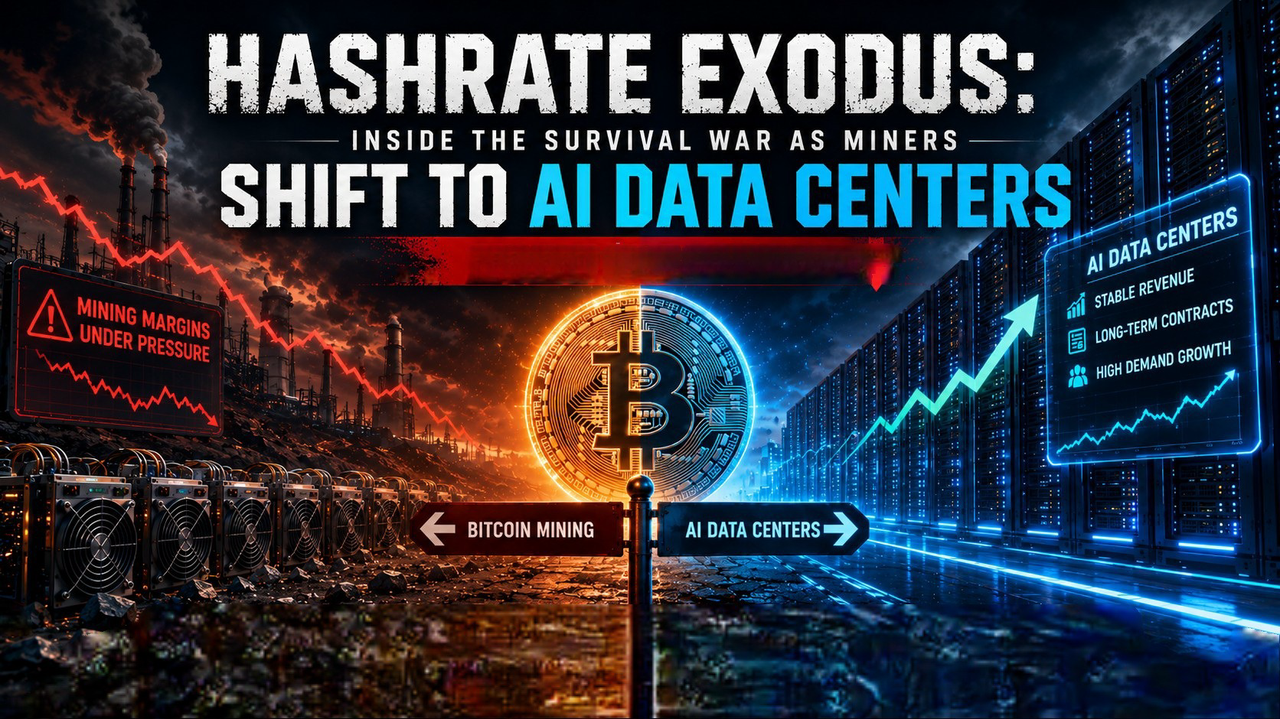
Bitcoin mining is facing a major survival test as BTC moves near the $58,000 stress zone. After 2024 halving reduced block rewards from 6.25 BTC to 3.125 BTC, miners have been dealing with weaker hashprice, high mining difficulty, rising electricity costs, and tighter profit margins. For high-cost mining operators, another deep Bitcoin price decline could turn ordinary pressure into a serious profitability problem.
At the same time, AI data centers are creating a new opportunity for miners. Many mining companies already control large power sites, cooling systems, land, and grid connections that artificial intelligence companies need. Because of this, some Bitcoin miners are shifting toward AI and high-performance computing contracts to create more stable long-term revenue.
Why Bitcoin Miners Are Shifting to AI Data Centers Now
The move from Bitcoin mining to AI data centers is accelerating because miners are finding more value in power infrastructure than in mining revenue alone. Recent industry data shows that public mining companies have announced more than $70 billion in AI and high-performance computing contracts, while several major firms are signing long-term data-center leases with AI customers.
Hut 8’s $9.8 billion, 15-year Texas AI data-center lease, TeraWulf’s multi-billion-dollar AI revenue pipeline, and IREN’s $9.7 billion Microsoft-linked GPU deal show how fast the sector is changing. At the same time, listed miners have reportedly sold more than 15,000 BTC from corporate treasuries to help fund this transition.
This shows that miners are no longer relying only on Bitcoin production. They are turning power capacity, land, cooling systems, and grid access into AI infrastructure businesses with more predictable long-term revenue.
Bitcoin Miner Profitability Breaks Down as BTC Tests the $58,000 Stress Zone
Bitcoin miners are facing growing pressure as BTC approaches the $58,000 stress zone. Although Bitcoin is currently trading above that level, a drop below $58,000 could make mining less profitable for high-cost operators, especially after halving reduced block rewards.
-
Why $58,000 Matters for Miners
Bitcoin mining revenue depends heavily on BTC price. When Bitcoin falls, miners still need to pay electricity bills, machine costs, facility expenses, and debt obligations. Large miners with cheap power and efficient ASIC machines may continue operating, but smaller miners with expensive electricity could struggle.
If BTC breaks below $58,000, weaker miners may need to shut down older machines, sell BTC reserves, delay expansion plans, or redirect power toward AI and high-performance computing data centers.
-
Weak Hashprice Adds More Pressure
Hashprice shows how much revenue miners earn from each unit of computing power. When hashprice falls, miners earn less even if their machines continue running. This makes weak hashprice one of the clearest signs of mining stress.
The pressure becomes stronger when Bitcoin price falls, mining difficulty stays high, and transaction-fee revenue remains low. In this environment, miners need cheaper electricity, better machines, or new revenue sources to protect margins.
-
High Difficulty and Energy Costs Create a Survival War
Bitcoin mining difficulty remains high, forcing miners to compete against massive global hashrate. At the same time, electricity costs remain one of the biggest challenges for the sector. AI companies and data-center operators are also competing for large-scale power, making energy access more valuable.
This is why some miners are moving toward AI data centers. If mining BTC becomes less profitable, the same power infrastructure may generate more stable revenue through AI hosting contracts.
-
Miner Selling Could Affect Bitcoin Sentiment
If profitability weakens, miners may sell BTC to cover costs, repay debt, or fund new infrastructure. This could add selling pressure when Bitcoin is already near key support levels.
The result is a divided mining industry. Weak miners may sell coins or shut down machines, while stronger miners may use the downturn to expand, sign AI contracts, and prepare for the next market cycle.
AI Data Centers Become the New Survival Strategy for Bitcoin Miners
As Bitcoin mining margins weaken, AI data centers are becoming a new survival path for mining companies. The shift is not only about chasing the artificial intelligence boom. It is also about protecting cash flow when BTC price, hashprice, mining difficulty, and electricity costs put pressure on traditional mining revenue.
For many miners, the most valuable asset is no longer only their ASIC fleet. It is their access to large-scale power, land, cooling infrastructure, and grid connections that AI companies urgently need.
-
Why Bitcoin Miners Are Moving Into AI Data Centers
Bitcoin miners are attractive to AI companies because they already control power-heavy infrastructure. AI data centers need large electricity capacity, reliable cooling systems, land access, and long-term energy agreements. Many Bitcoin mining companies already built facilities around these same needs.
This gives miners a new business opportunity. Instead of using every power site only for Bitcoin mining, they can convert selected locations into AI or high-performance computing facilities.
The reason is simple: AI workloads may offer more predictable revenue than Bitcoin mining. Mining income changes every day based on BTC price, network difficulty, transaction fees, and global hashrate. AI hosting contracts, however, can last for years and may provide more stable cash flow.
For miners under pressure, this stability is important. It can help them reduce dependence on Bitcoin price cycles and attract investors who want clearer long-term revenue.
-
Power Capacity Becomes More Valuable Than Hashrate Alone
In the past, mining companies were mainly judged by their hashrate. A higher hashrate usually meant a stronger ability to mine Bitcoin and earn block rewards. Now, the market is paying more attention to power capacity.
AI companies need electricity at scale, and securing grid-connected power is becoming difficult in many regions. A miner with hundreds of megawatts of available power may own an asset that is valuable beyond Bitcoin mining.
That is why some miners are being viewed less like pure crypto companies and more like energy infrastructure businesses. Their power sites can support Bitcoin mining, AI computing, cloud services, or high-performance computing.
This creates a new value model for miners:
-
Hashrate shows Bitcoin mining power
-
Power capacity shows infrastructure value
-
AI contracts show long-term revenue potential
-
Data-center conversion shows business flexibility
This change explains why miners with strong energy assets are attracting more market attention. In the AI era, power capacity can be just as important as mining machines.
-
AI Hosting Contracts Offer More Stable Cash Flow
Bitcoin mining revenue is volatile. A miner can be profitable when BTC is strong and quickly become stressed when BTC price drops, mining difficulty rises, or transaction fees fall.
AI hosting contracts can reduce that volatility. These contracts may provide fixed or long-term revenue from companies that need data-center capacity for model training, cloud computing, or AI operations.
For miners, this can create a more balanced business model. They can keep some exposure to Bitcoin upside while using AI contracts to support regular cash flow.
This is why the AI pivot is becoming a survival strategy, not just a growth story. In a weak BTC market, predictable revenue can help miners continue operating without relying only on Bitcoin price recovery.
A hybrid miner may have several revenue sources:
-
Bitcoin mining rewards
-
AI and HPC hosting revenue
-
Data-center lease income
-
Power management and grid services
This model could make miners more resilient during market downturns. If Bitcoin mining margins weaken, AI contracts may support cash flow. If BTC rallies, miners can still benefit from Bitcoin production.
-
Major Mining Companies Are Already Pivoting
The shift from Bitcoin mining to AI infrastructure is already visible across the public mining sector. Several listed miners have announced AI, high-performance computing, or data-center expansion plans.
Hut 8 has become one of the clearest examples after signing a major long-term AI data-center lease in Texas. Core Scientific has also been closely connected to high-performance computing demand through its relationship with CoreWeave. TeraWulf, Cipher Mining, IREN, Bitfarms, Applied Digital, and other infrastructure-focused companies are also moving deeper into AI infrastructure strategies.
This shows that the industry is moving beyond simple mining expansion. Companies are now trying to prove that their power assets can support higher-value computing demand.
The market is also responding. Investors are increasingly looking at miners with strong power pipelines, data-center conversion potential, and credible AI customers.
This does not mean every miner will succeed. But it shows that AI infrastructure has become one of the most important themes in the mining industry.
-
Why the AI Pivot Is Also Risky
The move into AI data centers is not easy. A Bitcoin mining site cannot always become an AI data center overnight. AI facilities usually require stronger infrastructure, better cooling, higher uptime standards, advanced networking, and larger capital investment.
This means miners need money, technical execution, and reliable customers. Companies that only announce AI plans without real contracts or construction progress may struggle to deliver results.
The AI market also carries its own risks. If AI infrastructure demand slows, if financing becomes expensive, or if large customers reduce spending, some projects could face delays or lower returns.
For this reason, the strongest miners may be those that balance both sides. They can continue mining Bitcoin where it remains profitable, while converting selected sites into AI or HPC facilities where long-term contracts make better economic sense.
The AI pivot can help miners survive, but it is not a guaranteed solution.
-
AI Data Centers Could Redefine the Mining Industry
The AI data-center pivot could permanently change how Bitcoin miners are valued. In the past, miner performance was mostly measured by hashrate, BTC production, mining cost, and Bitcoin holdings. Now, investors are also looking at power access, contracted capacity, AI revenue potential, and data-center development pipelines.
This could create a new type of mining company. Instead of being only a Bitcoin producer, the miner becomes a digital infrastructure operator.
That shift matters because it changes the survival strategy. Miners that depend only on BTC price may remain vulnerable during downturns. Miners that control flexible power infrastructure may have more options.
If Bitcoin falls below the $58,000 stress zone, this transition could accelerate. Weak miners may shut down older machines, while stronger operators may redirect power toward AI contracts with more predictable income.
The future of Bitcoin mining may not be pure mining. It may become a competition for power, infrastructure, and long-term compute demand.
What the Hashrate Exodus Means for Bitcoin, Miners, and the Future of Mining
The hashrate exodus does not mean Bitcoin mining is ending. Instead, it shows that the mining industry is entering a new phase where power infrastructure, cash-flow stability, and business flexibility matter more than ever. As some miners shift toward AI data centers and high-performance computing, Bitcoin mining may become more selective, more competitive, and more closely connected to global energy markets.
-
Bitcoin’s Network Can Adjust, But Mining Businesses May Not
Bitcoin was designed to survive changes in miner participation. If some miners shut down machines or redirect power away from mining, the network can adjust through its difficulty mechanism. This helps Bitcoin continue producing blocks over time, even when hashrate changes.
However, the business side is different. Bitcoin’s protocol can adjust, but mining companies still face real costs. Electricity bills, debt payments, machine upgrades, staff costs, and facility expenses do not disappear when BTC price falls.
This creates a major difference between Bitcoin as a network and Bitcoin mining as a business. The network may remain secure, but individual miners can still struggle or fail.
For Bitcoin, lower hashrate can be manageable. For miners with weak balance sheets, it can become a survival problem.
-
Smaller and High-Cost Miners Face the Biggest Risk
The hashrate exodus could hit smaller and high-cost miners hardest. These operators usually have less access to cheap electricity, weaker financing options, and older mining machines. When hashprice falls and BTC trades near stress levels, their margins can disappear quickly.
Large public miners may survive because they have better access to capital, stronger energy agreements, and more options to convert sites into AI infrastructure. Smaller miners may not have the same flexibility.
This could create more pressure on independent mining operators, especially those using older ASICs or paying higher electricity rates.
The miners most at risk are usually those with expensive electricity contracts, older and less efficient machines, high debt, weak cash reserves, limited access to AI or HPC customers, and no flexible power strategy.
If BTC drops below the $58,000 stress zone, these weaknesses could become more visible.
-
Miner Selling Pressure Could Affect Bitcoin Market Sentiment
When miners face weak profitability, they may need to sell Bitcoin to cover costs. This can include electricity bills, debt repayments, equipment purchases, or data-center conversion expenses.
Miner selling does not always control Bitcoin’s price direction, but it can affect market sentiment. If traders see miners selling while BTC is testing key support levels, fear can increase across the market.
This is especially important during periods of low liquidity or weak investor confidence. Miner selling can add pressure at the wrong time, even if the amount sold is not large compared with total Bitcoin trading volume.
At the same time, stronger miners may use the downturn differently. Instead of selling aggressively, they may hold BTC, buy distressed mining assets, or use AI contracts to protect cash flow.
This creates a split market: weak miners sell to survive, while stronger miners position for long-term growth.
-
AI Data Centers Could Pull Power Away From Bitcoin Mining
One of the biggest long-term effects of the hashrate exodus is that some power capacity may not return to Bitcoin mining. In previous cycles, miners often shut down machines during downturns and restarted them when BTC recovered.
This cycle may be different.
If a mining company signs a long-term AI data-center contract, that power may stay committed to AI workloads for years. This means some infrastructure that once supported Bitcoin mining could become permanently tied to artificial intelligence and high-performance computing.
That could change how Bitcoin mining expands in future bull markets. Instead of simply restarting old mining sites, miners may need to develop new power capacity, negotiate new energy deals, or build more efficient facilities.
This makes power access even more important. In the future, the strongest miners may not be the companies with the most machines. They may be companies with the best energy strategy.
-
Mining Companies May Become Hybrid Infrastructure Businesses
The future of Bitcoin mining may not be pure mining. More companies could become hybrid infrastructure businesses that combine Bitcoin mining, AI hosting, data-center leasing, and energy management.
This model gives miners more ways to earn revenue. When Bitcoin mining margins are strong, they can benefit from BTC production. When mining margins weaken, AI or HPC contracts may support cash flow.
A future mining company may depend on several revenue streams:
-
Bitcoin block rewards and transaction fees
-
AI and high-performance computing hosting
-
Long-term data-center lease income
-
Power trading and grid services
-
Infrastructure partnerships with cloud or AI firms
This could make the mining sector more mature and less dependent on one revenue source. However, it also means miners need stronger execution, better management, and more technical expertise.
-
The Future of Mining Will Depend on Power, Efficiency, and Flexibility
The hashrate exodus shows that Bitcoin mining is no longer only a race for more hashrate. It is becoming a race for efficient power use, flexible infrastructure, and long-term business survival.
Miners that depend only on high BTC prices may remain vulnerable. Miners with cheap electricity, modern ASIC fleets, strong balance sheets, and AI-ready infrastructure may have more options.
This shift could reshape the industry over the next several years. Bitcoin mining may become more competitive, more capital-intensive, and more connected to the broader data-center economy.
For Bitcoin, the network can continue adjusting. For miners, the challenge is much harder. They must prove that their power infrastructure can survive both Bitcoin market downturns and the rise of AI-driven energy demand.
The hashrate exodus is not the end of Bitcoin mining. It is a sign that the industry is evolving into a new survival model where power is the most valuable asset.
Conclusion
The hashrate exodus shows that Bitcoin mining is changing under pressure. If BTC falls below the $58,000 stress zone, high-cost miners could face weaker margins, more selling pressure, and possible shutdowns of older machines.
At the same time, AI data centers are becoming a new survival path. Miners with strong power access, efficient infrastructure, and long-term AI or HPC contracts may have more options than those relying only on Bitcoin rewards.
This does not mean Bitcoin mining is ending. It means the industry is evolving. The future of mining may depend less on hashrate alone and more on power capacity, cost efficiency, and the ability to turn energy infrastructure into stable digital revenue.
FAQs
What is the hashrate exodus?
The hashrate exodus means Bitcoin miners are moving some power capacity away from BTC mining and toward AI data centers.
Why are Bitcoin miners shifting to AI data centers?
Miners are shifting to AI data centers because AI hosting can offer more stable revenue than volatile Bitcoin mining rewards.
Why does $58,000 BTC matter for miners?
The $58,000 BTC level matters because a price drop below it could make mining unprofitable for high-cost operators.
What is hashprice in Bitcoin mining?
Hashprice measures how much revenue miners earn from each unit of computing power.
Why does weak hashprice hurt miners?
Weak hashprice hurts miners because they earn less revenue while electricity, machine, and debt costs remain high.
Can AI data centers be more profitable than Bitcoin mining?
Yes, for some miners, AI data-center contracts can provide more predictable long-term income than BTC mining.
Will the hashrate exodus hurt Bitcoin?
Not directly. Bitcoin can adjust mining difficulty, but slower hashrate growth could reshape the mining industry.
What is the future of Bitcoin mining?
Bitcoin mining may become a hybrid industry combining BTC mining, AI hosting, high-performance computing, and energy management.
Disclaimer
The information provided on this page may originate from third-party sources and does not necessarily represent the views or opinions of KuCoin. This content is intended solely for general informational purposes and should not be considered financial, investment, or professional advice. KuCoin does not guarantee the accuracy, completeness, or reliability of the information, and is not responsible for any errors, omissions, or outcomes resulting from its use. Investing in digital assets carries inherent risks. Please carefully evaluate your risk tolerance and financial situation before making any investment decisions. For further details, please consult KuCoin’s Terms of Use and Risk Disclosure.