

Ethereum Staking in 2026: Yield Trends, Validator Queue Dynamics, and MEV Impact Explained
Introduction
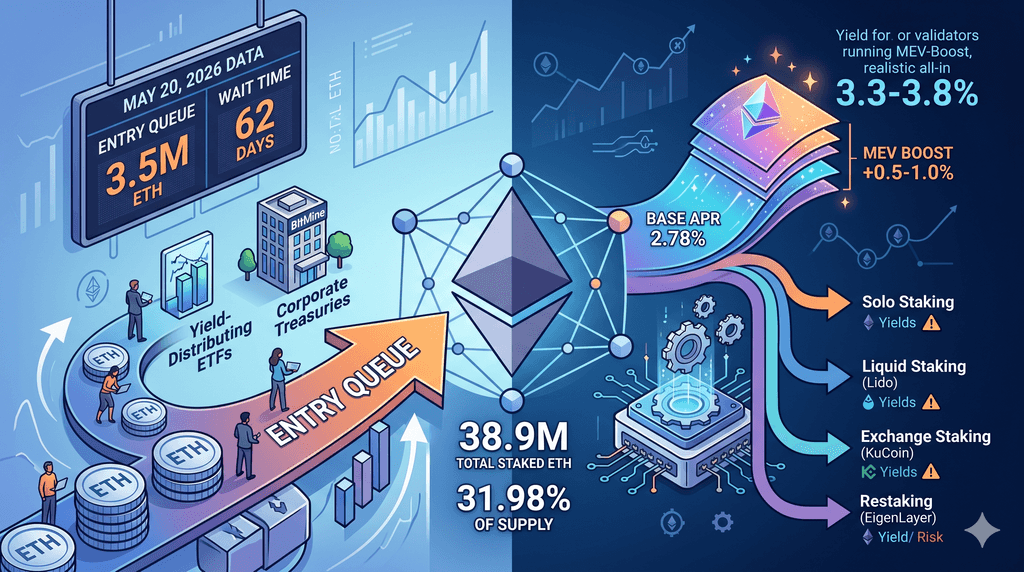
Ethereum's validator entry queue ballooned to 3,589,414 ETH with a wait time of 62 days and 8 hours as of May 20, 2026 — a stunning reversal from January, when queues sat near zero and analysts were calling staking demand "dead." So what's really happening to ETH staking yields, queue dynamics, and MEV economics in 2026?
The short answer: native staking APR has compressed to 2.78% across roughly 897,000 active validators, with total staked ETH at 38.9 million, or about 31.98% of supply, while institutional demand — driven by yield-distributing ETFs and corporate treasuries — has pushed entry queues to multi-year highs even as MEV rewards add another 0.5–1% to validator returns. The combination of Pectra-era consolidation, restaking layers, and ETF inflows has fundamentally reshaped what "staking ETH" means in 2026.
What Is the Current Ethereum Staking Yield in 2026?
Ethereum staking yield in 2026 sits at roughly 2.78% base APR, with MEV rewards adding another 0.5–1% for validators running MEV-Boost — meaning a realistic all-in yield of 3.3–3.8% for well-operated nodes. According to validator queue data referenced in late May 2026, staking APR averages 2.78% across roughly 897,000 active validators, a meaningful compression from the 4%+ yields seen in 2023.
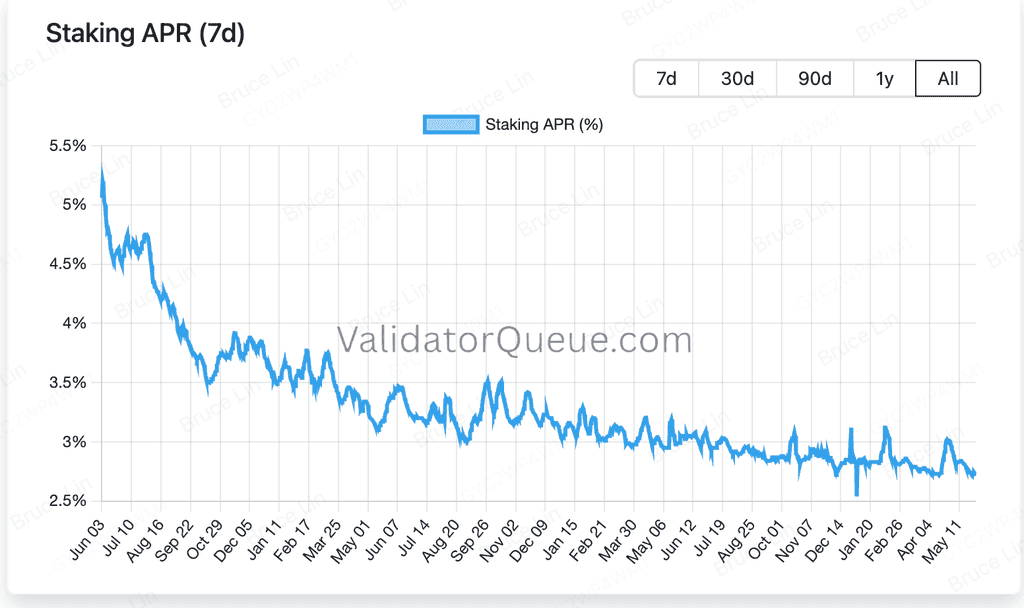
The yield compression is mechanical, not anomalous. Ethereum's issuance schedule scales inversely with the square root of total staked ETH, so the more validators that join, the smaller the per-validator slice becomes.
Yield by Staking Method
Different staking pathways deliver different net returns after fees and operational costs:
-
Solo staking (32 ETH) — captures the full base APR plus MEV, typically 3.3–4% all-in. Estimated annual yield is approximately 3-4% APR at current network parameters, before MEV, with MEV adding 0.5-1% depending on luck.
-
Liquid staking (Lido, Rocket Pool, ether.fi) — yields are slightly lower after the protocol fee. Liquid staking protocols like Lido charge around 10% of your rewards as a fee, but you get a tradeable token in return that you can use elsewhere in DeFi.
-
Exchange staking — easiest but lowest. Exchange staking is the easiest option but typically offers lower yields and comes with counterparty risk.
-
Restaking (EigenLayer AVSs) — adds layered rewards on top of base ETH yield, but with higher risk. A 12% restaking return and a 4% staking return are based on entirely different hypotheses on validator concentration, slashing exposure, smart contract dependency, and liquidity risk.
Why the Yield Compression Matters
Compressed yields raise an important threshold question for capital allocators. If onchain yields elsewhere climb meaningfully above the 2.78% staking APR, exit pressure can build fast. That sensitivity is why the 2026 staking landscape is structurally more reflexive than in prior years — capital can rotate quickly when relative yields shift.
Why Did the Validator Entry Queue Surge Back in 2026?
The validator entry queue exploded from near-zero in January to over 3.5 million ETH by late May because of three converging forces: yield-distributing spot ETH ETFs, corporate treasury staking by firms like BitMine, and post-Pectra consolidation efficiency. The exit side cleared after a brief April spike tied to DeFi exploits, including the $292 million KelpDAO bridge exploit, and the entry side has been climbing for months, with institutional staking through corporate treasuries and yield-distributing ETFs as the main driver.
The ETF Catalyst
US spot Ethereum ETFs flipped from holding raw ETH to distributing staking yields in early 2026, fundamentally changing the demand structure. US spot Ethereum ETFs now distribute staking rewards, which adds a structural buyer to the entry queue. That single change converted billions in passive ETF inventory into active validator deposits.
Specific products are leading the way. CoinShares Physical Staked Ethereum offers a 0.0% management fee structure while passing through 100% of the staking rewards to fund holders, and the VanEck Ethereum ETN provides exposure to native staking yields up to 5% while maintaining physical backing through regulated institutional crypto custodians.
Corporate Treasury Staking
Public companies treating ETH as a treasury asset have become a meaningful force. BitMine is now the biggest Ether digital-asset treasury, and the firm started staking on December 26, then added another 82,560 ETH (about $260 million) to the entry queue on January 3.
How Does the Exit Queue Reflect Holder Conviction?
The exit queue is currently empty, signaling near-zero willingness among existing stakers to unstake — a structural bullish signal for ETH supply. As of May 20, the exit queue sits at zero, an extraordinary contrast to September 2025 when the exit backlog approached 2.7 million ETH.
The reversal was rapid. Ethereum's validator exit queue plummeted to 32 ETH on January 6, 2026, marking a 99.9% collapse from its 2,670,000 ETH September peak, eliminating selling pressure as wait times for full withdrawals now average just 1 minute.
What an Empty Exit Queue Means
When nobody wants to unstake, ETH supply available for sale shrinks. As one industry analyst summarized in early 2026, no one wants to sell their staked ETH. Combined with low exchange reserves, the conditions resemble a classic supply squeeze setup.
But empty queues cut both ways. Ethereum's staking queues have emptied out and the network can now absorb new validators and exits almost in real time, meaning the rush to lock up ETH has faded for now and staking is settling into a steady-state instead of a scarcity trade. In other words, the option to exit quickly removes the "locked supply" premium that previously supported ETH price.
How Does MEV Impact Validator Rewards in 2026?
MEV-Boost adds 10–30% to validator base rewards in 2026, with relay market share now concentrated among Ultrasound Money, Titan, and bloXroute — and builder market share dominated by Titan. According to Relayscan data captured in April 2026, relay.ultrasound.money handled 33.92% of payloads, titanrelay.xyz 24.19%, bloxroute.max-profit 14.67%, and aestus.live 10.03% over a 24-hour window.
Relay and Builder Landscape
Block production has consolidated dramatically into a few professional builders. Based on the same Relayscan snapshot, Titan built 52.16% of blocks, BuilderNet 24.63%, and Quasar 15.06% — meaning roughly 92% of MEV-Boost blocks come from just three builder operations.
This concentration matters because builders, not validators, capture most of the MEV value upstream. The Aestus relay alone, a neutral non-censoring option, reports it has been operating continuously for over three years and serves over 650,000 validators, with between 3-5% of all Ethereum mainnet block auctions negotiated daily as of February 2026.
MEV's Yield Contribution
The economic uplift from MEV-Boost is substantial. MEV-Boost revenue typically adds 10-30% to rewards, which on a 2.78% base APR translates to roughly 0.28–0.83% additional yield. For institutional operators running thousands of validators, this is the difference between a profitable and marginal operation.
Censorship Considerations
Not all relays treat transactions equally. There are currently seven major MEV-Boost relays including Flashbots, BloXroute Max Profit, BloXroute Ethical, BloXroute Regulated, BlockNative, Manifold, and Eden, and of the 7 available major relays only 3 do not censor according to OFAC compliance requirements. Validators choosing relay sets effectively vote on Ethereum's neutrality.
What Are the Biggest Risks to Ethereum Stakers in 2026?
The three dominant risks are restaking contagion, regulatory shifts on yield-bearing ETFs, and yield competition from other Layer 1s — with slashing remaining a tail risk for poorly operated validators. As demonstrated in April 2026, exploit shocks: as April showed, security incidents in restaking and DeFi can flood the exit side overnight.
Restaking and Smart Contract Risk
Layered yields come with layered risks. Liquid staking protocols are smart contracts — a bug or exploit could result in loss of funds, and while major protocols have been audited extensively, the risk exists.
Regulatory Uncertainty
The yield-bearing ETF approval was the bullish surprise of 2026 — but regulatory tone can shift. That picture could shift quickly if U.S. policy evolves to allow yield-bearing ETH products, a change that would re-open the staking premium trade. The corollary is true as well: policy reversal could compress staking demand quickly.
Price Risk Dominates
For most holders, ETH price volatility dwarfs yield considerations. If ETH price drops 50%, your staked position is down 50% regardless of yield earned — staking doesn't protect against market downturns.
How to Stake and Trade ETH on KuCoin
KuCoin offers one of the most accessible routes to earn Ethereum staking yield without running validator infrastructure, alongside deep spot and futures markets for active ETH traders. Whether you want passive yield, leveraged exposure to ETH price moves around upgrade catalysts, or to rotate between ETH and liquid staking tokens, KuCoin consolidates the workflow in one account.
Getting started takes minutes:
-
Create a KuCoin account at kucoin.com and complete verification.
-
Deposit ETH or stablecoins via crypto transfer, bank card, or P2P trading.
-
Stake ETH through KuCoin Earn for flexible or fixed-term yield products that abstract away validator operations.
-
Trade ETH spot on deep ETH/USDT order books or rotate into liquid staking tokens.
-
Use ETH futures to hedge staked positions or express directional views around ETF flow data, queue dynamics, and protocol upgrades.
New users can now register at KuCoin and Get Up to 11,000 USDT in New User Rewards.

Conclusion
Ethereum staking in 2026 is a fundamentally different game than even 18 months ago. Base APR has compressed to 2.78%, but MEV-Boost adds 10–30% on top, restaking layers offer additional yield in exchange for additional risk, and yield-distributing ETFs have become the single largest source of new validator demand.
The validator queue dynamics tell the clearest story: an entry backlog above 3.5 million ETH with a 62-day wait, and an exit queue sitting at zero. That asymmetry reflects genuine institutional conviction, not retail speculation. Post-Pectra consolidation has simultaneously reduced active validator count while increasing capital efficiency, and the MEV landscape has consolidated around a handful of dominant builders and relays.
For stakers, the strategic question in 2026 is no longer whether to stake — it's which layer of the stack to participate in, and how much smart contract or restaking risk to absorb in pursuit of higher yield. For traders, the queue dynamics, ETF flow data, and MEV statistics now function as primary leading indicators for ETH price action.
FAQs
1. How long does it currently take to activate a new Ethereum validator?
Based on validator queue data from May 2026, the entry queue wait time is approximately 62 days and 8 hours, driven by an entry backlog above 3.5 million ETH against a daily churn limit of 57,600 ETH.
2. Can I unstake my ETH instantly in 2026?
Yes — the exit queue is currently empty, meaning withdrawals process within minutes rather than days. However, this can change rapidly during market stress events, as occurred briefly during the April 2026 KelpDAO exploit.
3. Is restaking through EigenLayer worth the additional risk?
It depends on your risk tolerance. Restaking can layer additional AVS rewards on top of base ETH yield, but it introduces smart contract risk, validator concentration risk, and additional slashing surfaces that native staking does not have.
4. How much does MEV-Boost actually add to my staking rewards?
MEV-Boost typically adds 10–30% to base validator rewards, equivalent to roughly 0.28–0.83% additional APR at current network parameters. Actual returns vary based on relay selection and luck on high-value blocks.
5. Why are there fewer active validators in 2026 than in 2025 if more ETH is staked?
Post-Pectra consolidation. EIP-7251 raised the maximum effective balance per validator from 32 ETH to 2,048 ETH, so large operators are merging many 32-ETH validators into fewer high-balance ones — reducing key count while staked ETH continues to grow.