

Best Methods to Conservatively Invest in Bitcoin in 2026
Introduction
Bitcoin remains one of the most volatile financial assets in the world, yet it continues to attract long-term investors seeking exposure to digital assets and the broader crypto economy. While aggressive traders often capitalize on short-term market swings, conservative Bitcoin investors focus on preserving capital, managing downside risks, and steadily growing their holdings over time.
As the crypto market matures in 2026, investors now have access to more sophisticated risk-management tools than ever before. Strategies such as Dollar Cost Averaging (DCA), Bitcoin ETFs, and futures hedging have become increasingly popular among investors who want exposure to Bitcoin without taking excessive risks. In addition, the expansion of institutional adoption, regulated investment products, and automated trading tools has made conservative crypto investing more accessible to retail participants worldwide.
This guide explores some of the most effective low-risk Bitcoin investment strategies for conservative investors navigating today’s evolving crypto market.
Who is a Bitcoin Conservative Investor?
The top distinguishing trait of a conservative investor is their need to preserve their capital. Bitcoin conservative investors prioritize capital; that means they are willing to trade off high returns for more stability. Obviously, achieving this can be a tall order, especially in the crypto market.
In a market that's constantly and unpredictably fluctuating, it's difficult to preserve your capital investment, given that your holding could significantly drop in value within hours. That's why conservative Bitcoin investors employ strategies that are designed to compensate them for the volatility.
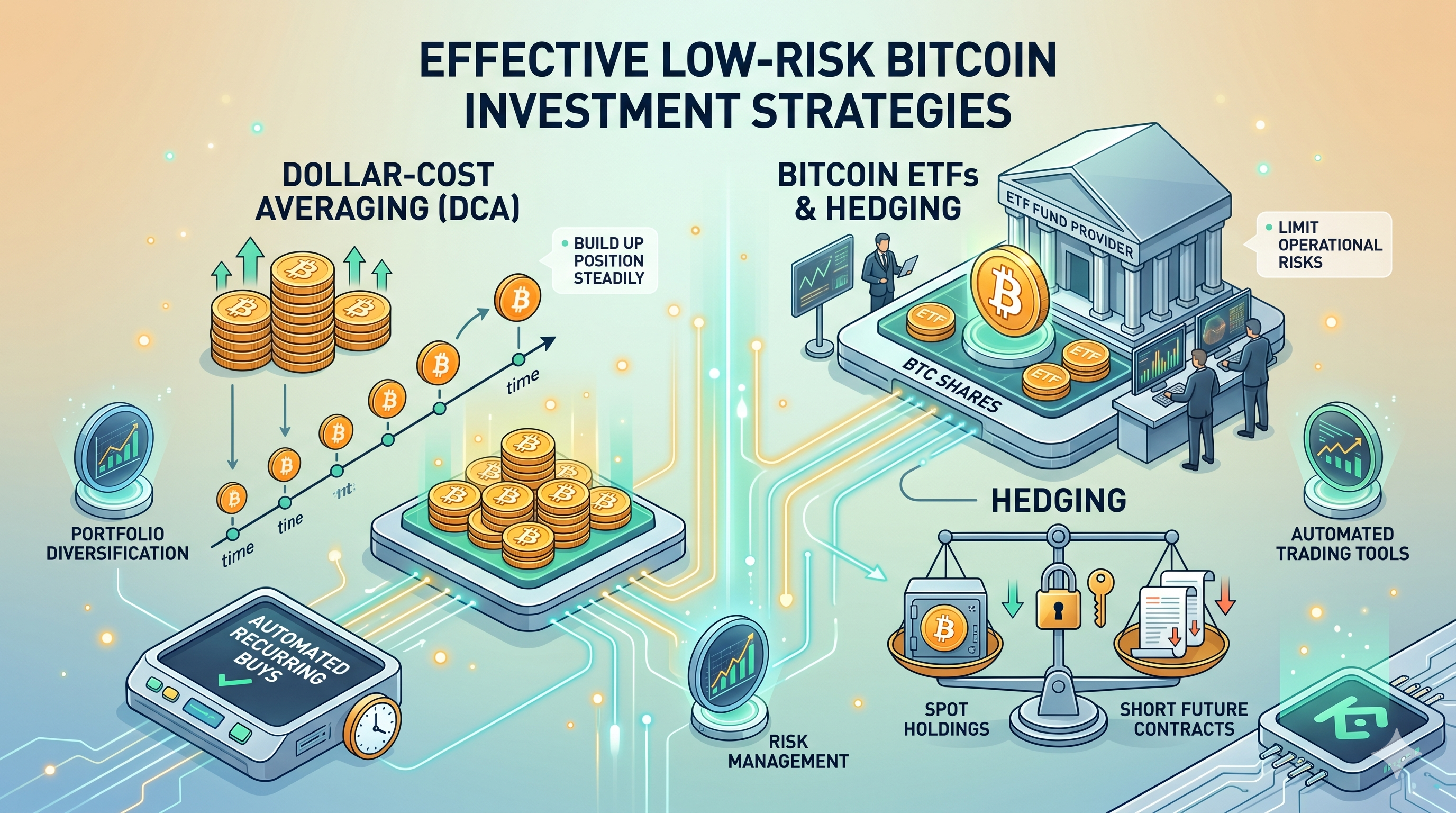
The Dollar Cost Averaging (DCA) Method
Everyone knows that the easiest way to profit is to buy an investment at the lowest value then sell when prices increase. Given Bitcoin's short-term volatility, the ultimate strategy for long-term investors is the dollar cost averaging method. It allows them to automatically buy more BTC when prices fall and buy less when prices rise.
DCA should help you build up a certain position size (the amount of an asset in your possession). At the same time, it protects you from the influence of short-term volatility.
With this strategy, you periodically divide the amount of money you want to invest in Bitcoin into equal amounts. The current price of Bitcoin does not play a role in the Dollar Cost Average investment strategy. The only constant in this method is the time interval.
In this case, The investment period is divided by you into clearly defined time intervals, whereby after each interval, you invest the same amount of money again. As mentioned earlier, the current price does not play a role in your investment decision. The time interval is determined by yourself, and your deposits can be made, for example, weekly or after each month.
Dollar Cost Averaging is a good way to invest in times of great uncertainty and volatility. It eliminates uncertainty. It provides an investor with an average mathematical value for your investment decision removing any emotions of FOMO or FUD from your investment strategy. The DCA strategy protects you from unfortunate market entries and the negative feelings that come with them in the long run.
Note that this strategy can also be used to invest in altcoins.
Why DCA Became More Popular After the 2024 Bitcoin Halving
The 2024 Bitcoin halving once again highlighted why Dollar-Cost Averaging (DCA) remains one of the most effective strategies for conservative crypto investors. Historically, Bitcoin halvings have reduced the supply of newly minted BTC entering the market, often contributing to long-term bullish momentum. However, the months following each halving have also been accompanied by sharp corrections and heightened volatility.
During the 2025 market cycle, Bitcoin experienced multiple double-digit pullbacks despite maintaining a strong long-term uptrend. Investors who attempted to time the market often struggled with emotional trading decisions, while DCA investors benefited from accumulating BTC at different price levels over time. This strategy helped smooth out entry prices and reduced the psychological pressure associated with market timing.
Many retail and institutional investors now automate recurring Bitcoin purchases through crypto exchanges and trading platforms. Automated DCA strategies have become increasingly popular because they remove emotional bias and allow investors to maintain long-term discipline regardless of short-term market sentiment.
Investing in Bitcoin ETFs
The crypto market boom experienced in the past has resulted in the creation of several derivatives for BTC. Bitcoin ETFs offer individual investors the opportunity to invest in Bitcoins for the long term without buying the Bitcoins directly.
An ETF is a structured investment that can be traded like securities. ETFs offer investors the opportunity to buy and sell a basket of assets without having to buy all the components individually.
Here's how an ETF works. The fund provider owns the underlying BTC, designs a fund to track its performance, and then sells shares in that fund to investors. A Bitcoin ETF is an ETF that mimics the price fluctuation of BTC. A regulated bank, crypto exchange, or asset management company would raise funds from investors – and from here buy Bitcoin (or in some cases, BTC futures) on behalf of investors. In return, a buyer would receive shares in the Bitcoin ETF, with prices rising or falling depending on the value of the cryptocurrency.
It allows investors to limit the risks of investing in BTC by leveraging the expertise of professional fund managers. Bitcoin ETFs are especially interesting for investors who are not allowed or do not want to invest directly in Bitcoin.
The Rise of Spot Bitcoin ETFs and Institutional Adoption
The approval and expansion of spot Bitcoin ETFs have significantly changed the crypto investment landscape. Since the launch of spot Bitcoin ETFs in major financial markets, institutional participation in Bitcoin has accelerated rapidly. Traditional investors who were previously hesitant to manage private wallets or interact directly with crypto exchanges can now gain Bitcoin exposure through regulated financial products.
Spot Bitcoin ETFs are particularly attractive to conservative investors because they simplify custody management and reduce operational risks associated with self-storage. Pension funds, hedge funds, family offices, and asset managers have increasingly added Bitcoin exposure to diversified portfolios through ETF products.
The growth of Bitcoin ETFs has also improved overall market liquidity and strengthened Bitcoin’s position as a mainstream macro asset. For conservative investors, this institutional adoption provides additional confidence that Bitcoin is evolving beyond a speculative asset class into a globally recognized store of value.
Using Bitcoin Futures for Hedging
One of the savvy investment strategies of dealing with volatility is through hedging. BTC hedging involves opening strategically trading in the futures market to offset any potential losses in the spot market.
Crypto investors typically hold the actual BTC in their crypto wallets, which means they intend to appreciate BTC. But with the rampant volatility in the crypto market, the certainty that the price will appreciate in the long term is non-existent. This is where the BTC futures come in.
Futures contracts are forward contracts; they are agreements between two traders that oblige one trader to buy or sell an asset at a certain time, quantity, and price. Trading futures essentially create a contract or agreement to buy or sell a particular asset in the future at a fixed price set today. The asset's actual market price at the future trading time does not matter, as the price is set when the contract is drawn.
In this case, the BTC investor enters into a short contract. This means the investor agrees to sell BTC at a fixed price at a later date. So, if the price of BTC drops, the futures contract guarantees that they have secured their capital.
Conclusion
Bitcoin’s volatility may appear intimidating at first, but for disciplined investors, it can create long-term opportunities rather than risks. Conservative Bitcoin investing is no longer limited to simply buying and holding BTC. Today’s investors have access to a wider range of tools, including automated DCA strategies, spot Bitcoin ETFs, futures hedging, and portfolio management systems that help reduce emotional trading and improve risk control.
As the crypto market matures and institutional adoption continues to grow, conservative investment strategies are becoming increasingly relevant for both retail and professional investors. Rather than attempting to predict every market movement, successful long-term investors often focus on consistency, risk management, and gradual portfolio growth.
For investors looking to optimize their Bitcoin investment strategies, platforms such as KuCoin provide access to trading bots, recurring crypto purchases, futures markets, and advanced portfolio management tools designed for both beginners and experienced traders.
FAQs
1. Is Dollar-Cost Averaging (DCA) still effective for Bitcoin in 2026?
Yes. DCA remains one of the most popular long-term Bitcoin investment strategies because it reduces the impact of short-term volatility and eliminates the need to perfectly time market entries.
2. Are Bitcoin ETFs safer than buying Bitcoin directly?
Bitcoin ETFs can be considered safer for some investors because they remove the need to manage private wallets and custody solutions. However, investors should still understand the risks associated with Bitcoin price volatility.
3. How do conservative investors protect themselves during crypto market crashes?
Conservative investors often use strategies such as portfolio diversification, Dollar-Cost Averaging, stablecoin allocations, and Bitcoin futures hedging to reduce downside risk during market corrections.
4. Can Bitcoin futures be used for risk management instead of speculation?
Yes. While futures trading is commonly associated with speculation, conservative investors can also use Bitcoin futures contracts to hedge against short-term price declines and protect portfolio value.
5. Are crypto trading bots suitable for long-term investors?
Automated trading bots can help long-term investors maintain disciplined investment strategies, especially during volatile market conditions. Bots that support recurring buys, grid trading, and portfolio rebalancing are commonly used to reduce emotional trading decisions.