

How to Earn ETH with KuCoin (A Data-Driven Yield Strategy Guide)
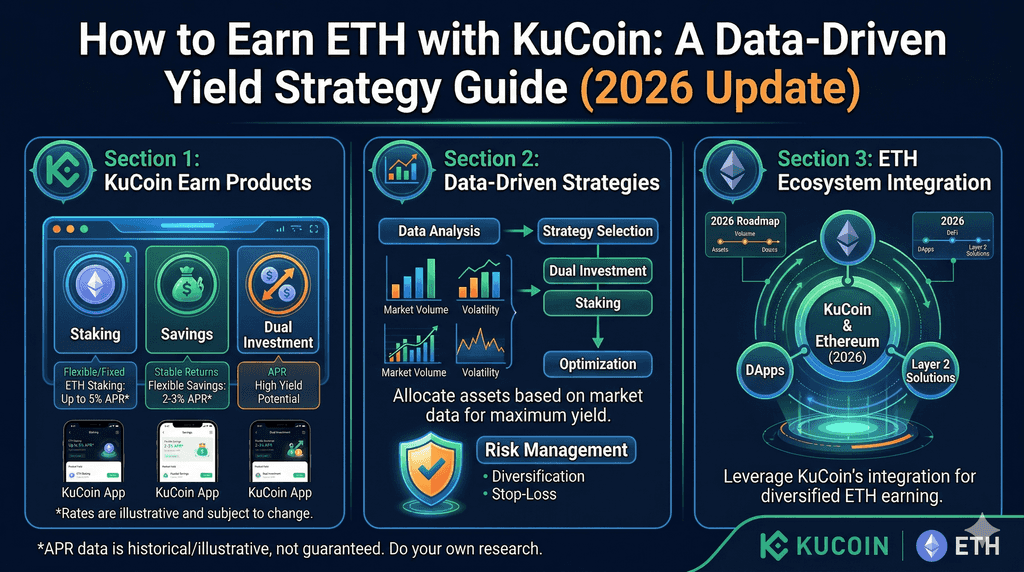
Earning Ethereum is no longer limited to technically complex validator setups or large capital requirements. Platforms like KuCoin have transformed ETH into a yield-generating asset accessible to everyday users. By understanding how staking rewards are calculated, how APR translates into real returns, and how compounding amplifies growth, users can move beyond passive holding and begin treating ETH as a productive financial instrument.
ETH Has Quietly Become a Yield Asset
Ethereum’s transformation into a yield-bearing asset is one of the most underappreciated shifts in the crypto market. Following the transition to proof-of-stake, ETH holders are now rewarded for contributing to network security rather than relying on price appreciation alone. This shift has introduced a new layer of utility, ETH is no longer idle capital sitting in a wallet; it is an asset that can generate consistent returns over time. On platforms like KuCoin, this process is simplified into user-friendly products that remove the need for technical knowledge or infrastructure.
Current staking yields generally hover around the low single digits annually, often between 2% and 3%, depending on validator activity and network participation levels. According to Ethereum network data from Glassnode, staking participation has steadily increased, which naturally compresses yields as more ETH competes for the same reward pool.
This dynamic creates a predictable but stable income stream. The real insight here is that ETH earning is not about chasing high returns, it is about consistency and accumulation. Over time, even modest yields can compound into meaningful growth, especially when combined with disciplined reinvestment strategies.
Reading Market Conditions Before Locking Your ETH
Timing plays a subtle but important role in how much ETH you actually earn over time. Many users focus only on APR, yet market conditions often matter just as much as the rate itself. When ETH volatility increases, liquidity demand across exchanges tends to rise, which can indirectly influence yield opportunities within platforms like KuCoin.
During periods of high trading activity, flexible products may experience increased utilization, occasionally improving returns or unlocking short-term earning opportunities. This creates a scenario where waiting for the right moment to allocate funds can outperform blindly locking ETH into long-term products. For example, if ETH is approaching a major price breakout, locking funds in a fixed product may limit your ability to react to price movements or reallocate capital quickly.
On the other hand, during stable or sideways markets, locking ETH can make more sense since opportunity cost is lower. Data trends from platforms like Glassnode show that staking inflows often increase during calmer market phases, reinforcing the idea that timing is tied to sentiment. The takeaway is clear: earning ETH is not just about choosing a product, it is about aligning your strategy with market behavior to avoid missed opportunities.
Scaling Strategy: When Small ETH Holdings Start to Matter
One of the most overlooked aspects of earning ETH is how quickly small holdings can become meaningful when managed correctly. Many users assume that staking only makes sense with large amounts, yet the structure of percentage-based returns means that consistency often outweighs size. On KuCoin, even fractions of ETH can generate rewards, and when combined with disciplined reinvestment, these small gains begin to compound into noticeable growth.
Consider a user who starts with just 0.5 ETH. At a 2.2% annual yield, this produces 0.011 ETH per year. While that may seem insignificant, adding just 0.1 ETH monthly alongside reinvested rewards changes the trajectory entirely. Over time, the growth curve becomes steeper, not because of yield alone but because of consistent accumulation layered with compounding.
According to long-term projections from Messari, accumulation strategies often outperform passive holding in proof-of-stake ecosystems due to the additive nature of rewards. This reinforces a key insight: the barrier to entry for earning ETH is lower than most people think. What matters is not the starting amount, but the consistency of strategy and the willingness to treat ETH as a growing asset rather than a static one.
Inside KuCoin Earn: Where Your ETH Rewards Actually Come From
To understand how ETH earnings are generated on KuCoin, it is important to break down the structure of its Earn ecosystem. Rather than being a single yield source, KuCoin Earn functions as a layered system where different financial mechanisms generate returns. ETH staking remains the core engine, where user funds are pooled and delegated to validators operating on the Ethereum network. These validators earn rewards from transaction fees and block validation incentives, which are then distributed proportionally to participants.
According to KuCoin’s official staking documentation, rewards are calculated daily based on network performance and total staked volume. Beyond staking, KuCoin also offers flexible savings products, where ETH may be used in internal liquidity systems or lending frameworks to generate additional yield. This introduces a second layer of income that is not directly tied to Ethereum’s base protocol rewards. The distinction matters because it explains why different products offer varying APRs.
Staking yields are influenced by network conditions, while savings yields depend on platform demand and capital utilization. This dual structure allows users to allocate ETH strategically, combining stability with opportunistic yield enhancement depending on market conditions.
Breaking Down ETH Staking Returns with Real Calculations
Understanding ETH earnings requires moving beyond advertised APR and into actual numbers. Let’s take a practical example using a realistic yield scenario on KuCoin. Suppose a user stakes 3 ETH at an annual rate of 2.2%. On paper, this generates 0.066 ETH per year. When broken down further, this equals approximately 0.0055 ETH per month or about 0.00018 ETH per day. If ETH is priced at $2,000, the daily earning translates to roughly $0.36, while monthly earnings reach around $11.
These numbers may appear modest, but they scale linearly with capital. At 10 ETH, the same structure produces approximately $36 per month, and at 50 ETH, the monthly return approaches $180. What becomes clear is that ETH earning is not about quick gains, it is about building a predictable income layer.
According to staking analytics from Beaconcha.in, reward rates fluctuate slightly depending on validator efficiency and total network participation. This means returns are dynamic rather than fixed, which adds a layer of variability that users must account for. By grounding expectations in real calculations, users can better understand how staking fits into a broader financial strategy rather than viewing it as a high-yield opportunity.
Flexible vs Fixed Products: A Strategic Capital Decision
Choosing between flexible and fixed ETH products on KuCoin is less about preference and more about strategy. Flexible products allow users to withdraw funds at any time, providing liquidity that can be critical during volatile market conditions. This flexibility comes at a cost, as yields are typically slightly lower compared to fixed-term options. Fixed products, on the other hand, require users to lock their ETH for a predetermined period, often offering marginally higher returns in exchange.
The difference may seem small on the surface, but over time it compounds into meaningful gains. For instance, a user staking 8 ETH at 2.1% versus 2.6% will see a difference of 0.04 ETH annually, which becomes increasingly significant as capital grows. KuCoin frequently introduces limited-time fixed products with boosted rates, often highlighted in its announcements section.
These opportunities reward users who actively monitor the platform and allocate funds strategically. The key insight is that no single product is universally optimal. Instead, effective ETH earning involves balancing liquidity needs with yield optimization, ensuring that capital remains both productive and accessible.
Compounding: The Quiet Force Behind ETH Growth
Compounding is the mechanism that transforms modest ETH yields into long-term growth. Rather than withdrawing rewards, users can reinvest them, increasing their base capital and, in turn, their future earnings. On KuCoin, rewards are distributed frequently, making it possible to compound on a near-continuous basis.
Consider a scenario where a user begins with 5 ETH at a 2.2% annual yield. In the first year, they earn 0.11 ETH, bringing the total to 5.11 ETH. In the second year, the same yield applies to the new total, generating slightly higher rewards. Over five years, this compounding effect results in a noticeably larger balance compared to simple interest. Data from long-term staking projections by Staking Rewards shows that even low-yield assets can achieve meaningful growth when compounded consistently.
The critical factor is discipline, reinvesting rewards rather than treating them as short-term income. This approach aligns with a long-term accumulation strategy, where the goal is to increase ETH holdings rather than extract immediate profit. Over time, this mindset shift can significantly impact overall portfolio performance.
The 32 ETH Barrier: Why Native Staking Remains Out of Reach for Most Investors
A key limitation often overlooked in ETH yield strategies is the barrier to native, on-chain staking. Running a validator directly on Ethereum requires a minimum deposit of 32 ETH, a threshold that places it out of reach for most retail investors. At current market prices, this represents a substantial capital commitment, not to mention the additional technical requirements such as maintaining uptime, securing private keys, and managing validator performance.
For smaller holders, this creates a structural divide between direct network participation and indirect access through platforms like KuCoin or staking pools. While pooled or exchange-based solutions lower the entry barrier, they introduce trade-offs in the form of custodial risk and reduced control over assets.
This dynamic highlights why many users opt for simplified earning platforms despite slightly lower yields, accessibility and convenience often outweigh the complexities and capital demands of running a full validator node.
Timing Promotions: Where Yield Spikes Happen
KuCoin’s promotional campaigns introduce periods where ETH yields temporarily increase, creating opportunities for enhanced returns. These campaigns, often featured in the platform’s official announcements, can offer boosted APRs or special structured products tied to market conditions. The key characteristic of these opportunities is scarcity, they are typically limited in both duration and capacity. Users who act quickly can allocate capital to these higher-yield products, capturing returns that exceed standard staking rates.
This introduces a tactical element to ETH earning, where timing becomes just as important as allocation. Historical campaign data shows that promotional yields can significantly outperform baseline rates, even if only for short periods. The challenge lies in balancing these opportunities with overall strategy.
Allocating too much capital to short-term promotions may reduce flexibility, while ignoring them entirely leaves potential returns on the table. The most effective approach involves reserving a portion of ETH specifically for opportunistic allocation, ensuring that users can respond quickly when high-yield opportunities arise.
Portfolio Structuring: Turning ETH Into a Yield System
Earning ETH effectively requires treating it as part of a structured portfolio rather than a single asset. On KuCoin, this means distributing ETH across multiple products to balance risk, liquidity, and return. A well-structured approach might involve allocating a portion to flexible staking for liquidity, another portion to fixed-term products for higher yield, and a smaller reserve for promotional opportunities.
This diversification ensures that capital remains productive under different market conditions. Data from crypto portfolio studies by CoinGecko suggests that diversified yield strategies tend to outperform single-product approaches over time. The reason is simple: they capture multiple sources of return while reducing exposure to any single risk factor.
This approach transforms ETH earning from a passive activity into an active financial strategy. Instead of relying on one income stream, users build a layered system where different components contribute to overall growth.
Conclusion: ETH Is No Longer Idle Capital
Ethereum has evolved into a productive financial asset, and platforms like KuCoin have made it accessible to a global audience. The process of earning ETH is no longer limited by technical barriers or capital thresholds. It is now defined by strategy, calculation, and consistency.
Users who understand how yields are generated, how APR translates into real returns, and how compounding amplifies growth can turn ETH into a long-term income engine. The opportunity is not in chasing high returns but in building a system that works continuously over time.
As staking adoption continues to grow and the Ethereum network matures, the role of ETH as a yield asset is likely to become even more significant. Those who approach it with discipline and insight will be best positioned to benefit from this shift.
FAQ
-
How much ETH can I realistically earn on KuCoin?
At around 2–3% APR, 1 ETH generates roughly 0.02–0.03 ETH annually, depending on network conditions.
-
Are rewards paid daily?
Yes, KuCoin distributes staking rewards daily based on performance data.
-
Is compounding automatic?
No, users must manually reinvest rewards to benefit from compounding.
-
Can I withdraw staked ETH anytime?
Flexible products allow withdrawals, while fixed-term products require waiting until maturity.
Disclaimer
This content is for informational purposes only and does not constitute investment advice. Cryptocurrency investments carry risk. Please do your own research (DYOR).