

Kondratiev Wave 2026: Are We Entering the Bottoming‑Out Phase of the Global Economic Cycle?
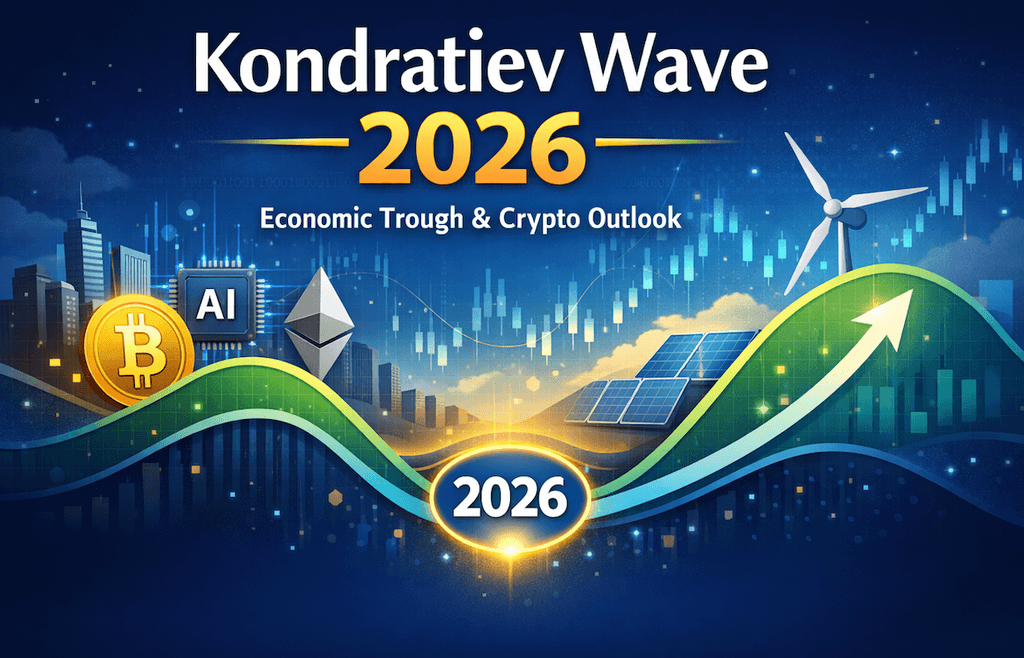
The global economy rarely moves in a straight line. From industrial revolutions to technological booms, periods of rapid growth are often followed by stagnation or decline. Among the most fascinating theories describing these long-term patterns is the Kondratiev wave, also known as the K-wave or economic supercycle. This century-old concept suggests that economies experience extended cycles of approximately 40–60 years, driven by technological innovation, capital investment, and structural shifts.
As we approach 2026, financial analysts, economists, and cryptocurrency investors alike are asking: could 2026 potentially represent the bottom of the current Kondratiev wave, according to some interpretations? And if so, what opportunities could arise from the upcoming growth phase? Understanding this long-term rhythm can help investors anticipate major economic and technological shifts, including how emerging technologies like artificial intelligence (AI), renewable energy, and blockchain might shape the next wave of wealth creation.
By the end of this article, you will gain:
-
A thorough understanding of Kondratiev wave theory
-
Historical patterns and their economic significance
-
Insight into why 2026 may be a pivotal year in the current cycle
-
Practical considerations for investors, innovators, and policymakers
Hook
What if the seemingly chaotic global economy follows a predictable rhythm spanning decades, where each technological revolution triggers an era of growth followed by a structural slowdown? Imagine timing your investments or innovation strategies around a multi-decade cycle. The stakes are enormous.
Historically, Kondratiev waves have coincided with major innovations: the steam engine, railroads, electricity, automobiles, and information technology. Could the combination of AI, green energy, and blockchain technologies herald the next long-term expansion?
Overview
In this article, we will explore:
-
The fundamentals of the Kondratiev wave and why it matters for global economic planning.
-
Historical examples of previous waves and how they shaped markets and technological progress.
-
The debate around whether 2026 marks the bottoming-out phase of the current cycle.
-
Implications for cryptocurrency, investment strategy, and technological adoption.
-
Challenges and considerations when applying Kondratiev theory in the modern world.
By understanding these elements, readers can interpret macroeconomic signals, anticipate shifts in capital flow, and strategically position themselves for the next long-wave growth period.
Thesis
This article aims to provide a comprehensive, evidence-based understanding of the Kondratiev wave, examining historical patterns and current economic indicators to evaluate whether 2026 could represent the trough of the sixth long-wave cycle.
Through this lens, investors, policymakers, and technology innovators can better prepare for potential opportunities and risks as the global economy transitions into the next expansion phase.
Introduction to the Kondratiev Wave
The 50-Year Economic Pulse
The Kondratiev wave is a long-term economic cycle first theorized by Russian economist Nikolai Kondratiev in the 1920s. Kondratiev observed that capitalist economies do not simply expand and contract in the short-term business cycle (typically 3–10 years). Instead, he proposed long waves of 40–60 years, each comprising periods of growth followed by stagnation.
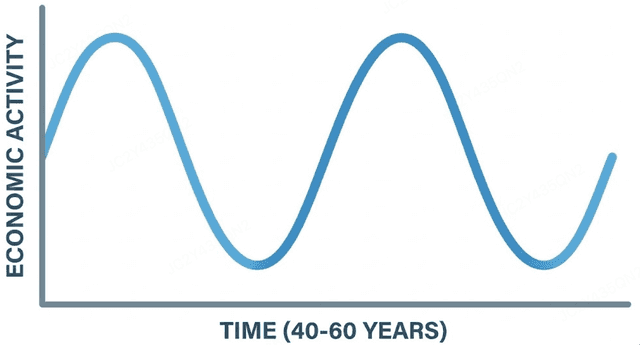
These waves are not random; they often align with major technological innovations that fundamentally alter productivity, trade, and investment. For example:
-
The first wave (1780–1830) coincided with the Industrial Revolution, driven by steam engines and mechanized textiles.
-
The second wave (1830–1880) featured railroads, steel, and coal.
-
The third wave (1880–1930) emerged from electricity, chemicals, and early automotive production.
-
The fourth wave (1930–1980) involved mass production, automobiles, and petrochemicals.
-
The fifth wave (1980–2020) centered around information technology, computers, and the Internet.
Today, analysts speculate that we are entering the sixth Kondratiev wave, likely driven by AI, renewable energy, biotechnology, and blockchain technologies, although the exact starting point of this wave is debated.
Core Concepts of the Wave
-
Long Duration: Kondratiev waves typically last 40–60 years, much longer than standard business cycles.
-
Four Phases: Each wave is often divided into four phases:
Expansion/Prosperity: Rapid economic growth, innovation, and employment gains.
Crisis/Recession: Market corrections, overproduction, or asset bubbles.
Depression/Stagnation: Slow growth, deleveraging, and declining investment.
Recovery/Renewal: Emergence of new technologies and structural shifts that lay the foundation for the next expansion.
-
Technological Drivers: Innovations cluster in each wave, fueling productivity, capital accumulation, and new industries.
-
Predictive Utility: While the theory identifies broad trends, it cannot precisely predict timing. Instead, it offers a framework to interpret historical patterns and anticipate structural economic changes.
Relevance to Modern Economies
Kondratiev waves are particularly useful in the modern era because:
-
Globalization accelerates the diffusion of technology.
-
Financial markets respond more quickly to innovation clusters.
-
Long-wave thinking helps investors and policymakers identify structural opportunities and risks rather than short-term market noise.
For example, the 2000–2020 digital revolution reshaped industries, labor markets, and capital flows, illustrating the long-term impact of technological waves on macroeconomics.
Statistics and Historical Data
-
Kondratiev’s original analysis used price and interest data across industrialized economies.
-
Historical stock market, commodity, and credit cycles often align with the approximate timing of long waves.
-
Modern interpretations suggest that 2024–2026 could be the low point of the current wave, setting the stage for post-2026 growth.
Impact of the Kondratiev Wave on Cryptocurrency
How Long Economic Cycles Shape Digital Asset Markets
While Kondratiev waves were originally applied to industrial economies, their influence extends to modern financial markets, including cryptocurrencies. Digital assets are deeply affected by macroeconomic conditions, liquidity cycles, and technological innovations all core drivers of K-waves.
Cryptocurrencies tend to reflect both the expansion and contraction phases of long economic cycles:
-
Expansion Phases
In periods of technological innovation and abundant liquidity, cryptocurrencies like Bitcoin (BTC) and Ethereum (ETH) often experience rapid adoption and price growth.
Investors are more willing to take on risk, venture capital funding flows freely, and blockchain projects flourish.
Example: Between 2016 and 2017, during the late stages of the fifth wave’s expansion, BTC rose from around $400 to nearly $20,000, coinciding with global fintech innovation.
-
Contraction/Winter Phases
During long-wave downturns, capital tightens, risk tolerance declines, and speculative assets underperform.
The 2018 crypto bear market reflected features typical of a K-wave trough: deleveraging, regulatory scrutiny, and slower adoption of new technologies.
Analysts note that the 2022–2024 crypto slowdown mirrors these Kondratiev “winter” characteristics, with venture funding falling from $31 billion in 2021 to under $10 billion in 2024 (PitchBook data).
Macro Drivers Affecting Cryptocurrency in K-Waves
Several structural factors tie K-waves to cryptocurrency performance:
-
Technological Innovation: Each long wave historically favors sectors driving productivity. Today, blockchain scalability, decentralized finance (DeFi), AI integration, and renewable energy-based crypto mining are at the forefront.
-
Capital Flows and Liquidity: Expansion phases increase global capital availability, supporting new token launches, NFT ecosystems, and blockchain startups. Conversely, contraction phases reduce speculative funding.
-
Regulatory Cycles: Governments often introduce regulatory measures during K-wave downturns, attempting to stabilize markets after rapid speculative growth.
-
Investor Sentiment: Long waves influence broader confidence in high-risk, high-reward assets. Digital currencies are highly sensitive to macroeconomic mood swings.
Case Studies: Cryptocurrency in Historical K-Wave Contexts
-
Bitcoin and the Late Fifth Wave Expansion
The 2016–2017 bull run occurred during the late expansion phase of the fifth Kondratiev wave (information technology). Investor optimism in blockchain technology, coupled with global liquidity, drove unprecedented capital inflows into crypto markets.
-
Crypto Bear Markets as Winter Phases
The 2018–2019 market decline followed patterns typical of long-wave contraction:
-
Major projects collapsed or restructured
-
Exchanges faced liquidity stress
-
DeFi and new blockchain infrastructure paused, awaiting the next technological surge
-
2022–2024 Crypto Slowdown
Falling venture funding, increased regulatory oversight, and macroeconomic pressures align with a K-wave winter, potentially bottoming out around 2026.
Advantages of Understanding the Kondratiev Cycle in the Current Market
Strategic Insights for Crypto Investors
Understanding Kondratiev waves and where we are in the cycle can give investors, developers, and policymakers a practical edge. Here’s what to keep in mind:
-
Timing and Accumulation If 2026 really marks the bottom of the current K-wave, it could be a great time to patiently accumulate high-quality digital assets. History shows that buying near the low of long-term cycles often pays off handsomely when the next growth phase kicks in. On KuCoin, features like Recurring Buy or Auto‑Invest can help you dollar‑cost average into positions over time.
-
Think Beyond Short-Term Noise Markets are noisy. Knowing the broader wave helps you focus on the bigger picture. For instance, institutional investors often move into blockchain infrastructure just as macro indicators hint at a growth phase catching the wave early instead of chasing trends.
-
Focus on Innovation Kondratiev waves favor sectors driving productivity and technological change. Right now, some of the most exciting areas include:
-
Cross-chain blockchain platforms
-
AI-powered financial products
-
Energy-efficient crypto mining
-
Decentralized finance (DeFi) solutions
-
-
Placing your investments where innovation is happening increases your chance of riding the next growth surge.
-
Manage Risk Smartly Being aware of these long cycles helps you balance risk. Hold defensive assets during contraction phases, and pivot toward high-growth opportunities as the wave shifts toward expansion. It’s about playing offense and defense at the right times.
-
Listen to the Experts Analysts at the World Economic Forum point out that technology is spreading faster than ever, compressing K-wave timelines. Smart investors can take advantage of these shorter, high-growth windows. Economists also suggest that a transition around 2026 could coincide with broad adoption of AI and blockchain, setting the stage for a new expansion phase in digital assets.
Real-World Applications
Institutional Investment: Hedge funds and family offices can use K-wave frameworks to plan multi-year allocations in blockchain, AI, and renewable energy tokens.
Project Development: Blockchain startups can time launches and capital raises to align with anticipated economic upswings.
Policy Planning: Governments can coordinate stimulus and infrastructure support to align with emerging technological clusters, accelerating recovery and innovation diffusion.
Statistics Highlighting Advantages
-
Historical K-wave troughs have led to 50–300% growth in early-adopting sectors within 5–10 years.
-
Cryptocurrencies often mirror these cycles, with Bitcoin historically achieving major price peaks in late expansion phases of previous long waves.
-
Venture funding data suggest that post-2026 could mark renewed capital inflows into digital assets and blockchain infrastructure.
Challenges and Considerations
Interpreting Kondratiev Waves Responsibly
While the Kondratiev wave provides a compelling framework to understand long-term economic cycles, it is important to approach the theory with caution. Misinterpretation can lead to poorly timed investments or unrealistic expectations.
Key Challenges in Applying Kondratiev Wave Analysis
Speculative Timing
Analysts often disagree on the exact start and end points of economic waves. For example, some date the sixth wave as beginning in 2020, while others place it between 2022 and 2024. This variation creates uncertainty around forecasts, such as a potential trough in 2026. Investors should view these projections as approximate indicators rather than precise predictions.
External Shocks
Unexpected events like geopolitical crises, pandemics, or major monetary policy interventions can disrupt long-wave patterns. The COVID-19 pandemic, for instance, accelerated technological adoption but also caused market volatility that temporarily obscured underlying cycle trends.
Data Limitations
Kondratiev waves are historically based on aggregated economic data, including prices, interest rates, and production. Such data can be incomplete or inconsistent. In addition, modern economies are increasingly complex and globally interconnected, making it harder to observe long-wave patterns clearly.
Overfitting Risk
Investors may be tempted to interpret market events as fitting a wave model, potentially overlooking other macroeconomic or sector-specific factors. Kondratiev wave analysis should serve as a complement to standard economic and financial evaluation, not a replacement.
Precautionary Strategies
-
Combine long-wave analysis with shorter-term indicators such as liquidity, interest rates, and credit cycles.
-
Diversify investments across sectors likely to benefit from emerging technological trends.
-
Keep a close watch on regulatory and policy developments that could accelerate or hinder market movements.
Conclusion
The Kondratiev wave remains one of the most fascinating tools for interpreting the long-term rhythm of the global economy. It highlights how technological innovation, capital accumulation, and structural change drive extended cycles of growth and contraction.
Evidence suggests that 2026 could plausibly represent the bottoming-out phase of the current wave, marking a transition point between contraction and the next period of expansion. For investors and innovators, this signals an opportunity to prepare for emerging technologies and digital assets that may dominate the next growth cycle.
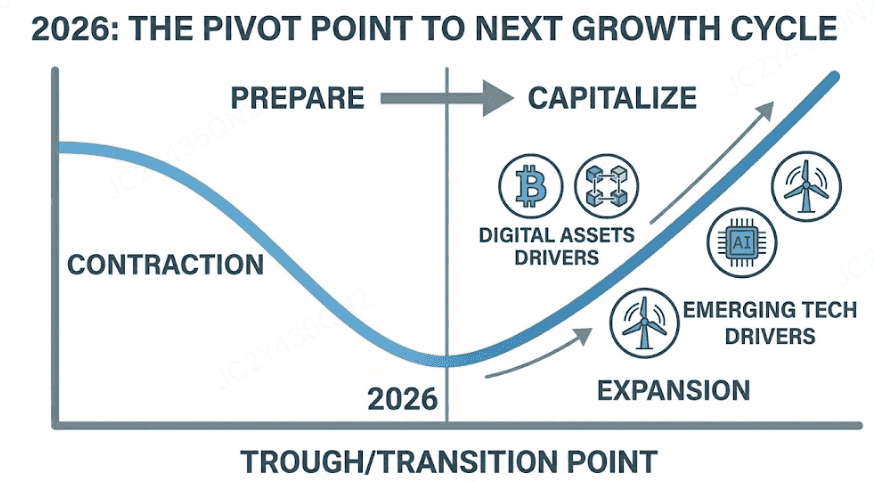
While the timing and magnitude of cycles cannot be predicted with precision, understanding the Kondratiev wave framework provides valuable strategic insights for positioning assets, allocating capital, and anticipating structural changes.
FAQs
What is the Kondratiev wave?
A long-term economic cycle lasting approximately 40–60 years, driven by technological innovation, capital investment, and structural change.
How many Kondratiev waves have occurred historically?
Analysts typically identify five completed waves, with a sixth wave emerging in the early 2020s, potentially leading to post-2026 expansion.
What technologies define the current wave?
The sixth wave is associated with AI, blockchain, renewable energy, biotechnology, and other emerging innovations.
How does the K-wave impact cryptocurrencies?
Cryptos mirror macroeconomic cycles: they thrive during liquidity-rich expansion phases and experience contraction during K-wave “winters.”
Is 2026 confirmed as the trough of the current wave?
Not definitively. Many analysts suggest 2026 could be near the bottom based on macro trends, but exact timing varies by interpretation.
How can investors leverage this knowledge?
By accumulating high-quality digital assets during potential downturns and aligning investment strategies with structural technology adoption.
What are the criticisms of Kondratiev wave theory?
It lacks strict empirical proof, relies on historical patterns, and can be misapplied if used as a precise forecasting tool.
Where can I learn more?
Resources include Investopedia’s Kondratiev Wave entry, BIS reports on long-term cycles, and World Economic Forum studies on technological diffusion.
Disclaimer: The information provided on this page may originate from third-party sources and does not necessarily represent the views or opinions of KuCoin. This content is intended solely for general informational purposes and should not be considered as financial, investment, or professional advice. KuCoin does not guarantee the accuracy, completeness, or reliability of the information, and is not responsible for any errors, omissions, or outcomes resulting from its use. Investing in digital assets carries inherent risks. Please carefully evaluate your risk tolerance and financial situation before making any investment decisions. For further details, please consult our Terms of Use and Risk Disclosure