

How to Earn Passive Income in a Bear Market: Funding Rate Arbitrage Explained
TL;DR — What You're About to Learn
-
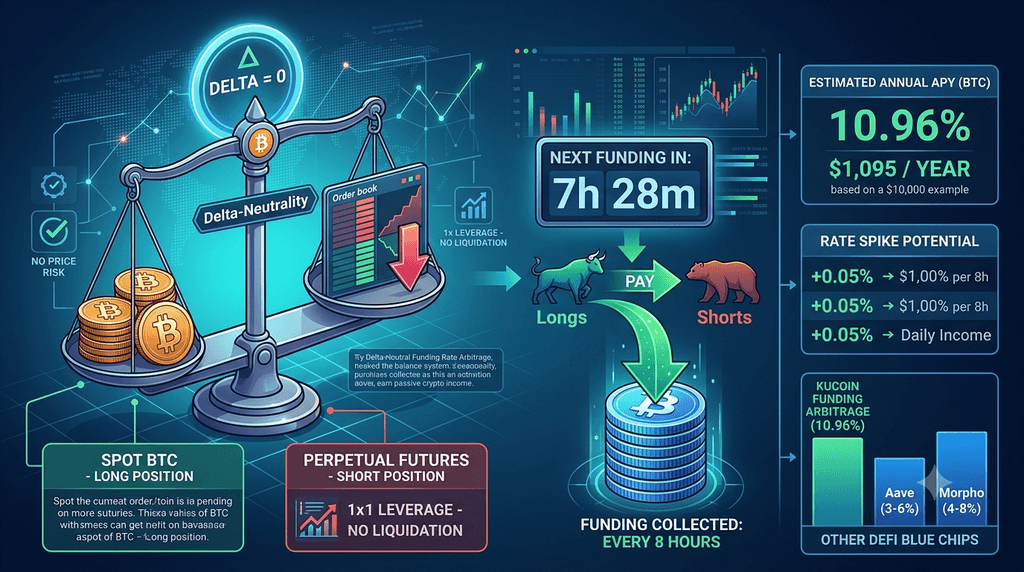
Delta-neutral funding arbitrage eliminates price risk by holding offsetting long and short positions, letting you collect funding rate payments every 8 hours as pure profit.
-
When the funding rate is positive (current KuCoin BTC rate: +0.0100%): go long spot BTC + short perpetual futures → shorts get paid by longs.
-
When the funding rate is negative: go short spot BTC + long perpetual futures → longs get paid by shorts.
-
A $10,000 delta-neutral position at the current KuCoin rate generates roughly $3/day or ~11% APY from funding alone—2–3x what DeFi lending pays in 2026.
-
This strategy carries no liquidation risk at 1x leverage and is insulated from BTC's price direction entirely.
Why DeFi Yield Chasers Are Turning to Funding Arbitrage
If you've been earning passive income from DeFi, you've felt the squeeze. USDC lending rates on Aave have compressed from double digits in 2021 to just 3–6% APY as of mid-2026. Morpho Blue, the current yield leader among major protocols, pays 4–8% on USDC deposits. Compound V3 sits at 3–5%. Even the top-performing Ethereum mainnet vaults barely crack 19.54%—and those carry smart contract and liquidity risks that funding arbitrage simply doesn't have.
Meanwhile, a quieter corner of the crypto market has been paying yield chasers 2–3x those DeFi rates with far less complexity. It's called funding rate arbitrage, and it works on a simple principle: perpetual futures exchanges pay traders every 8 hours to keep the futures price aligned with the spot price. If you know how to position yourself, those payments flow directly into your wallet—regardless of whether Bitcoin goes up or down.
This guide is for yield seekers who want to learn how to earn passive income in a bear market crypto environment without taking directional bets. No predicting prices. No impermanent loss. No smart contract exploits. Just math, executed on KuCoin Futures.
What Is Funding Rate Arbitrage?
Perpetual futures contracts never expire. So how do they stay priced near the actual BTC spot price? Through a mechanism called the funding rate.
Every 8 hours, traders with open positions exchange a small payment:
|
Funding Rate
|
Who Pays
|
Who Gets Paid
|
Market Condition
|
|
Positive (+)
|
Longs
|
Shorts
|
More traders are bullish (long-heavy)
|
|
Negative (−)
|
Shorts
|
Longs
|
More traders are bearish (short-heavy)
|
Here's the key insight: If you hold both a long and a short position of equal size, the price can do whatever it wants—you're delta-neutral. But one of those positions will be on the side that receives funding. That funding is your yield.
The Two Setups
Setup A — Positive Funding Environment (Current Market)
|
Position
|
Direction
|
Purpose
|
|
Spot BTC
|
Long (buy & hold)
|
Captures upside if BTC rises
|
|
BTC Perpetual Futures
|
Short (sell)
|
Cancels out the spot long; collects funding
|
|
Net Result
|
Delta = 0
|
Price doesn't matter. Funding payments = profit.
|
Setup B — Negative Funding Environment
|
Position
|
Direction
|
Purpose
|
|
Spot BTC
|
Short (sell borrowed BTC)
|
Captures downside if BTC falls
|
|
BTC Perpetual Futures
|
Long (buy)
|
Cancels out the spot short; collects funding
|
|
Net Result
|
Delta = 0
|
Price doesn't matter. Funding payments = profit.
|
Current market snapshot (July 2026): KuCoin's BTC perpetual funding rate is +0.0100% every 8 hours, with the next countdown at approximately 7 hours 28 minutes. This means longs are currently paying shorts—a positive environment where Setup A is profitable.
How Much Passive Income Can You Earn in a Bear Market?
Let's run the numbers using live KuCoin data.
Scenario 1: Conservative ($5,000 at 1x Leverage)
|
Parameter
|
Value
|
|
Capital deployed
|
$5,000
|
|
Position size
|
$5,000 (0.079 BTC at $62,800)
|
|
Leverage
|
1x (zero liquidation risk)
|
|
Funding rate
|
+0.0100% per 8 hours
|
|
Daily funding income
|
$5,000 × 0.0100% × 3 = $1.50/day
|
|
Monthly income
|
~$45
|
|
Annual income (no compounding)
|
~$548
|
|
APY
|
~10.96%
|
Scenario 2: Moderate ($15,000 at 1x Leverage)
|
Parameter
|
Value
|
|
Capital deployed
|
$15,000
|
|
Position size
|
$15,000 (0.239 BTC at $62,800)
|
|
Daily funding income
|
$15,000 × 0.0100% × 3 = $4.50/day
|
|
Monthly income
|
~$135
|
|
Annual income
|
~$1,643
|
|
APY
|
~10.96%
|
Scenario 3: Rate Spike ($10,000 at +0.05% Average Funding)
During volatile periods, funding rates spike. After major exchange liquidations or sharp price moves, rates can hit +0.03% to +0.10% per 8-hour period.
|
Parameter
|
Value
|
|
Capital deployed
|
$10,000
|
|
Average funding rate
|
+0.05% per 8 hours
|
|
Daily funding income
|
$10,000 × 0.05% × 3 = $15/day
|
|
Annual income
|
~$5,475
|
|
APY
|
~54.75%
|
Comparison: Funding Arbitrage vs. DeFi Lending (2026)
|
Strategy
|
Capital
|
Annual Yield
|
Risk Level
|
|
KuCoin Funding Arbitrage (current rate)
|
$10,000
|
~$1,095 (10.96%)
|
Low (delta-neutral, 1x leverage)
|
|
Aave V3 USDC Lending
|
$10,000
|
~$300–$600 (3–6%)
|
Low–Medium (smart contract risk)
|
|
Morpho Blue USDC Vault
|
$10,000
|
~$400–$800 (4–8%)
|
Medium (curator risk)
|
|
$10,000
|
~$300–$500 (3–5%)
|
Low–Medium (smart contract risk)
|
|
|
Top DeFi Mainnet Vault
|
$10,000
|
~$700–$1,954 (7–19.54%)
|
High (protocol complexity)
|
Key takeaway: At current rates, KuCoin funding arbitrage delivers 2–3x the yield of blue-chip DeFi lending with no smart contract exposure. During rate spikes, it can exceed even the most aggressive DeFi vaults—with dramatically lower risk.
Risk Management: What Can Go Wrong (And How to Prevent It)
Funding arbitrage is low-risk, not no-risk. Here's what to watch:
Risk 1: Funding Rate Reversals
The funding rate flips direction based on market sentiment. A rate of +0.0100% today could turn −0.0050% tomorrow if shorts suddenly outweigh longs.
Mitigation:
-
Monitor the rate daily. If it stays negative for 3+ consecutive settlements, consider closing your short futures and flipping to a long futures position (with a corresponding spot short or reduced spot holding).
-
Use KuCoin's funding rate history chart to identify trends. Sustained positive rates over weeks = reliable income. Choppy flipping = lower average yield.
Risk 2: Exchange Counterparty Risk
Your capital lives on KuCoin. While KuCoin has operated since 2017 with a strong security record, all centralized exchanges carry custody risk.
Mitigation:
-
Only deploy capital you can afford to lose.
-
Enable 2FA, withdrawal whitelists, and anti-phishing codes.
-
Consider splitting capital across KuCoin and one other exchange (e.g., Binance) for diversification—run the same strategy on both.
Risk 3: Spot-Futures Basis Divergence
In extreme market stress, the perpetual futures price can decouple from the spot price (this is why funding rates exist—to correct this). During rapid moves, your "delta-neutral" position may briefly show a small PnL imbalance.
Mitigation:
-
This is usually temporary—funding rate adjustments bring prices back in line within hours.
-
At 1x leverage with an overcollateralized buffer, you have massive room to absorb temporary divergence.
-
Avoid closing positions during extreme volatility; wait for the basis to normalize.
Risk 4: Opportunity Cost
Your $10,000 is tied up in this strategy. If BTC rallies 50% in a week, your delta-neutral position captures zero upside.
Mitigation:
-
This isn't a bug—it's the trade-off. You're exchanging directional gains for guaranteed yield.
-
Consider allocating only a portion of your portfolio to funding arbitrage (e.g., 30–50%), leaving the rest in spot or other strategies with upside exposure.
Conclusion
For yield seekers wondering how to earn passive income in a bear market crypto landscape, delta-neutral funding rate arbitrage offers a compelling alternative to the compressed returns of DeFi lending. With Aave and Compound delivering 3–6% APY in 2026—down from double digits just a few years ago—funding arbitrage's ~11% APY at current KuCoin rates represents a genuine upgrade in risk-adjusted yield.
The strategy is elegantly simple: go delta-neutral by matching a spot position with an opposing perpetual futures position, then collect funding payments every 8 hours from the side that gets paid. At 1x leverage, there's no liquidation risk. No directional bets. No smart contract exposure. Just a mechanical yield stream that compounds three times daily.
As of July 2026, KuCoin's BTC perpetual funding rate of +0.0100% means long spot + short futures is the profitable setup. A $10,000 position generates roughly $3 per day or ~$1,095 per year—before any rate spikes that can push yields significantly higher. With BTC trading at $62,800 and KuCoin's futures open interest at $1.8 billion, the market is deep and liquid enough to support even larger allocations.
Ready to start? Open your KuCoin Futures account, fund both your spot and futures wallets, and deploy your first delta-neutral position today. Start with $2,000–$5,000 to learn the mechanics, then scale as you get comfortable watching those funding payments roll in every 8 hours.
FAQs
Is funding rate arbitrage really risk-free?
No strategy is entirely risk-free, but delta-neutral funding arbitrage at 1x leverage is one of the lowest-risk strategies in crypto. Your primary risks are: (1) exchange counterparty/custody risk, (2) funding rate reversals that temporarily reduce or eliminate yield, and (3) spot-futures basis divergence during extreme volatility. There is no liquidation risk at 1x leverage, no smart contract risk, and no directional price risk.
What happens if the funding rate turns negative while I'm in a short futures position?
If the rate flips negative, your short futures position will start paying funding instead of receiving it. Monitor the rate daily. If it stays negative for 3 consecutive settlements (24 hours), close your short futures and open a long futures position instead, reducing your spot long by the same amount to maintain delta-neutrality. You're now on the receiving side again.
Do I need to monitor this strategy constantly?
No—this is a set-and-check strategy, not day trading. Most practitioners check their positions and funding rates once daily (takes 2–3 minutes). The only action required is flipping your position direction if funding rates reverse for an extended period. KuCoin's mobile app lets you check rates and manage positions on the go.
Can I do this with other coins besides BTC?
Yes. KuCoin offers 200+ perpetual futures contracts, and many have attractive funding rates. ETH, SOL, and high-volatility altcoins often have higher funding rates (both positive and negative), creating larger arbitrage opportunities. However, BTC has the deepest liquidity, tightest spreads, and most predictable funding—making it the ideal starting point for beginners.