

Dogecoin Paxos Integration: How DOGE Gains Indirect Access to PayPal and Venmo Ecosystems for Enterprises
2026/06/02 11:33:00
Introduction
Dogecoin just got a regulated on-ramp to one of the largest fintech distribution networks in the world. On June 1, 2026, House of Doge — the official corporate arm of the Dogecoin Foundation — along with merger partner Brag House Holdings (NASDAQ:TBH), announced a strategic partnership with Paxos to integrate the listing of Dogecoin (DOGE) across Paxos' enterprise-grade crypto brokerage and custody infrastructure.
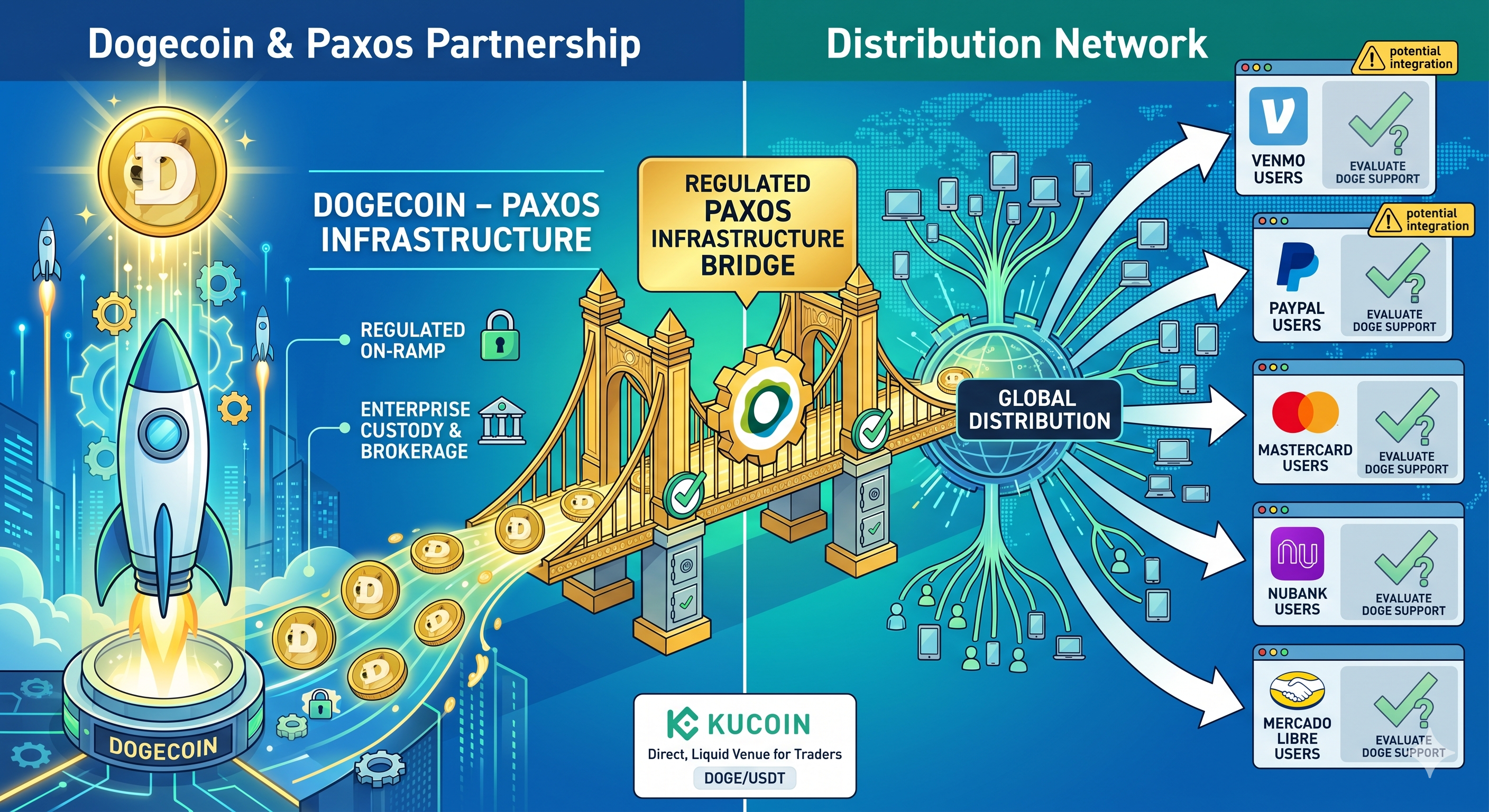
What makes this deal different from a typical exchange listing? Paxos is the regulated infrastructure layer that already powers crypto services for PayPal, Venmo, Interactive Brokers, Mercado Libre, Mastercard, and Nubank. By plugging DOGE into that stack, House of Doge has positioned the memecoin one product decision away from hundreds of millions of mainstream fintech users — without forcing any single platform to flip the switch overnight.
This article unpacks exactly what the deal does, what it does not do, why it matters for enterprises, and how DOGE traders can act on the news.
What Does the Dogecoin–Paxos Partnership Actually Do?
The partnership integrates DOGE into Paxos' enterprise crypto brokerage and custody platform — it does not automatically list Dogecoin on PayPal or Venmo. According to the June 1, 2026 GlobeNewswire release, Paxos will integrate Dogecoin into its enterprise-grade crypto brokerage and custody platform, and partners can then offer buying, selling, holding, and sending DOGE to users while Paxos manages custody, liquidity, and compliance functions in the background.
In practice, the deal is an infrastructure handoff. Each of those clients still has to choose whether to switch DOGE on for end users; the announcement is an infrastructure handoff, not a coordinated retail launch.
The partnership does not mean those companies will automatically offer DOGE trading or custody services. However, it makes the asset available for Paxos clients to evaluate and potentially integrate into their own product offerings. Whether the partnership translates into meaningful adoption remains to be seen.
For enterprises, the value is the removal of the heaviest lift: regulated custody, liquidity sourcing, and compliance plumbing are already built. Adding DOGE becomes a product and risk decision rather than an engineering project.
Why Is Paxos the Key to PayPal and Venmo Access?
Paxos is the only fully OCC-chartered crypto infrastructure provider connected to all four of the major US and Latin American fintech distribution channels for digital assets. The integration runs on the same OCC-chartered national-trust-bank stack Paxos uses to issue PayPal USD and to power the white-label brokerage Interactive Brokers wired up in September 2021. Paxos handles custody, liquidity and compliance; the partner-facing app offers buy, sell, hold and send. The company converted to a full OCC national trust bank charter in December 2025 and operates regulated entities across the U.S., Singapore, Europe and Abu Dhabi Global Market.
That regulatory footprint matters because it satisfies the internal compliance bar at most US banks and broker-dealers. According to The Defiant, the announcement compresses the regulatory distance between DOGE and consumer-grade fintech to near zero — Paxos's OCC charter, custody segregation and MiCA-compliant European entity already satisfy the bar most of its partner banks and brokerages set internally.
How Big Is the Paxos Distribution Network?
Paxos' enterprise reach spans more than 150 countries through a small number of very large consumer platforms. According to the GlobeNewswire release, this partnership significantly expands the potential reach of Dogecoin, positioning it for access to hundreds of millions of users through Paxos' enterprise client network.
Per the Paxos disclosure, the company partners with leading global enterprises to tokenize, custody and trade assets, and its blockchain solutions are used by leaders like PayPal, Interactive Brokers, Mastercard, Mercado Libre and Nubank. Paxos is licensed to engage in virtual currency business activity and is the issuer of numerous digital assets including PayPal USD (PYUSD), Pax Dollar (USDP) and Pax Gold (PAXG).
Will PayPal and Venmo Add Dogecoin Immediately?
No — PayPal and Venmo would each need to make an independent product decision to extend their crypto menu to DOGE. According to The Defiant, PayPal and Venmo currently offer a curated crypto menu — BTC, ETH, LTC, BCH and PYUSD — and would need to formally extend it.
The release deliberately avoided a launch timeline. The release does not name a rollout order or a date for any consumer app to enable DOGE. That ambiguity is structural: each fintech operates under its own jurisdictional compliance reviews and consumer protection frameworks.
What Does This Mean for Enterprise Clients of Paxos?
Enterprise fintechs, neobanks, and brokerages can now evaluate adding DOGE without rebuilding their crypto stack. According to Yahoo Finance, the partnership does not automatically place DOGE inside every Paxos client product. It gives enterprise platforms using Paxos infrastructure the ability to evaluate Dogecoin support through a regulated custody, liquidity and compliance layer. For House of Doge, that distinction is important: the work is less about another exchange listing and more about making Dogecoin easier for fintech platforms to offer at scale.
The commercial value to enterprises breaks into three layers:
|
Layer
|
What Paxos Handles
|
What the Enterprise Decides
|
|
Custody
|
Segregated, OCC-regulated storage of DOGE
|
Whether to expose holdings to retail users
|
|
Liquidity
|
Order routing and market-making for DOGE pairs
|
Pricing, spreads, and product UX
|
|
Compliance
|
KYC/AML tooling, regulated entity coverage
|
Local jurisdictional approvals
|
How Does This Fit Into House of Doge's Broader Utility Strategy?
The Paxos deal is one piece of a deliberate push to convert Dogecoin from a speculative memecoin into a payments asset. The integration supports House of Doge's strategy to build real-world Dogecoin utility across payments, commerce, and financial services, alongside the Such app, Doge Connect API suite, and merchant acceptance solutions.
The foundation arm launched a beta of its Such app — a self-custodial DOGE wallet with merchant-facing QR-payment tooling — on May 25, is going public via a reverse merger with Brag House Holdings (NASDAQ:TBH) announced in October 2025, and saw the 21Shares Dogecoin ETF (TDOG) list in January. Margiotta, who co-founded Payfare before its 2025 acquisition by Fiserv, was installed as CEO of the corporate arm last June to drive that payments push.
The macro backdrop supports the timing. According to Crypto Briefing, as of January 2026, 39% of US retailers reported accepting digital assets at point of sale, and that number has been climbing steadily — the addition of Dogecoin to widely used consumer apps would further normalize its use as a transactional token rather than a purely speculative asset.
What Are the Key Risks Investors Should Weigh?
The biggest risk is execution: the partnership creates optionality, not guaranteed distribution. For Dogecoin, the upside is asymmetric: the asset moves from piecemeal support on Robinhood, Coinbase and IBKR to sitting one product decision away from PayPal's and Venmo's combined retail base. For Paxos, adding DOGE rounds out the asset menu its enterprise clients can offer without expanding the company's regulatory perimeter. Whether the partner apps actually light up DOGE buying — and how fast — is the next data point worth watching.
Tokenomics remain a separate structural concern. According to Crypto Briefing, there are real risks here that any investor should weigh carefully, and Dogecoin's inflationary tokenomics remain a structural concern.
Finally, regulatory rollout could be uneven. According to Crypto Economy, in the short term, the technical integration protocol is expected to progress through deployment phases within Paxos' enterprise software, remaining subject to the compliance reviews that each distribution partner executes in their respective financial jurisdictions during 2026.
How to Trade Dogecoin on KuCoin After the Paxos News
If you want exposure to DOGE's potential upside from the Paxos catalyst without waiting for PayPal or Venmo to flip the switch, KuCoin offers immediate, deep-liquidity access. KuCoin has supported Dogecoin since 2018 and provides DOGE spot pairs against USDT, USDC, and BTC, plus DOGE perpetual futures with leverage for traders who want to express directional or hedged views.
Getting started takes minutes:
-
Create a KuCoin account and complete identity verification to unlock full trading and withdrawal limits.
-
Fund your account by depositing crypto from an external wallet or by buying USDT/USDC with a card or bank transfer through KuCoin's fiat on-ramp partners.
-
Trade DOGE spot on the DOGE/USDT pair for straightforward long-term accumulation, or use DOGE futures if you want leveraged exposure or hedging.
-
Set risk controls — stop-loss orders, position size limits, and a clear thesis tied to whether PayPal, Venmo, or Mercado Libre actually enable DOGE.
New users can now register at KuCoin and Get Up to 11,000 USDT in New User Rewards.
Conclusion
The Dogecoin–Paxos partnership is the most credible bridge yet between a memecoin and mainstream regulated fintech distribution. By integrating DOGE into Paxos' OCC-chartered brokerage and custody stack, House of Doge has placed Dogecoin on the same infrastructure that already powers crypto on PayPal, Venmo, Interactive Brokers, Mercado Libre, Mastercard, and Nubank — a network spanning hundreds of millions of users across more than 150 countries.
The deal does not guarantee that any single consumer app will list DOGE. Each Paxos client must make its own product and compliance decision, and the press release deliberately avoided rollout dates. What the deal does deliver is regulatory readiness: the heaviest lifts of custody, liquidity, and compliance are already solved.
For enterprises, that lowers the barrier to adding DOGE to their digital asset menus. For traders, it creates a clear catalyst to monitor — the next data points are which Paxos client lights up DOGE first, and how quickly the rest follow. Until then, KuCoin remained a direct, liquid venue for taking a position.
FAQs
1. Did PayPal or Venmo officially list Dogecoin on June 1, 2026?
No. The June 1 announcement was a partnership between House of Doge and Paxos to integrate DOGE into Paxos' enterprise infrastructure. Neither PayPal nor Venmo has announced consumer-facing DOGE trading, and each platform must independently decide whether to extend its crypto menu.
2. Who is House of Doge and how is it related to the Dogecoin Foundation?
House of Doge is the official corporate arm of the Dogecoin Foundation. According to the GlobeNewswire release, House of Doge is the official corporate arm of the Dogecoin Foundation, committed to advancing Dogecoin ($DOGE) as a widely accepted and decentralized global currency. It is going public via a reverse merger with Brag House Holdings (NASDAQ:TBH).
3. What other digital assets does Paxos issue or custody?
Paxos is the issuer of numerous digital assets including PayPal USD (PYUSD), Pax Dollar (USDP) and Pax Gold (PAXG). Global Dollar (USDG) is issued by Paxos Digital Singapore, which is a Major Payments Institution supervised by the Monetary Authority of Singapore. USDG is also issued by Paxos Issuance Europe under the supervision of FIN-FSA and in compliance with MiCA. USDG is also available on Solana.
4. Has Paxos integrated other memecoins before Dogecoin?
Yes. According to Crypto Economy, Paxos integrated BONK into its crypto brokerage platform, allowing the memecoin to reach more than 500 million users worldwide. The DOGE integration follows a similar enterprise-distribution pattern.
5. How does the Paxos deal compare to a Dogecoin ETF?
They are different distribution channels. An ETF gives traditional brokerage investors price exposure to DOGE through a regulated wrapper, while the Paxos partnership enables fintech apps to offer direct DOGE buying, selling, holding, and sending to consumers. The 21Shares Dogecoin ETF (TDOG) listed in January 2026, and the Paxos deal extends DOGE's reach into payments and wallet use cases that an ETF cannot serve.