

Bitcoin Pizza Day 2026: What It Means for Crypto Payments and Why It Still Matters
2026/05/22 15:57:02
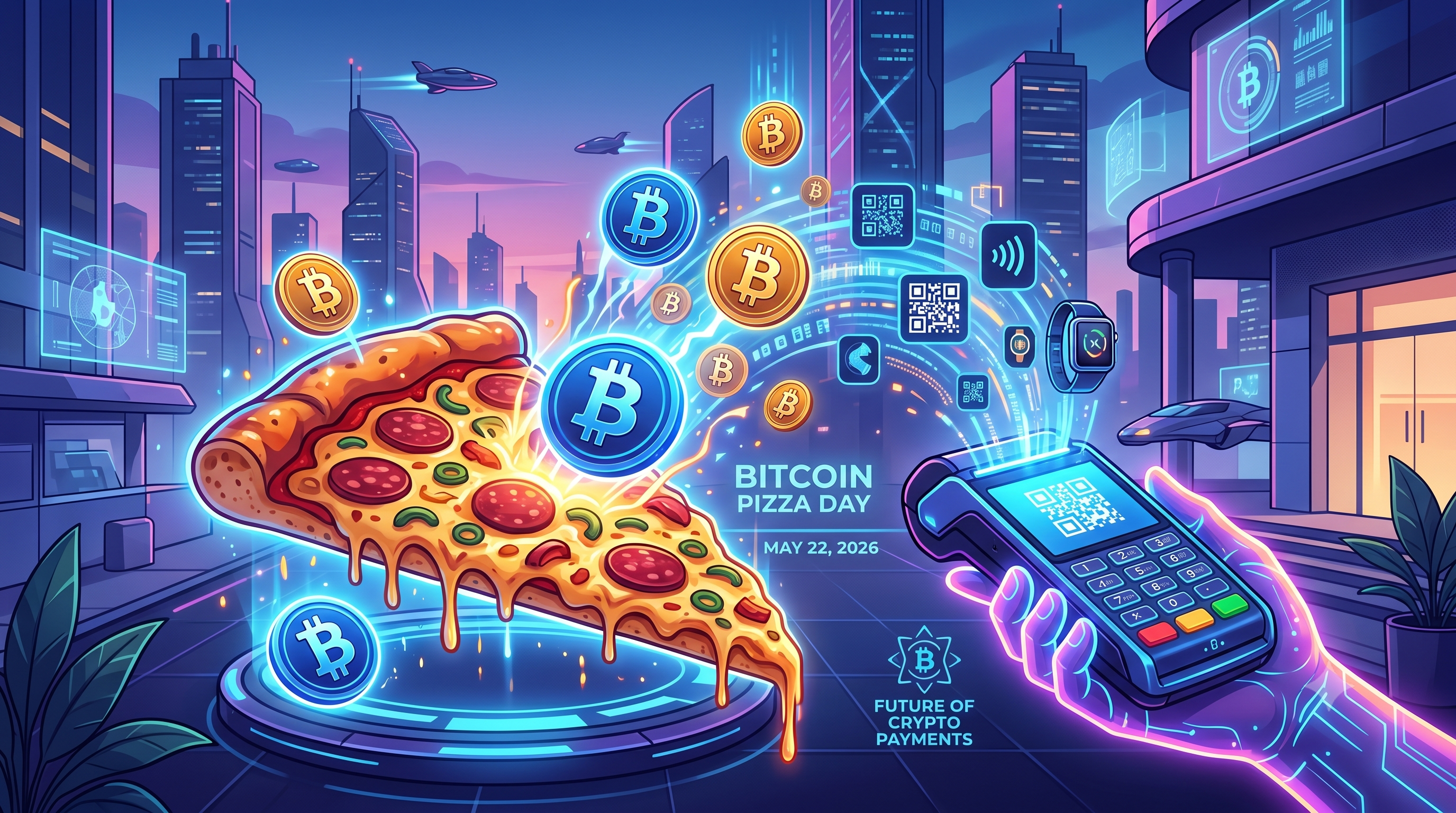
On May 22, 2010, Laszlo Hanyecz made history by exchanging 10,000 Bitcoins for two Papa John's pizzas. At the time, it was a simple peer-to-peer experiment. Today, as we celebrate Bitcoin Pizza Day 2026, that transaction represents the foundational moment of a multi-trillion-dollar financial evolution. The narrative has shifted drastically from novelty internet money to a robust, global payment infrastructure. In 2026, the crypto payment landscape is driven by the Lightning Network processing over $1 billion monthly, stablecoins dominating cross-border settlements, and nearly 40% of U.S. merchants accepting digital assets at checkout. This article explores the legacy of Bitcoin Pizza Day, analyzing the latest 2026 data on merchant adoption, consumer behavior, and the technological leaps transforming cryptocurrency from a speculative store of value into an everyday medium of exchange.
Key Takeaways
-
Layer-2 Dominance: The Lightning Network has surpassed $1 billion in monthly transaction volume in 2026, solving base-layer scalability issues.
-
Merchant Integration: Nearly 39% of U.S. merchants now accept digital assets at checkout, driven heavily by consumer demand and lower transaction costs.
-
Stablecoin Utility: Stablecoins currently facilitate 76% of all cryptocurrency payments, offering merchants a volatile-free settlement option.
-
Generational Shift: Millennials and Gen Z are the primary catalysts for crypto payments, citing speed, privacy, and security as superior to traditional credit rails.
-
Emerging Market Growth: Latin America and South Asia are experiencing massive surges in crypto transaction volumes, utilizing digital assets for remittances and daily commerce.
From 10,000 BTC to Micro-Sats: The Evolution of Digital Currency
Why the 2010 Pizza Purchase Proved Bitcoin Could Work as Money
Bitcoin Pizza Day fundamentally proved the theoretical medium-of-exchange property of decentralized networks. Prior to May 22, 2010, Bitcoin existed purely as a cryptographic novelty mined by a niche group of developers with no tangible real-world fiat equivalent. Laszlo Hanyecz's decision to offer 10,000 BTC on a forum for two pizzas established the first empirical exchange rate for the digital asset.
This transaction demonstrated that trustless, peer-to-peer money could function in a commercial capacity without centralized banking intermediaries. The event immediately validated the economic incentives built into the blockchain protocol, proving that miners and users could align to create a self-sustaining financial ecosystem.
The absence of liquid cryptocurrency exchanges in 2010 forced early adopters to rely on direct barter systems, highlighting the organic, grassroots growth of the network. Because fiat off-ramps did not exist, Hanyecz had to find an individual willing to accept raw digital code in exchange for a physical product purchased with traditional credit cards.
The staggering deflationary appreciation of that original 10,000 BTC continues to serve as a stark lesson in digital asset tokenomics. Evaluated at 2026 market prices, those two pizzas represent hundreds of millions of dollars in purchasing power. This extreme appreciation initially created a hoarding mentality among retail investors, severely stunting Bitcoin's use as everyday cash for several years. However, without this initial sacrifice of potential wealth, the broader cryptocurrency market would have lacked the definitive proof-of-concept necessary to attract global institutional infrastructure.
Why Bitcoin Pizza Day Remains the Ultimate Benchmark for Crypto Payments
The 2010 pizza purchase serves as the ultimate benchmark for industry progress because it established a permanent historical baseline for decentralized commerce. Every modern payment integration, point-of-sale terminal upgrade, and Layer-2 scaling solution is measured against the friction of that original forum-based barter. When financial analysts in 2026 evaluate the success of instant digital asset settlements, they are directly contrasting today's sub-second finality with the multi-day coordination required by Hanyecz. This benchmark prevents the industry from losing sight of cryptocurrency's original whitepaper mandate: to function as a peer-to-peer electronic cash system, not merely as digital gold sitting dormant in hardware vaults.
The ongoing celebration of this anniversary actively forces developers to address the remaining friction points in digital commerce. Industry leaders use Bitcoin Pizza Day as an annual audit of the ecosystem's transactional health. If users cannot buy everyday items with the same ease as a credit card swipe, the original vision remains unfulfilled.
Lightning Network Hits $1 Billion Monthly: How Layer-2 Solved Bitcoin's Speed Problem
The Lightning Network's $1 Billion Monthly Milestone
Layer-2 scaling has definitively solved Bitcoin's everyday payment viability, hitting a monumental $1 billion in monthly transaction volume by early 2026. The Lightning Network, a secondary protocol built directly atop the Bitcoin base layer, currently processes over 12 million transactions a month. This explosion in usage directly contradicts older narratives that blockchain networks are too slow or expensive for retail commerce.
By shifting the bulk of micro-transactions off the main blockchain and only settling the final balances, the network achieves unparalleled efficiency. This milestone confirms that both retail users and institutional players have aggressively adopted Layer-2 rails to bypass the traditional 10-minute block confirmation bottleneck.
Network capacity and liquidity have reached unprecedented levels to support this massive transactional volume. As of the first quarter of 2026, public Lightning Network capacity exceeds 5,600 BTC, distributed across more than 18,000 highly active routing nodes. This robust infrastructure ensures that payments can instantly find a secure path from sender to receiver without requiring direct, pre-established channels between every party.
The reduction in latency and fee overhead is the primary catalyst driving this $1 billion volume surge. Lightning Network payments routinely achieve finality in under half a second, easily outpacing traditional legacy networks like Visa or Mastercard in specific routing conditions. Furthermore, the median base fee for a Lightning transaction remains incredibly negligible—often hovering around 1 satoshi (fractions of a cent). This cost efficiency completely alters the economics of digital commerce, enabling entirely new business models such as real-time streaming micropayments for content creators and fractional salary disbursements for remote global workers.
How Lightning Network Beat the Blockchain Scalability Trilemma
Modern routing protocols and Hash Time-Locked Contracts (HTLCs) have successfully bypassed the blockchain scalability trilemma for retail checkouts. The scalability trilemma traditionally dictates that a network must sacrifice either decentralization, security, or speed. The Lightning Network elegantly sidesteps this by leveraging smart contracts to enforce honest behavior off-chain. HTLCs ensure atomic transactions—meaning a payment either perfectly succeeds across all intermediary nodes or immediately returns to the sender's wallet. This cryptographic guarantee prevents middleman theft while allowing funds to hop across the globe instantly.
Integration by major cryptocurrency exchanges has drastically lowered the technical barrier to entry for everyday consumers. Platforms like Binance, Kraken, and Bitget have fully deployed Lightning node infrastructure, automating the complex channel management previously required by users. Instead of manually funding and balancing channels, retail consumers can now withdraw funds instantly to external Lightning invoices.
The expansion of channel capacity limits has further normalized high-ticket purchases via digital assets. Historically, the Lightning Network was restricted to experimental micropayments due to tight liquidity constraints. In 2026, typical payment channels easily range up to 5 BTC, allowing for the seamless purchase of luxury goods, international travel bookings, and enterprise software licenses. This increased carrying capacity proves that Layer-2 is no longer just for buying coffee or pizza—it has evolved into a comprehensive financial rail capable of handling significant corporate transaction volume.
On-Chain vs. Lightning Network Metrics (2026 Data):
| Metric Category | Base-Layer Bitcoin (On-Chain) | Lightning Network (Layer-2) |
| Average Settlement Time | 10 to 60 minutes (depending on block congestion) | Sub-second to 2 seconds (instant finality) |
| Average Transaction Fee | ~$1.50 to $3.00+ (highly volatile) | ~1 Satoshi (fractions of a penny) |
| Throughput Capacity | ~7 transactions per second (global maximum) | Millions of transactions per second (theoretically unlimited) |
| Primary 2026 Use Case | Large capital settlements, institutional cold storage | Retail checkouts, remittances, daily micro-payments |
39% of U.S. Merchants Now Accept Crypto: The 2026 Retail Revolution
Nearly 4 in 10 American Businesses Embrace Digital Payments
Merchant adoption has definitively crossed the chasm, with nearly four in ten U.S. retailers integrating digital checkout options in 2026. A comprehensive joint study by the National Cryptocurrency Association and PayPal reveals that 39% of domestic merchants now accept some form of cryptocurrency. This shift is not isolated to niche online storefronts; it heavily features enterprise-level participants. Fully 50% of large enterprises generating over $500 million in annual revenue have integrated digital payment rails.
Customer demand is the overwhelming driver forcing retailers to upgrade their point-of-sale infrastructure. The 2026 data shows that an astounding 88% of merchants report receiving direct customer inquiries regarding crypto payment options. Furthermore, 79% of surveyed business owners believe that accepting digital assets serves as a vital growth lever to attract net-new demographics.
The hospitality, travel, and digital goods sectors are leading the charge in total transaction volume. In 2026, 81% of hospitality and travel businesses accept crypto, heavily utilizing it to bypass exorbitant cross-border currency conversion fees. Similarly, digital goods and gaming platforms sit at 76% adoption, reflecting the inherently digital nature of their consumer base. For merchants already accepting crypto, these alternative payments represent a substantial 26% of their total overall sales volume.
Why Stablecoins Now Power 76% of All Crypto Retail Payments
Volatility concerns have driven a massive paradigm shift toward stablecoins, which now comprise an estimated 76% of all cryptocurrency retail payments. While Bitcoin remains the most recognized asset, its price fluctuations create significant margin risks for merchants between the time of transaction authorization and final fiat settlement. To combat this, payment processors have heavily integrated fiat-pegged assets like USDT and USDC.
Stablecoins provide the exact same borderless, instant settlement benefits of traditional cryptocurrencies but completely strip away the speculative market volatility. This allows merchants to price their goods accurately and maintain predictable profit margins without acting as impromptu currency traders.
Automated conversion mechanics operating in the background have further accelerated stablecoin dominance. Leading payment service providers (PSPs) now offer immediate crypto-to-fiat or crypto-to-stablecoin liquidation the exact second a customer initiates a payment. The consumer spends their volatile asset, but the merchant receives an equivalent, stable USD value directly into their treasury account. This dynamic eliminates complex accounting headaches and drastically simplifies capital gains tax reporting for the business.
Emerging Markets Lead While Western Adoption Faces Regulatory Hurdles
While overall global e-commerce adoption remains under 15%, emerging markets are experiencing explosive, double-digit transaction volume growth. In developing regions like Latin America and South Asia, cryptocurrency is rapidly transitioning from an investment vehicle to a vital daily utility. Recent 2026 data indicates an 80% increase in crypto adoption volume in South Asia, while Latin America achieved 63% growth. In these markets, localized inflation, currency devaluation, and lack of access to traditional banking infrastructure force consumers to seek alternative financial networks.
Conversely, adoption in Western markets faces entirely different structural and operational constraints. In North America and Europe, traditional credit card networks and digital wallets like Apple Pay offer incredibly frictionless consumer experiences, making it difficult for cryptocurrency to compete on pure convenience alone. Furthermore, complex regulatory ambiguity continues to deter small-to-medium enterprises (SMEs) from overhauling their checkout systems. Specifically, KYC (Know Your Customer) and AML (Anti-Money Laundering) compliance complexities challenge 68% of cross-border merchants, while tax reporting difficulties impact over half of crypto-accepting firms.
The path to global saturation depends entirely on regulatory clarity and the continued refinement of cross-border infrastructure. For merchants operating internationally, the incentives remain massive: bypassing traditional correspondent banking networks results in exponentially faster settlements and vastly reduced international wire fees.
Millennials and Gen Z Are Forcing Retailers to Accept Crypto
Younger Generations Drive the Crypto Checkout Revolution
Younger generations are the undisputed primary catalysts forcing the integration of crypto payments across the retail sector. Extensive 2026 market research indicates that 77% of Millennials and 73% of Gen Z consumers are actively driving the market demand for alternative checkout options. These digital-native demographics view cryptocurrency not as a foreign concept, but as a standard, logical evolution of internet commerce.
This generational shift is rooted in a profound distrust of traditional financial institutions and hidden banking fees. Younger consumers are actively rejecting the multi-day settlement delays, overdraft penalties, and arbitrary account freezes associated with legacy credit networks. They prefer the absolute autonomy and self-custody provided by digital wallets.
Small and medium-sized businesses are feeling the direct impact of this demographic pressure. Small businesses report an 82% inquiry rate from Gen Z customers explicitly asking to finalize purchases with digital assets. To capture the immense lifetime value of these young consumers, merchants are compelled to modernize. Their spending habits prove that cryptocurrency is transitioning seamlessly from a speculative wealth-building tool into standard generational spending capital.
Privacy, Speed, and Borderless Shopping: Why Consumers Choose Crypto
Consumers prioritize crypto at checkout primarily for transaction privacy, enhanced security, and the total elimination of cross-border friction. According to 2026 data, 45% of users cite faster transaction speeds as their primary motivation for using digital assets, while 40% point directly to greater financial privacy. Unlike traditional credit card purchases that harvest vast amounts of personal consumer data for targeted advertising, cryptocurrency transactions push funds from the user to the merchant without transmitting sensitive, reusable identity markers.
The borderless nature of digital assets completely neutralizes the concept of foreign exchange barriers for the end-consumer. A shopper in Tokyo can instantly purchase physical goods from a boutique in New York using the exact same digital asset, completely bypassing punitive bank exchange rates and international clearing delays.
Enhanced security features inherently built into decentralized wallets provide consumers with absolute financial sovereignty. Because blockchain payments cannot be pulled from an account without explicit cryptographic authorization, the risk of unauthorized subscription renewals or hidden merchant charges drops to absolute zero.
Join KuCoin Pizza Day 2026
As Bitcoin Pizza Day 2026 reignites global attention on cryptocurrency’s journey from experimental internet money to mainstream financial infrastructure, major exchanges are using the occasion to celebrate how far the industry has evolved.
KuCoin is among the platforms marking the event with a series of Bitcoin Pizza Day campaigns, community activities, and trading initiatives designed to engage both longtime crypto holders and new market participants.
Users now can join KuCoin's Pizza Day Event to share 100,000 USDT prize pool. The period of event is: 05/20/2026 00:00:00 ~ 06/07/2026 23:59:59 (UTC)
What's Next for Crypto Payments: Smart Contracts, Regulation, and Mass Adoption
How PayPal, Stripe, and Block Are Bridging Crypto and Traditional Retail
Major fintech payment providers have seamlessly bridged the gap between complex blockchain rails and traditional point-of-sale terminals. Industry titans like PayPal, Block, and Stripe have spent the first half of the 2020s silently building the background infrastructure required for mainstream adoption. In 2026, their efforts have culminated in hybrid checkout systems where consumers can pay via a mobile crypto wallet while the physical cash register natively processes the transaction just like a Visa swipe.
The proliferation of crypto-linked debit and credit cards has served as the ultimate Trojan horse for retail integration. These financial products allow users to spend their cryptocurrency balances at any of the millions of merchants worldwide that accept traditional card networks. When a consumer swipes a crypto-linked card, the issuing bank instantly liquidates the exact required amount of digital assets into fiat to fund the purchase. The merchant remains completely unaware that cryptocurrency was involved in the transaction.
Looking forward, the native integration of smart contracts into retail supply chains represents the next major evolutionary leap. Beyond simple peer-to-peer payments, 2026 is witnessing the early stages of programmable commerce. Smart contracts can automatically disburse payments to suppliers, shippers, and retailers simultaneously the exact moment a consumer finalizes a purchase. This instantaneous, trustless revenue splitting eliminates the need for complex, 30-day net invoicing and dedicated accounts receivable departments.
The Final Barriers: Capital Gains Taxes and Regulatory Clarity
Regulatory ambiguity and capital gains tax complexities remain the final, formidable barriers preventing 100% merchant and consumer saturation. In jurisdictions like the United States, current 2026 tax codes treat most digital assets as property rather than currency. This means every single time a consumer buys a coffee with Bitcoin, they are technically executing a taxable event, requiring them to calculate capital gains or losses based on the asset's price fluctuation since acquisition.
The integration costs and perceived technical debt continue to deter a significant portion of small-to-medium enterprises. Approximately 40% of SMEs cite integration costs and operational complexity as their primary reasons for rejecting crypto checkouts. Business owners fear the requirement to train staff on new protocols, secure digital wallets against hacks, and navigate the labyrinth of international AML compliance.
Despite these hurdles, the trajectory of decentralized commerce is overwhelmingly positive. As stablecoin adoption continues to neutralize volatility and Layer-2 networks permanently solve throughput issues, the underlying technology is practically flawless. The remaining challenges are purely bureaucratic and educational. Once comprehensive regulatory frameworks are established globally, standardizing the treatment of digital assets, the floodgates for mass corporate adoption will open.
Conclusion: Bitcoin Pizza Day 2026 and the Future of Money
Bitcoin Pizza Day 2026 stands as a testament to the incredible evolution of digital assets from obscure internet experiments to foundational pillars of global commerce. The journey from Laszlo Hanyecz's 10,000 BTC transaction to a landscape where the Lightning Network processes over a billion dollars monthly highlights a rapidly maturing financial ecosystem.
Today, with nearly 40% of U.S. merchants embracing digital payments and stablecoins handling the bulk of retail settlements, the vision of decentralized commerce is a tangible reality. While challenges regarding regulatory clarity, tax friction, and global e-commerce integration persist, the relentless demand from younger demographics and the seamless infrastructure provided by institutional payment processors point toward a borderless financial future.
As technological scaling solutions continue to erase the historical boundaries of transaction speed and cost, the original promise of a peer-to-peer electronic cash system is actively redefining how the modern world exchanges value.
FAQs:
How are capital gains taxes calculated on cryptocurrency used for small everyday purchases like food?
Capital gains taxes on small purchases are calculated by determining the difference between the fair market value of the cryptocurrency at the time of the transaction and its original cost basis. If the value increased since acquisition, the spender owes short-term or long-term capital gains tax on that profit, regardless of the purchase size.
Can a Lightning Network transaction be reversed or refunded if a merchant fails to deliver the goods?
Lightning Network transactions cannot be reversed or charged back on the protocol level once cryptographic finality is reached. Refunds require the merchant to initiate a completely new, separate transaction to send the funds back to the customer's wallet.
What specific hardware is required to run a full routing node for digital asset payments?
Running a routing node requires a device with at least a 1TB Solid State Drive (SSD), 4GB to 8GB of RAM, a reliable multi-core processor (such as a Raspberry Pi 4 or a standard desktop CPU), and an uninterrupted broadband internet connection to maintain ledger synchronization.
Do hardware wallets support direct, contactless point-of-sale payments in physical stores?
Most hardware wallets do not support direct contactless (NFC) point-of-sale payments. Users typically must transfer funds from their hardware wallet to a mobile "hot wallet" equipped with NFC capabilities or scan a merchant's QR code using a mobile interface connected to the hardware device.
How do multi-signature (multisig) wallets change the checkout process for enterprise buyers?
Multisig wallets require multiple authorized parties to cryptographically sign a transaction before the funds are released. This means enterprise buyers cannot execute instant, single-click checkouts; the payment remains pending until the predetermined quorum of keyholders formally approves the transfer.
Disclaimer: This article is for informational purposes only and does not constitute financial or investment advice. Cryptocurrency investments carry significant risk. Always conduct your own research before trading.