

The Law on State Control Over Cryptocurrency in Russia: What Changed in the Final Version of the Bill
2026/07/08 14:18:00
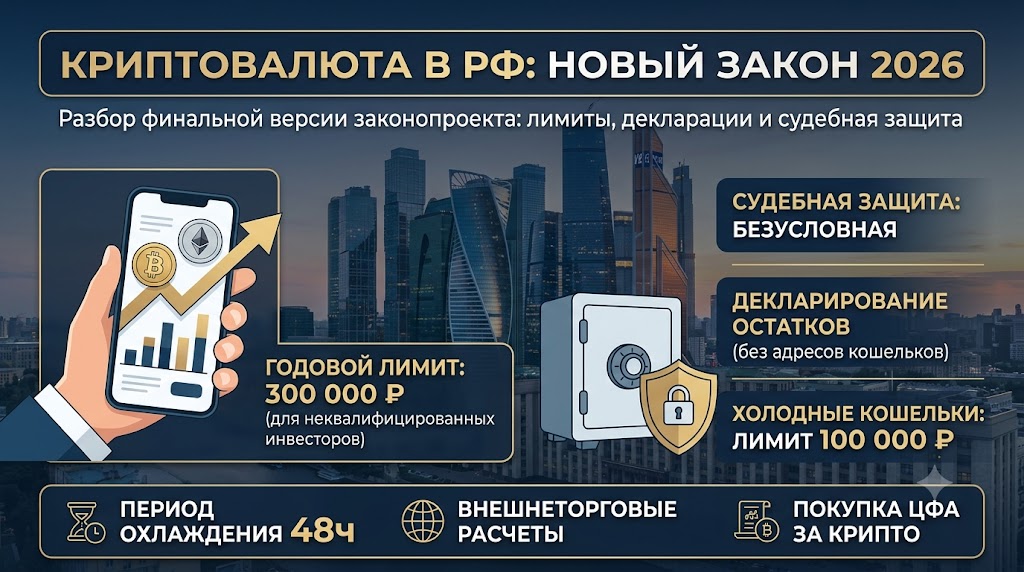
The annual limit on cryptocurrency purchases for retail investors will be just 300,000 rubles — yet foreign wallet addresses may no longer need to be disclosed to the state. On July 7, 2026, the State Duma's Financial Market Committee approved the final version of the bill "On Digital Currency and Digital Rights," which is set to go through its second reading. The document significantly softens the original requirements: instead of mandatory disclosure of specific crypto wallet addresses, residents will only need to report balances and turnover. At the same time, the bill introduces unconditional judicial protection for crypto ownership rights, a 48-hour cooling-off period for large transfers, and permission to use cold wallets with a 100,000-ruble limit. Let's break down exactly what changed in the final draft and how it will affect crypto holders, traders, and businesses involved in foreign trade settlements.
What Changed in the Final Version of the Bill?
The main change is the shift away from mandatory disclosure of foreign crypto wallet addresses toward declaring only aggregate balances and turnover. According to Financial Market Committee Chairman Anatoly Aksakov, lawmakers proposed dropping the requirement to disclose specific foreign wallet addresses during the second reading, replacing it with an obligation to report only total balances and transaction volumes.
The official rationale is that disclosing specific addresses creates a risk of sensitive data leaks that unfriendly states could theoretically use against Russian citizens and companies under sanctions. Replacing address-level identification with aggregated figures reduces this threat while preserving the state's fiscal oversight.
Beyond this point, the final version also establishes judicial protection for crypto ownership rights, introduces a cooling-off mechanism for transfers, regulates cold wallets, and opens the door to using cryptocurrency in foreign trade settlements. All these provisions aim to legalize the market while preventing it from remaining a haven for fraud and money laundering.
How Will Foreign Crypto Wallets Now Be Declared?
Residents will only need to report balances and turnover on foreign crypto wallets, not their exact addresses. This is the key concession lawmakers made during the second reading: the original version called for full disclosure of address information, which raised serious concerns among market participants.
The logic behind the amendment is straightforward — the state retains visibility into asset volumes and transaction flow for tax and oversight purposes, but no longer receives data that, if leaked, could expose specific wallets to third countries. For holders of large crypto portfolios, this substantially reduces risks tied to sanctions pressure and de-anonymization.
It's important to understand that dropping address-level reporting doesn't mean abandoning oversight altogether — transactions are still recorded by licensed intermediaries, and turnover data is still passed to supervisory authorities.
What Judicial Protection Do Crypto Holders Get?
The law establishes unconditional judicial protection for cryptocurrency ownership rights, regardless of whether the holder previously declared the asset. This provision is based on the Constitutional Court's position and removes one of the main barriers that, for years, prevented crypto holders from securing legal protection in disputes, thefts, and fraud cases.
In practice, this means that if a user falls victim to fraud, an exchange hack, or a dispute with a counterparty, they have the right to go to a Russian court — even if they never previously reported holding those assets to tax authorities. Aksakov emphasized that this approach helps curb fraudulent schemes without creating excessive barriers to market development.
This guarantee is especially significant given the rising number of crypto theft cases and scams involving exchangers — victims now have a real legal tool at their disposal, not just the technical ability to trace a transaction on the blockchain.
What Purchase Limit Applies to Ordinary Investors?
Non-qualified investors will be able to purchase no more than 300,000 rubles' worth of cryptocurrency per year through a single licensed intermediary — and only the most liquid coins. The Central Bank confirmed this limit and refused to revise it even after criticism from market participants and banking associations.
First Deputy Chairman of the Bank of Russia Vladimir Chistyukhin stated that the regulator views retail investor participation in crypto purchases as an extremely high-risk activity and has no plans to raise the limit. However, Aksakov clarified an important detail: the 300,000-ruble cap applies per intermediary, meaning an investor can open accounts with multiple licensed brokers or exchangers, with the limit applying separately to each.
The list of "most liquid cryptocurrencies" available to non-qualified investors will be determined by the regulator itself — expected to include Bitcoin, Ethereum, and other top-cap assets. Low-liquidity altcoins will remain off-limits for retail investors. Before making their first purchase, users will also need to pass a suitability test confirming they understand the risks.
What Is the 48-Hour Cooling-Off Period and How Does It Work?
The cooling-off period is a mandatory 48-hour hold on large cryptocurrency transfers sent abroad or to third parties, introduced to protect against fraud. The mechanism mirrors a practice already used in the banking system to counter social engineering scams and phone fraud.
Chistyukhin clarified that the measure will apply exclusively to account-to-account transfers and will not affect ordinary exchange trading — users will still be able to buy and sell crypto on an exchange instantly, without delays. The restriction only kicks in when funds are being withdrawn to a third party or outside the country in a significant amount.
Digital custodians will be authorized to suspend such transfers for two days, giving investors time to cancel the operation if it looks suspicious. If an intermediary fails to apply this hold and a client loses funds to fraud as a result, the intermediary will be required to fully compensate the stolen amount. This substantially raises the accountability of licensed platforms and pushes them toward stronger anti-fraud systems.
Can You Use Cold Non-Custodial Wallets?
Yes, but with a strict 100,000-ruble limit and only under certain storage conditions. The Bank of Russia has allowed the use of non-custodial (cold) wallets, but only outside Russian jurisdiction — meaning formally beyond the control of domestic intermediaries.
Within the country, a different principle applies: cryptocurrency purchased through a licensed Russian intermediary can be withdrawn to a personal cold wallet (such as a hardware wallet or Ledger), but transactions through it will be capped at 100,000 rubles and will require reporting to the Federal Tax Service. Originally, the regulator insisted on custodial storage only, where private keys remain with the depository — but under pressure from market participants, that position was softened.
This compromise reflects the Central Bank's concern that fully unrestricted access to non-custodial wallets would undermine the entire control model: without access to the keys, the state cannot freeze or seize assets by court order, nor can it enforce the 300,000-ruble annual limit on assets a user holds offline, outside the regulator's view.
How Is Cryptocurrency Regulated in Foreign Trade?
Companies are getting nearly complete freedom in choosing instruments for cross-border settlements, including any cryptocurrency or stablecoin. For foreign economic activity (FEA), the bill makes its most significant concession to business throughout the entire drafting process.
Settlements can be conducted either through a regulated intermediary or directly, using Russian or foreign systems. A company can freely choose any cryptocurrency or stablecoin to pay for an import or export contract. The only mandatory requirement is registering the contract with a bank, similar to the standard procedure for other types of international settlements.
FEA participants also get simplified reporting: companies won't need to disclose every single transaction to the tax service — it will be enough to record the mere fact that cryptocurrency was used in settlements. This provision is explicitly aimed at supporting companies facing restrictions from traditional banking infrastructure due to sanctions, and should simplify foreign trade payments without direct reliance on dollar- or euro-based systems like SWIFT.
Can You Buy Stocks and Digital Financial Assets with Cryptocurrency?
The final version of the law, for the first time, allows residents to purchase traditional securities and Russian digital financial assets (DFAs) directly with cryptocurrency. This is one of the most notable additions made at the final stage of the bill's preparation.
Aksakov noted that this capability expands capital-raising tools and makes settlements more flexible for both Russian and foreign investors. Looking ahead, licensed brokers and asset managers will also be able to execute trades on foreign crypto exchanges and with foreign crypto exchangers on behalf of clients — though only in jurisdictions the authorities deem "friendly."
This convergence of the crypto market with the traditional stock market could gradually boost liquidity in both segments and attract new foreign participants seeking alternative settlement methods amid sanctions restrictions.
Should You Invest or Trade Cryptocurrency on KuCoin?
The legalization of Russia's crypto market opens up new opportunities for investors, but choosing a reliable and functional platform remains a key factor for success. KuCoin provides access to a wide range of liquid cryptocurrencies, including Bitcoin and Ethereum — assets that fall into the category permitted for non-qualified investors under the discussed rules.
The platform offers convenient tools for spot and margin trading, along with built-in risk management features — especially relevant given that regulators worldwide, including Russia's Central Bank, continue to emphasize the high-risk nature of crypto assets. Before you start trading, it's important to independently assess your tolerance for market volatility and never risk more than you're prepared to lose.
To start trading on KuCoin, register an account, complete verification, and fund your balance using a convenient method. A diversified approach and gradually building your position is a sound strategy for those just getting familiar with the market under this new regulatory environment.
Conclusion
The final version of the bill on state control over cryptocurrency noticeably softens the originally strict requirements, striking a balance between state interests and market participants. Key changes include: dropping the disclosure of foreign wallet addresses in favor of declaring balances and turnover, unconditional judicial protection for crypto ownership rights regardless of prior declaration, and permission to use cold non-custodial wallets with a 100,000-ruble limit.
Retail investors will still face an annual limit of 300,000 rubles per intermediary and restrictions on purchasing only the most liquid coins, while a 48-hour cooling-off period will apply to transfers to third parties to guard against fraud. Businesses engaged in foreign trade gain significant freedom in choosing crypto instruments for cross-border settlements. The law is expected to take effect on September 1, 2026. Before then, the bill must still pass its second and third readings in the State Duma, receive approval from the Federation Council, and be signed by the president.
Frequently Asked Questions
Do you need to have declared your cryptocurrency to get judicial protection in case of fraud?
No, the law establishes unconditional judicial protection for cryptocurrency ownership rights regardless of whether the holder previously declared the asset — this position is based on a ruling by Russia's Constitutional Court.
Does the cooling-off period apply to regular cryptocurrency trading on an exchange?
No, the 48-hour delay applies only to transfers of funds to third parties or abroad and does not affect standard buy and sell operations on a licensed platform.
Can you store cryptocurrency in a wallet like MetaMask or Ledger in Russia?
Yes, but transactions through such a non-custodial wallet within Russian jurisdiction are capped at 100,000 rubles and require reporting to the tax service; without restrictions, such wallets can only be used outside Russia.
How can companies use cryptocurrency to settle with foreign partners?
Companies are free to choose any cryptocurrency or stablecoin for cross-border settlements, conducting transactions either through an intermediary or directly, provided the contract is registered with a bank.
What happens if an intermediary fails to block a suspicious transfer and the client loses funds?
The intermediary will be required to fully compensate the client for the stolen amount if it failed to apply the mandatory 48-hour hold on a large transaction.