

What is Bitcoin (BTC)? And What It Means in 2026?
Introduction
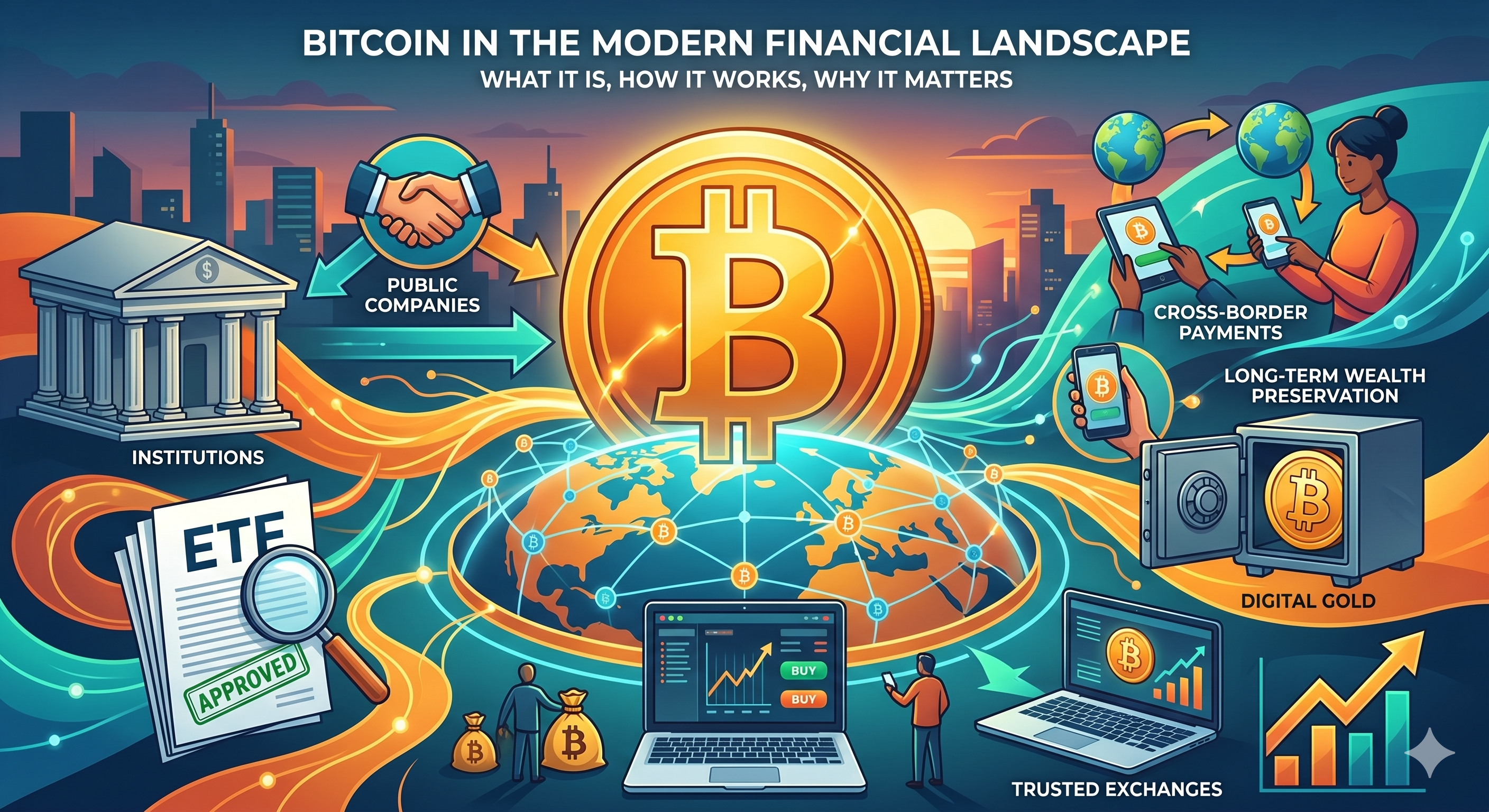
Bitcoin has evolved far beyond its early reputation as an experimental digital currency. In 2026, Bitcoin is widely recognized as a global financial asset, attracting retail investors, institutions, public companies, and even governments. From the approval of spot Bitcoin ETFs in major financial markets to increasing adoption for cross-border payments and long-term wealth preservation, Bitcoin continues to reshape the modern financial landscape.
Unlike traditional currencies controlled by central banks, Bitcoin operates on a decentralized blockchain network that is open, transparent, and resistant to censorship. Its limited supply of 21 million coins has also positioned Bitcoin as a potential hedge against inflation and monetary debasement, leading many investors to refer to it as “digital gold.”
As cryptocurrency adoption grows worldwide, understanding how Bitcoin works has become increasingly important for both new and experienced investors. This guide explains what Bitcoin is, how it works, why it matters, and how users can buy and use Bitcoin safely in today’s crypto ecosystem.
What is Bitcoin?
Bitcoin is the first and most well-known cryptocurrency in the world. It was created in 2009 as a response to the careless government usage and control of assets, which caused the 2008 financial crisis. Bitcoin’s main goal was to create a fully digital and decentralized currency that could be used for electronic payments.
Fiat money (like the US dollar) is backed and regulated by the government that issues it. On the other hand, Bitcoin is the complete opposite - it is regulated by its network of users. It is designed to be secure, open, and global.
Many think of Bitcoin as post-industrial or post-institutional money. The rules under which it operates are neutral and predictable. Every transaction is treated the same, without any censorship or third-party control. The power of Bitcoin is spread across the network, making it extremely difficult to manipulate.
On top of that, Bitcoin has a finite supply of only 21 million, making it impossible to “print” money and add it to circulation. This ensures that the only factors that influence its value are its supply and demand.
Over the past few years, Bitcoin has transitioned from a niche internet asset into a mainstream financial instrument. Major financial institutions such as BlackRock, Fidelity, and other asset managers have launched Bitcoin-related investment products, while several countries continue exploring Bitcoin integration into their financial systems. The approval of spot Bitcoin ETFs in multiple regions has significantly increased institutional exposure to Bitcoin and improved accessibility for traditional investors.
Bitcoin is also increasingly viewed as a macroeconomic asset. During periods of inflation, banking instability, or currency devaluation, many investors turn to Bitcoin as an alternative store of value due to its scarcity and decentralized nature. This growing narrative has strengthened Bitcoin’s position as one of the most important digital assets in the global economy.
Who created Bitcoin?
The first Bitcoin specification was published in 2009 by Satoshi Nakamoto, an unknown and mysterious person or team. Satoshi completely vanished in late 2010 without revealing much about themselves. The community has grown exponentially since then, with many developers working on improving Bitcoin.
While many concern themselves with the identity of Satoshi Nakamoto, the truth is: it doesn’t matter. Bitcoin’s protocol is open-source by nature, meaning that any developer can review the code, and even make their own versions of Bitcoin.
How does Bitcoin work?
Bitcoin is a digital file stored on the blockchain, the technology that powers it. Blockchain is a digital ledger made of units (called blocks) that contain all the important information about the network transactions, such as the date and time of the transaction, buyer and seller, as well as the unique code for each transaction. However, Bitcoin’s blockchain does not contain actual names of the buyer and seller, but rather just a set of numbers called the wallet address.
Each time a transaction is made and validated by miners, it gets put on the blockchain where anyone can see it. Once the information is put on the blockchain, it cannot be changed. This makes Bitcoin’s blockchain immutable.
Bitcoin’s decentralization, though it may sound risky to some, is its main advantage. In order for a block of transactions to be added to a blockchain, it first needs to be verified by the majority of Bitcoin validators, called miners.
Bitcoin’s infrastructure has also become significantly more advanced over time. While the Bitcoin blockchain prioritizes decentralization and security, newer technologies such as the Lightning Network help improve transaction speed and reduce costs for everyday payments. The Lightning Network is a Layer-2 scaling solution built on top of Bitcoin that enables near-instant transactions with minimal fees.
As a result, Bitcoin is no longer viewed solely as a long-term investment asset. In some regions, it is increasingly used for remittances, online commerce, and peer-to-peer payments, especially in areas where access to traditional banking services remains limited.
What is Bitcoin mining?
Each Bitcoin transaction contains a puzzle that miners need to solve by utilizing powerful specialized hardware. This puzzle is created to protect the network from fraudulent transactions. Bitcoin’s network incentivizes miners to work by rewarding them with newly-minted Bitcoin (this is how new Bitcoin is created) and transaction fees. This concept of mining to ensure network stability is called Proof-of-Work.
While it was possible for a person to mine Bitcoin with a regular computer in the early days, that is no longer the case. Bitcoin’s code is written in such a way that the difficulty of the puzzles increases and decreases based on the total computing power of the network. Today, Bitcoin mining requires new and powerful hardware, as well as access to cheap electricity, in order to be profitable.
Bitcoin mining has also become a highly competitive global industry. Large-scale mining companies now operate specialized facilities powered by advanced ASIC hardware and increasingly rely on renewable or surplus energy sources to improve efficiency. In recent years, many mining firms have expanded into regions with lower electricity costs and favorable regulatory environments.
Despite concerns about energy consumption, supporters argue that Bitcoin mining can help stabilize energy grids and encourage renewable energy development by utilizing excess power that would otherwise go unused. At the same time, the Bitcoin network continues to maintain one of the highest levels of security among all blockchain networks due to its massive global mining infrastructure.
Following the Bitcoin halving events, which reduce miner rewards approximately every four years, Bitcoin’s supply issuance gradually decreases over time. Historically, halving cycles have played an important role in Bitcoin’s long-term market dynamics by reinforcing its scarcity-driven economic model.
How to use Bitcoin
Using Bitcoin has become significantly easier compared to the early days of cryptocurrency. Today, users can buy, store, trade, and spend Bitcoin through a wide range of platforms and financial services. Whether someone wants to invest long term, make international transfers, or diversify their portfolio, Bitcoin offers multiple use cases within the digital economy.
Before purchasing Bitcoin, users typically need a crypto wallet or an account on a trusted cryptocurrency exchange. Once acquired, Bitcoin can be stored in custodial wallets provided by exchanges or in self-custody wallets where users fully control their private keys.
Cryptocurrency exchanges are places where users can buy Bitcoin with their money, or exchange their cryptocurrencies for one another. They are incredibly versatile and usually have the most features. To buy Bitcoin with Kucoin, head over to our website and create an account.
To learn more about Kucoin and how to use it to buy Bitcoin, visit our beginner’s guide page.
There are many traditional investment brokerages that offer cryptocurrency trading nowadays. Robinhood was the first large investment broker to offer Bitcoin and other cryptocurrencies.
Peer-to-peer platforms are places where users can buy Bitcoin directly from other owners.
People can also acquire Bitcoin by mining. However, nowadays, mining requires expensive hardware, cheap electricity, and technical expertise, which put it out of reach for most people.
People interested in Bitcoin could sell their things on marketplaces that allow for crypto purchases. This way, they will get Bitcoin by selling things they don’t want.
For beginners entering the crypto market, centralized exchanges remain one of the easiest and safest ways to access Bitcoin. Platforms like KuCoin provide users with spot trading, recurring crypto purchases, fiat on-ramp services, trading bots, and educational resources that simplify the onboarding experience for new investors.
In addition to buying Bitcoin, many users also explore passive income opportunities within the crypto ecosystem, such as crypto lending, staking alternative digital assets, or using Bitcoin as collateral in decentralized finance applications. As the broader blockchain ecosystem matures, Bitcoin continues to play a foundational role across the entire crypto industry.
Conclusion
Bitcoin has grown from a decentralized digital currency experiment into one of the most influential financial innovations of the modern era. Its transparent monetary policy, limited supply, and decentralized infrastructure have helped it gain recognition from retail users, institutions, and even governments around the world.
Although Bitcoin remains volatile in the short term, its long-term adoption trend continues to strengthen as blockchain technology becomes more integrated into the global financial system. Innovations such as the Lightning Network, institutional investment products, and expanding real-world adoption are further solidifying Bitcoin’s role within the digital economy.
For investors and newcomers alike, understanding Bitcoin is no longer optional in today’s rapidly evolving financial landscape. Whether used as a store of value, a hedge against inflation, or a decentralized payment network, Bitcoin continues to shape the future of finance.
Users interested in buying or trading Bitcoin can explore the crypto ecosystem through platforms like KuCoin, which provides access to Bitcoin trading, educational content, and a wide range of digital assets.
FAQs
Is Bitcoin still a good investment in 2026?
Bitcoin remains one of the most widely adopted cryptocurrencies in the world. Many investors view it as a long-term store of value due to its limited supply, institutional adoption, and growing role in the global financial system. However, Bitcoin is still a volatile asset, and investors should always conduct their own research before investing.
What is the difference between Bitcoin and traditional money?
Traditional fiat currencies are issued and controlled by governments and central banks, while Bitcoin operates on a decentralized blockchain network without a central authority. Bitcoin also has a fixed maximum supply of 21 million coins, unlike fiat currencies which can be printed in unlimited quantities.
Can Bitcoin be used for payments?
Yes. Bitcoin can be used for online purchases, peer-to-peer transfers, and international payments. Technologies like the Lightning Network have made Bitcoin transactions faster and cheaper, improving its usability for everyday payments.
Is Bitcoin mining still profitable?
Bitcoin mining can still be profitable, but it now requires specialized ASIC hardware, access to low-cost electricity, and efficient operations. Profitability also depends on Bitcoin’s market price, mining difficulty, and energy costs.
How can beginners buy Bitcoin safely?
Beginners typically buy Bitcoin through trusted cryptocurrency exchanges like KuCoin. Users should enable security features such as two-factor authentication (2FA), use strong passwords, and consider storing long-term holdings in secure crypto wallets.