

Santa Stealer: What We Know About the New MaaS Stealer Targeting Russian Businesses and Crypto Wallets in 2026
2026/07/06 14:23:00
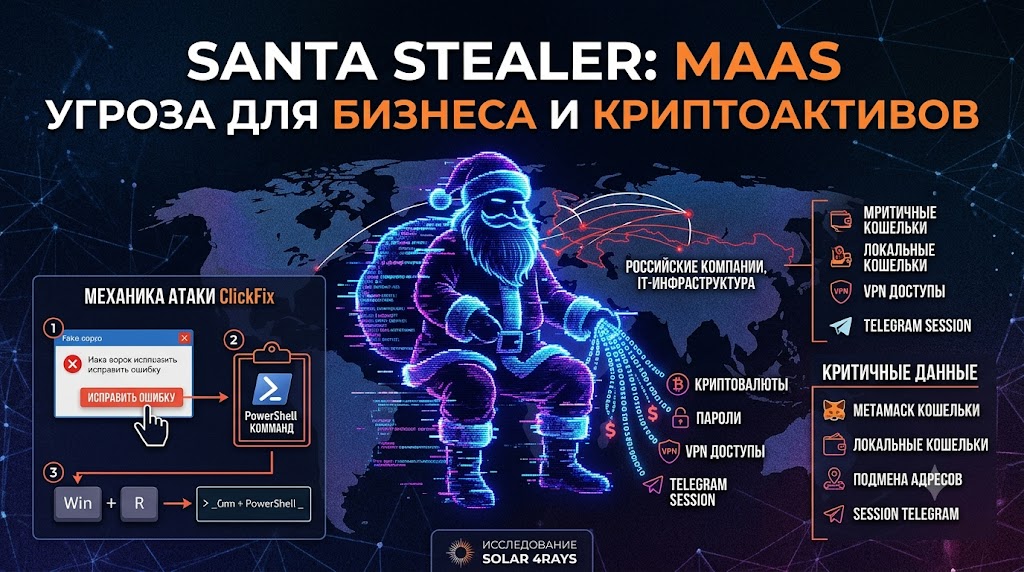
In just a few months, Santa Stealer has grown from a local threat into a full-fledged criminal platform operating under the Malware-as-a-Service model. Already in spring 2026, researchers documented an attack on an industrial enterprise in Russia, and by summer the malware had entered the underground market as a commercial product with flexible pricing plans. So what exactly is Santa Stealer, and why is it dangerous? It is a next-generation infostealer that harvests passwords, Telegram sessions, VPN credentials, and cryptocurrency wallet data — and thanks to the MaaS model, it is now being purchased by dozens of independent attackers, not only to target companies but also to hunt individual crypto holders. Below, we break down how it works, who it targets, and how to protect your digital assets.
What Is Santa Stealer, and Why Is It Dangerous for Businesses and Individuals
Santa Stealer is a mature MaaS data-theft platform, not just another short-lived commodity stealer. That is the conclusion reached by researchers at Solar 4RAYS, the threat-research center of the Solar group of companies, after analyzing the malware's control panel. The developer has built a complete business model around the stealer: flexible pricing tiers, technical support for "customers," and partnerships with major sellers on underground forums, all of which dramatically expand the reach of attacks.
What sets Santa Stealer apart is that it isn't tied to a single operator. Anyone can rent access to the platform, customize a build for their own targets, and launch an independent campaign. This is exactly what turns a localized threat against Russian companies into a potential danger for users worldwide, including cryptocurrency holders, who are traditionally a priority target for operators of stealers like this one.
How Santa Stealer Infiltrates Systems: The Mechanics of the ClickFix Attack
The primary infection vector is a social-engineering technique known as ClickFix, in which the victim executes the malicious code themselves while believing they are fixing a technical problem. The attack begins when a user visits a compromised website or clicks a phishing link, where they are shown a fake error window — for example, a message claiming the browser is missing a component or that a Cloudflare verification is required.
As soon as the user clicks the suggested "fix" or "continue" button, the site silently copies a malicious PowerShell command to the clipboard. The victim is then prompted to press Win + R and paste the copied text into the "Run" dialog. Because the command is executed by the user rather than by an external process, many antivirus solutions and behavioral-analysis systems that focus on parent-child process relationships let this activity through undetected.
In one documented case, an employee at an industrial company was tricked into visiting a phishing site disguised as a Cloudflare CAPTCHA check. As a "reward," the victim was promised a 90-day trust token that would supposedly eliminate the need for repeated verification. In reality, running the command triggered the download of a Go-based dropper, which deployed Santa Stealer entirely in the process's memory, leaving no traces on disk.
Why Users Fall for This So Easily
The main reason ClickFix succeeds is the illusion of control. The person believes they are personally resolving a browser or certificate issue, rather than executing a command at the instruction of an unknown website. This format bypasses the wariness that usually kicks in when downloading files or clicking suspicious links.
What Data Santa Stealer Steals: From Passwords to Crypto Wallets
Santa Stealer primarily targets data that can be quickly monetized, and cryptocurrency assets rank at the top of that list. The malware scans browser-based crypto wallet extensions, including popular tools such as MetaMask, and also searches the disk for configuration files belonging to local desktop and hardware cold wallets.
Beyond crypto assets, the stealer also collects:
-
passwords and saved data from browsers, including Yandex Browser and Chrome, which are especially widespread among Russian users;
-
credentials for connecting to VPN services, which, if leaked, give attackers access to an entire corporate network;
-
Telegram sessions, allowing attackers to bypass two-factor authentication and gain full control of an account;
-
gaming platform accounts, including Roblox, as well as various tokens and credentials for developer services.
One feature deserves particular attention: the ability to swap cryptocurrency wallet addresses directly in the clipboard. If a victim copies a recipient's address while transferring cryptocurrency, the stealer silently replaces it with an address belonging to the attacker — the transfer goes to the wrong recipient, and detecting the swap without carefully checking every character is nearly impossible.
| Data Category | What Santa Stealer Steals | Main Risk |
| Cryptocurrency | Wallet browser extensions, cold-wallet config files, clipboard address swapping | Direct financial loss |
| Corporate access | VPN credentials, internal service accounts | Full network compromise |
| Messengers | Active Telegram sessions | Malicious links sent to the victim's contacts |
| Other | Browser passwords, gaming accounts, developer credentials | Identity theft, follow-on attacks |
Why Santa Stealer Is Hard to Detect: Its Defense-Evasion Techniques
Santa Stealer's developers have prioritized stealth, setting the platform apart from the mass-market stealers of previous years. The malware runs entirely in process memory without writing files to disk, making it difficult for traditional antivirus scanners to detect.
In addition, according to the Solar 4RAYS analysis, the stealer employs advanced techniques to evade Windows memory scanning, and it uses a dead-drop-resolver technique to conceal the real address of its command-and-control server — infrastructure data is posted in Telegram and Mastodon messages and retrieved dynamically by the malware. This lets attackers quickly change infrastructure without rewriting the stealer's code, complicating blocklisting by IP address or domain.
Newer builds also feature traffic tunneling through Cloudflare WARP and WireGuard, disguising communication with the command server as legitimate UDP packets. Researchers note that the code deliberately disables its self-destruct mechanism when it detects systems located in CIS countries — a clear sign that the campaign is deliberately targeting the Russian-speaking segment.
Another notable feature is the high degree of build customization. An operator renting access to Santa Stealer can configure exactly which file types and credentials to harvest, bind the malicious code to a legitimate installer for extra camouflage, or select specific templates for the cryptocurrency address-swapping feature. This flexibility makes each individual attack slightly different from the last, complicating the creation of universal antivirus signatures.
Who Has Already Been Hit: Attacks on Russian Companies in 2026
The first documented Santa Stealer attacks targeted industrial enterprises and logistics companies in Russia. Solar 4RAYS researchers note that the malware collects data not only from employees' personal accounts but also from work environments where credentials for corporate services and internal infrastructure are typically stored.
Santa Stealer's entry into the MaaS market has dramatically widened the pool of attackers. The stealer's developer has established partnerships with major sellers on underground forums, meaning the same tool is now used by dozens of independent groups pursuing very different goals — from industrial espionage to simple cryptocurrency theft from random victims.
Tellingly, in the documented incident, the victim was lured in under the pretext of a routine procedure — a Cloudflare CAPTCHA check that nearly every internet user encounters. The absence of obvious red flags dramatically increases the conversion rate of such attacks compared with classic phishing emails linking to suspicious domains or executable archives.
What This Means for Corporate Security Teams
Traditional defenses focused on scanning files on disk or blocking suspicious attachments are largely ineffective against Santa Stealer precisely because it operates in memory and leaves no file-based artifacts. Security teams should shift their focus toward monitoring anomalous PowerShell activity, restricting access to the "Run" dialog through group policy, and training employees to recognize ClickFix warning signs before a malicious command ever reaches the clipboard.
Does Santa Stealer Threaten Individual Users and Cryptocurrency Holders?
Yes, and the threat to individuals keeps growing as the platform becomes more commercialized. Although the first wave of attacks targeted Russian enterprises, IT infrastructure, and logistics companies, the malware's MaaS status means that access to the stealer can be purchased by any small- or mid-tier hacker — and such operators traditionally hunt individual cryptocurrency holders as easier yet highly lucrative targets.
Personal computer defenses are, on average, weaker than corporate systems with their SOC monitoring and network segmentation, which makes individual users even more vulnerable to Santa Stealer's advanced evasion techniques. Combined with its in-memory stealth and dynamic infrastructure hidden behind Telegram and Mastodon, this makes an attack nearly invisible to an ordinary user without specialized protection tools.
Should You Trade Cryptocurrency on KuCoin Given These Threats?
Yes, but it's important to strictly separate where you store assets from where you execute trades. Using a reliable centralized exchange like KuCoin for trading does not eliminate the need for basic digital hygiene — on the contrary, the more actively a user trades cryptocurrency, the more important it becomes to secure the device used to access the account.
Before buying or trading cryptocurrency on KuCoin, make sure two-factor authentication is enabled via an authenticator app rather than SMS alone, and check the list of active account sessions regularly. KuCoin supports an anti-phishing code that appears in all official emails and notifications — a simple way to distinguish a genuine message from the exchange from a fake one. It's also worth keeping the bulk of your crypto assets out of browser extensions and instead storing them in a hardware cold wallet, connecting it to KuCoin only when a transaction is actually needed.
This approach limits the damage even if a device becomes infected: if a stealer does gain access to the browser, the data critical to moving funds remains out of its reach. Signing up on KuCoin and configuring an account's security features takes only a few minutes, and these basic precautions are worth putting in place before your very first trade.
It's also worth checking the device you use to log in for signs of compromise — unusual browser activity, unfamiliar extensions, or pop-up windows demanding that you "fix" an error via a terminal or command line. If even one of these red flags is present, it's safer to change your passwords and move assets using a verified device before continuing to trade. KuCoin also lets you set up a withdrawal address whitelist — a feature that's especially useful given that Santa Stealer can silently swap wallet addresses in the clipboard: if the recipient's address is pre-added to the trusted list, withdrawing to an unauthorized wallet is technically impossible even on a compromised device.
Conclusion
Santa Stealer is a striking example of how quickly a localized cyberthreat can turn into a large-scale commercial platform. Since entering the Malware-as-a-Service market, the malware has stopped being a problem confined to individual Russian companies and has become a tool available to a broad range of attackers worldwide.
The stealer's key danger lies in its combination of advanced evasion techniques, in-memory execution, and hidden infrastructure routed through Telegram and Mastodon, paired with a targeted hunt for cryptocurrency assets — including clipboard-based wallet address swapping. This makes Santa Stealer a threat not only to corporate networks but also to individual cryptocurrency holders, whose defenses are, on average, weaker than those of a corporation.
The basic rules remain unchanged: never execute commands copied from unverified websites, keep large sums in hardware cold wallets, regularly check active Telegram sessions, and carefully verify wallet addresses before every transfer. Following these measures significantly reduces risk even as the number of similar MaaS threats continues to grow.
Frequently Asked Questions
What exactly can Santa Stealer steal from a cryptocurrency holder? Santa Stealer is a multifunctional stealer that specifically searches for data from crypto wallet browser extensions like MetaMask, configuration files for local and cold wallets, as well as VPN credentials, Telegram sessions, and even gaming accounts and developer credentials. It can also swap cryptocurrency wallet addresses in the clipboard during copy-paste operations.
How exactly does infection happen, and how can you avoid falling for this scheme? The primary method is the ClickFix phishing technique. On a compromised site or via a phishing link, the user is shown a fake error window offering to "fix" a problem. Clicking it copies a malicious PowerShell command to the clipboard, and the victim is prompted to paste and run it via Win + R. Because the user executes the command themselves, some antivirus solutions fail to block it. The rule is simple: never run commands copied from unverified pages, no matter how convincing the error message looks.
The attacks target Russian companies — does that mean individual users have nothing to worry about? No, the risk to individuals is real and growing. First, once a stealer enters the MaaS market, independent attackers buy access and use it widely against individuals, cryptocurrency holders in particular. Second, personal computer defenses are, on average, weaker than corporate ones, and advanced evasion techniques make infection almost invisible to an ordinary user.
Does Santa Stealer target specific software commonly used by Russian users? Yes. The stealer specifically scans data from browsers popular among Russian audiences, including Yandex Browser and Chrome, as well as credentials for various VPN services widely used by both individuals and companies. A leaked VPN credential can give an attacker entry into an entire corporate network connected to the victim.
What crypto-asset protection measures should you take right now? Stick to three rules: never execute commands via Win + R or a terminal at a webpage's request, no matter how convincing the pretext; move large sums out of browser extensions and into hardware cold wallets; and regularly check the active sessions section in Telegram settings, ending suspicious connections immediately, since Santa Stealer often uses stolen sessions to send malicious links to the victim's contacts.