

Russia Crypto Regulation: Rosfinmonitoring and KYC Tighten Control Over Digital Assets
2026/06/29 17:24:00
Introduction
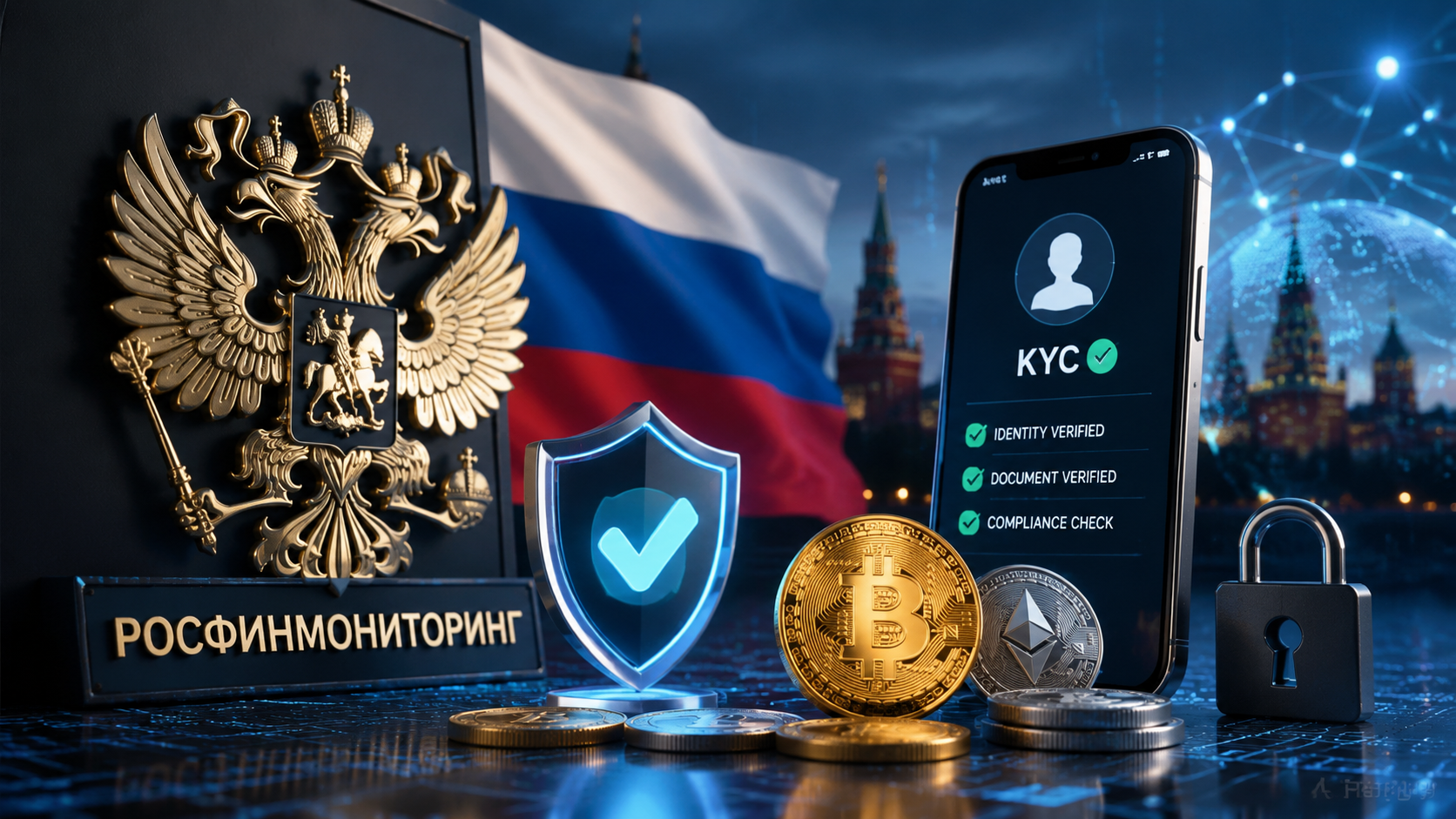
By 2026, Russia has effectively established a fully regulated crypto market model, where every digital asset transaction is subject to mandatory KYC identification and oversight by financial authorities. This means that cryptocurrency no longer functions as an anonymous instrument—it is now integrated into the banking and tax system.
The main goal of this new approach is to eliminate non-transparent transactions and reduce money laundering risks. Therefore, Rosfinmonitoring is strengthening oversight by combining data from banks, exchanges, and blockchain analytics into a unified monitoring system.
As a result, the market is split into legal KYC-compliant channels and illegal operations that are gradually being pushed out. In this system, identification requirements, transparency, and licensing of all participants in the crypto economy become key elements.
Why did KYC become mandatory for all crypto operations in Russia?
KYC became mandatory because the state integrated cryptocurrency into the financial control system under 115-FZ, where every transaction must have an identified owner.
Previously, the crypto market allowed P2P transactions and anonymous wallets, which created risks of mixing legal and illegal financial flows. This approach is now considered unacceptable for financial security.
The main reason for introducing KYC is to combat money laundering and the financing of illegal activities. Banks are required to verify the origin of funds, while crypto platforms must record user identities.
Additionally, international exchanges, including KuCoin, have introduced mandatory user verification, making KYC a global standard.
As a result, crypto transactions are no longer anonymous: every transaction is now linked to a specific individual through banking and digital identification.
How does Rosfinmonitoring control cryptocurrency transactions?
Rosfinmonitoring controls cryptocurrency transactions by integrating banking data, KYC databases, and blockchain analysis into a unified monitoring system.
The key tool is the “Transparent Blockchain” technology, which allows tracking crypto asset flows from the moment of purchase to fiat withdrawal. The system links crypto addresses to real individuals through banks and government services.
Control operates on three levels:
First, it analyzes banking transactions related to crypto purchases. Second, it tracks blockchain transactions. Third, it cross-references KYC data with tax and state registries.
This allows authorities to detect suspicious transaction chains even if they pass through multiple wallets or jurisdictions.
As a result, cryptocurrency becomes a fully observable financial instrument, and anonymity is almost eliminated.
What regulatory changes come into force in 2026–2027?
The main change is the transition from partial oversight to full legalization of the crypto market with criminal liability for violations.
Starting July 1, 2026, the use of licensed intermediaries becomes mandatory for all crypto transactions. Direct P2P deals without KYC are effectively pushed out of the legal framework.
Restrictions are also introduced for retail investors: transactions are only available after passing a test and within a set limit through licensed intermediaries.
Starting July 1, 2027, the second stage of reform begins—criminal liability for using illegal crypto infrastructure. Violations may result in severe penalties, including imprisonment.
Additionally, mining regulation is tightened: in several regions, restrictions are introduced due to energy constraints, making the industry more centralized.
How does the two-tier crypto market and the 300,000 ruble limit work?
The two-tier crypto market separates users into retail investors and participants in foreign economic activity (FEA).
For retail users, there is a limit: purchasing cryptocurrency through a single licensed intermediary is capped at around 300,000 rubles per year. A basic risk-awareness test is also required.
This level is designed to protect individual investors and prevent speculative risks.
The second level is foreign economic activity (FEA). It is intended for businesses that use cryptocurrency for international settlements.
Within FEA, a separate infrastructure operates where transactions are processed through licensed intermediaries and centralized digital asset accounting systems. Direct transfers between companies without identification are prohibited.
Thus, the market becomes structured: retail activity is restricted, while businesses gain a regulated channel for international operations.
How is the problem of bank account blocks under 115-FZ being solved?
The problem of account blocks is being solved by shifting from informal P2P to “white-listed” licensed crypto exchange channels.
Previously, users often faced bank account freezes due to suspicious transfers linked to P2P platforms. This was caused by “dirty” funds entering general payment flows.
Now a whitelist system is introduced. If a user exchanges crypto through licensed exchanges or registered brokers, such transactions are automatically recognized as safe.
Banks no longer block such operations because they have a transparent source of funds and a verified KYC profile.
At the same time, using unofficial channels significantly increases the risk of account freezes and financial monitoring checks.
How is full KYC implemented technically in the crypto system?
Full KYC is implemented through the integration of banking data, government registries, and blockchain analytics into a unified digital control system.
The foundation is the “Transparent Blockchain” system, which tracks all transactions in real time. It matches crypto addresses with users’ KYC profiles and bank accounts.
Technology uses artificial intelligence to detect suspicious patterns, including transaction splitting and multi-wallet transfer chains.
Every transaction is automatically checked for compliance with the user profile and source of funds.
As a result, a fully transparent system is created where cryptocurrency flows can be tracked at every stage—from purchase to withdrawal.
How does the foreign economic crypto framework (FEA) work?
The FEA crypto framework enables the use of cryptocurrency for international settlements within a strictly regulated system.
Starting in 2026, businesses are allowed to conduct cross-border payments using digital assets, but only through licensed intermediaries.
Direct transfers between companies or the use of unidentified wallets is prohibited. All transactions pass through a centralized digital repository where assets receive unique identifiers.
This allows the state to control currency flows while maintaining efficiency in foreign trade.
This model is especially important for imports, parallel imports, and international B2B settlements.
What risks arise from non-compliance with the new rules?
Non-compliance with the new rules leads to financial, administrative, and criminal consequences.
Key risks include bank account freezes, asset confiscation, and refusal of service by financial institutions.
Starting in 2027, illegal crypto operations may be classified as criminal offenses. This includes using uncertified platforms and bypassing licensed infrastructure.
There is also an increased risk of enhanced financial monitoring for any suspicious transactions.
Thus, the cost of non-compliance becomes significantly higher than the potential benefit of using illegal channels.
How to trade cryptocurrency on KuCoin under the new regulatory conditions?
Trading cryptocurrency on international platforms is possible only with KYC compliance and the use of legal fiat on/off-ramp channels.
The exchange KuCoin continues to serve users from Russia but requires mandatory identity verification.
Under the new conditions, users must:
-
complete KYC on the exchange
-
use licensed exchanges to deposit rubles
-
avoid informal P2P transactions
-
comply with limits and tax obligations
For active traders, KuCoin remains a gateway to global liquidity, but only within a fully transparent financial framework.
Thus, trading remains accessible but becomes significantly more regulated.
Conclusion
By 2026, Russia’s crypto market has transformed into a fully regulated financial system where mandatory KYC and Rosfinmonitoring oversight play a central role. Every digital asset transaction is now tied to user identification and recorded in state and banking systems.
The introduction of a two-tier market structure separates retail investors from businesses, creating distinct rules for retail transactions and international settlements. At the same time, control over P2P transactions is tightened and licensed exchange channels are introduced.
The technological backbone—“Transparent Blockchain”—enables full monitoring of crypto flows by linking blockchain addresses to real identities.
As a result, cryptocurrency is no longer an anonymous instrument but part of a regulated financial infrastructure. This reduces risks of illegal activity but also requires users to strictly comply with new rules and maintain full transparency in all operations.
FAQs
-
Is KYC mandatory for all crypto services in Russia?
Yes, all legal crypto platforms and exchanges are required to perform KYC for user identification.
-
Can foreign exchanges be used without verification?
Practically not, since fiat on/off-ramping requires KYC and transaction monitoring.
-
What happens if illegal P2P services are used?
There is a higher risk of account freezes and possible criminal liability for repeated violations.
-
Can small investments be made without restrictions?
No, retail investors are subject to an annual limit of about 300,000 rubles via licensed intermediaries.
-
How do banks treat legal crypto transactions?
Legal transactions through licensed exchanges are placed on a whitelist and do not trigger 115-FZ restrictions.