

SpaceX Drops 6.8% on Nasdaq-100 Inclusion Day: Why Index Additions Can Trigger Institutional Sell-Offs
2026/07/10 10:04:00
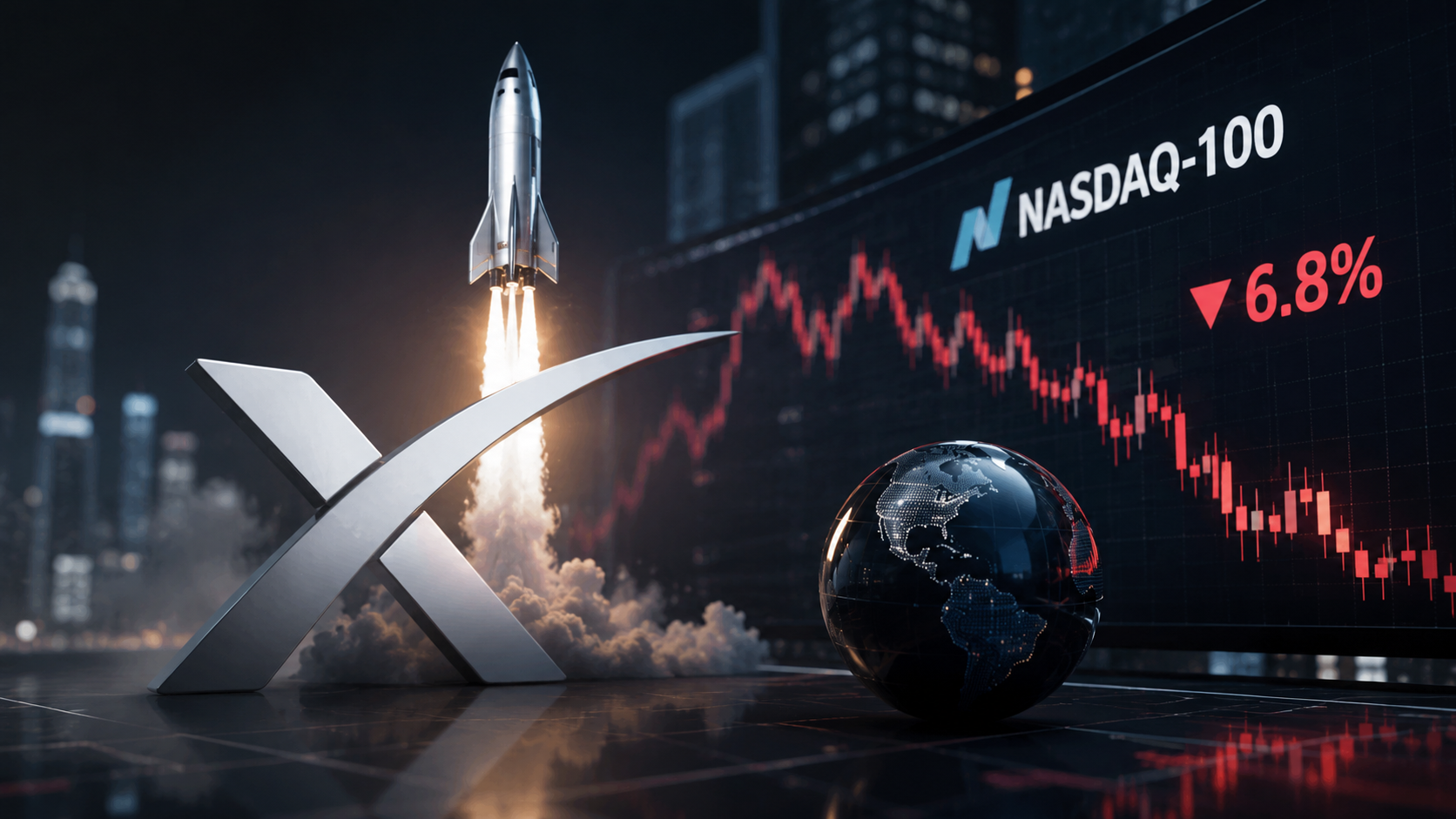
Could the largest initial public offering in stock market history suffer a major sell-off on the exact day it joins Wall Street's most prestigious tech index? This counterintuitive reality shocked the financial markets on July 7, 2026, when Space Exploration Technologies Corp (NASDAQ: SPCX) officially entered the Nasdaq-100 Index. Instead of experiencing an institutional buying surge, SpaceX shares tumbled 6.8% to close at $149.47, highlighting the immense friction between mechanical index tracking and short-term capital distribution. Understanding these complex institutional mechanics, index structural limits, and shifting macroeconomic realities is crucial for any market participant analyzing top-tier equities.
Key Takeaways
-
"Sell-the-News" Dynamics: Active institutional traders front-ran the Nasdaq-100 inclusion, using the $4.3 billion passive liquidity pool on July 7 to dump shares and lock in profits.
-
Free-Float Restrictions: Despite a total valuation near $2.0 trillion, SpaceX's low public float caps its index weight at under 1%, exposing it to high volatility without massive passive buffers.
-
S&P 500 Ineligibility: Due to strict twelve-month seasoning rules and GAAP net losses driven by its $1 billion monthly AI cash burn, SpaceX cannot join the S&P 500 until mid-2027 at the earliest.
-
Extreme Valuation Divide: Wall Street remains deeply fractured on SPCX, with bullish targets hitting $800 (valuing it as a frontier AI/space infrastructure play) and bearish targets dropping to $115 (citing high execution risk).
Why Did SpaceX Fall on Its First Day in the Nasdaq-100 Index?
The primary reason for the sharp price decline was a classic institutional "sell-the-news" event executed by active market participants. Based on historical capital flow structures, active institutional traders routinely front-run major index additions by accumulating shares weeks before the effective inclusion date. Once the inclusion date arrives, these early buyers utilize the massive, legally mandated liquidity pool provided by passive index-tracking funds to exit their positions and lock in early profits.
According to data compiled by J.P. Morgan in July 2026, SpaceX's fast-tracked inclusion into the Nasdaq-100 was projected to generate approximately $4.3 billion in automated, mandatory passive buying from exchange-traded funds (ETFs) and mutual funds tracking the index. Chief among these is the Invesco QQQ ETF, which had to absorb massive blocks of SPCX shares at the market close to match the index rebalancing parameters. Active hedge funds and momentum traders capitalized on this programmatic demand, aggressively distributing their shares directly into the passive inflows. This institutional profit-taking completely overwhelmed the index-driven buying pressure, forcing a rapid correction toward the primary $135 IPO price baseline.
Historical market data confirms that this post-inclusion pullback is a frequent structural occurrence rather than an isolated anomaly. According to a market behavior report published by MarketPulse in July 2026, previous high-profile, fast-tracked additions to the Nasdaq-100 index—such as Palantir Technologies—experienced systematic medium-term drawdowns of 15% to 23% immediately following their inclusion dates. This historical precedent illustrates that initial public offering (IPO) momentum and passive index rebalancing frequently mark local peaks in valuation, as speculative liquidity gives way to baseline market float mechanics.
How Does Free-Float Structure Cap SpaceX's Nasdaq-100 Weight?
SpaceX commands a massive total market capitalization approaching $2.0 trillion, yet its actual structural weight inside the Nasdaq-100 index is strictly constrained to less than 1%. This dramatic reduction exists because index providers calculate asset weighting based on free-float adjusted market capitalization rather than total outstanding equity value. The vast majority of SpaceX equity remains tightly held by founder Elon Musk via super-voting Class B insider stock and early venture capital partners, leaving only a small percentage of Class A shares floating in public markets.
According to index methodology sheets updated by Nasdaq in July 2026, the exchange modifies its core tech index weighting by applying strict limits that restrict a constituent's index presence to a maximum of three times its float-adjusted market capital. Consequently, for index calculation purposes, Wall Street treating vehicles treat SpaceX as a $300 billion entity rather than a $2.0 trillion mega-cap powerhouse. This regulatory adjustment is summarized below to illustrate the variance between gross valuation and index-effective capitalization:
| Capitalization Metric | Nominal Value | Index Operational Value | Effective Index Weight |
| SpaceX (SPCX) Equity | ~$1.98 Trillion | ~$300 Billion | < 1.00% |
| NVIDIA (NVDA) | ~$3.10 Trillion | ~$3.10 Trillion | ~8.69% |
| Apple (AAPL) | ~$3.25 Trillion | ~$3.25 Trillion | ~7.64% |
This restricted weighting means that while major passive instruments like the Invesco QQQ Trust must allocate capital to SpaceX, the asset's daily price swings will not single-handedly dictate the direction of the broader tech index. Instead, it exposes the stock to high-volume passive turnover without granting it the defensive, multi-billion dollar continuous allocation buffer enjoyed by structural giants like NVIDIA or Apple.
Why Is SpaceX Barred From Entering the S&P 500 Index?
SpaceX is entirely ineligible to join the S&P 500 Index until mid-2027 at the absolute earliest due to rigid regulatory frameworks maintained by S&P Dow Jones Indices. While the Nasdaq selection committee relaxed traditional seasoning rules to fast-track SpaceX into its core index directly after its historic June 12, 2026 public listing, S&P Dow Jones executives explicitly declined to alter their structural mandates.
According to an equity index strategy brief published by Dow Jones on July 7, 2026, any newly listed company must trade on a public exchange for a minimum continuous period of one full calendar year before it can be considered for S&P 500 inclusion. This structural rule builds a forced twelve-month delay that completely insulates S&P 500 capital pools from the typical extreme price discovery cycles common to early-stage IPOs.
Beyond basic listing duration constraints, SpaceX faces severe fundamental hurdles regarding the S&P 500's strict GAAP profitability mandates. According to financial accounting disclosures analyzed by the Wall Street Journal, the S&P 500 index selection committee requires that the sum of a company’s most recent four consecutive quarters of earnings—as well as its most recent individual quarter—must be thoroughly positive.
SpaceX operates under a deeply split financial model that fails this test due to heavy capital expenditure burns. The core business segments are broken down as follows:
-
Launch Services: The long-standing Falcon 9 and Falcon Heavy lines generate reliable, multi-billion dollar cash flows via commercial satellite contracts and NASA payloads.
-
Starlink Satellites: This high-margin subscription network generated the majority of the firm's $15.6 billion revenue in 2025, supported by 9 million global paying subscribers.
-
SpaceXAI Division: Following the total all-stock absorption of xAI in February 2026, this artificial intelligence cluster is burning roughly $1 billion per month in computing clusters and model development, dragging the consolidated entity into a net GAAP loss.
Because the multi-billion dollar AI capital expenditure burn cancels out the positive cash flows produced by Starlink and global launch services, SpaceX remains fundamentally unable to meet the S&P 500 eligibility criteria. This creates a massive divergence in volatility tracking between major stock indexes.
Why Are Wall Street Analysts Deeply Divided on SpaceX's Valuation?
The end of the post-IPO quiet period in July 2026 unleashed a massive wave of initiation reports from primary underwriters and independent analysts, revealing an unprecedented valuation divide across Wall Street. The equity core trades at a highly demanding valuation exceeding 115 times its trailing sales while simultaneously posting consolidated GAAP net losses. This extreme structural profile forces analysts to choose between valuing the firm as a traditional aerospace infrastructure operator or as a speculative, frontier artificial intelligence compute ecosystem.
According to analyst consensus updates tracking the SPCX ticker in July 2026, the target estimates span a wild spread of hundreds of dollars, ranging from a highly bullish $800 target by Raymond James down to a deeply bearish $115 target issued by CFRA Research. Lead underwriters like Morgan Stanley maintain an optimistic $300 target—viewing the firm as the ultimate AI infrastructure play—while Goldman Sachs sits more conservatively in the middle with a target price of $205.
The Institutional Bull Case
Firms like Raymond James and Morgan Stanley view SpaceX through a non-traditional tech lens, modeling it as the definitive infrastructure play for the global digital economy. Their financial models heavily weight the long-term compounding power of the Starlink network and the commercial development of the Starship program. Underwriter research treats the integrated SpaceXAI segment as a core competitive advantage, arguing that owning massive orbital data center constellations will allow the company to capture a dominant share of global AI infrastructure processing.
The Institutional Bear Case
Conversely, fundamental research firms like CFRA maintain a highly defensive Sell rating with an explicit price target of $115, a level significantly below the initial $135 IPO price line. Analysts taking this stance point out that trading at 115x trailing revenue leaves zero margin of safety for operational delays, launch failures, or macro-driven tightening of financial conditions. These bears argue that the massive $12 billion annual capital expenditure burn rate required by the SpaceXAI model expansion presents an unsustainable drag on corporate profitability that retail momentum traders are systematically ignoring.
Should You Trade the SpaceX (SPCX) Market Trend on KuCoin?
Trading a high-volatility, historic corporate listing like SpaceX requires accessing institutional-grade financial tools that can capitalize on both sharp upward expansions and steep market pullbacks. KuCoin delivers a comprehensive trading infrastructure specifically designed to navigate extreme post-IPO price discoveries like the one currently impacting SPCX. By utilizing KuCoin's advanced spot matching engines, deep liquidity pools, and flexible derivatives products, market participants can execute precise strategies around major corporate events without encountering the strict capital lockups typical of legacy traditional finance brokerages.
Whether your strategy focuses on trading short-term "sell-the-news" rebalancing pullbacks using inverse instruments, or accumulating baseline positions as the equity tests its foundational $135 IPO price, KuCoin provides the precise tools needed for execution. Traders can deploy automated KuCoin Trading Bots to capture programmatic profits within volatile price ranges, or access leverage profiles to maximize exposure efficiency across shifting trends. Take command of major global market transformations—create your verified account on KuCoin today to seamlessly trade the cutting-edge intersection of blockchain, technology, and space exploration infrastructure.
Conclusion
The dramatic 6.8% sell-off of SpaceX on its official Nasdaq-100 inclusion day serves as an important lesson in structural market mechanics versus retail market hype. While the fast-tracked addition successfully triggered over $4.3 billion in programmatic passive buying from major index-tracking funds, it simultaneously created a perfect liquidity exit window for sophisticated institutional players to distribute shares and realize early profits. This classic "sell-the-news" rebalancing correction pulled the stock down to $149.47, highlighting the volatile nature of early post-IPO price discovery phases.
Moving forward, SpaceX's market valuation will be driven by fundamental corporate execution rather than index inclusion mechanics. Because the company remains strictly barred from entering the S&P 500 index due to mandatory seasoning timelines and GAAP net losses driven by its $1 billion monthly AI cash burn, it will continue to experience independent, tech-heavy volatility loops. Traders and long-term investors must carefully weigh the massive bullish projections of space-based infrastructure against the stark, high-multiple revenue realities noted by conservative market analysts.
FAQs
What does "sell-the-news" mean in institutional stock index rebalancing?
It describes a market dynamic where active investors buy an asset weeks ahead of an anticipated, positive structural event—such as index inclusion—and then deliberately sell their accumulated positions directly into the massive, automated buying pools provided by passive funds on the actual day the event goes live.
What is the exact difference between total market cap and free-float market cap?
Total market cap reflects the absolute dollar value of all outstanding shares issued by a company, whereas free-float market cap excludes locked insider equity and strategic holdings, tracking only the specific portion of shares actively available for public trading on open stock exchanges.
Why do corporate mergers often temporarily hurt a company's GAAP profitability metrics?
Mergers frequently cause severe near-term drops in Generally Accepted Accounting Principles (GAAP) profitability because the acquiring company must fully absorb the target firm's operational debts, cash burn rates, and ongoing capital expenditures directly onto its consolidated income statement.
What is the primary purpose of an IPO quiet period mandated by financial regulators?
The quiet period is a legally enforced timeframe directly following a public listing during which the company's executives, insiders, and underwriting investment banks are strictly prohibited from publishing research reports or making promotional statements to prevent artificial asset inflation.
How does an index seasoning rule help stabilize major retirement benchmarks?
A seasoning rule forces a newly public stock to trade transparently on open markets for a set period—such as one full year—before it becomes eligible for index inclusion, ensuring the benchmark filters out hyper-volatile, unproven listings before they can impact passive institutional wealth pools.