

How Can DeFi Protocols Balance Compliance, Privacy, and Self-Custody?
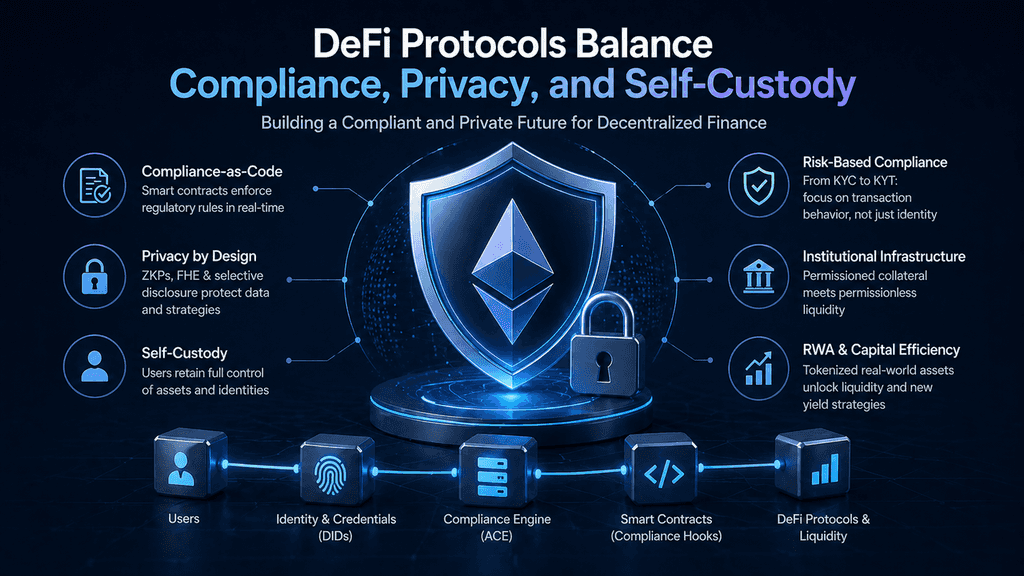
The rapid maturation of decentralized finance in 2026 has forced a critical confrontation between institutional adoption and the core ethos of blockchain technology. As global regulatory frameworks like MiCA and the GENIUS Act take full effect, the industry is racing to answer a fundamental question: How can DeFi protocols balance compliance, privacy, and self-custody without compromising the permissionless nature of Web3?
The following exploration details the shift from reactive oversight to proactive cryptographic guardrails, demonstrating how modern DeFi protocols balance compliance, privacy, and self-custody through innovative "Compliance-as-Code" architectures.
Key Takeaways: The Institutional Pivot Toward Decentralized Compliance
As the market transitions from retail-driven speculation to institutional-led momentum, the definition of success in DeFi has fundamentally changed. Large-scale capital allocators no longer view decentralization as a hurdle, but rather as an opportunity for better risk management—provided the right infrastructure exists.
-
Risk-Based KYC: Compliance is shifting from "Knowing the Customer" (Identity) to "Knowing the Transaction" (Behavior).
-
Cryptographic Privacy: Technologies like FHE and ZKPs allow institutions to protect proprietary strategies while remaining auditable.
-
Programmable Compliance: Regulatory rules are being embedded directly into smart contracts via "hooks," ensuring real-time enforcement.
-
The RWA Multiplier: Real-world assets (RWAs) are becoming the primary collateral for institutional DeFi, requiring sophisticated composability layers.
The Compliance-as-Code Revolution: Why Traditional Models are Obsolete
The legacy financial system was built on a foundation of centralized intermediaries who act as gatekeepers. In contrast, DeFi is built on code that executes autonomously. Attempting to overlay 20th-century manual reporting requirements onto 21st-century automated protocols creates friction that neither regulators nor users can sustain.
The Speed Mismatch: Why Legacy T+2 Settlement Can't Survive Blockchain Finality
In traditional finance, the T+2 settlement window provides a "safety buffer" where errors can be corrected or illicit transactions manually reversed by bank managers. Blockchain transactions, however, achieve settlement finality in seconds. If a compliance check occurs after a block is confirmed, the funds have likely already been moved through cross-chain bridges. To solve this, protocols must adopt real-time, automated screening that triggers before a transaction is included in a block.
Beyond Identity: Shifting from KYC to Risk-Based "Know Your Transaction" (KYT)
The industry is moving away from the "passport-upload" model, which is prone to data leaks and excludes the unbanked. Instead, DeFi protocols balance compliance, privacy, and self-custody by focusing on on-chain behavior. Using advanced analytics, protocols can determine if a wallet has interacted with sanctioned addresses or mixers like Tornado Cash. This behavior-based approach maintains user anonymity while effectively blocking illicit fund flows.
Avoiding the "Honey Pot": Why On-Chain Privacy is a Prerequisite for Institutional Entry
Institutions cannot function in a glass-box environment where competitors can see every trade and portfolio rebalance. Public transparency, once touted as a feature, is an operational risk for a hedge fund. Without on-chain privacy, institutions face "front-running" and "liquidation sniping." Decentralized compliance must therefore decouple the verification of a user's eligibility from the disclosure of their identity.
Technical Pillars: Innovative Ways DeFi Protocols Balance Compliance, Privacy, and Self-Custody
The technical stack enabling this balance is composed of three distinct cryptographic layers. Each layer addresses a specific pain point in the trilemma.
Privacy Layers: Using Fully Homomorphic Encryption (FHE) for Confidential Trading
Fully Homomorphic Encryption (FHE) is often called the "holy grail" of cryptography. It allows smart contracts to perform computations on encrypted data without ever decrypting it. For example, a protocol can execute a swap or calculate interest on a loan while the actual asset types and amounts remain hidden from everyone—including the protocol developers themselves. This ensures that sensitive information remains confidential, satisfying institutional needs for operational security.
Selective Disclosure: Balancing Public Transparency with Shareable Viewing Keys
Privacy does not mean total opacity. Selective disclosure mechanisms, such as those used in "Shareable Viewing Keys," allow users to remain private by default while granting "read-only" access to specific transaction histories for auditors or tax authorities. This creates an auditable trail that satisfies the "Travel Rule" without exposing the user to the general public.
Decentralized Identifiers (DIDs): Giving Users Sovereignty Over Their Credentials
Self-custody extends beyond tokens to include identity. DIDs allow users to hold "Verifiable Credentials" in their own wallets. A user can prove they are a "Verified Accredited Investor" or "Non-Sanctioned User" by presenting a cryptographic proof from a trusted issuer, without ever revealing their name or passport number to the DeFi protocol.
Institutional Infrastructure: Bridging TradFi Standards with DeFi Innovation
Infrastructure providers are now building "safe harbors" for capital that require a higher degree of certainty than the typical "wild west" DeFi pool.
Permissioned Collateral + Permissionless Liquidity: Lessons from Aave Horizon
Aave Horizon serves as a prime example of how DeFi protocols balance compliance, privacy, and self-custody. By creating a licensed, separate instance of the Aave protocol, institutions can supply permissioned assets (like tokenized Treasury bills) as collateral. While the collateral is restricted to approved participants, the liquidity (such as stablecoin borrowing) remains permissionless. This hybrid model allows regulated entities to participate in DeFi without being exposed to unverified counterparties.
Automated Compliance Engines (ACE): Real-Time Screening and Policy Enforcement
Platforms like Chainlink’s Automated Compliance Engine (ACE) act as a middleware layer. They handle identity verification, asset-source screening, and transaction eligibility in real-time. If a transaction violates a specific policy—such as a user from a sanctioned jurisdiction attempting to borrow—the engine prevents the smart contract from executing the trade.
Private Proofs of Innocence (PPOI): Cryptographically Proving Clean Funds
Protocol-level tools like PPOI allow users to prove that their funds have no link to known hacks or blacklisted addresses. This is done via zero-knowledge proofs (ZKP), where the user provides a "proof of non-membership" in a set of illicit addresses. This ensures that the protocol remains a "clean" environment for institutions without requiring users to sacrifice their entire transaction history.
The Future of Real-World Assets (RWA): Composability and Capital Efficiency
The true potential of DeFi lies in its ability to turn static real-world assets into programmable, liquid capital. In 2026, RWA tokenization has moved beyond simple representation to active utility.
Turning Static Tokens into Productive Assets: Universal Collateralization
In the past, tokenized gold or real estate sat idle in wallets. Today, universal collateralization protocols allow these tokens to be "pledged" as collateral for minting yield-bearing stablecoins. This allows a user to maintain exposure to a traditional asset (like a stock or property) while simultaneously deploying the value of that asset into DeFi yield strategies.
Granular Hedging: Trading Yield Components and Stripping RWA Interest
Advanced protocols like Pendle have introduced the concept of "yield stripping" to RWAs. Institutions can now separate a tokenized Treasury bill into its Principal Token (PT) and its Yield Token (YT). This allows for highly granular hedging strategies where a fund can lock in a fixed rate of return or speculate purely on the interest rate fluctuations of a government bond, all within a decentralized framework.
Ignoring the shift toward compliance is no longer an option for serious protocol developers. The risks of non-compliance have moved from theoretical legal threats to tangible infrastructure roadblocks.
Infrastructure Isolation: How Stablecoin Blacklists and Bridge Restrictions Stifle Growth
Non-compliant protocols increasingly find themselves isolated. Major stablecoin issuers (like Circle or Tether) and cross-chain bridges often blacklist addresses associated with protocols that lack AML controls. Without access to liquid stablecoins or the ability to move assets across chains, a protocol’s liquidity eventually dries up, leading to a slow "economic death."
Front-End Accountability: The Shift in Regulatory Focus Toward User Interfaces
Regulators are increasingly targeting the "gateways" to DeFi. Even if a smart contract is decentralized, the website (front-end) used to access it is often managed by a legal entity. Protocols are now implementing compliance checks at the interface level, using geofencing and wallet screening to ensure they do not facilitate trades for sanctioned individuals.
Conclusion
The evolution of the blockchain industry has reached a turning point where DeFi protocols balance compliance, privacy, and self-custody not as a compromise, but as a standard for long-term viability. By leveraging Zero-Knowledge Proofs, Decentralized Identifiers, and real-time on-chain screening, the ecosystem has proven that regulatory oversight does not have to mean the end of financial sovereignty. As institutional capital continues to pour into tokenized RWAs and permissioned liquidity pools, the protocols that prioritize these cryptographic guardrails will be the ones that define the next decade of global finance.
FAQ:
Q: Can a protocol be fully compliant and still respect self-custody?
A: Yes. By using "Compliance-as-Code," protocols can enforce rules via smart contracts while the user retains sole ownership of their private keys and assets at all times.
Q: Does KYC in DeFi mean my personal data is stored on the blockchain?
A: No. Modern DeFi protocols use Zero-Knowledge Proofs to verify you are a "qualified user" without ever storing or revealing your specific identity data on the public ledger.
Q: How do DeFi protocols balance compliance, privacy, and self-custody for institutional users?
A: They utilize private sub-networks, FHE for confidential calculations, and selective disclosure keys to ensure trade secrets are protected while maintaining a regulatory audit trail.
Q: What happens if a protocol ignores AML/KYC requirements in 2026?
A: Non-compliant protocols face "infrastructure isolation," where stablecoin issuers and bridges may blacklist their addresses, effectively cutting off their access to the broader liquidity of the crypto market.
Q: What is the role of RWAs in the balance of DeFi compliance?
A: RWAs require strict legal ownership proofs. Protocols bridge this by using "Permissioned Collateral" layers that verify asset ownership before allowing them to be used in "Permissionless Liquidity" pools.