

Kimi K3 Release: Is This the DeepSeek 2.0 Moment for US Stocks and Crypto Markets?
2026/07/20 11:01:00
Introduction
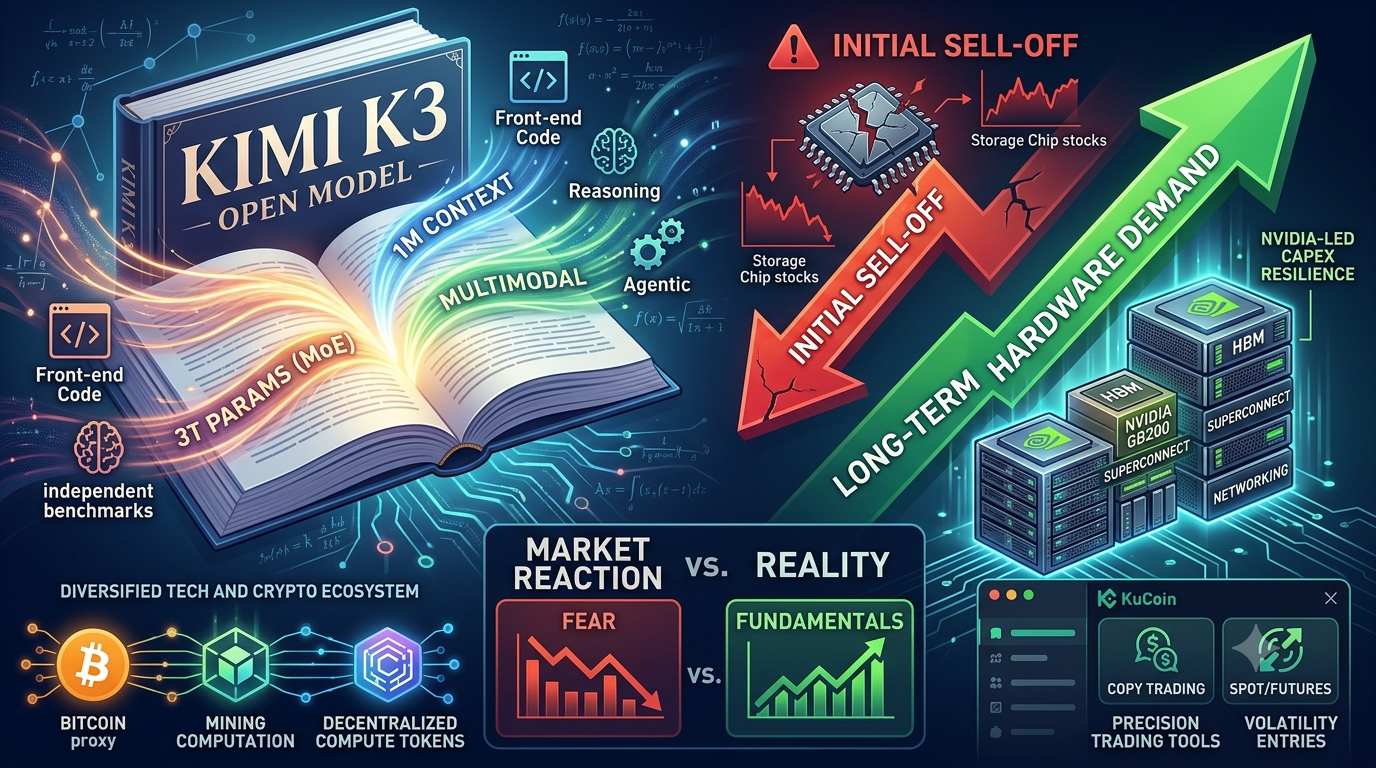
Kimi K3, Moonshot AI’s 2.8-trillion-parameter open model released on July 16-17, 2026, has already sparked immediate market jitters. Storage chip stocks weakened post-release, with broader semiconductor weakness echoing fears of another valuation reset similar to DeepSeek’s 2025 impact.
What Is Kimi K3 and Why Does It Matter?
Kimi K3 stands as the world’s largest open 3T-class model with strong frontier capabilities. Moonshot AI launched it with 2.8 trillion total parameters in a Mixture-of-Experts (MoE) architecture (16 of 896 experts active), a 1-million-token context window, and native multimodal support for text, images, and video.
It tops independent benchmarks in areas like front-end coding (Arena leaderboard) and delivers competitive scores on reasoning and agentic tasks. Artificial Analysis gave it an Intelligence Index of 57, ahead of Claude Opus 4.8 and near Claude Fable 5 and GPT-5.6 Sol. API pricing sits at $3/$0.30 (cache-hit) input and $15 output per million tokens — roughly half the task cost of Claude Opus 4.8.
Market Reaction: Immediate Sell-Off vs. Long-Term Fundamentals
Initial market reaction mirrored DeepSeek fears but proved short-lived for hardware leaders. On July 18, 2026, semiconductor stocks sold off globally. Asian indices dropped sharply (Taiwan >6%, Japan ~4%), while the Nasdaq fell ~1.5%. Memory-related names and some Chinese AI firms saw steeper declines.
Investors worried that a high-performing, lower-cost open model could reduce hyperscaler spending on proprietary infrastructure. Bitcoin also dipped below $64K amid broader risk-off sentiment.
However, this overlooks Kimi K3’s actual compute demands. The model’s 1.5TB+ HBM requirement for weights, plus significant KV cache offloading to CPU/DDR5 and NVMe in real deployments, leaves little headroom. Moonshot recommends at least 64-chip supernode clusters for efficient inference — aligning directly with NVIDIA’s GB200/GB300 NVL72 rack-scale systems.
SemiAnalysis View: Why Kimi K3 Strengthens NVIDIA and AI Hardware Demand
Kimi K3’s scale reinforces demand for premium AI hardware rather than commoditizing it. SemiAnalysis analysis (post-July 17, 2026) highlights that even with efficient architecture (Kimi Delta Attention and Attention Residuals for faster decoding and ~25% better training efficiency), the model’s size drives needs for high-bandwidth memory, interconnects, and large-scale clusters.
Linear attention misconceptions led some to expect GPU demand erosion. In reality, lower inference costs from efficiency gains expand application adoption, increasing overall GPU, HBM, DRAM, and networking consumption over time. This dynamic supports sustained capex cycles for leaders like NVIDIA.
Recent data backs hardware resilience: NVIDIA’s data center revenue continues strong growth, with Blackwell ramping and HBM shortages persisting into late 2026. Memory market projections reach $1.09T–$1.52T in coming periods, driven by AI servers.
Implications for Crypto Markets and AI Narrative
Crypto remains sensitive to AI sentiment because Bitcoin and altcoins often trade as high-beta proxies for tech growth and risk appetite. A “DeepSeek 2.0” repeat could pressure prices short-term through risk-off flows. However, confirmation that frontier models still require massive GPU/HBM investment supports the long-term AI infrastructure thesis — positive for crypto miners, data center plays, and tokens tied to decentralized compute.
Traders should watch NVIDIA earnings, HBM supply updates, and hyperscaler capex guidance for directional cues. Volatility around AI releases creates both risks and entries.
Should You Trade Crypto or US Stocks on KuCoin During AI-Driven Volatility?
KuCoin’s tools help you navigate AI news impacts on crypto with precision. The platform offers copy trading to follow experienced traders positioning around tech events, spot and futures markets for quick reactions to stock-crypto correlations, and advanced charting for monitoring Bitcoin or NVIDIA futures.
If you worry about the recent volatility, you may resort to KuCoin's copytrading hub or TraderPro campaign, to follow other lead traders' strategies, or register as the lead traders.

Conclusion
Kimi K3 represents a major step in open AI development, delivering impressive scale and performance without repeating the DeepSeek-induced valuation destruction. Its hardware requirements — massive HBM footprints, large inference clusters, and efficiency that drives broader adoption — point to continued strong demand for NVIDIA GPUs, memory, and related infrastructure.
Initial market jitters reflect familiar fears, but analyst consensus and deployment realities suggest a net positive for the AI supply chain. For crypto traders, this means monitoring short-term volatility while recognizing the longer-term bullish setup for compute-intensive narratives.
The AI race accelerates, with Chinese innovation pushing boundaries and global infrastructure needs expanding. Smart positioning on platforms like KuCoin allows participation in both the technology upside and the market swings it creates. Stay informed, manage risk, and focus on the fundamental compute demand that underpins the entire ecosystem.
FAQs
Will Kimi K3 replace NVIDIA GPUs?
No. Its size and recommended 64+ chip deployments increase demand for high-end NVIDIA systems like GB200 NVL72.
How does Kimi K3 pricing compare to US models?
It costs roughly half per task versus Claude Opus 4.8 while approaching Fable 5 and GPT-5.6 Sol performance.
What should traders watch next?
NVIDIA earnings, HBM supply data, hyperscaler capex, and any follow-on Chinese model releases for ongoing volatility signals.