

Warren Buffett's Record $397 Billion Cash Hoard: Is a 2026 Market Crash Coming?
2026/05/05 16:18:02
Introduction
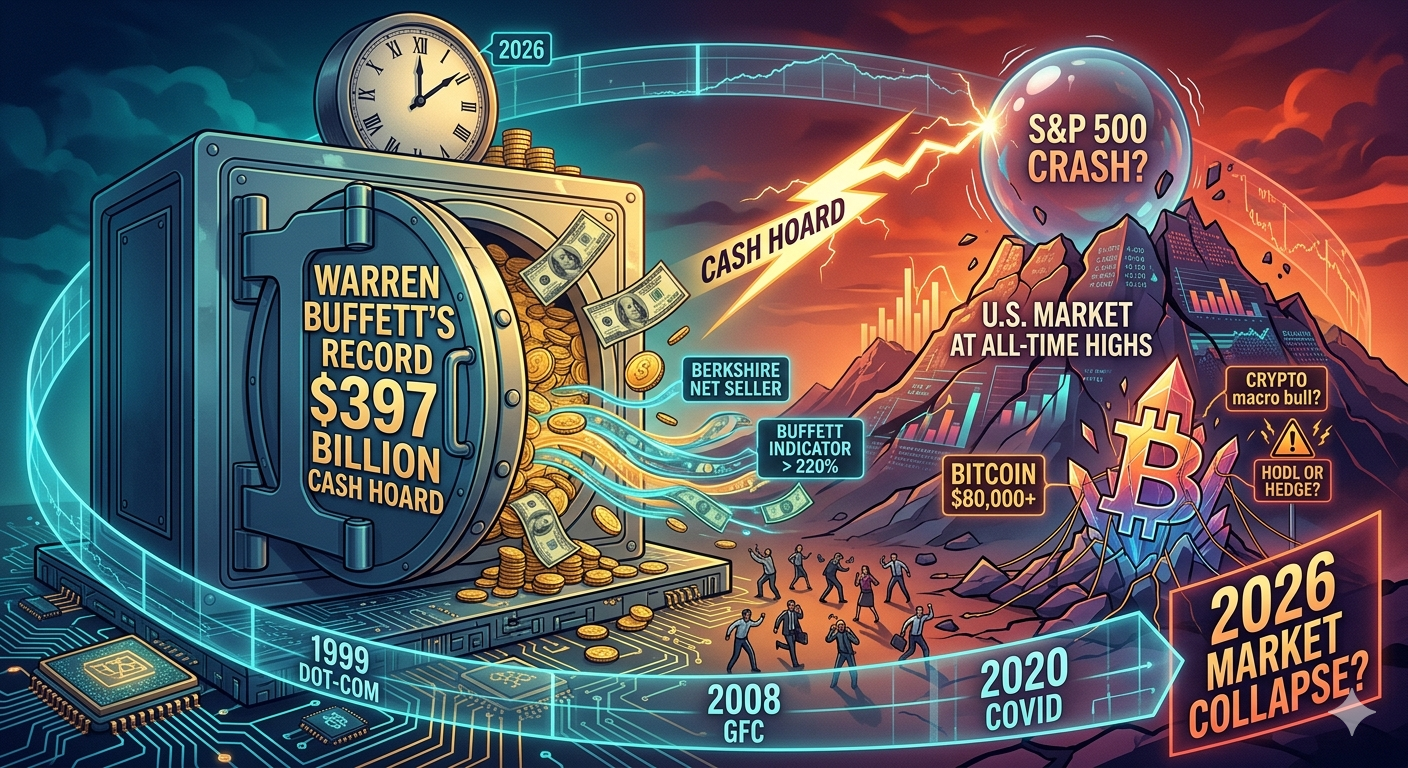
U.S. equities are trading near all-time highs and Bitcoin has reclaimed $80,000 on May 5, 2026, yet Berkshire Hathaway holds a record $397 billion in cash while selling stocks for the 14th consecutive quarter. History shows this pattern is not a coincidence. When Buffett accumulates cash at this scale, major dislocations tend to follow.
This article examines whether Buffett is front-running a crash, what his caution means for crypto, and how to position when valuations offer no margin of safety.
For readers looking to act on these signals:
-
"How to Diversify Portfolio Between Crypto and Stocks" offers practical frameworks for balancing traditional and digital assets.
-
"Stocks Hit ATH: Is Crypto Entering a Macro Bull Market?" analyzes cross-asset correlations and cycle positioning.
-
"Bear Market in Stocks" provides historical context for equity downturns and recovery patterns.
How Much Cash Does Berkshire Hathaway Hold Right Now?
Berkshire Hathaway holds $397.38 billion in cash and cash equivalents as of March 31, 2026, a new all-time record that surpasses the previous high of roughly $373 billion at the end of 2025. The conglomerate added to this pile by selling $24.09 billion in equity securities during the first quarter while purchasing only $15.94 billion, continuing a net-selling streak that has now persisted for over three years. Operating earnings surged nearly 18% year-over-year to $11.35 billion in Q1 2026, driven largely by a rebound in insurance underwriting profits.
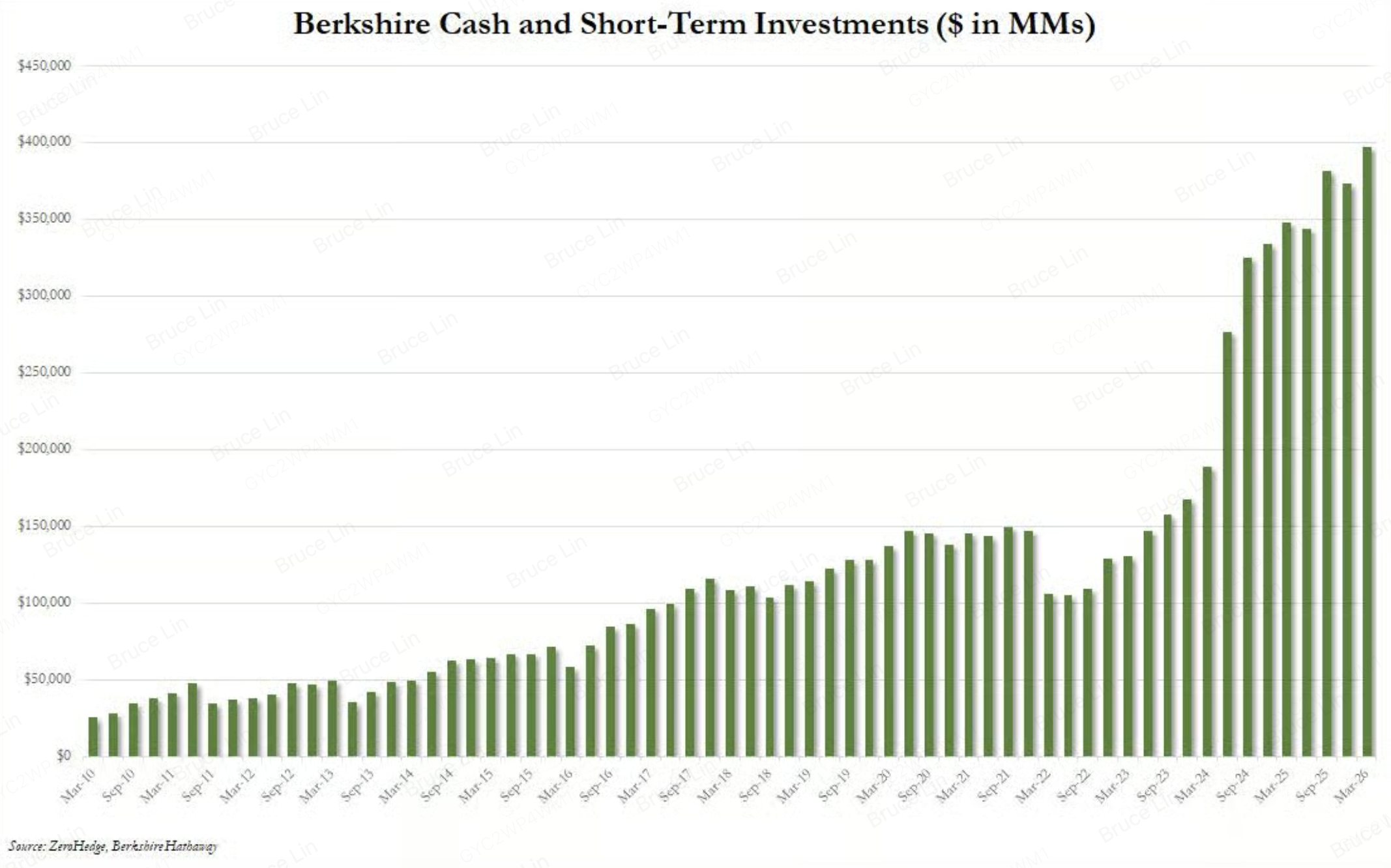
Even under new CEO Greg Abel, who formally took the reins from Buffett at the end of 2025, the capital allocation strategy has not changed. Abel told shareholders at the May 2026 annual meeting that he sees a "unique opportunity" for Berkshire's core businesses, but he did not announce any major acquisitions or equity deployments. The cash reserve now represents more than 30% of Berkshire's total assets, the highest proportion in at least three decades.
What Happened to the Last Three Times Buffett's Cash Hit Records?
Buffett's cash pile has reached record levels three times in the past three decades, and each episode preceded a major market collapse. The pattern is not proof of causation, but the correlation is striking.
In 1999, Berkshire's cash position swelled just before the dot-com crash, when the Nasdaq Composite subsequently fell 78% over the next two years.
In 2007, cash climbed to fresh highs alongside accelerated stock sales, and Buffett later deployed $80 billion into Goldman Sachs and General Electric at distressed prices during the 2008 Global Financial Crisis.
In 2019, cash touched $128 billion, then the largest reserve in company history, only months before the COVID-19 flash crash of March 2020.
The current $397 billion cash position is roughly triple the 2019 peak, implying that if history rhymes, the resulting dislocation could be proportionally deeper. The table below summarizes the sequence.
|
Period
|
Cash Level (Approx.)
|
Subsequent Event
|
Market Outcome
|
|
1999
|
Record high
|
Dot-com bubble burst
|
Nasdaq -78% (2000–2002)
|
|
2007
|
Record high + net selling
|
2008 GFC
|
S&P 500 -57% (2007–2009)
|
|
2019
|
$128 billion
|
COVID-19 crash
|
S&P 500 -34% (Feb–Mar 2020)
|
|
2026
|
$397 billion
|
Unknown
|
To be determined
|
The 2026 figure is unprecedented not only in absolute dollars but also as a percentage of Berkshire's asset base. Each prior instance delivered Buffett the dry powder to buy world-class assets at panic prices. The question today is whether he is once again waiting for the market to come to him.
Why Is Buffett's Cash Hoard Viewed as a Leading Indicator for Market Tops?
Market participants treat Berkshire's rising cash balance as a warning signal because it reflects Buffett's core investment discipline: buy when others are fearful and wait when others are greedy. When the world's most closely watched value investor cannot find assets trading below their intrinsic value, it usually means the broader market is overpriced and risk is accumulating.
Buffett has described the current environment as a "church with a casino attached," noting that more participants are behaving like gamblers than investors. At the 2026 annual meeting, he pointed to the explosion of one-day options and prediction markets as evidence that speculation has overtaken investing. He stated that the world has never seen people in more of a gambling mood than now. According to Watcher Guru, the Buffett Indicator, which measures total US market capitalization against GDP, stood at approximately 227% in early May 2026. Buffett has previously called readings above 200% "playing with fire," which means current valuations sit deep in the danger zone.
The cash accumulation also signals liquidity risk management. Berkshire's insurance and utility operations generate massive cash flows that must be reinvested, yet the firm has chosen to earn modest returns on cash and Treasuries rather than accept inflated equity prices. Abel confirmed this defensive posture at the annual meeting, stating that Berkshire will not force capital into overvalued assets simply because the money is available. This discipline is rare in bull markets, where most managers feel pressure to stay fully invested and benchmarked to rising indices. When Berkshire chooses liquidity over returns, it implies that the risk-reward balance across public markets has turned unfavorable. The conglomerate's $397 billion war chest is essentially a loaded gun aimed at the next dislocation.
Will Bitcoin Price Fall Again?
Bitcoin reclaimed the $80,000 level in early May 2026 for the first time since late January. The move was supported by $630 million in US spot Bitcoin ETF inflows on May 1 and a monthly April total of $1.97 billion, the highest of 2026. Price action has improved dramatically from the February lows near $60,000, creating a sharp split between bulls and bears.
Bulls argue that institutional treasury adoption, led by firms like MicroStrategy, has created a durable demand floor that did not exist in previous cycles. They contend that the $60,000 zone may have marked the bottom of this bear market cycle, supported by eight consecutive days of ETF inflows totaling $2.1 billion through late April.
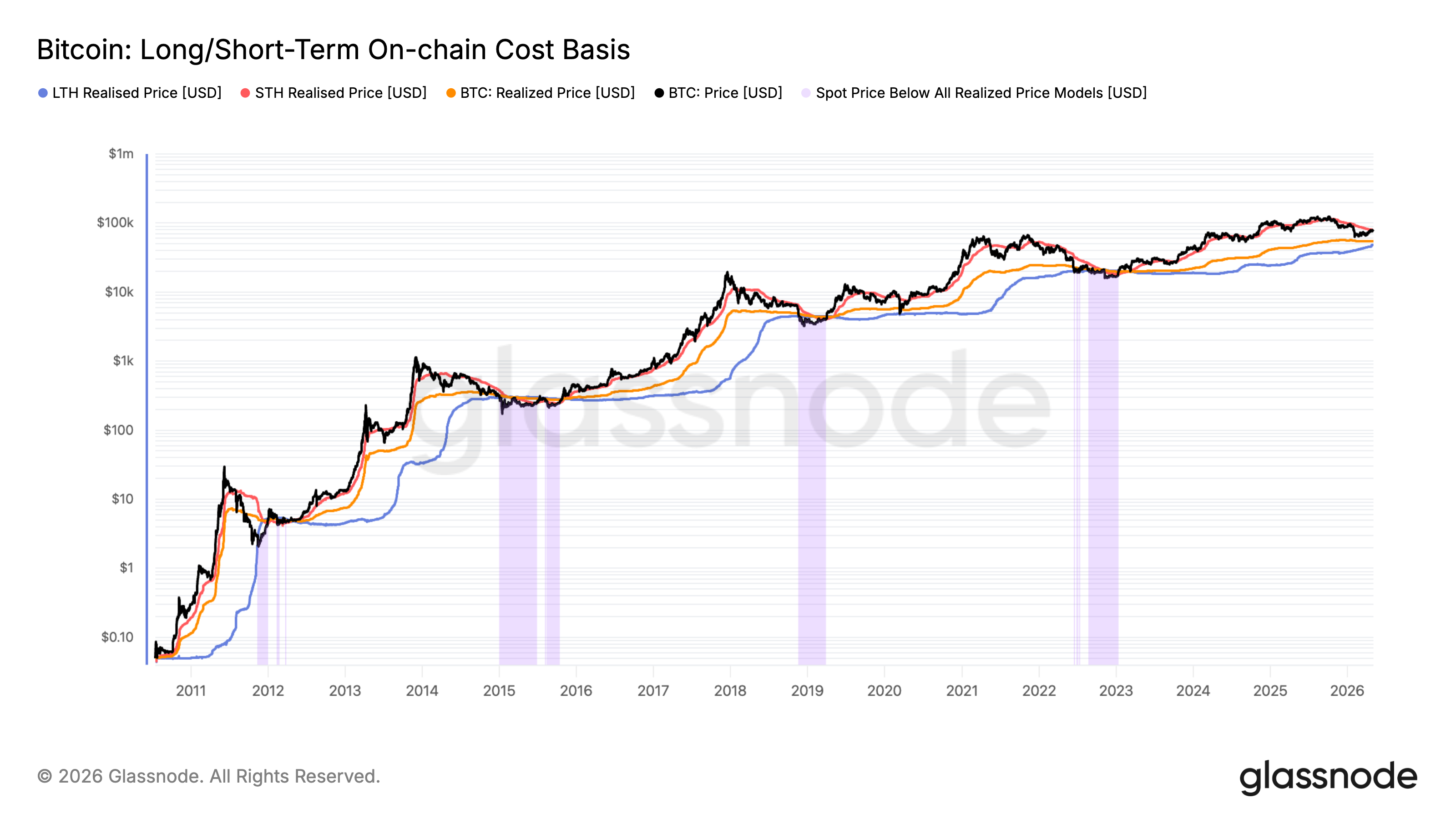
Bears counter that Bitcoin has historically broken below the long-term holder cost basis at least once per four-year cycle. According to Glassnode data, the current long-term holder cost basis sits near $48,000. Previous cycles saw Bitcoin fall below this metric during drawdowns, and skeptics believe a retest of sub-$50,000 levels remains possible before the next halving-driven bull phase fully begins. CryptoQuant analysts add that the recent rally has been driven by ETF inflows and leveraged longs rather than broad-based spot accumulation, a pattern historically linked to fragile gains that can reverse quickly.
What Should Crypto Investors Do Right Now?
The safest approach is to acknowledge both the short-term recovery signals and the medium-term downside risks. Bitcoin and Ethereum have shown resilience, but Berkshire's $397 billion cash position and 14-quarter selling streak suggest that traditional market risks remain elevated. A correlated drawdown across stocks and crypto is still possible if macroeconomic conditions deteriorate or if the Buffett Indicator above 200% finally triggers a broad repricing of risk assets.
Dollar-cost averaging into Bitcoin and Ethereum offers a middle path. Rather than attempting to time a market bottom or chase momentum at $80,000, investors can build positions gradually through fixed-interval purchases. This strategy reduces the impact of volatility and removes emotional decision-making during headline-driven price swings.
Should You Trade Bitcoin on KuCoin?
If Buffett's defensive posture convinces you that a broader market repricing is coming, Bitcoin and Ethereum may offer asymmetric upside once the dust settles. KuCoin provides the infrastructure to trade these assets with deep liquidity, tight spreads, and access to both spot markets and derivatives.
Traders can use KuCoin's futures platform to hedge existing spot exposure or to short overbought rallies, while spot buyers can systematically accumulate via recurring buy orders. The exchange also lists a wide range of altcoins, allowing investors to diversify beyond BTC and ETH when risk appetite returns. Risk management tools such as stop-loss orders and portfolio margin help ensure that even in volatile conditions, capital is protected. Opening an account takes minutes, and KuCoin's global reach means you can trade 24/7 without waiting for traditional market hours. Whether you believe Bitcoin will retest lower levels first or break out above $82,000, having a funded KuCoin account ready ensures you can execute your strategy the moment opportunity appears.
New users can now register at KuCoin and Get Up to 11,000 USDT in New User Rewards.

Conclusion
Warren Buffett's $397 billion cash position is not a retirement account. It is a loaded weapon aimed at the next market dislocation. Berkshire's 14 consecutive quarters of net stock sales, combined with the Buffett Indicator reading near 227%, suggest that the Oracle of Omaha sees risks that bulls are ignoring. History supports his caution: the three previous record cash peaks in 1999, 2007, and 2019 all preceded major crashes or corrections that wiped out fortunes for unprepared investors.
Bitcoin's recovery to $80,000 offers a contrasting narrative of institutional adoption and technical strength. Yet the same macroeconomic headwinds that worry Buffett could eventually pressure crypto markets as well. The long-term holder cost basis near $48,000 remains a magnet for bearish scenarios if risk assets sell off in unison. Rather than choosing between the bull and bear cases, investors can prepare for both. Dollar-cost averaging into quality assets, maintaining cash reserves, and using disciplined exchange tools create a framework that survives volatility and exploits it. When the next wave of fear arrives, those who prepared will be the ones who profit.
FAQs
Has Warren Buffett ever been wrong about market timing?
Buffett does not attempt to time markets in the short term, so his cash hoards have sometimes built years before any crash arrives. He was early in 1999 and 2007, but the eventual drawdowns validated his caution. His record is defined by avoiding permanent capital loss, not by predicting exact tops.
How much cash does Berkshire Hathaway hold in 2026?
Berkshire Hathaway holds a record $397 billion in cash and short-term Treasury securities as of March 31, 2026, based on the company's first-quarter earnings report.
Could Bitcoin fall below $50,000 if a stock market crash occurs?
Yes. Bitcoin's long-term holder realized price sits near $48,000, and historical bear cycles have often pushed spot price below this cost basis during final capitulation phases. A broad de-risking event would likely drag BTC down with equities initially, even if it recovers faster.