

RAVE Token Surges 48x in One Week to $3.1B — What's Driving the Rally?
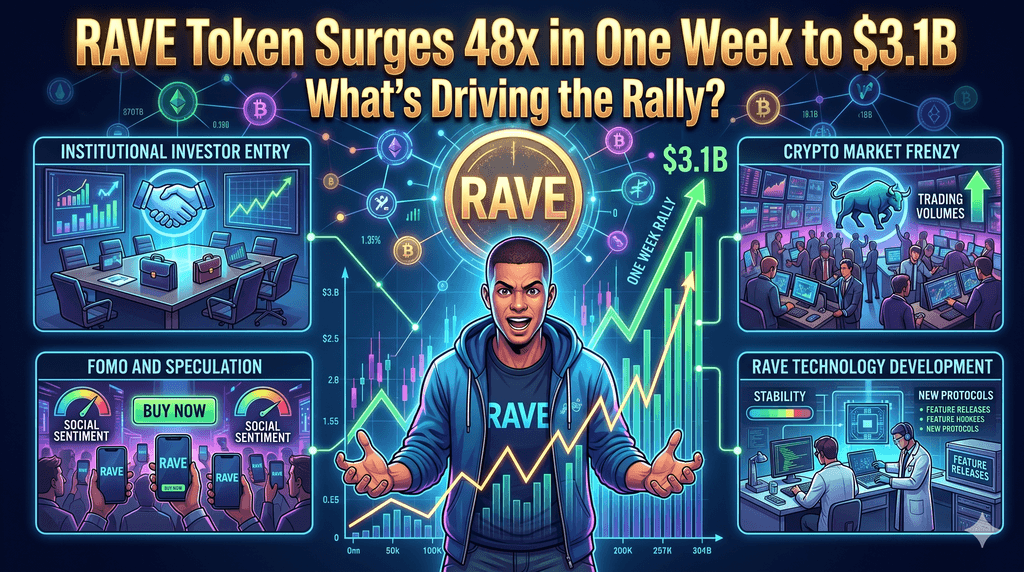
The digital asset landscape in April 2026 is witnessing one of its most polarizing events to date. While the broader market remains in a state of cautious optimism, a relatively niche Web3 entertainment project known as RaveDAO has shattered performance expectations. In a span of just seven days, the native RAVE token has catapulted from obscurity to a multi-billion dollar valuation, printing a 4,800% gain that has left both retail traders and institutional analysts scrambling for answers. As of April 14, 2026, RAVE has achieved a staggering $3.1 billion market capitalization, securing a spot among the top 100 cryptocurrencies and defying the "neutral" sentiment currently clouding the Altcoin Season Index.
This meteoric rise is not merely a byproduct of a rising tide; in fact, RAVE is aggressively outperforming Bitcoin and Ethereum, which have remained relatively range-bound this week. The surge represents a classic "idiosyncratic rally," where specific internal mechanics and aggressive market positioning outweigh the general market trend. However, behind the flashy green candles and the social media euphoria lies a complex web of engineered short squeezes, tactical on-chain maneuvers by the development team, and a growing narrative around the "Live-to-Earn" entertainment model. To understand if this $3.1 billion valuation is a sustainable floor or a precarious peak, we must dissect the specific catalysts that ignited this vertical explosion.
Engineered Scarcity and the Low Float Trap
One of the primary technical drivers behind the RAVE rally is a phenomenon known as a "low float, high FDV" squeeze. On-chain data reveals that while the total supply of RAVE is capped at 1 billion tokens, the circulating supply is currently estimated at only 248 million. This means that nearly 75% of the supply remains locked in vesting contracts or is held by the RaveDAO treasury and early seed investors. In the world of high-stakes crypto trading, a thin circulating float acts as a force multiplier for price action. When demand spikes—whether through organic interest or coordinated buying—there is simply not enough sell-side liquidity to absorb the pressure, leading to the parabolic vertical moves we have seen this week.
Furthermore, monitoring services like Yu Jin and RootData have flagged specific "contract operations" that suggest the rally was not entirely accidental. Analysts observed the RAVE team transferring approximately 30.58 million tokens (valued at roughly $42 million at the time) to the Bitget exchange just days before the surge. This move was widely interpreted by the trading community as an invitation to "short" the asset, under the assumption that the team was preparing to dump. However, the opposite occurred. As short interest peaked, the team reportedly withdrew a similar amount of tokens back on-chain, effectively removing liquidity from the exchange and triggering a massive short squeeze. This forced buyback from liquidated traders acted as jet fuel, propelling the price from under $0.30 to its current highs above $6.00 in record time.
The Convergence of Web3 and Global Live Entertainment
Beyond the mechanical price manipulation, RaveDAO is riding a legitimate wave of fundamental interest in the Web3 entertainment sector. Unlike many "meme coins" that rely solely on social media hype, RAVE is backed by an active ecosystem focused on decentralized event management. The project has already proven its revenue-generating capabilities, reporting $3 million in event revenue for 2025, with projections for 2026 exceeding $7.5 million. This financial backbone provides a degree of legitimacy that most speculative assets lack.
The timing of this week's rally aligns perfectly with several high-profile real-world activations. RaveDAO is currently preparing for the "Dim Sum Rave" in Hong Kong, scheduled for April 18, 2026. This sold-out event utilizes the project's core infrastructure: tickets are sold as NFTs, and attendees receive $RAVE rewards for participation. Additionally, RaveDAO was recently announced as a co-host for the Lisbon Dance Summit, a major industry gathering running from late April into early May. By integrating on-chain ticketing and "proof of attendance" protocols at these events, the project is demonstrating a tangible use case for its token, which is helping to convert short-term speculators into long-term holders who see RAVE as the "Ticketmaster of Web3."
Institutional Positioning and the Short Squeeze Mechanics
The scale of the RAVE rally has been significantly amplified by the derivatives market. Open Interest (OI) for RAVE futures surged to nearly $250 million this week, a level of leverage rarely seen for a project of this size. This aggressive positioning created a "liquidation cascade." As the price began its initial ascent, traders who had bet against the token (the bears) were forced to buy back their positions at higher prices to cover their losses. This forced buying then pushed the price even higher, hitting the stop-loss orders of the next tier of short-sellers.
This cycle of liquidations is a hallmark of the 2026 crypto market, where sophisticated algorithmic trading bots can exploit high-leverage positions. In RAVE's case, the 24-hour trading volume reached $375 million, representing a volume-to-market-cap ratio of nearly 30%. For context, established assets like Bitcoin typically maintain a ratio between 5% and 10%. This hyper-activity suggests that while some of the rally is driven by genuine belief in the project's entertainment model, a significant portion is the result of high-frequency trading and speculative fervor.
Regulatory Tailwinds and the Digital Asset Clarity Act
The broader macro environment in April 2026 is also providing an unexpected backdrop for the RAVE surge. The U.S. Senate is currently preparing to vote on the Digital Asset Market Clarity Act, a piece of legislation aimed at providing a definitive federal framework for crypto assets. While the outcome of the vote remains uncertain, the anticipation has led to a "risk-on" appetite for altcoins that demonstrate clear utility and revenue models.
Investors are increasingly looking for "high-beta" assets—tokens that move more aggressively than Bitcoin—to capture outsized returns. Because RaveDAO operates in the entertainment space, it is often viewed as being less susceptible to the regulatory scrutiny faced by decentralized finance (DeFi) protocols or privacy coins. This perceived "regulatory safety" has encouraged institutional "whales" to allocate capital to RAVE, viewing it as a safer bet within the volatile altcoin sector. The narrative that RAVE is a "utility-first" token has allowed it to decouple from the "neutral" sentiment of the wider market, as traders hunt for the next breakout success story.
Analyzing the Sustainability of a $3.1 Billion Valuation
While the 48x surge is an undeniable success for early investors, it raises critical questions about the token's long-term sustainability. The fully diluted valuation (FDV) of RAVE now sits near $6.2 billion, creating a significant gap between its current market cap and the value of all tokens if they were in circulation. This "FDV overhang" is a known risk in cryptocurrency; as locked tokens are released to the team and early investors according to their vesting schedules, they often create massive sell pressure that can deflate even the strongest rallies.
Technical indicators are currently flashing "extreme overbought" signals. The 14-day Relative Strength Index (RSI) for RAVE has touched 98.7, a level that historically precedes a cooling-off period or a sharp correction. Most analysts agree that for RAVE to maintain its $3 billion status, the "hype" must be replaced by "adoption." If the upcoming events in Hong Kong and Lisbon fail to meet expectations or if the project experiences any logistical hurdles, the momentum could shift rapidly. However, if RaveDAO continues to burn tokens using a portion of its event profits—a deflationary mechanism recently implemented—it could create a permanent supply-side constraint that supports the higher price floor.
Future Outlook: Can RAVE Reach $10?
As we look toward the remainder of April 2026, the trajectory of RAVE will depend on whether it can flip its previous resistance levels into support. The key level to watch is the $5.00 mark; if the token can hold above this psychological barrier during the inevitable profit-taking phases, it could set the stage for a run toward $10.00. The upcoming "sell-the-news" risk surrounding the Lisbon Dance Summit in May is the next major hurdle for the bulls.
The story of RAVE in 2026 is a microcosm of the current state of the crypto market: a blend of high-tech utility, aggressive financial engineering, and the undeniable power of community-driven narratives. Whether it remains a top-tier asset or serves as a cautionary tale of "vertical chaos" remains to be seen, but for now, RAVE has undeniably captured the crown as the most explosive performer of the year.
Conclusion
The 48x surge of the RAVE token is a testament to the unique market dynamics of 2026, where low-float tokenomics and high-leverage derivatives can create unprecedented wealth in a matter of days. While the "engineered" nature of the short squeeze suggests caution is warranted, the underlying revenue from RaveDAO’s live events provides a fundamental anchor that many of its peers lack. Investors must weigh the current "overbought" technical signals against the project’s aggressive expansion into the global entertainment industry. As the Digital Asset Market Clarity Act looms and major events in Hong Kong and Lisbon approach, RAVE will remain the focal point of market speculation, serving as a high-stakes barometer for the "Live-to-Earn" sector’s viability.
FAQs
Q1: What is the main reason for the RAVE token price increase?
The rally was driven by a combination of factors: an engineered short squeeze targeting high leverage on exchanges, a "low float" circulating supply that magnified price volatility, and positive fundamental news regarding sold-out events in Hong Kong and Lisbon.
Q2: Is RAVE a safe investment at current prices?
RAVE is currently considered a high-risk, high-reward asset. With an RSI of nearly 99 and a massive gap between its market cap and fully diluted valuation, the token is technically overbought, meaning a short-term correction is highly likely.
Q3: How does RaveDAO make money?
RaveDAO generates revenue through its Web3 entertainment ecosystem, including NFT ticketing for live music events, sponsorships, and "Live-to-Earn" participation rewards. The project reported $3 million in revenue in 2025.
Q4: What are the key price levels to watch for RAVE?
Traders are closely watching the $5.00 support level. If RAVE stays above this, it may attempt a run toward $8.00 or $10.00. A break below $4.50 could signal a deeper correction toward the $2.00 range.
Q5: Will the RAVE team dump their tokens?
While the team recently moved large amounts of tokens to exchanges, on-chain analysis suggests these moves were intended to trigger short squeezes rather than a total exit. However, upcoming vesting unlocks remain a long-term risk for the price.
Q6: How can I use RAVE tokens?
RAVE tokens are used within the RaveDAO ecosystem to purchase event tickets, access exclusive VIP perks at global raves, and participate in governance decisions regarding future event locations.