

The Doge Evolution: How 2026 ETF Approvals are Shaping Price Dynamics
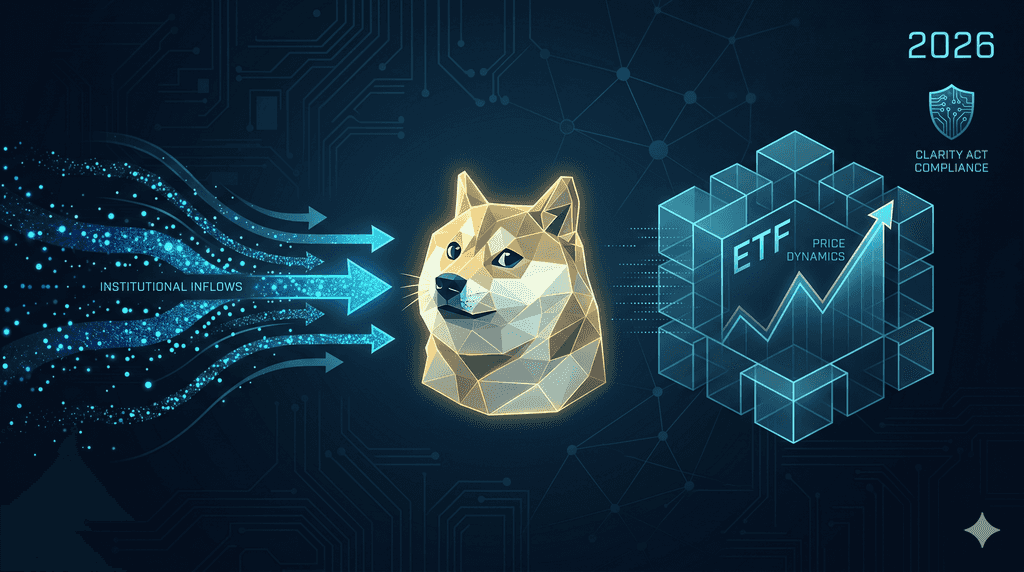
Once viewed as the quintessential meme coin, DOGE has successfully transitioned into a recognized institutional asset class following the landmark SEC and CFTC joint classification of Dogecoin as a digital commodity in March 2026. This regulatory clarity, spurred by the CLARITY Act of 2025, has paved the way for the first wave of spot ETFs, most notably the 21Shares Dogecoin ETF (TDOG), which debuted on the Nasdaq in January.
The arrival of these regulated investment vehicles has shifted market dynamics from purely speculative retail hype toward more sophisticated, valuation-driven models. With the integration of DOGE into the X Money payment rails and the emergence of the DogeOS application layer, the asset is being repriced to reflect its role as a high-velocity settlement tool for the global digital economy.
Key Takeaways
-
The March 2026 SEC/CFTC joint framework officially classified Dogecoin as a digital commodity, providing the legal foundation for spot ETF products.
-
The January 2026 launch of the 21Shares Dogecoin ETF (TDOG) on Nasdaq marked the start of the institutionalization phase for meme assets.
-
While ETFs offer accessibility, early 2026 data shows modest assets under management, suggesting that institutional capital is entering at a more measured pace than retail cycles.
-
The development of DogeOS and its smart contract layer is beginning to shift the DOGE narrative from a "pure meme" to a functional utility network.
-
Dogecoin price in 2026 remains sensitive to broader market liquidity and the pro-crypto policy shifts of the current administration.
From Meme to Commodity: The Regulatory Pivot
For years, the asset occupied a gray zone, often dismissed by institutional investors due to the lack of a clear regulatory framework. That changed with a series of legislative and agency-led milestones that rebranded DOGE from a speculative social experiment into a regulated financial commodity.
The Impact of the CLARITY Act
The CLARITY Act served as the primary catalyst for this evolution. By establishing definitive categories for virtual assets, the bill successfully resolved the long-standing jurisdictional dispute between the SEC and the CFTC.
One of the most critical provisions of the act was the Mature Blockchain Pathway. This rule stipulated that any digital asset that was the primary underlying asset of an exchange-traded product (ETP) listed on a national securities exchange by January 1, 2026, would be classified as a non-ancillary asset, effectively granting it commodity status. Because 21Shares and other issuers successfully listed DOGE-based products globally in 2025, Dogecoin entered the new year with protected legal standing alongside Bitcoin and Ethereum.
SEC and CFTC Joint Classification
The legislative momentum culminated on March 17, 2026, when SEC Chair Paul Atkins and CFTC Chair Michael Selig issued a landmark joint interpretation. This Interpretive Release officially categorized a select group of decentralized assets as Digital Commodities.
Intrinsic Value: The agencies noted that Dogecoin’s value is derived from its functional crypto system and supply-demand dynamics rather than the managerial efforts of others.
The End of the Investment Contract: The release clarified that while early sales of a token might involve an investment contract, an asset can "mature" out of that status.
Institutional Green Light: By explicitly naming Dogecoin as a digital commodity, the SEC provided the Safe Harbor that major banks and pension funds required. This removed the risk of retroactive enforcement actions, allowing institutional desks to finally add DOGE to their 2026 asset allocation models without fear of regulatory reprisal.
While its cultural roots remain, its 2026 price discovery is now anchored in its status as a recognized commodity within the global financial system.
Analyzing the ETF Landscape: TDOG and Beyond
The current landscape is dominated by three primary vehicles that have set the standard for how Wall Street interacts with meme-based digital commodities.
The 21Shares TDOG Milestone
The 21Shares Dogecoin ETF (TDOG), which began trading on the Nasdaq on January 22, 2026, serves as the industry’s primary benchmark. Unlike the retail-driven surges of 2021, the launch of TDOG was a calculated move by institutional market makers.
Early AUM Trends: As of mid-April, TDOG’s Assets Under Management (AUM) sit at approximately $3.5 million. While this is modest compared to Bitcoin’s multi-billion dollar funds, it represents a sticky capital base of Registered Investment Advisors (RIAs) who are using DOGE as a high-beta diversifier for younger, risk-tolerant clients.
Institutional Liquidity: The presence of TDOG has introduced institutional-grade liquidity providers to the Dogecoin market. This has tightened the bid-ask spreads significantly, making it cheaper for large-scale players to enter and exit positions without the massive slippage seen on decentralized exchanges.
Grayscale (GDOG) and Bitwise (BWOW): The Expansion
Following the 21Shares lead, other major issuers have converted or launched their own products to capture the diversifying interest in the "Big Three" (BTC, ETH, and DOGE).
Grayscale Dogecoin Trust ETF (GDOG): Formerly a private placement trust, Grayscale’s conversion to a spot ETF has allowed long-term trust holders to finally trade their shares at par with the Net Asset Value (NAV). This transition cleared a significant amount of locked supply, contributing to the price consolidation seen in Q1 2026.
Bitwise Dogecoin ETF (BWOW): Known for its focus on the Internet of Value narrative, Bitwise’s entry has focused on the technical merits of the Dogecoin network. The BWOW fund is often marketed alongside their index products, positioning Dogecoin as the settlement layer for the masses.
The Shift to Quality Over Quantity
Data from the first quarter of 2026 shows that while the number of individual DOGE holders has remained relatively flat, the average size of the holdings has increased. The ETF structure has encouraged a shift from diamond-handed retail speculators to managed-risk institutional desks.
This transition is reflected in the way DOGE now reacts to news; rather than 40% vertical spikes based on social media mentions, we are seeing 3% to 5% steady accumulations during US market hours, a sign that Dogecoin is being traded as a legitimate commodity rather than a lottery ticket.
Price Discovery in the Institutional Era
In previous market cycles, Dogecoin’s price discovery was almost entirely reactive, characterized by sudden, vertical spikes triggered by social media trends or high-profile endorsements.
In April 2026, the presence of institutional market makers (IMMs) within the ETF ecosystem has introduced a layer of professional liquidity that is beginning to dampen this extreme behavior.
Volatility Compression through Liquidity
Institutional market makers, such as those facilitating trades for the 21Shares TDOG fund, operate with sophisticated algorithmic models that prioritize order book depth and tight bid-ask spreads. By providing a continuous bid and ask during US market hours, these entities absorb the shock of rapid retail movements.
The "Elon Effect" Stabilization: While social media remains a factor, the impact of a single post is no longer as disruptive. When a sudden surge in sentiment occurs, institutional liquidity acts as a buffer, allowing the price to move in a more orderly fashion. This volatility compression is a sign of a maturing market, where price discovery is driven by cumulative inflows rather than isolated events.
Algorithmic Arbitrage: Market makers constantly arbitrage the difference between the ETF’s Net Asset Value (NAV) and the underlying spot price on exchanges. This professional activity ensures that DOGE trades more in line with broader market liquidity, reducing the "disconnect" that previously allowed for irrational price swings.
The Supply-Side Challenge: 5 Billion Annual Dilution
A critical factor in Dogecoin’s price discovery remains its unique inflationary model. Unlike Bitcoin, which has a diminishing supply, Dogecoin adds a fixed amount of 5 billion new coins to its circulation every year.
The Continuous Selling Pressure: This equates to roughly 10,000 new coins every minute. For Dogecoin to maintain its current price in 2026, the market must absorb billions of dollars in annual sell-side pressure from miners.
The ETF Demand Threshold: For Dogecoin to see sustained price appreciation toward the $1.00 mark, ETF inflows must reach a specific absorption threshold. Analysts estimate that the combined AUM of spot DOGE products must grow at a rate that exceeds the 5-billion-coin annual supply. In early 2026, current net inflows into products like TDOG and BWOW are beginning to meet this threshold, but consistent growth is required to move the price floor permanently higher.
DOGE as a High-Beta Sentiment Gauge
In the institutional era, Dogecoin is increasingly used by desk traders as a high-beta sentiment gauge for the entire crypto market.
When institutional risk appetite is high, capital rotates into DOGE as a leveraged play on broader digital asset growth. This shift in usage means that Dogecoin's price is now more correlated with global liquidity cycles and interest rate expectations than it was during its era as a purely retail-driven meme
The Utility Shift: DogeOS and Smart Contracts
For over a decade, DOGE was limited by its "Scrypt" architecture, which, while secure, lacked the smart contract capabilities of networks like Ethereum or Solana. The 2026 roadmap has addressed this through the introduction of DogeOS, a Layer-2 scaling solution that utilizes zero-knowledge (ZK) rollups to bring decentralized finance (DeFi) to the Dogecoin ecosystem.
The Role of DogeOS and ZK-Scaling
DogeOS operates as a high-throughput execution layer built on top of the Dogecoin mainnet. By using ZK-rollups, the protocol can bundle thousands of transactions into a single cryptographic proof that is verified on the Dogecoin blockchain.
This technical upgrade, implemented in early 2026, allows the Dogecoin network to verify ZK-proofs natively. It enables the creation of decentralized exchanges (DEXs) and lending protocols that use native DOGE as collateral without requiring "wrapped" versions on other chains.
DogeOS targets a throughput of over 50,000 transactions per second (TPS). This puts Dogecoin on par with high-performance networks, allowing it to handle the massive volume required for global micro-payments and high-frequency trading.
X Money
The April 2026 launch of X Money serves as the primary real-world laboratory for these technical upgrades. While the initial public beta focuses on fiat remittances, the internal infrastructure is designed to leverage DogeOS for its Crypto Rails.
In the proposed X Money architecture, DOGE is positioned not just as a currency, but as the "gas" for the platform's social-media-integrated DApps. From tipping creators to purchasing digital collectibles, every interaction on X could eventually settle on the Dogecoin L2.
The introduction of Smart Cashtags allows users to execute complex financial contracts, like automated recurring payments or escrow services—directly within the X timeline using Dogecoin smart contracts.
From Speculative Hype to Utility-Driven Value
With DogeOS and X Money integration, the asset is developing a fundamental demand floor.
Some DogeOS proposals include a small fee burn for every smart contract transaction, introducing a deflationary counter-weight to the annual 5-billion-coin mining issuance.
As DeFi protocols launch on DogeOS, a significant portion of the circulating DOGE supply is being locked in smart contracts as liquidity or collateral. This reduces the available "sell-side" liquid supply, creating a setup where even moderate ETF inflows can have a more pronounced impact on price.
Price Predictions
The Bull Case: The Road to $1.00 and Beyond
The bullish camp, led by firms like InvestingHaven and Coinpedia, argues that the $1.00 target is no longer a matter of "if," but "when." This optimism is anchored in three primary 2026 catalysts:
The ETF "Institutional Floor": The launch of the 21Shares TDOG ETF in early 2026 has introduced a persistent source of buy-side pressure. Analysts argue that as wealth managers integrate DOGE into "Digital Commodity" portfolios alongside Bitcoin and Gold, the resulting liquidity will act as a permanent floor, preventing the 80% drawdowns seen in previous years.
X Money Integration: With the X Money public beta launching this month, speculation is mounting that DOGE will serve as the native clearing layer for global micro-payments. If Dogecoin captures even 1% of X's 600 million users' transaction volume, the fundamental demand would easily outpace current supply.
The DogeOS Scarcity Effect: The development of DogeOS and its proposed Fee Burn mechanism for smart contract transactions could, for the first time, introduce a deflationary counter-pressure to Dogecoin’s mining issuance.
The Bear Case: Structural Inflation and ETF Fatigue
Conversely, more conservative models from CoinCodex and DigitalCoinPrice suggest that DOGE is more likely to consolidate between $0.12 and $0.20 for the remainder of 2026.
The 5 Billion Annual Headwind: Critics point out that Dogecoin’s fixed annual inflation, 5 billion new coins every year, requires roughly $500 million to $1 billion in fresh capital annually just to maintain current price levels. Without Hyper-Growth in utility, this dilution remains a significant hurdle for a $1.00 valuation (which would require a market cap of ~$168 billion).
Early ETF Fatigue: Early data from April 2026 indicates that while TDOG has seen consistent inflows, the Institutional Flood has been more of a Measured Leak. If institutional demand doesn't accelerate, the price may struggle to break past the psychological resistance levels established during the 2024-2025 rally.
While ETFs like TDOG offer a simplified entry point during banking hours, the KuCoin Spot Market provides the 24/7 agility and advanced toolset required to navigate the rapid price swings that define the DOGE ecosystem.
Tactical Trading with AI Bots
The 2026 market is too fast for manual reaction alone. To handle the "volatility compression" and sudden breakouts mentioned in recent KuCoin market reports, traders utilize automated tools:
-
Spot Grid Bots: These are ideal for the sideways consolidation phases often seen in DOGE. By setting a grid between the current $0.10 support and $0.15 resistance, the bot automatically "buys low and sells high," capturing incremental profits from micro-fluctuations that an ETF wrapper simply ignores.
-
Smart Rebalance: For those maintaining a "Digital Commodity" portfolio (BTC, ETH, and DOGE), this tool ensures your DOGE allocation doesn't become over-extended during a rally, automatically locking in gains and rotating them into more stable assets or other emerging utility tokens.
Hedging and Leverage via KuCoin Futures
With Dogecoin’s Open Interest (OI) surging to over 12 billion DOGE in April 2026, the derivatives market has become a primary driver of price discovery.
-
Hedged Positions: If you hold a long-term position in a Dogecoin ETF but anticipate a weekend sell-off, perhaps due to a shift in X Money sentiment, you can use KuCoin Futures to open a short hedge. This allows you to protect your portfolio value without having to sell your core holdings.
-
Leveraged Exposure: For high-conviction trades around "Golden Cross" formations, KuCoin offers up to 50x leverage on DOGE pairs, providing a capital-efficient way to play the volatility that institutional ETFs are restricted from touching.
Capturing Yield: KuCoin Earn vs. Passive ETFs
A significant disadvantage of the Dogecoin ETFs is their lack of productivity; they are strictly price-tracking vehicles. KuCoin addresses this Opportunity Cost through its expanded yield suite:
-
KuCoin Earn: Investors can deposit their DOGE into flexible or fixed-term programs to earn a passive return. While the ETF sits idle, your DOGE on KuCoin can generate a yield that helps offset the asset's natural 5-billion-coin annual inflation.
Conclusion
The arrival of Dogecoin ETFs in 2026 has provided the asset with a structural liquidity floor it previously lacked. While the $1.00 psychological milestone remains an uphill battle due to inflationary math, the institutionalization of the coin has permanently de-risked its profile. DOGE is no longer just a meme; it is a regulated digital commodity serving as a high-velocity utility layer within the global payment ecosystem.
FAQs
Can I buy a Dogecoin ETF in my 401(k)?
Yes, as of 2026, major brokerages allow you to purchase approved spot DOGE ETFs like TDOG within self-directed 401(k) or IRA accounts.
Does an ETF mean the "Elon Musk" era of Dogecoin is over?
While institutional capital adds stability, social sentiment and public endorsements still play a significant role in Dogecoin's short-term price movements.
Why is DOGE considered a commodity and not a security?
The CLARITY Act and recent SEC guidance determined that Dogecoin's decentralized nature and proof-of-work mechanism align more closely with commodities like gold.
How do ETF management fees compare to KuCoin trading fees?
Dogecoin ETFs typically charge an expense ratio of 0.30% to 0.50%. Trading on the KuCoin Spot Market generally offers a more cost-effective route for active participants.
What is DogeOS?
DogeOS is an independent project aimed at adding a smart contract layer to Dogecoin, intended to increase the network's utility for decentralized applications.
Disclaimer:This content is for informational purposes only and does not constitute investment advice. Cryptocurrency investments carry risk. Please do your own research (DYOR).