

SpaceXAI Eyes Texas Data Center Expansion as AI and Bitcoin Miners Compete for Power
2026/07/24 11:30:00
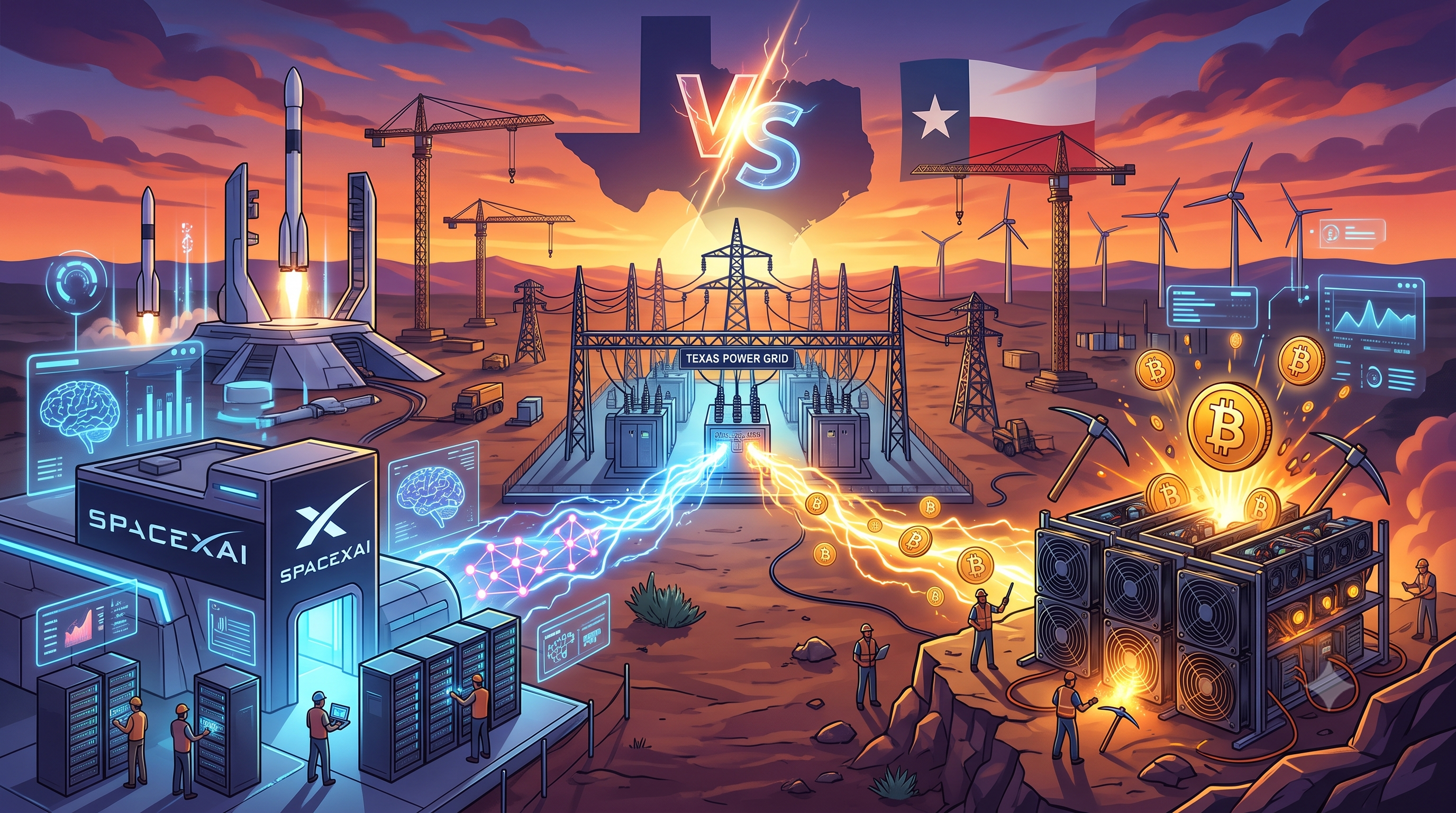
SpaceX is reportedly laying the groundwork for at least one large-scale artificial intelligence data center in Texas. The potential expansion could substantially increase the company’s computing capacity beyond its existing Memphis-area facilities, which reportedly provide around one gigawatt of combined capacity. The company has explored several possible Texas sites, including both purpose-built campuses and the conversion of existing industrial properties.
The timing matters to the cryptocurrency industry. Texas has become one of the most important regions in the United States for Bitcoin mining, partly because of its large electricity market, extensive energy resources and programs that allow major users to reduce consumption during grid stress. Those same characteristics are now attracting AI developers that need enormous amounts of electricity to train models, serve customers and operate high-density computing clusters.
SpaceX has not announced a final site, construction budget, electricity source or operating date. It would therefore be inaccurate to suggest that the company has already started building the facility or that its expansion has already pushed up mining costs. Nevertheless, the reported plans illustrate a structural shift across the digital economy: AI developers and Bitcoin miners are beginning to compete for the same land, substations, transmission connections and long-term power contracts.
For crypto investors, the central question is no longer simply whether AI will consume more electricity than Bitcoin mining. The more useful question is how AI demand will change the value of energy infrastructure—and whether Bitcoin miners will emerge as competitors, partners, landlords or acquisition targets in the next stage of the computing boom.
What Is SpaceXAI Planning in Texas?
Current reporting uses “SpaceXAI” to describe SpaceX’s integrated AI operations following its combination with xAI. The business now brings together SpaceX’s engineering and infrastructure capabilities with Grok development and large-scale AI computing. A Texas data center could therefore support several objectives at once, from internal model training to commercial cloud contracts and potentially government computing services.
According to reports, the company has considered multiple potential locations and discussed both constructing new facilities and retrofitting an existing warehouse. Some data center personnel have reportedly been sent to Texas, while recent job listings have referred to property identification, acquisitions, construction and operational support in cities including Austin, Bastrop and Conroe. Those signals indicate active preparation, but they do not prove that a final investment decision has been made.
| Project detail | What is currently known |
| Location | Texas, but no final city or property has been announced |
| Number of facilities | At least one is reportedly under consideration |
| Development model | New construction or conversion of an existing warehouse |
| Potential scale | Similar to or larger than the Memphis-area facilities |
| Power requirement | Not officially disclosed |
| GPU configuration | Not disclosed |
| Current stage | Site exploration and preparation |
| Construction date | Not announced |
| Opening date | Not announced |
The most accurate description is therefore that SpaceXAI is exploring and preparing for a major Texas expansion. Expressions such as “opens,” “launches” or “begins construction” would go beyond the information currently available.
Why SpaceXAI Needs More Computing Power
Developing a frontier AI model requires much more than purchasing individual GPUs. Thousands of accelerators must be linked through high-speed networks, supplied with large datasets and kept operating reliably during training runs that may continue for extended periods. Storage, networking, cooling and power-conversion systems must all scale alongside the processors.
Computing demand does not end when a model finishes training. Once Grok or another AI service is released, additional infrastructure is required to process user prompts, support enterprise applications and maintain acceptable response times. Training demand can arrive in concentrated cycles, while inference demand continues for as long as customers use the product.
SpaceX also appears interested in turning part of its infrastructure into a commercial computing business. The company has reportedly discussed supplying AI computing capacity to government and external corporate customers, while some existing capacity may already be available to third parties. This suggests that SpaceX could be evolving from an AI model developer into a broader compute provider that competes with cloud companies and specialized GPU infrastructure operators.
A Texas location would also reduce dependence on the Memphis area. Geographic diversification can protect a company against local grid failures, extreme weather, infrastructure problems and regulatory disputes. Different locations could eventually specialize in model training, customer inference, government workloads or third-party compute contracts.
Why Texas Is Becoming a Compute Hub
Texas offers many of the resources that large computing operators need. It has extensive natural gas production, rapidly growing wind and solar generation, broad areas of developable industrial land and a wholesale electricity market in which prices can vary significantly by location and time. The state also has established technology and engineering clusters, including major SpaceX operations.
However, the idea that Texas provides unlimited cheap electricity is misleading. Statewide generation capacity does not guarantee that electricity is immediately available at a specific property. A large data center needs nearby transmission lines, suitable substations, high-voltage equipment and approval from the relevant utility and grid operator. Upgrading those systems may require substantial capital and several years of construction.
Energy authorities have identified data centers and cryptocurrency mining facilities as major drivers of electricity-demand growth in Texas. Forecasts expect demand to increase as new large computing loads come online, although the final total will depend on how many proposed projects secure financing, permits and grid connections.
This creates a development race. Companies are not merely searching for the cheapest electricity price; they are competing for sites where large quantities of power can actually be delivered. A property with approved grid capacity, usable fiber connections and room for expansion may be significantly more valuable than undeveloped land located near inexpensive energy production.
Why AI Data Centers Use So Much Electricity
AI data centers use electricity across several interdependent systems. GPUs perform the main computations, but high-speed networks must move data between servers, storage equipment must deliver training datasets, and cooling systems must remove the heat generated by densely packed processors. Backup systems and power-conversion equipment add further demand.
Advanced AI hardware is also increasing power density. A facility may consume more electricity per rack than a conventional cloud server room, requiring redesigned electrical systems and more sophisticated cooling. Data center planning must therefore account for power, networking, storage, rack layout and cooling rather than treating processors as isolated components.
| Factor | AI data center | Bitcoin mining facility |
| Primary hardware | GPUs and AI accelerators | SHA-256 ASIC miners |
| Main workload | Model training, inference and cloud computing | Producing hash rate for the Bitcoin network |
| Revenue source | AI services, subscriptions and compute contracts | Block subsidies and transaction fees |
| Network needs | High-capacity, low-latency fiber is important | Generally less data-intensive |
| Cooling needs | Often complex because of high rack density | Air, hydro or immersion systems are common |
| Power reliability | Customer workloads may require continuous service | Operations can usually be interrupted quickly |
| Main site priorities | Power, fiber, reliability and scalability | Electricity cost, equipment efficiency and flexibility |
The two industries therefore use similar physical resources but create value differently. Bitcoin mining converts electricity into hash rate, with profitability affected by Bitcoin prices, network difficulty, transaction fees and machine efficiency. AI facilities sell computing services or support software products that may generate more revenue per megawatt. That economic difference can allow AI developers to pay more for premium infrastructure.
How Bitcoin Miners Compete for the Same Power
The competition is often described as a fight over electricity, but electricity prices are only one part of the problem. AI operators and miners also compete for substation capacity, transmission lines, industrial land, long-term power agreements, cooling equipment, construction labor and tax incentives. In areas with limited grid access, an existing energized property may be more valuable than the machines operating inside it.
AI developers generally have stronger purchasing power at high-quality locations. A hyperscale technology company or investment-grade customer may support a 10- or 15-year data center contract, giving developers predictable revenue that can justify large construction costs. Bitcoin miners face more variable income because their revenue depends on Bitcoin’s market price, network difficulty, block rewards, transaction fees and electricity expenses.
Miners still possess an important advantage: operational flexibility. ASIC fleets can usually be shut down quickly when electricity prices rise or the grid faces shortages. Some Texas mining companies participate in programs that compensate or encourage large users to reduce consumption during stressed periods.
AI data centers may also provide some flexibility, particularly for training jobs that can be delayed or moved between regions. However, customer-facing inference services and contractual cloud workloads may require much higher availability. The value of each facility to the grid will therefore depend on what it is computing, how quickly the workload can be interrupted and what obligations the operator has to its customers.
Could AI Push Bitcoin Miners Out of Texas?
SpaceXAI alone is unlikely to remove Bitcoin miners from Texas. The market is too large and geographically varied for one company to determine the future of the entire sector. The more realistic risk is that SpaceXAI will add to a wider wave of AI development that increases competition for the most desirable sites.
Miners located near strong transmission networks, reliable substations and high-capacity fiber may receive attractive offers from AI developers. In those cases, continuing to mine Bitcoin may no longer be the most profitable use of the property. A company could earn more by leasing its energized land, converting the campus or selling it to a data center developer.
Less attractive AI sites may remain highly suitable for mining. Bitcoin operations can function in remote locations where fiber is limited and power is intermittent. A miner may willingly curtail during high-price periods, while an AI customer operating critical workloads may reject the same energy arrangement. The two industries may therefore separate into different categories of infrastructure rather than one completely replacing the other.
The likely outcome is a mixed market. AI companies could dominate premium, highly connected sites, while miners continue operating in regions where flexible demand and low-cost energy matter more than uninterrupted computing. Some mining companies will remain focused on Bitcoin, while others will increasingly present themselves as owners of digital infrastructure rather than pure crypto producers.
Bitcoin Miners May Also Benefit From the AI Boom
The growth of AI can create opportunities for mining companies that already control valuable infrastructure. Many miners spent years securing industrial land, negotiating power agreements and constructing substations. Those assets are now in demand among AI developers that want to avoid lengthy grid-connection processes.
Miners can benefit through several models:
-
Converting part of a mining site into an AI or high-performance computing campus.
-
Leasing energized land and power capacity to an AI developer.
-
Signing long-term colocation agreements with cloud customers.
-
Selling an approved site at a premium.
-
Developing AI facilities while maintaining Bitcoin mining elsewhere.
The transition is already visible across the industry as mining companies sign longer-term data center agreements and reposition themselves as energy and compute infrastructure providers. At the user level, direct ownership of industrial mining equipment is not the only way to understand or access mining economics. Platform-based mining and reward services provide a useful comparison with the capital-intensive model of owning ASIC fleets, land and electrical infrastructure.
Conversion remains difficult. AI customers generally require more reliable power, stronger fiber connections, advanced cooling, higher construction standards and specialized operational teams. A company cannot simply remove ASIC miners and install GPUs without redesigning much of the facility. The miners best positioned to benefit will be those with strong sites, credible financing and actual customers—not merely an announcement containing the words “AI” and “data center.”
ERCOT Could Decide Who Wins the Power Race
The Electric Reliability Council of Texas manages most of the state’s grid and is becoming a crucial gatekeeper for large computing developments. Texas regulators have introduced a batch-review process for connection requests from major electricity users, allowing large proposed projects to be evaluated collectively.
The framework enables ERCOT to assess the combined effect of qualifying projects, allocate available grid capacity and identify required transmission upgrades. This approach responds to the growing number of data center and other large-load applications that have become difficult to evaluate through a purely project-by-project system.
The process also matters because the queue of proposed projects may exaggerate the amount of demand that will actually materialize. Developers sometimes examine several sites before committing to one, creating multiple requests for what may eventually become a single project. A combined review may help distinguish mature developments from speculative applications, but it could also delay projects that cannot demonstrate site control, financing or technical readiness.
For SpaceXAI, access to capital does not eliminate the physical limits of the grid. Unless the company builds substantial generation behind the meter, its Texas expansion will still depend on local transmission conditions, utility cooperation and ERCOT approval. The final location may therefore be determined as much by available electrical infrastructure as by land prices or proximity to other SpaceX operations.
Energy, Water and Regulatory Risks
A very large data center can resemble an energy project as much as a technology facility. It may need new substations, transmission lines, backup generators, gas infrastructure and cooling systems. Local communities increasingly want to know who will pay for those additions and whether residential customers will face higher costs.
Water use is another concern, although consumption varies according to cooling technology. Some facilities depend heavily on evaporative cooling, while newer designs use closed-loop liquid systems or other approaches that can reduce water requirements. Any meaningful environmental assessment must consider the specific design rather than assuming that every AI data center has the same impact.
SpaceXAI’s existing infrastructure has faced scrutiny over natural gas turbines, emissions and local environmental effects around its Memphis-area operations. That history could lead Texas communities and regulators to examine future power-generation and permitting plans closely. The company has not disclosed whether a Texas facility would rely primarily on the grid, onsite gas generation, renewable energy, batteries or a hybrid system.
Gaining access to electricity may therefore require more than demonstrating an ability to pay. SpaceXAI may also need to show that its project will fund necessary upgrades, manage environmental impacts and avoid shifting excessive infrastructure costs to local residents.
What This Means for Crypto Investors
The Texas expansion does not directly affect the Bitcoin protocol, block subsidy or transaction-fee market. Its importance lies in how AI demand may change the value of the physical assets controlled by mining companies.
Investors evaluating Bitcoin miners should look beyond total hash rate and ASIC counts. Four questions are becoming increasingly important:
-
Does the company control valuable power infrastructure? Ownership of land, substations and approved grid capacity can create strategic value beyond mining revenue.
-
Can the site support AI workloads? Energized land is not enough if the property lacks fiber, cooling capacity, reliable power or room for modern data halls.
-
Does the company have a signed customer? A binding long-term contract provides stronger evidence than preliminary discussions or an AI-focused rebranding campaign.
-
Can the company finance construction? AI conversion can require billions of dollars and may reduce existing mining revenue before new data center income begins.
A miner with an investment-grade AI customer may eventually generate more stable revenue than a company fully exposed to Bitcoin’s price cycle. However, construction delays, financing costs and technical problems can still undermine the strategy. Infrastructure value should be judged by execution rather than theoretical power capacity.
Investors should also compare company-specific developments with broader crypto market conditions. Mining stocks can be influenced by Bitcoin prices, risk appetite, liquidity and wider digital-asset trading activity even when their long-term strategy increasingly depends on AI infrastructure.
SpaceXAI’s reported search may increase investor attention around Texas mining assets, but it does not make every local miner an automatic acquisition target. Site quality, contractual rights, transmission access and development capability will determine which businesses can monetize the AI transition.
What Happens Next
A confirmed location will be the most important next development. A land purchase, warehouse lease or local development agreement would show that the project has moved beyond general site exploration. ERCOT or utility documents could then reveal the amount of electricity requested and the likely connection timetable.
The clearest indicators of progress will include:
-
A confirmed Texas city and property.
-
Land, warehouse or development transactions.
-
An ERCOT large-load application or interconnection study.
-
Utility plans for new transmission or substation infrastructure.
-
Environmental, water and onsite-generation permits.
-
Contracts for servers, GPUs and liquid-cooling equipment.
-
Local tax incentives or infrastructure agreements.
-
A formal construction schedule.
-
Announced external computing customers.
Until those signals emerge, the project should continue to be described as a proposed or exploratory expansion. The reported ambition is significant, but the site, scale and timetable remain subject to change.
Compute Is Becoming an Energy Business
SpaceXAI’s Texas plans illustrate how AI is moving beyond software. Large AI systems depend on physical infrastructure measured in acres, megawatts, substations and cooling capacity. Bitcoin miners have operated at the intersection of energy and computing for years, but they now face competitors with greater access to capital and potentially higher revenue per unit of electricity.
Some miners will be pressured as AI developers compete for premium sites. Others may benefit because their most valuable assets are no longer only ASIC machines. An approved grid connection, long-term power agreement or expandable data center campus can become the foundation of an AI infrastructure business.
The future relationship between AI and Bitcoin mining will not be defined entirely by competition. Miners may become landlords, development partners, flexible-load providers or acquisition targets. AI companies may also learn from the mining sector’s experience with electricity markets and demand response.
The next phase of the AI and crypto infrastructure race will not be decided by algorithms alone. It will be decided by who can secure power, connect to the grid, finance construction and convert physical energy resources into profitable computing capacity.
FAQs
Is SpaceXAI a publicly traded company?
The availability of SpaceX or SpaceXAI shares depends on the company’s current corporate and listing status. Investors should verify information through official company announcements and regulated securities-market sources rather than relying on tokens or unofficial products using similar names.
Does SpaceXAI have an official cryptocurrency?
The reports about the Texas data center do not mention an official cryptocurrency, token sale or blockchain project. Investors should not assume that tokens using the names SpaceX, xAI, Grok or Elon Musk are connected to the company. The use of company branding by a token does not establish an official relationship.
Can an AI data center also mine Bitcoin?
A data center can theoretically host different types of computing equipment, but AI and Bitcoin mining use different hardware. AI workloads generally run on GPUs and other accelerators, while modern Bitcoin miners use specialized ASIC equipment designed to perform SHA-256 calculations efficiently.
Converting an AI facility into a Bitcoin mine—or a mine into an AI facility—requires more than changing software. The operator may need different power distribution, cooling, networking, rack design and support systems.
Could SpaceXAI’s Texas expansion increase Bitcoin transaction fees?
Not directly. Bitcoin transaction fees are primarily determined by demand for limited block space and the fees users attach to transactions. The construction of an AI data center does not change Bitcoin’s block-size rules or directly increase activity in the mempool.
The expansion could affect miners indirectly if it changes local electricity prices or access to infrastructure, but that would influence mining economics rather than the protocol’s fee mechanism.
Can Bitcoin mining help stabilize the Texas grid?
Bitcoin miners can reduce electricity consumption quickly when prices rise or the grid faces shortages. This operational flexibility has allowed some large mining facilities to participate in ERCOT demand-response and curtailment arrangements.
However, the amount of flexibility available at any moment depends on mining profitability, electricity contracts and market conditions. Miners may be less willing to shut down when mining revenue is particularly strong.
How can investors verify whether a miner’s AI strategy is credible?
Investors should look for concrete evidence rather than relying on promotional language. Useful indicators include site ownership, approved power capacity, strong fiber connectivity, committed financing, named customers, signed contracts, construction milestones and realistic revenue dates.
Disclaimer: This content is for informational purposes only and does not constitute investment advice. Cryptocurrency investments carry risk. Please do your own research (DYOR).