

Is Bitcoin Still an Inflation Hedge in 2026, or Just Another Risk Asset?
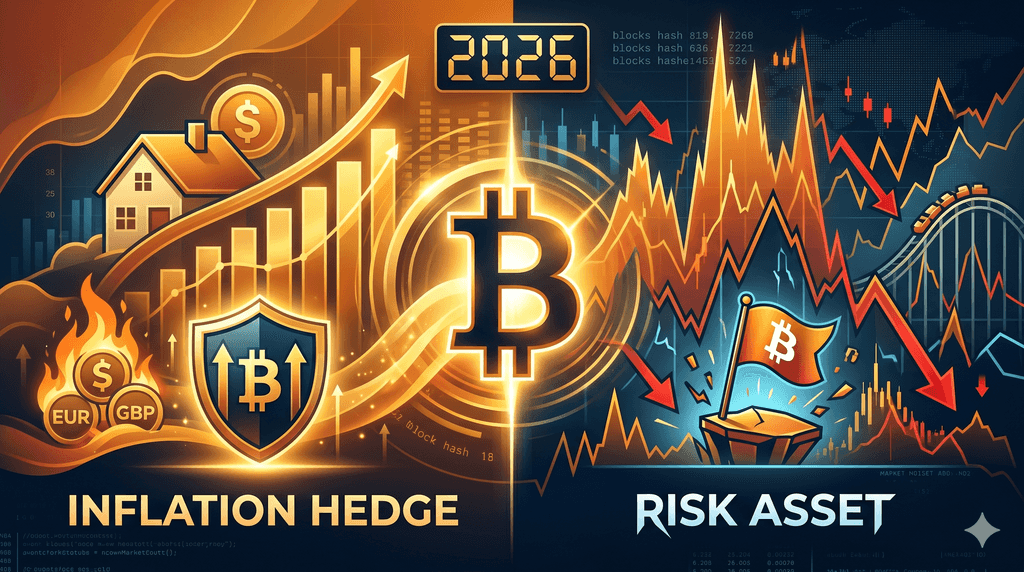
Key Takeaways
-
Bitcoin has dropped roughly 20% year-to-date in 2026, falling from ~$93,000 at the start of the year to around $74,000 as of mid-April — even as headline CPI climbed to 3.3% and geopolitical risk intensified.
-
The "digital gold" narrative is under pressure. Bitcoin's 6-month correlation with the Nasdaq reached 92% by late 2025, and its behavior during 2026 stress events has mirrored tech stocks more than safe-haven assets.
-
Gold hit a record high of $5,589 per ounce in January 2026 and remains approximately 80% higher than early 2025 — performing exactly as a crisis hedge should.
-
Time horizon is the key variable. Bitcoin has proven to be an exceptional long-term store of value in countries facing currency collapse, but repeatedly fails as a short-term safe haven during acute market stress.
-
Institutional adoption is a double-edged sword. ETF inflows and corporate treasury strategies have matured Bitcoin, but also wired it into the same risk-on/risk-off machinery as equities.
-
Signs of decoupling are emerging. In March 2026, Bitcoin held firm above $71,000 during widespread equity carnage — a milestone that may signal a gradual shift toward greater macro independence.
For years, Bitcoin's pitch to mainstream investors was elegantly simple: in a world of money printers and government debt, here is a scarce digital asset that no central bank can inflate away. Twenty-one million coins. Fixed supply. Decentralized. The "digital gold" story captivated hedge funds, corporations, sovereign wealth funds, and millions of retail investors, peaking at $126,000 per coin in October 2025.
Then 2026 arrived and complicated everything.
With inflation re-accelerating due to an Iran-war-driven energy shock — March CPI hit 3.3% YoY, the hottest since April 2024 — and the Federal Reserve locked in a holding pattern at 3.50%–3.75%, Bitcoin shed roughly 20% year-to-date. Gold, meanwhile, is the unambiguous macro winner of 2026, up approximately 80% since early 2025.
The contrast has forced a genuinely important question back into the center of crypto discourse: is Bitcoin actually an inflation hedge — or has it evolved into just another risk asset that rises when liquidity flows and falls when it dries up?
The honest answer in 2026 is: it depends on your timeframe. But those nuances have profound implications for how you allocate your portfolio and think about Bitcoin's long-term role in the global financial system.
The Case That Bitcoin Has Become a Risk Asset: Correlation Data Doesn't Lie
Start with the numbers. Bitcoin's 6-month correlation with the Nasdaq reached 92% by September 2025 — a figure highlighted in CME Group analysis that reflects a deep structural change in how Bitcoin is traded. Its daily standard deviation runs roughly three to five times higher than the S&P 500, meaning BTC acts as a leveraged bet on the same risk-on/risk-off cycle as equities, not as an independent inflation hedge.
Three interlocking forces drive this correlation. First, the ETF pipeline: BlackRock's iShares Bitcoin Trust, Fidelity's Wise Origin fund, and a half-dozen other spot ETFs channel billions in daily volume from the same portfolio managers who trade SPY and QQQ. When the Fed signals "higher for longer" and risk budgets shrink, those managers sell across the board — Bitcoin alongside Nasdaq futures, because they sit in the same allocation bucket. Second, algorithmic trading: quantitative funds run BTC-equity spread strategies that mechanically reinforce correlation, pulling the two assets back together whenever they diverge. Third, shared liquidity dependence: Bitcoin borrows the Fed's central bank. When the Fed cut rates in late 2024, BTC and equities rallied together; when the pause extended into 2026, both sold off in tandem.
The 2026 price action validates this with brutal clarity. Bitcoin dropped 10.7% in January, 14.8% in February, and barely scraped a 0.19% gain in March — its first back-to-back quarterly losses since 2022. Inflation was rising and geopolitical risk was elevated: precisely the conditions under which an inflation hedge should protect investors. Instead, Bitcoin behaved like a high-beta tech stock, falling hardest when macro conditions tightened.
The Case That Bitcoin Is Still an Inflation Hedge: Time Horizon Is Everything
Before writing Bitcoin's inflation-hedge thesis an obituary, it's worth asking what "hedging inflation" actually means — and over what timeframe.
In 2022, during the historic inflation spike that saw CPI peak above 9%, Bitcoin dropped 65%, from $47,000 to $16,000. An asset that loses two-thirds of its value during the very period it is supposed to protect capital is not a reliable short-term hedge. Yet that same cycle ended with Bitcoin recovering completely and reaching new all-time highs above $126,000 in October 2025. From 2015 to 2025, Bitcoin delivered an annualized return above 60%, vastly outperforming gold at 8%, real estate at 5%, and TIPS at just 2%.
Bitcoin's inflation-hedging property is most powerful over multi-year horizons. It works against slow-burn monetary debasement — not sudden market panics.
Real-world evidence from countries with chronic inflation makes the distinction vivid. Bitcoin appreciated roughly 90% against the Argentine peso and over 200% against the Turkish lira in 2024. When a government systematically destroys its currency, Bitcoin thrives. The problem is that its reputation has been partially built on claims of short-term crisis protection that the data consistently fails to support.
Academic research adds nuance: Bitcoin prices do increase after positive inflation shocks in statistical models, confirming a hedging property in principle. But unlike gold, Bitcoin prices also decline sharply in response to financial uncertainty shocks measured by the VIX. Bitcoin may hedge against anticipated, gradual inflation and currency debasement over years — but it is not a safe haven during sudden financial stress. Critically, that inflation-hedging property appears to stem primarily from Bitcoin's pre-institutional era. As ETFs and corporate treasuries integrated BTC into mainstream financial markets, its behavior has increasingly mirrored those markets rather than acting as an independent hedge.
Gold vs. Bitcoin in 2026: The Divergence That Defines the Debate
Nowhere is the inflation-hedge debate more starkly illustrated than in the gold-versus-Bitcoin comparison of 2026.
Gold hit a record high of $5,589 per ounce in January 2026 and remains approximately 80% higher than early 2025. As of mid-April, it trades around $4,800 per ounce — still roughly 46% higher year-over-year even after pulling back from its January peak. Bitcoin, by contrast, trades around $74,000, down from $93,000 at the start of the year and far below its $126,000 all-time high. If you bought both in early 2025 expecting inflation protection, one position looks dramatically better than the other.
Gold has been the straightforward beneficiary of every major 2026 macro event. The U.S.-Iran conflict that began February 28 sent energy prices above $100 per barrel and intensified inflation risks — reinforcing exactly the conditions gold was built for. Central banks are expected to buy around 755 tonnes of gold in 2026 as governments quietly diversify away from dollar-heavy reserves, providing a structural demand floor that Bitcoin simply doesn't have.
The volatility gap matters too. Bitcoin's annual volatility runs 45–60%; gold's runs 12–18%. That difference explains how Bitcoin can lose half its value within months while gold typically doesn't. For risk-averse capital seeking genuine inflation protection right now, that gap is decisive.
That said, gold cannot replicate Bitcoin's long-run return profile. The 2026 comparison speaks to which asset hedges this year's specific inflation shock — it doesn't settle which asset performs better over the next decade.
Early Signals of Decoupling: Is Bitcoin Finding Its Own Identity?
Despite the unflattering 2026 performance narrative, something potentially important is developing beneath the surface.
In mid-January 2026, Bitcoin held above $96,000 while the Nasdaq dropped more than 1% in a single session — catching analysts off guard and briefly rekindling decoupling talk. More notably, in March 2026, Bitcoin held firm above $71,000 on a day of widespread equity carnage, described by some analysts as a milestone moment where the narrative shifted toward "a sophisticated hedge against monetary policy." Santiment data confirmed Bitcoin moving independently from equities in certain windows, rising even as stocks fell.
Three catalysts could harden this into a sustained trend. The 2028 halving cycle — historically driving crypto-native price action 12–18 months before the event — is a story equities cannot replicate. Regulatory clarity from frameworks like the CLARITY Act could open institutional allocation channels currently independent of equity flows. And a genuine dollar-credibility crisis — a credit downgrade or sustained loss of confidence in U.S. fiscal policy — would be the definitive test of the digital-gold thesis.
None of these catalysts has fully materialized yet. But they represent the forward-looking case for why 2026's poor inflation-hedge performance is not necessarily Bitcoin's final word on the matter.
Bitcoin in 2026 demands a platform that matches its complexity — one that handles both the short-term risk-asset volatility and the long-term accumulation thesis without switching tools.
KuCoin covers both modes. For active traders, it offers perpetual futures with up to 125x leverage, deep liquidity, and competitive fees that preserve profits on the fast 5–7% swings that follow CPI prints or Fed statements. For long-term accumulators, automated DCA bots buy on a set schedule regardless of daily price noise, while KuCoin Earn lets holdings generate yield during consolidation phases rather than sitting idle. KuCoin Live rounds out the ecosystem with real-time market streams and live analyst commentary — context precisely when macro events are moving fast.
With 700+ supported assets and institutional-grade infrastructure, KuCoin is built for traders who recognize that Bitcoin's identity in 2026 is still being written — and who want the tools to act on whichever version of that identity dominates next.
The Long View: What Bitcoin Actually Is in 2026
By 2026, serious investment discourse has moved past the binary "digital gold vs. speculation" debate. In diversified portfolios, Bitcoin increasingly appears as a satellite holding — not a core one.
Spot Bitcoin ETFs recorded approximately $1.6 billion in net inflows in March 2026 alone, signaling institutional appetite remains intact despite price weakness. Strategy holds over 761,000 BTC, ETFs hold roughly 6.45% of all supply, and the U.S. government holds 328,372 BTC — concentration that reflects maturation while introducing systematic risks absent from Bitcoin's retail-driven past.
The most practical 2026 framework: Bitcoin is a high-volatility, asymmetric bet on the long-term failure of fiat monetary systems that also happens to amplify macro liquidity conditions in the short term. Gold is the defensive allocation; Bitcoin is the aggressive satellite that can dramatically outperform over years, while disappointing during the exact crisis moments when you expect it to shine.
That framework doesn't undermine Bitcoin's long-term case. It clarifies it — and in 2026, clarity is the most valuable thing a crypto investor can carry.
Conclusion
The verdict on Bitcoin's inflation-hedge status in 2026 is not a clean binary. In the short term, its 20% year-to-date decline against a backdrop of rising inflation, its 92% Nasdaq correlation at peak, and its repeated failures during acute stress all point to an asset tethered to the same liquidity machinery as equities. In the long term, the debasement-hedge thesis remains alive: 60%+ annualized returns from 2015 to 2025 are not the returns of an asset that failed to protect against monetary expansion.
The most important development to watch is whether the early decoupling signals of early 2026 — Bitcoin holding firm when equities sold off — harden into a structural trend driven by halvings, regulatory clarity, or a dollar-confidence event. If they do, the inflation-hedge narrative gets its most credible reboot yet.
For now, Bitcoin is simultaneously more institutionally mature, more correlated with risk assets, and more capable of surprising its skeptics than at any previous point in its history. Navigate that complexity with a clear-eyed understanding of what the data actually says — and 2026 becomes less an argument against Bitcoin, and more a masterclass in what it's still becoming.
FAQs
Why is Bitcoin falling while inflation is rising in 2026?
Bitcoin's short-term price is more sensitive to Fed policy and liquidity conditions than to inflation itself. When the Fed holds rates high to fight inflation, risk appetite shrinks and Bitcoin falls alongside other risk assets. The inflation-hedge thesis applies to long-term monetary debasement, not short-term hawkish policy cycles.
Is Bitcoin correlated with the stock market in 2026?
Yes, significantly. Bitcoin's 6-month correlation with the Nasdaq reached 92% by September 2025, driven by ETF adoption, shared macro liquidity dependence, and algorithmic trading. That said, emerging decoupling signals in early 2026 suggest this relationship may be gradually weakening.
How has gold performed compared to Bitcoin in 2026?
Gold has dramatically outperformed. It hit a record $5,589 per ounce in January 2026 and remains up ~80% since early 2025. Bitcoin is down roughly 20% year-to-date. Gold is behaving as a traditional crisis hedge; Bitcoin is trading more like a high-beta risk asset in the current macro regime.
Will Bitcoin eventually decouple from equities?
Potential catalysts include the 2028 halving cycle, broader regulatory clarity, and a dollar-credibility shock. Early decoupling signals have appeared in 2026, but a structural break from equity correlation has not yet materialized.
How should investors position Bitcoin in their portfolio?
Most strategists in 2026 treat Bitcoin as a satellite holding — a higher-volatility, asymmetric position sized conservatively (typically 1–10% of portfolio) alongside a more defensive allocation to gold or TIPS. Dollar-cost averaging is widely recommended to smooth entry-point volatility over the long run.
Disclaimer: This article is for informational purposes only and does not constitute financial or investment advice. Cryptocurrency investments carry significant risk. Always conduct your own research before making investment decisions.