

HKMA Stablecoin Ordinance Explained: Why HSBC and Standard Chartered Won the First Licences
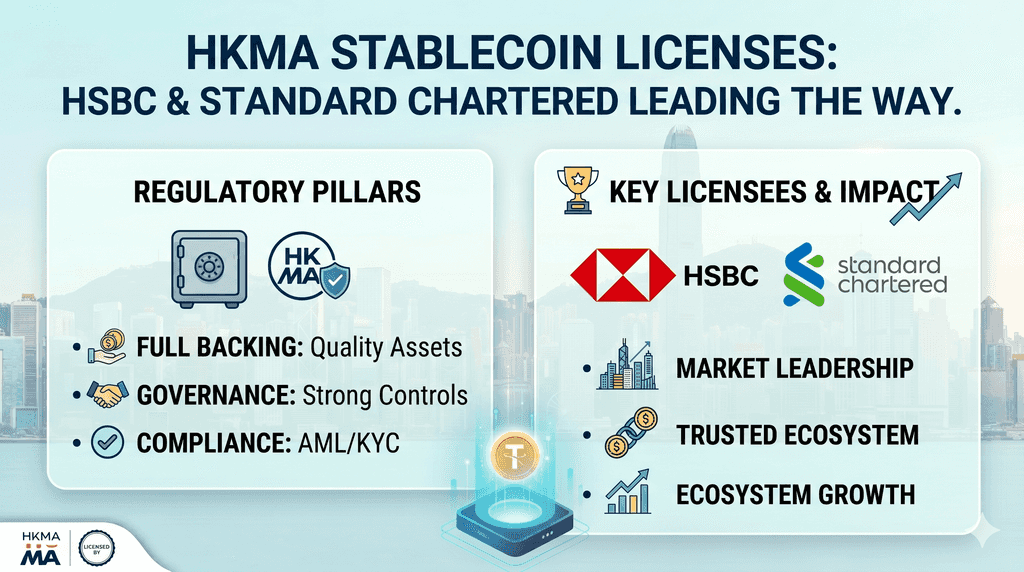
The digital asset landscape in Hong Kong reached a historic turning point on April 10, 2026, when the Hong Kong Monetary Authority (HKMA) officially granted the city’s first stablecoin issuer licenses. In a move that signaled a preference for institutional stability over "move fast and break things" crypto-native startups, the two inaugural licenses were awarded to HSBC and Anchorpoint Financial Limited—a heavyweight joint venture led by Standard Chartered in partnership with HKT and Animoca Brands.
This announcement follows the full implementation of the Stablecoins Ordinance, which became law in August 2025. The framework was designed to transition the wild west of fiat-pegged tokens into a regulated financial service. For the global crypto community, the success of these two banking giants is more than just a local news story; it represents the first time a major global financial hub has successfully integrated stablecoin issuance into the core of its traditional banking system.
Out of 36 initial applicants that entered the HKMA’s rigorous "Stablecoin Issuer Sandbox" and subsequent licensing process, only these two emerged. This low approval rate underscores the stringent requirements of the new Ordinance, which prioritizes 1:1 high-quality reserve backing, local incorporation, and robust redemption rights. As we look toward the second half of 2026, the launch of these regulated tokens will likely reshape how both retail users and institutional players interact with the Hong Kong Dollar (HKD) on the blockchain.
The Evolution of the HKMA Stablecoin Ordinance
The journey toward a regulated stablecoin environment in Hong Kong began in earnest back in 2023, following the collapse of several high-profile algorithmic stablecoins globally. The HKMA realized that for stablecoins to serve as a legitimate medium of exchange, they could not exist in a regulatory vacuum. The resulting Stablecoins Ordinance is a comprehensive piece of legislation that focuses primarily on Fiat-Referenced Stablecoins (FRS).
Under this law, any entity seeking to issue a stablecoin pegged to the HKD—or any other fiat currency if marketed to the Hong Kong public—must obtain a license from the HKMA. The Ordinance is built on several non-negotiable pillars. First, issuers must maintain a reserve of high-quality, highly liquid assets that at all times equals or exceeds the par value of the stablecoins in circulation. These assets must be segregated from the issuer's own funds and held with a licensed custodian.
Furthermore, the Ordinance mandates that users must have a right to redeem their stablecoins for the underlying fiat currency at par value within a reasonable timeframe. This eliminates the "de-pegging" fears that have plagued unregulated tokens. By the time the application deadline passed in late 2025, the HKMA had made it clear that "technical competence" was only half the battle; the other half was "financial resilience." This is why traditional giants like HSBC and Standard Chartered were positioned so perfectly to win the race.
Why HSBC and Standard Chartered Secured the First Licenses
The selection of HSBC and the Standard Chartered-backed Anchorpoint as the first licensees was a strategic decision by the HKMA to ensure the new ecosystem launched with maximum credibility. As "note-issuing banks" in Hong Kong, these institutions already manage the city’s physical currency. They possess the existing infrastructure for anti-money laundering (AML), "Know Your Customer" (KYC) protocols, and massive capital reserves that newer fintech firms struggle to match.
HSBC’s approach was particularly integrated. By winning the license, the bank plans to embed its HKD-denominated stablecoin directly into its existing retail infrastructure, including the popular PayMe app. This means that by late 2026, millions of Hong Kong residents could be using blockchain-based money for daily transactions without ever needing to download a separate crypto wallet.
Standard Chartered took a more collaborative route via Anchorpoint Financial. By joining forces with HKT (Hong Kong’s largest telecom) and Animoca Brands (a global leader in Web3 and gaming), Standard Chartered combined banking reliability with tech-forward distribution. Their focus leans heavily toward Real-World Asset (RWA) tokenization and supply chain financing, areas where institutional-grade stablecoins are desperately needed to settle high-value transactions instantly.
Rigorous Standards for Reserve Management and Security
One of the primary reasons 34 other applicants have yet to receive a license is the HKMA’s uncompromising stance on reserve management. The Ordinance requires that reserve assets be restricted to "high-quality and high-liquidity" instruments. This typically includes bank deposits with maturities under three months or government-guaranteed debt securities with residual maturities of no more than one year.
For a traditional bank like HSBC, managing such a portfolio is second nature. However, for a crypto-native startup, the overhead of maintaining such a "clean" balance sheet while providing 24/7 liquidity is a massive hurdle. The HKMA also requires a minimum paid-up share capital of HK$25 million for non-bank issuers, though the effective capital requirement for a successful operation is likely much higher due to the need for operational redundancy and cybersecurity insurance.
Security is the other side of the coin. The HKMA expects issuers to demonstrate "bank-grade" systems that can withstand sophisticated cyberattacks. Because both HSBC and Standard Chartered already operate under the Banking Ordinance, they were able to leverage their existing security frameworks to meet the new Stablecoin Ordinance standards faster than their competitors. This "regulatory shortcut" allowed them to move from the sandbox to full licensure in record time.
The Strategic Role of Trading Platforms in the New Ecosystem
While the banks are the issuers, they do not operate in a vacuum. A stablecoin is only as useful as the places it can be spent or traded. This is where established global platforms become essential to the broader narrative. Even as Hong Kong moves toward a highly regulated "on-shore" model, the global liquidity of these new HKD stablecoins will eventually depend on their availability on high-volume exchanges.
The global platforms provide the necessary infrastructure for price discovery and global accessibility. As the HSBC and Anchorpoint tokens launch in the latter half of 2026, we can expect a "hybrid" era where regulated fiat-backed tokens meet the high-velocity trading environments of the crypto world. If these tokens are integrated into global trading pairs, they could provide a more stable alternative to the US Dollar-dominated stablecoin market, especially for Asian traders looking for a hedge.
The HKMA has indicated that while it is "open but cautious," it will eventually allow these regulated stablecoins to be listed on Virtual Asset Trading Platforms (VATPs). This creates a virtuous cycle: banks provide the trust and the "minting," while platforms and local licensed exchanges provide the "movement" and utility. This synergy is what will ultimately determine if the HKMA’s experiment succeeds in making Hong Kong a global Web3 hub.
Impact on Cross-Border Payments and Tokenized Assets
The launch of regulated stablecoins by HSBC and Standard Chartered is set to revolutionize two specific sectors: cross-border remittances and tokenized investments (RWA). Currently, moving money between Hong Kong and other jurisdictions involves the SWIFT network, which can take days and incur significant fees. A regulated HKD stablecoin allows for T+0 (instant) settlement.
HSBC has explicitly stated that its stablecoin will be used for "peer-to-peer payments and customer-to-merchant payments." For a city that processes billions in trade with mainland China and Southeast Asia, the efficiency gains are staggering. Because these tokens are issued by a bank and regulated by the HKMA, corporate treasurers will feel far more comfortable holding them on their balance sheets compared to an offshore, unregulated token.
On the investment side, the rise of tokenized assets—such as fractionalized real estate or green bonds—requires a stable, on-chain settlement layer. If you are buying a token representing a share in a Hong Kong skyscraper, you want to pay with a currency that has the same legal standing as the cash in your bank account. The HSBC and Anchorpoint licenses provide exactly that "missing link," allowing the entire lifecycle of an investment to stay on the blockchain while remaining fully compliant with local law.
Future Outlook for the Hong Kong Stablecoin Market
The granting of these two licenses is only the beginning. The HKMA has stated it will "continue to engage" with the remaining applicants, but it warned that the number of additional licenses would be "very limited." This suggests a "quality over quantity" approach that aims to prevent the market fragmentation seen in other jurisdictions.
By 2027, we may see a small group of 5 to 7 "premier" issuers in Hong Kong, consisting of traditional banks and perhaps one or two exceptionally well-funded tech giants. The goal is to make the HKD-pegged stablecoin a "regional standard" for digital finance in Asia. If other countries in the region follow Hong Kong’s lead and adopt similar "bank-led" stablecoin models, we could see the emergence of a regulated, interoperable network of digital fiat currencies.
For the average investor, this means the era of "stablecoin anxiety"—the fear that your digital dollars might vanish overnight—is coming to an end in Hong Kong. Whether you are using a bank app or a global exchange, the presence of HKMA-regulated tokens provides a layer of safety that was previously unimaginable in the crypto space.
Conclusion: A New Era for Digital Money
The HKMA’s decision to award the first stablecoin licenses to HSBC and Standard Chartered is a masterclass in pragmatic regulation. By choosing institutions that are already woven into the fabric of the city’s economy, the HKMA has ensured that the first steps of its stablecoin journey are taken on solid ground. These banks bring the "trust" that is the fundamental requirement of any currency, while the blockchain brings the "efficiency" of modern technology.
As these tokens roll out in the coming months, the focus will shift from "who is allowed to issue" to "how will people use them." With plans to integrate these stablecoins into everyday apps like PayMe and to facilitate complex institutional settlements, Hong Kong is positioning itself as the world’s most sophisticated laboratory for the future of money. For the global crypto industry, the message is clear: the future of stablecoins isn’t just digital; it’s regulated, institutional, and centered in Hong Kong.
FAQs
Q1: What is the HKMA Stablecoin Ordinance?
The Stablecoin Ordinance is a regulatory framework in Hong Kong that requires all issuers of fiat-referenced stablecoins (FRS) to be licensed by the Hong Kong Monetary Authority. It mandates 1:1 reserve backing, local incorporation, and strict redemption rights for users.
Q2: Why did HSBC and Standard Chartered win the first licenses?
As note-issuing banks, they already possess the capital, compliance infrastructure, and reserve management expertise required by the HKMA. Their participation ensures the stablecoin ecosystem starts with high credibility and minimal risk of failure.
Q3: Can I use these stablecoins on international exchanges?
While the initial rollout will likely focus on local applications and bank-specific wallets, these tokens are built on standard blockchain protocols. This means they could eventually be listed on global platforms, provided they meet the regulatory requirements of those platforms.
Q4: Are these stablecoins different from Bitcoin?
Yes. Unlike Bitcoin, which has a volatile price and no central issuer, these stablecoins are pegged 1:1 to the Hong Kong Dollar and are backed by physical cash and government bonds held in reserves.
Q5: When will the public be able to use the HSBC stablecoin?
According to the latest announcements, HSBC and Anchorpoint (Standard Chartered) plan to complete their preparatory work and launch their stablecoins in the second half of 2026.
Q6: What happens to unlicensed stablecoins in Hong Kong?
Under the Ordinance, it is illegal for unlicensed entities to issue or actively market fiat-referenced stablecoins to the Hong Kong public.() Licensed Virtual Asset Trading Platforms (VATPs) in the city are also restricted to offering only regulated stablecoins to retail investors.