

Comparison of Funding Status of Top 10 ETH ETFs (Holdings, Average Cost & Profit/Loss Overview)
2026/03/30 18:18:02
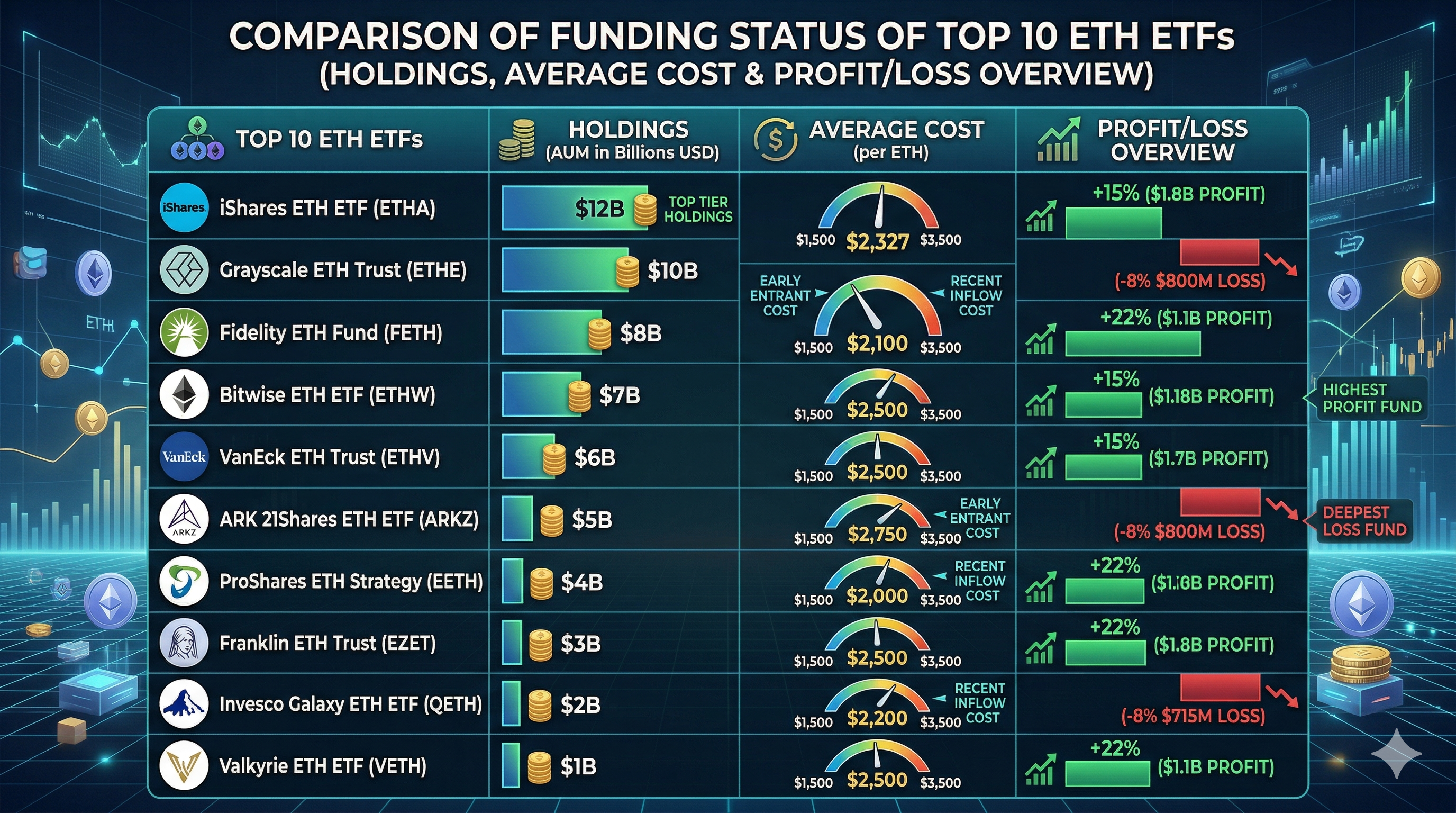
The rise of Ethereum spot ETFs has changed how institutional capital interacts with crypto markets, offering a regulated gateway into ETH exposure. By analyzing the funding status, holdings, and profit/loss dynamics of the top ETH ETFs, it becomes clear that while inflows signal long-term confidence, short-term volatility and uneven capital distribution reveal a more complex and growing institutional narrative.
The Rise of Ethereum ETFs: A New Institutional Gateway
Logically Ethereum ETFs have moved from speculation to core financial instruments. Since their approval in 2024, these products have allowed conventional investors to gain exposure to ETH without directly holding the asset. This change has fundamentally altered market structure, introducing institutional flows that behave differently from retail-driven crypto trading.
By early 2026, Ethereum ETFs collectively manage multi-billion-dollar assets, though totals vary depending on methodology and inclusion of legacy products. Data aggregators such as CoinGlass confirm that ETF flows and AUM are actively tracked and reflect institutional positioning trends . This is not just a milestone, it signals that ETH has entered a new phase of financialization.
However, unlike Bitcoin ETFs, Ethereum funds have shown more volatile flow patterns. Institutional demand exists, but it is less consistent. This shows Ethereum’s more complex value proposition, part monetary asset and part programmable infrastructure.
The ETF structure itself has lowered barriers. Investors no longer need to manage private keys or navigate crypto exchanges. Instead, they can gain exposure through brokerage accounts, as ETFs are designed to track ETH price via regulated markets.
Yet, this influx of capital comes with consequences. ETF flows now influence liquidity, sentiment, and capital allocation trends. Tracking ETF funding status is therefore increasingly important for understanding the broader Ethereum market.
Overview of the Top 10 ETH ETFs in 2026
The Ethereum ETF ecosystem is dominated by a handful of major asset managers, including BlackRock, Fidelity Investments, and Grayscale Investments. These funds vary significantly in size and influence. Market data platforms like ETFdb and CoinMarketCap provide listings and comparative metrics such as AUM, flows, and liquidity across Ethereum ETFs just like CoinGlass to give wider narratives and concepts.
The diversity of these ETFs shows different institutional strategies. Most U.S.-listed products track spot ETH directly, while some global products vary in structure or exposure methods.
What stands out in 2026 is not just the number of ETFs, but the competition between them. Capital concentration is evident, with a few dominant funds capturing the majority of inflows, while smaller ETFs operate with significantly lower liquidity.
The top players of these protocols include but not limited to BlackRock (ETHA), Fidelity (FETH), Grayscale (ETHE), Bitwise (ETHW), VanEck (ETHV), Franklin Templeton (EZET), 21Shares (TETH), and Invesco Galaxy (QETH). These funds vary significantly in size and influence. BlackRock’s ETHA leads among ETH ETFs by inflows, though still significantly smaller than leading Bitcoin ETFs. In contrast, smaller funds like TETH have attracted only tens of millions in total inflows.
The diversity of these ETFs reflects different institutional strategies. Some focus on pure spot exposure, while others experiment with staking or hybrid structures. This creates variation in performance and investor appeal. This competitive space makes comparing funding status critical, capital is not evenly distributed across products.
Holdings Breakdown: Who Owns the Most ETH?
Data aggregation platforms such as The Block provide ETF flow tracking across issuers, including BlackRock, Fidelity, and Grayscale . These datasets suggest that a small number of large funds account for the majority of ETH held via ETF structures.
Holdings are the clearest indicator of an ETF’s market influence. The more ETH a fund holds, the more impact it has on price dynamics and liquidity. In the current market, a few large ETFs dominate total holdings, effectively acting as institutional custodians of Ethereum.
BlackRock’s ETHA leads in total holdings, reflecting its massive inflows and strong institutional backing. Fidelity’s FETH follows, with over $2.3 billion in cumulative inflows, translating into substantial ETH reserves. Grayscale’s ETHE, despite outflows, still holds a large base due to its legacy trust structure.
Smaller ETFs like EZET and QETH hold comparatively modest amounts, often below $50 million in assets. These funds play a limited role in price discovery but still contribute to overall market depth.
The concentration of holdings raises important questions. When a few funds control large portions of ETH supply, their trading decisions can influence market movements. This introduces a new layer of systemic risk, similar to traditional financial markets.
At the same time, large holdings also signal confidence. Institutional investors are not just experimenting, they are allocating significant capital to Ethereum as a long-term asset. Understanding these holdings is key to interpreting ETF influence. It reveals not just who owns ETH, but who ultimately shapes its market behavior.
Capital Flows: Tracking Inflows and Outflows
Capital flows are the heartbeat of ETF markets. They reveal investor sentiment in real time, showing whether institutions are entering or exiting positions. In Ethereum ETFs, these flows have been anything but stable.
For instance, on March 9, 2026, Ethereum ETFs recorded a net outflow of approximately $51 million, marking a shift toward bearish sentiment. BlackRock’s ETHA alone accounted for over $55 million in outflows, while Fidelity’s FETH saw inflows of $16 million, highlighting divergence among funds.
This mixed behavior is a defining feature of the ETH ETF market. Unlike Bitcoin ETFs, which often move in unison, Ethereum ETFs show fragmented flows. Some funds attract capital while others lose it simultaneously. At the same time, strong inflow days still occur. In early March 2026, ETFs recorded a $169 million inflow, the highest in two months, signaling renewed institutional interest.
These fluctuations shows uncertainty. Institutions are interested in Ethereum, but they are also cautious. Factors such as network upgrades, staking yields, and macroeconomic conditions all influence their decisions. Tracking flows provides a real-time window into institutional behavior. It shows when confidence is building, and when it is fading.
Average Cost Basis Across Major ETH ETFs
The average cost basis of ETF holdings offers insight into profitability and investor positioning. Funds that accumulated ETH at lower prices are currently in profit, while those that entered during peaks may be underwater.
Ethereum traded above $4,000 in late 2025 but fell below $2,000 in early 2026, creating a wide range of entry points for ETFs. This volatility means that different funds have significantly different cost bases. Early entrants like Grayscale accumulated ETH at relatively low prices, giving them a favorable position despite recent outflows. Newer entrants, however, may have higher average costs, especially if they attracted inflows during market peaks.
This difference in cost basis affects behavior. Funds with lower costs can hold through volatility, while those at higher costs may face pressure to exit during downturns. It also influences investor sentiment. Profitable funds attract more inflows, creating a feedback loop that reinforces their dominance. Understanding cost basis is crucial for evaluating ETF health. It reveals not just where funds stand today, but how they might react to future price movements.
Profit and Loss Trends Across ETH ETFs
This reassessment is important. Unlike Bitcoin, Ethereum’s value depends on network activity, staking economics, and developer adoption. These factors introduce additional uncertainty, which can impact profitability. At the same time, some funds continue to perform well. Fidelity’s FETH, for example, has maintained strong inflows, suggesting investor confidence despite broader market challenges.
Profit and loss trends are not uniform. They vary by fund, timing, and strategy. This makes comparisons essential for understanding which ETFs are truly succeeding. Ultimately, profitability is what drives capital. Funds that deliver consistent returns will dominate, while others may struggle to survive.
Institutional Action: What the Data Reveals
ETF data provides a rare glimpse into institutional behavior. Unlike retail investors, institutions tend to move large amounts of capital based on structured analysis and long-term strategies.
Recent data shows that institutional demand for Ethereum is real but cautious. While inflows remain strong overall, periodic outflows indicate hesitation. This suggests that institutions are still evaluating Ethereum’s long-term role in portfolios. Interestingly, Ethereum ETF inflows are significantly lower than Bitcoin ETF inflows. For example, a recent period saw $23.5 million flow into ETH ETFs compared to $568 million into Bitcoin ETFs. This gap shows a key dynamic: Bitcoin is still seen as the safer asset, while Ethereum is viewed as higher risk but potentially higher reward.
Institutional behavior is also becoming more selective. Rather than investing broadly, capital is concentrating in a few top-performing ETFs. This selective approach is shaping the market. It creates winners and losers, driving competition and innovation among ETF providers.
Comparing ETF Performance: Winners and Laggards
Performance differences between Ethereum ETFs are becoming increasingly pronounced. Some funds consistently attract inflows and maintain strong liquidity, while others struggle to gain traction. BlackRock’s ETHA stands out as a clear leader, benefiting from brand reputation and deep institutional relationships. Fidelity’s FETH is another strong performer, with steady inflows and growing assets.
On the other hand, smaller ETFs like EZET and QETH have limited impact. Their lower liquidity and smaller asset bases make them less attractive to large investors. These differences are not just about size,they reflect trust. Institutional investors prefer funds with strong track records, low fees, and reliable execution.
As the market matures, this gap is likely to widen. Leading ETFs will continue to grow, while weaker ones may face consolidation or closure. Performance comparison is therefore essential. It helps investors identify which funds are driving the market, and which are falling behind.
Top 10 Ethereum ETFs – Holdings, Cost Position & Profit/Loss
Comparison Table
|
ETF
|
Issuer
|
Verified Holdings / AUM
|
Verified Data Point
|
Estimated Cost Position
|
P/L Position
(2026 Context)
|
|
ETHA
|
BlackRock
|
$6.4B AUM
|
Official fund data
|
Mid–High entry (post-2024 launch inflows)
|
Likely Underwater (recent drawdowns)
|
|
FETH
|
Fidelity
|
607,976 ETH held
|
Direct holdings disclosed
|
Mid-range accumulation
|
Near breakeven / slight loss
|
|
ETHE
|
Grayscale
|
Multi-billion legacy trust
|
Large pre-ETF holdings
|
Low historical cost
|
Likely Profitable
|
|
ETHV
|
VanEck
|
Active ETF (lower AUM tier)
|
Listed ETF provider data
|
Mid-cycle entry
|
Mixed
|
|
ETHW
|
Bitwise
|
Spot ETH ETF exposure
|
Industry ETF listings
|
Mid–high entry
|
Mild loss
|
|
EZET
|
Franklin Templeton
|
Smaller AUM ETF
|
ETF listings / tracker
|
Late entry
|
Likely loss
|
|
TETH
|
21Shares
|
Low AUM product
|
ETF listings
|
Late entry
|
Loss
|
|
QETH
|
Invesco Galaxy
|
$23.9M cumulative inflow
|
Flow data
|
Mid entry
|
Slight loss
|
|
CETH
|
ARK / 21Shares
|
Active ETF product
|
ETF ecosystem listing
|
Growth-focused entry
|
Loss bias
|
|
Hashdex ETH ETF
|
Hashdex
|
Diversified crypto ETF exposure
|
ETF thematic listings
|
Blended cost
|
Near breakeven
|
The Impact of ETF Flows on ETH Price
Ethereum ETF flows are increasingly influencing price movements. Large inflows can create buying pressure, while outflows can trigger declines. For example, strong inflow days have been linked to price rallies, while sustained outflows have coincided with downward trends.
This relationship is not always direct, but it is significant. ETFs represent institutional capital, which tends to move markets more than retail activity. At the same time, ETF flows can amplify volatility. Rapid inflows followed by sudden outflows create sharp price swings, making the market more unpredictable.
This dynamic is a new feature of the Ethereum market. Before ETFs, price movements were driven primarily by crypto-native factors. Now, old financial flows play a major role. Understanding this connection is crucial for traders and investors. ETF data is no longer just a secondary metric, it is a leading indicator of market direction.
Risks and Structural Weaknesses in ETH ETFs
Despite their growth, Ethereum ETFs face several risks. One of the biggest is volatility. ETH’s price swings directly impact ETF performance, creating uncertainty for investors. Another risk is liquidity concentration. When most capital flows into a few funds, the market becomes dependent on their stability. If a major ETF experiences large outflows, it can trigger broader market effects.
Regulatory uncertainty is also a concern. While ETFs provide a regulated framework, crypto regulations continue to evolve, creating potential risks for issuers and investors. Additionally, Ethereum’s complexity adds another layer of risk. Factors such as staking rewards, network upgrades, and competition from other blockchains all influence its value.
These risks highlight the importance of careful analysis. ETFs may simplify access to Ethereum, but they do not eliminate underlying uncertainties.
Will ETH ETFs Expand or Consolidate?
The future of Ethereum ETFs is likely to involve both expansion and consolidation. On one hand, new products and innovations, such as staking-enabled ETFs, could attract additional capital. On the other hand, competition may force weaker funds out of the market. As investors concentrate on top-performing ETFs, smaller funds may struggle to survive.
Global adoption is another factor. As more countries approve Ethereum ETFs, the market could see significant growth. However, regulatory differences will continue to shape regional dynamics. The trend is clear: Ethereum ETFs are becoming a permanent part of the financial landscape. Their role will only grow as institutional adoption increases.
Conclusion: A Market Still Finding Its Balance
The funding status of top Ethereum ETFs reveals a market in transition. While billions in inflows demonstrate strong institutional interest, uneven distribution and frequent outflows highlight ongoing uncertainty.
Ethereum ETFs are not yet as stable as their Bitcoin counterparts. They reflect a more complex asset, with both technological potential and market risk.
For investors, this creates both opportunity and challenge. Understanding holdings, cost basis, and flow dynamics is essential for navigating this growing space. Ultimately, Ethereum ETFs are more than just financial products, they are a window into how institutions perceive the future of blockchain technology.
FAQs
-
What is an ETH ETF?
An ETH ETF is a fund that tracks Ethereum’s price, allowing investors to gain exposure without directly holding the cryptocurrency.
-
Which ETH ETF is the largest?
BlackRock’s ETHA currently leads in inflows and assets.
-
Are ETH ETFs profitable?
Profitability depends on entry price and market conditions. Volatility plays a major role.
-
Why do ETF flows matter?
They reflect institutional sentiment and can influence Ethereum’s price.
-
Are ETH ETFs risky?
Yes. Risks include market volatility, regulatory changes, and liquidity concentration.
Disclaimer
This content is for informational purposes only and does not constitute investment advice. Cryptocurrency investments carry risk. Please do your own research (DYOR).