

How to Earn ORAI with KuCoin: Simple Earn, Flexible Staking, Reward Calculations, and Key Risks
2026/04/02 19:00:03
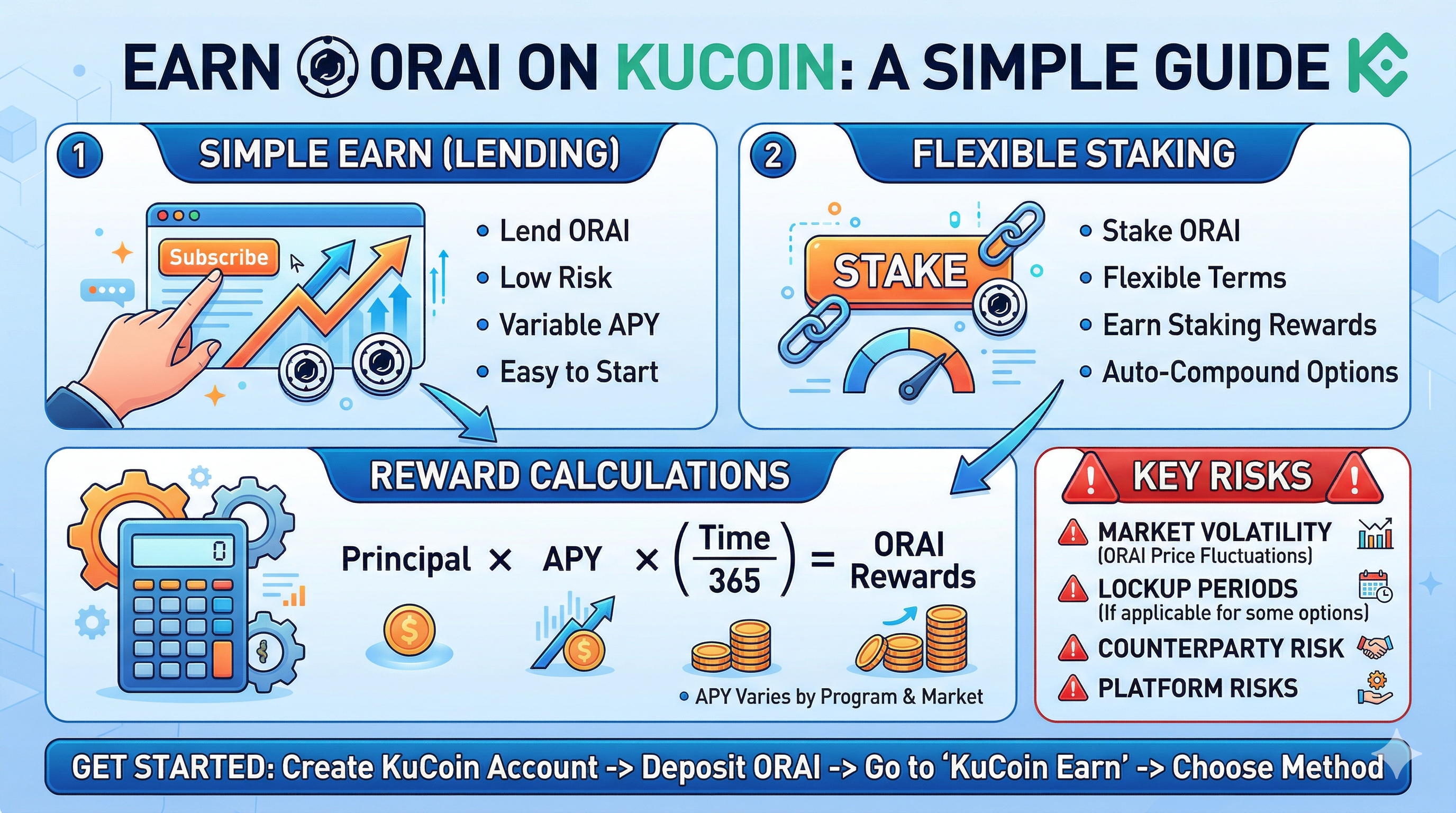
ORAI is no longer just a token people buy and leave alone. On KuCoin, it can also be used in earning products, which gives holders more than one way to use the asset. Instead of treating ORAI as something that only sits in a spot wallet, users can now look at practical ways to put it to work.
At the moment, ORAI appears under both Simple Earn and Staking in KuCoin Earn. The available options show a 0.5% to 14% range under Simple Earn, with both Flexible and Fixed term types, while Staking shows 13% Flexible. That means ORAI holders are not limited to one product style. They can compare the options and decide which one fits their balance, holding period, and comfort with liquidity.
That matters because most users do not look at a token in only one way. They want to know whether they can trade it, hold it, transfer it, and possibly earn more from it without adding too much complexity. ORAI now fits that broader use case much better. It remains a tradable asset through the ORAI/USDT market, but it also has a clear role inside the earning side of the platform.
Still, it is important to keep expectations realistic. A displayed rate is only one part of the picture. The actual value of an ORAI Earn product depends on the term structure, the amount subscribed, how long the user stays in the product, and whether the rate changes over time. For some users, flexibility will matter more than the highest visible APR. For others, the main goal will simply be finding a practical way to keep their ORAI balance from sitting idle.
This guide breaks the topic down in a clear way. It explains what ORAI is, how ORAI earning works on KuCoin, the difference between Simple Earn and Staking, how to estimate potential rewards, and what risks deserve attention before subscribing.
What Is ORAI?
ORAI is the native token of the Oraichain ecosystem. For users on KuCoin, though, the most useful question is not the formal definition. It is what the token can actually do in practice.
On KuCoin, ORAI can be bought and sold, held as part of a longer-term position, transferred when needed, and used in earning products. That makes it more flexible than a token that exists only for trading. Once a token can serve several roles at once, it becomes more relevant to active users.
For most people using KuCoin, ORAI currently stands out for three main reasons.
The first is market access. ORAI is available through the ORAI/USDT pair, so users can build or reduce a position directly on the exchange.
The second is portfolio flexibility. Some users want ORAI as part of a broader long-term crypto allocation, while others want short-term exposure. A listed token can serve both purposes, depending on how the user manages it.
The third is earning potential. ORAI now appears in more than one Earn category, which means users who already hold it can consider turning that balance into something more productive.
That combination makes ORAI more practical than a token that only waits for price movement. It gives users more options, and those options are exactly what make the article worth writing in the first place.
Why ORAI Is More Useful on KuCoin Now
A token becomes more useful when it can do more than one job. That is what makes ORAI more interesting on KuCoin right now.
If ORAI were only tradable, the article would be much shorter. It would mostly be about price exposure, timing, and basic exchange access. But once a token also appears in Earn products, the conversation changes. It becomes part of a broader platform experience. Users can choose whether to keep it liquid, hold it for longer, or subscribe to an earning product that fits how they want to manage their funds.
This matters because many users are not looking for constant trading activity. They may already have ORAI in their account and simply want to know whether there is a sensible way to use it more efficiently. Earn products answer that question. They give holders a reason to think beyond the spot balance.
The useful part is not only the rate itself. It is the range of choice. One user may want flexibility and easy access to funds. Another may be comfortable choosing a fixed term if the product setup is more attractive. Another may prefer a staking-style structure because it feels more direct and easier to understand. ORAI now sits in a position where those decisions can actually be made on the platform instead of somewhere else.
That is why ORAI feels more relevant on KuCoin now. It has moved beyond being only a listed asset and become something users can actively manage in different ways.
Current Ways to Earn ORAI with KuCoin
There are two main exchange-side routes available right now.
-
ORAI Simple Earn
The first route is Simple Earn.
ORAI shows a displayed range of 0.5% to 14%, and the product type includes both Flexible and Fixed terms. That suggests there is more than one ORAI setup available under this category, rather than one single return for all users.
This is an important distinction. A lot of weak articles take the highest visible number and present it as if it applies universally. That is not helpful. The presence of a range tells you immediately that the actual result depends on the selected product.
In practical terms, that means one user might choose a lower-rate option because it offers more flexibility, while another might prefer a different term that sits closer to the higher end of the range. The token is the same, but the product structure changes the expected outcome.
Simple Earn is likely to appeal to users who want a more familiar savings-style environment. It can be easier to understand, easier to compare, and easier to fit into a general holding strategy. For users who like having more than one product type under the same category, this is often the natural starting point.
-
ORAI Staking
The second route is Staking.
ORAI also appears under Staking with 13% Flexible. This matters because some users prefer staking-style products over broader savings categories. A staking label feels more direct. It signals that the product is built around a staking-style model rather than a general earn structure.
The word Flexible also matters. Many users care just as much about liquidity as they do about yield. Even a strong displayed rate can lose its appeal if access to funds becomes too restrictive. A flexible label makes the product easier to consider for people who want the option to move their funds sooner if needed.
For some users, this will be the clearest ORAI route on the platform. It is simple, direct, and easier to evaluate because the product identity is obvious. Instead of sorting through a wider range of earn structures, they can focus on one staking product and decide whether the current terms work for them.
How ORAI Earning Works on KuCoin
From the user side, the process is fairly simple.
First, the user holds ORAI in the KuCoin account. Then they open the Earn section, search for ORAI, and compare the product options available. After that, they review the details, enter the amount they want to use, and confirm the subscription.
The real decision is not whether ORAI can earn. It is which ORAI product makes more sense.
Simple Earn includes multiple term types and a wider displayed range.
Staking appears as a separate product with a current flexible rate.
That means each product may fit a different kind of user. Someone who wants to compare flexible and fixed structures may prefer Simple Earn. Someone who wants a more direct staking-style experience may lean toward the Staking option.
Either way, the mechanics are meant to be straightforward. The user does not need to do anything complicated just to get started. The more important part is evaluating what the product means for their balance over time. Rate, access to funds, and product conditions all matter more than the label alone.
Step-by-Step: How to Start Earning ORAI on KuCoin
-
Buy or transfer ORAI into your KuCoin account
The first step is to hold ORAI in the account. A user can do that by buying ORAI on KuCoin or transferring it in from somewhere else.
This step sounds obvious, but it still matters because everything else depends on having the token ready inside the platform. Without that starting balance, there is nothing to subscribe to.
-
Open KuCoin Earn
Once ORAI is in the account, go to the Earn section and search for the token.
This is where the available products become visible. Instead of guessing whether ORAI has an earning route, users can compare the listed options directly inside the platform.
-
Compare the ORAI product options
The visible choices are:
-
Simple Earn: 0.5% to 14%
-
Staking: 13%
-
Simple Earn terms: Flexible / Fixed
-
Staking term: Flexible
At this point, users should slow down and compare structures rather than chasing the highest number immediately.
-
Review the details before subscribing
This step matters more than many people expect.
A displayed APR tells only part of the story. Users should also look at the term type, how rewards are credited, how redemption works, whether the rate can change, and whether the product behaves differently from what they initially assumed.
A good subscription decision comes from reading the product details, not just the headline.
-
Subscribe and monitor the product
Once the user chooses a product, they enter the amount, confirm the subscription, and then monitor how it performs over time.
That means watching rewards, any visible changes in rate, and whether the product still matches the original reason for entering it. Good product management is not only about starting. It is also about paying attention after the subscription is live.
How to Calculate ORAI Earnings
A simple estimate looks like this:
Estimated ORAI earned = Subscribed ORAI × APR × Days held ÷ 365
This is the most practical formula for setting a baseline expectation. It is not a guarantee, and it does not capture every detail, but it gives users a clear way to estimate what a product might generate over time.
Example 1: 100 ORAI at 13%
If a user subscribes 100 ORAI at 13% APR:
100 × 0.13 ÷ 365 = 0.0356 ORAI per day
That number may look small, but that is normal. Token-based earning tends to build gradually.
Example 2: 500 ORAI for 30 days at 13%
500 × 0.13 × 30 ÷ 365 = 5.34 ORAI
This is a more useful example for someone who wants to understand what a medium-sized position might produce over the course of a month.
Example 3: 1,000 ORAI for 90 days at 14%
1,000 × 0.14 × 90 ÷ 365 = 34.52 ORAI
This helps show how a larger balance and a longer holding period increase the outcome.
Example 4: 1,000 ORAI for 90 days at 0.5%
Since Simple Earn shows a wide range, it also helps to compare the lower end:
1,000 × 0.005 × 90 ÷ 365 = 1.23 ORAI
That contrast is important. It shows why users should pay attention to the exact product they are selecting instead of looking only at the token name. The same asset can lead to very different results depending on the term structure and rate.
Why the APR Range Matters
The 0.5% to 14% range is one of the most important details here.
It tells you immediately that ORAI does not have one single return across all Earn setups. The outcome depends on which product the user actually chooses.
That matters because people tend to anchor on the highest number they see. It is a natural mistake. But in practice, the highest visible rate may apply only to a specific term or structure. Another product under the same token may sit much closer to the low end of the range.
This is why clear writing matters. The honest way to describe ORAI is not that it “earns 14%.” The better explanation is that ORAI currently has multiple earning setups, and those setups produce different potential returns.
That is much more useful for readers because it helps them think in terms of product choice, not just headline marketing.
Simple Earn vs. Staking: Which Makes More Sense?
The better option depends on what the user values most.
Users who want more flexibility in product structure may lean toward Simple Earn, especially since it includes both Flexible and Fixed terms. That gives them more room to compare different setups and choose one that fits their liquidity needs, holding period, and return expectations.
Users who prefer a more straightforward product may find Staking more appealing. The 13% Flexible staking option is easier to interpret at a glance and may suit those who want a simpler, more direct way to earn from their ORAI balance.
The stronger choice is not always the one with the highest displayed rate. It is the one that aligns best with the user’s priorities.
For example, someone who wants easier access to funds may prefer a flexible product even if the return is lower. Another user may be willing to accept a different term structure in exchange for a more attractive rate. Others may simply prefer the staking category because it feels clearer and easier to manage.
That is why comparing the available product types matters. The token is the same, but the experience and trade-offs can differ significantly depending on the route selected.
Risks to Understand Before Earning ORAI
Price volatility
Even if a user earns more ORAI, the market value of those tokens can still drop if the token price falls.
This is one of the biggest misunderstandings in crypto earning products. A larger token balance does not guarantee that the position is worth more in fiat terms.
Variable rates
Displayed APRs can change.
What looks attractive today may not remain the same later. Users should treat visible rates as current conditions, not permanent outcomes.
Product structure differences
Flexible and fixed products are not the same. They can differ in how quickly funds can be redeemed, how rewards are credited, and how the overall product feels from a user perspective.
That means the product label matters, not just the rate.
Platform availability
A token can appear in Earn now and show different terms later.
That is why users should always check the live product setup when they are ready to act. Conditions can change, and product availability can evolve over time.
Opportunity cost
Using ORAI in one product means not using it somewhere else.
That could mean not trading it, not transferring it, or not keeping it fully liquid. Every product decision comes with a tradeoff, even when the setup looks convenient.
Final Thoughts
ORAI now has a broader role on KuCoin than simple spot trading alone. It can be traded, held, and used in earning products through both Simple Earn and Staking.
That gives users more flexibility in how they use the token. Some may prefer a flexible staking-style route. Others may compare flexible and fixed term setups under Simple Earn. Others may simply want a practical way to keep an ORAI balance from sitting idle.
The important part is not to focus only on the highest visible APR. The better approach is to compare the available structures, estimate rewards realistically, and understand what each option means before subscribing.
That leads to a much better decision. It also leads to a much better article, because it treats the topic like a real product choice instead of reducing everything to one percentage.
FAQ
-
What is the main way to earn ORAI on KuCoin?
The main ways to earn ORAI on KuCoin are through Simple Earn and the Staking product available for ORAI.
-
What is the difference between ORAI Simple Earn and ORAI Staking?
Simple Earn offers different term structures, including Flexible and Fixed options, while Staking is presented as a separate product with a Flexible setup.
-
Does the ORAI return stay the same across all products?
No, the return does not stay the same across all products because different ORAI options can have different rates and term structures.
-
Why is ORAI listed with a range of returns?
ORAI is listed with a range because the available return depends on the specific product type and the subscription terms selected.
-
Who may prefer ORAI Simple Earn?
Users who want more flexibility in choosing between product structures may prefer ORAI Simple Earn.
-
Who may prefer ORAI Staking?
Users who want a more direct staking-style product may prefer ORAI Staking, especially if they value a simpler structure.
-
Can ORAI holders keep their tokens productive without actively trading?
Yes, ORAI holders can use KuCoin Earn products to put their balance to work instead of leaving it idle.
-
What should users check before subscribing to an ORAI product?
Users should check the rate, term type, redemption conditions, reward schedule, and overall product structure before subscribing.
Disclaimer: The information in this article is provided for general information only and does not constitute investment advice, financial advice, or a recommendation to buy, sell, or hold any digital asset. Crypto assets involve risk and may not be suitable for all users. Readers should independently verify all information, assess their own risk tolerance, and consult qualified professionals where appropriate before making any financial decisions.