

Why Privacy Infrastructure in Ethereum DeFi is Essential for Enterprise Adoption in 2026
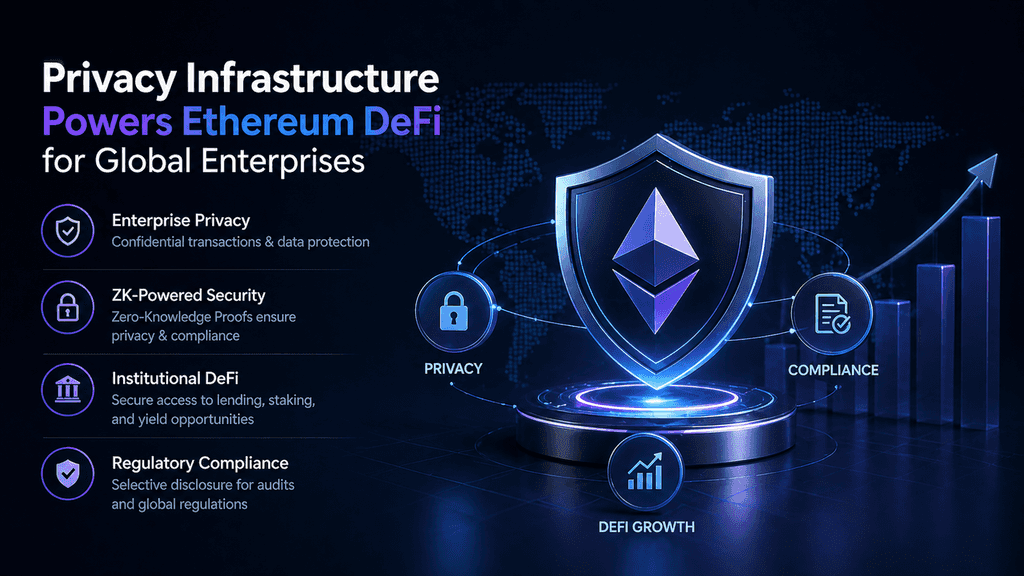
The rapid maturation of the decentralized finance ecosystem has reached a critical juncture in 2026, where the total value locked (TVL) in the market now exceeds $140 billion. As global institutions pivot from experimentation to full-scale deployment, the demand for robust privacy infrastructure in Ethereum DeFi has become the primary catalyst for sustainable corporate integration and long-term financial security.
In this comprehensive guide, we explore how cutting-edge privacy infrastructure and the Ethereum DeFi landscape are evolving to meet stringent enterprise requirements for confidentiality, security, and regulatory compliance.
Key Takeaways:
The transition of "Smart Money" into decentralized protocols is no longer hindered by scalability, but by the inherent transparency of public blockchains. For an enterprise, the ability to transact without exposing proprietary strategies is paramount.
-
Confidentiality is Mandatory: For corporations, "transparency" is a liability when it concerns payroll, vendor contracts, or treasury rebalancing.
-
The Tech Stack Has Arrived: Zero-Knowledge Proofs (ZKPs) and Layer 2 (L2) shielded pools are now stable enough for high-volume institutional use.
-
Regulation-Friendly Privacy: Modern infrastructure allows for "Selective Disclosure," enabling companies to remain private to the public while compliant with auditors.
-
Economic Moats: By utilizing private trading and lending, firms can protect themselves from MEV (Maximal Extractable Value) front-running, saving billions in slippage annually.
Understanding the Core of Privacy Infrastructure in Ethereum DeFi
At its heart, privacy infrastructure in Ethereum DeFi represents a suite of cryptographic tools designed to decouple transaction validity from data visibility. Unlike early privacy coins that focused solely on simple transfers, modern Ethereum-based privacy solutions enable complex smart contract interactions.
Beyond Anonymity: How Zero-Knowledge Proofs (ZKPs) Power Institutional Confidentiality
Zero-Knowledge Proofs are the crown jewel of modern privacy. They allow a "prover" to convince a "verifier" that a statement is true (e.g., "I have enough funds for this trade") without revealing the underlying data (e.g., "Exactly how much money is in my wallet"). In 2026, ZK-SNARKs and ZK-STARKs have been optimized for Ethereum’s Virtual Machine (EVM), allowing enterprise users to interact with protocols like Aave or Uniswap while keeping their wallet balances and transaction histories completely shielded.
Shielded Transactions vs. Public Pools: The Evolution of Ethereum’s Layer 2 Privacy
The main Ethereum network (Layer 1) remains a transparent settlement layer. However, the emergence of "Shielded Layer 2s" has changed the game. These networks operate on top of Ethereum, bundling transactions into encrypted proofs. While the final settlement is posted to Ethereum for security, the internal details—who sent what to whom—remain encrypted within the L2 environment. This separation allows for high-speed, low-cost transactions that maintain institutional-grade secrecy.
Selective Disclosure: Balancing On-Chain Privacy with Global Regulatory Compliance
One of the biggest misconceptions in 2026 is that privacy means "non-compliant." Modern privacy infrastructure in Ethereum DeFi utilizes "view keys" and "proof of innocence" protocols. This allows a business to stay 100% private from the general public and competitors while providing specific, time-limited access to regulators or tax authorities. This "compliance-by-design" approach is what finally opened the floodgates for Western banks to enter the DeFi space.
Why Global Enterprises are Prioritizing Private DeFi Solutions
The move toward private DeFi is driven by necessity. In a traditional corporate environment, financial data is a guarded secret. On a public blockchain, that data is an open book.
Protecting Strategic Assets: Why Corporate Treasuries Can No Longer Risk Public Exposure
If a major corporation like Apple or Tesla moves $500 million into a specific DeFi yield vault, the entire market sees it instantly. This leads to "copy-trading" or, worse, predatory movements by speculators. By using privacy infrastructure, corporate treasurers can rebalance their portfolios and hedge against inflation without alerting the global market to their specific movements, maintaining their competitive edge.
Mitigating MEV Attacks: Using Privacy to Block Front-Running on High-Volume Trades
Maximal Extractable Value (MEV) has historically been a "tax" on DeFi users. On public networks, bots can see a large pending trade and execute their own trades ahead of it to profit from the price move. Privacy infrastructure encrypts the transaction in a "private mempool." Since the bots cannot see the trade details until they are settled, front-running becomes mathematically impossible, saving enterprises millions in transaction costs.
Data Sovereignty in B2B Payments: Securing Vendor Contracts and Employee Payroll
Imagine a company paying 10,000 employees via a public Ethereum address. Every employee could potentially see the salary of their colleagues. Similarly, B2B vendor contracts often include negotiated discounts that are meant to be confidential. Privacy infrastructure in Ethereum DeFi enables "stealth addresses" and encrypted streaming payments, ensuring that financial relationships remain private between the parties involved.
High-Growth Use Cases: Where "Smart Money" Meets Private Infrastructure
As we move through 2026, several high-growth sectors within the Ethereum DeFi ecosystem have become the primary targets for institutional capital allocation.
-
Confidential Asset Management: Fund managers are increasingly using shielded vaults to execute complex multi-step strategies without leaving a "breadcrumb trail" for competitors to follow.
-
Privacy-Preserving Synthetic Assets: The ability to trade tokenized versions of stocks or commodities privately on-chain is attracting traditional brokerage firms.
-
Cross-Chain Privacy Bridges: Institutions are utilizing ZK-bridges to move assets between Ethereum and other chains without exposing the origin or destination of the funds.
Institutional Lending: Leveraging Private Credit Scores for Under-Collateralized Loans
The "holy grail" of DeFi has always been under-collateralized lending. Traditionally, this required "Doxing" (revealing your identity). With the new privacy stack, users can generate a ZK-proof of their off-chain creditworthiness (from traditional banks) and submit it to a DeFi protocol. The protocol verifies the "score" is high enough to grant the loan, but never sees the user's name, bank account number, or social security details.
Private Yield Farming: Maximizing Aave V4 Returns via Stealth Address Protocols
Aave V4 has integrated deeply with privacy layers to allow "Shielded Staking." Large-scale yield farmers can now deposit liquidity into Aave's institutional pools through stealth addresses. This prevents "whale tracking," where smaller retail traders dump assets whenever they see a large wallet moving funds, which often causes unnecessary market volatility.
Liquid Staking Privacy: Protecting Validator Identities in the $140B DeFi Market
Liquid staking (LSTs) like Lido and Rocket Pool are fundamental to Ethereum's security. However, as the stake grows, validator privacy becomes a national security concern for some jurisdictions. Private staking infrastructure obscures the link between the staking entity and the physical validator node, protecting the infrastructure from targeted physical or digital attacks while still allowing for the free trade of staked assets.
How to Access Privacy-Centric Assets and Infrastructure
For investors and enterprises looking to gain exposure to this sector, navigating the market requires a reliable platform that supports the latest innovations in the privacy space.
Navigating the Privacy Market: Monitoring Trends on KuCoin
As a leading global exchange, KuCoin has remained at the forefront of the privacy narrative. By providing specialized categories for ZK-proof tokens, privacy coins, and Layer 2 infrastructure projects, KuCoin allows users to identify high-potential assets early. The platform’s advanced charting and real-time data feeds are essential for tracking the flow of institutional "Smart Money" into the privacy sector.
Institutional Liquidity: Why Top-Tier Privacy Projects are Listing on KuCoin for Global Reach
For emerging privacy infrastructure projects, listing on KuCoin is a major milestone. The exchange provides the deep liquidity and global user base necessary for these protocols to scale. Enterprises looking to hedge their positions or acquire the governance tokens of privacy protocols often look to KuCoin’s high-volume pairs to ensure minimal slippage and secure custody of their assets.
Security First: Best Practices for Managing ZK-Based Tokens and Private Smart Contracts
Interacting with private DeFi requires a higher level of "security hygiene." When trading or holding privacy assets on KuCoin, users should utilize multi-factor authentication (MFA) and consider hardware wallet integration. Because private transactions cannot be easily "unwound" or tracked via public explorers like Etherscan, verifying recipient addresses and ensuring the integrity of your "view keys" is the most important step in institutional asset management.
The 2026 Outlook: Will Privacy Infrastructure Become the Standard for Ethereum?
As we look toward the end of 2026 and into 2027, the line between "Private DeFi" and "Standard DeFi" is beginning to blur. Much like how HTTPS became the default for the internet after years of being an optional security feature, privacy infrastructure in Ethereum DeFi is becoming the default state for the financial web. The combination of ZK-Rollups, institutional-grade liquidity on platforms like KuCoin, and the shift toward "Selective Disclosure" has effectively removed the final barriers to entry for the world’s largest financial entities. Ethereum is no longer just a public ledger; it is a confidential, global settlement layer capable of powering the entire world's economy with the privacy and security that modern business demands.
FAQ
Is privacy infrastructure in Ethereum DeFi legal for registered businesses?
Yes, in 2026, most jurisdictions recognize that financial privacy is a prerequisite for business. By using "Selective Disclosure" tools, businesses can maintain public privacy while remaining fully compliant with AML and KYC regulations through authorized audit keys.
How do ZK-SNARKs differ from traditional encryption in private payments?
Traditional encryption hides data from everyone except the key holder. ZK-SNARKs allow the blockchain to verify that the encrypted data follows the rules of the network (like not spending money you don't have) without actually seeing the data itself.
Can I trade the leading privacy-preserving tokens on KuCoin?
Absolutely. KuCoin is one of the primary venues for trading privacy-centric assets. You can find a wide range of tokens ranging from ZK-Rollup infrastructure to private smart contract platforms with high liquidity and competitive fees.
What are the cost implications of implementing private smart contracts for enterprises?
Initially, private transactions had a higher "gas" cost due to complex math. However, with 2026's Layer 2 optimizations, the cost of a private transaction is often lower than a public Layer 1 transaction, making it both a secure and economical choice for businesses.