

Bitcoin Bleeds, Stablecoins Peak: What's the Signal?
2026/03/30 17:15:02
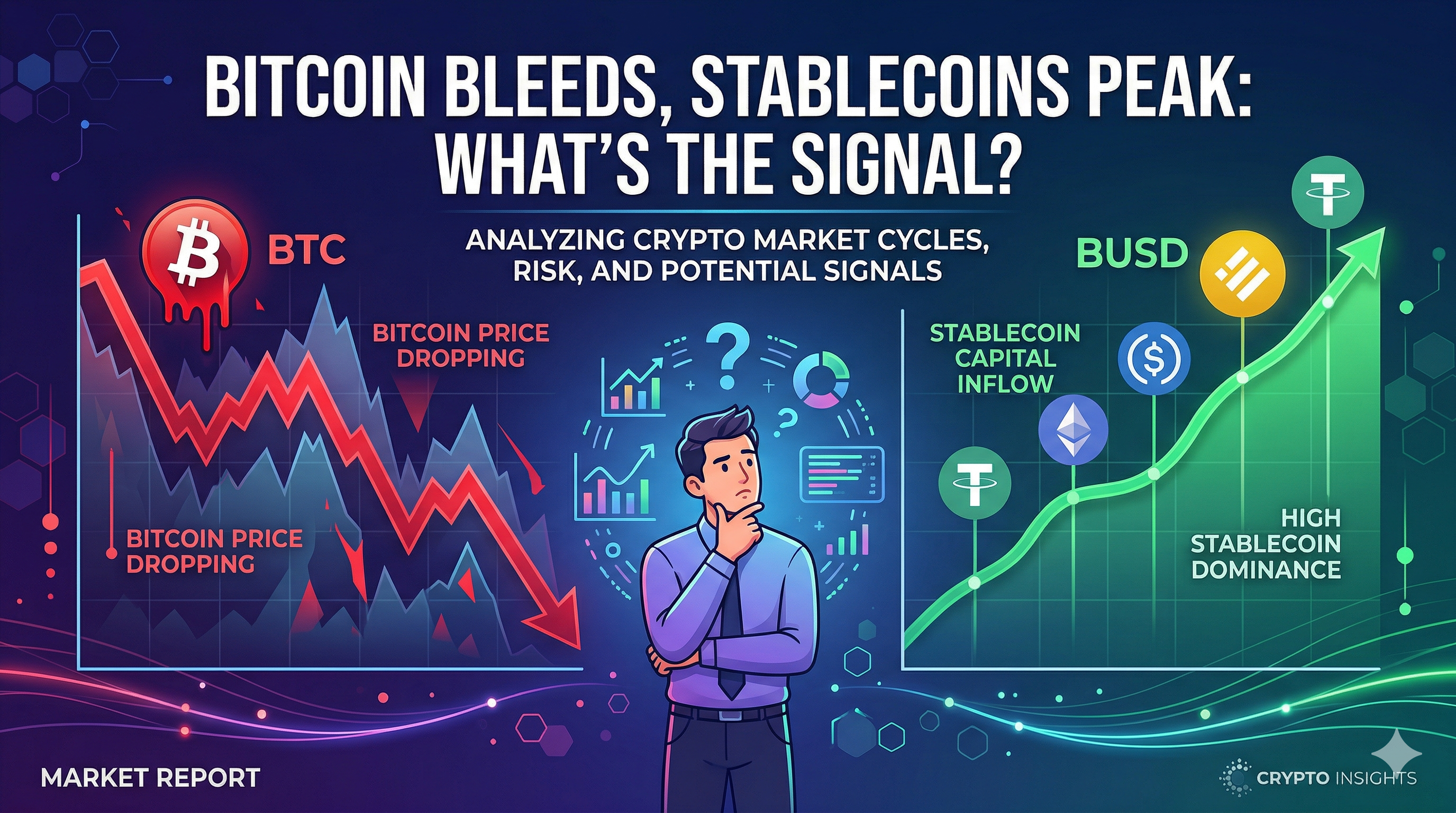
The cryptocurrency market in early 2026 is presenting a paradox that has left both retail traders and institutional desks scratching their heads. On one side of the screen, Bitcoin (BTC) has been consistently testing local laws, shivering under the pressure of macroeconomic uncertainty and specific structural liquidations. On the other side, the total market capitalization of stablecoins—led by USDT, USDC, and the newly regulated federally-compliant tokens—is surging to unprecedented all-time highs.
Historically, when Bitcoin "bleeds," capital usually exits the ecosystem entirely, flowing back into the safety of the U.S. Dollar or Treasury bonds. However, the current data suggests a different narrative: the money is staying inside the house. This "Great Divergence" is not merely a market fluke; it is a sophisticated shift in how liquidity is being managed in a post-regulation crypto landscape. To understand where the market is headed, we must look past the red candles and analyze the "dry powder" accumulating on the sidelines.
Key Takeaways
Before diving into the deep technical and macroeconomic drivers of this trend, here are the essential points to understand about the current market structure:
-
Liquidity Rotation, Not Exit: Capital is not fleeing the crypto ecosystem; it is rotating from volatile assets (Bitcoin/Altcoins) into stable value stores (Stablecoins) to hedge against short-term downside.
-
The "Dry Powder" Thesis: Record-high stablecoin market caps represent a massive reservoir of sidelined buying power. This is often a precursor to a high-velocity recovery once a "buy signal" is triggered.
-
Regulatory Maturity: 2026 legislation has transformed stablecoins into institutional-grade instruments, making them the preferred vehicle for "parking" cash during periods of high volatility.
-
The SSR Indicator: The Stablecoin Supply Ratio (SSR) is currently at levels that suggest Bitcoin is technically "undersold" relative to the amount of buying power available on exchanges.
-
Macro Headwinds vs. Micro Strength: Bitcoin’s current weakness is largely tied to external factors, including Federal Reserve "higher-for-longer" rhetoric, while the internal on-chain metrics remain exceptionally robust.
-
Institutional "Ready-Position": Asset managers are maintaining large stablecoin balances to facilitate near-instantaneous re-entry into BTC Spot ETFs and on-chain markets.
Why Bitcoin is Hitting Lows: The 2026 Macro Perspective
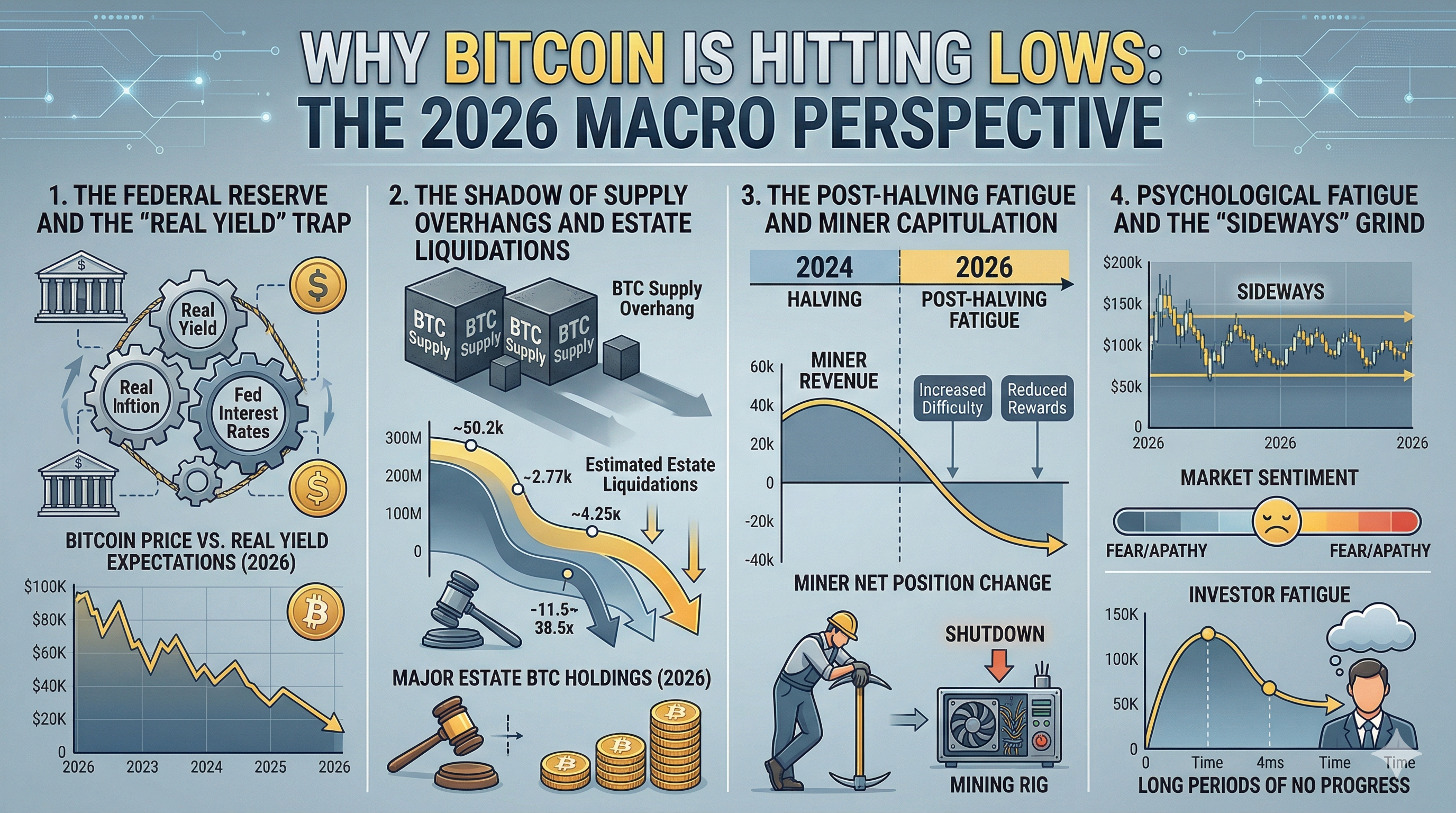
To understand the signal, we must first diagnose the "bleed." Bitcoin’s price action in the first quarter of 2026 has been characterized by "death by a thousand cuts" rather than a single catastrophic crash. Several overlapping factors have contributed to this downward drift.
The Federal Reserve and the "Real Yield" Trap
As we move through March 2026, the global macro environment remains stubbornly complex. Despite earlier predictions of aggressive rate cuts following the 2025 cooling period, the Federal Reserve has maintained a cautious, data-dependent stance. With "real yields" (the yield on Treasuries minus inflation) remaining positive and attractive, the opportunity cost of holding a non-yielding asset like Bitcoin has increased.
Institutional investors, who now make up over 60% of Bitcoin’s daily volume via Spot ETFs and sophisticated derivatives, are highly sensitive to these interest rate differentials. When the "risk-free rate" is high, the speculative appetite for digital gold naturally softens. This has led to a period of "valuation compression" where Bitcoin is being treated more like a high-duration tech stock than a detached monetary sovereign.
The Shadow of Supply Overhangs and Estate Liquidations
A specific weight on the 2026 market has been the final distribution of assets from long-defunct entities. We are currently seeing the tail end of major liquidations involving legacy whale wallets that have been locked in legal battles for over a decade. As these coins are returned to creditors, many choose to realize gains that have been compounding since 2013 or 2014.
These distributions create a "sell-side pressure" that the market must absorb. While the underlying demand for Bitcoin from pension funds and corporate treasuries remains steady, the sheer volume of these forced sales—often hitting the market in $500M tranches—has prevented the price from establishing a firm floor, leading to the repeated testing of lower support levels near the $65,000–$68,000 range.
The Post-Halving Fatigue and Miner Capitulation
We are now nearly two years past the 2024 halving. Historically, the mid-point between halvings is often a period of "re-accumulation" where the initial hype has faded, and the market waits for the next supply-shock catalyst. In this phase, the "hashrate wars" reach a fever pitch. Miners who are operating on thin margins with older ASIC models often find themselves forced to sell their rewards to cover upgraded hardware costs or debt obligations. This "miner capitulation" adds further incremental pressure to the price, creating a feedback loop where lower prices force more selling until the least efficient miners are flushed out.
Psychological Fatigue and the "Sideways" Grind
Market psychology in 2026 is grappling with the "boring" phase of the cycle. After the explosive growth seen in late 2024 and early 2025, the current sideways-to-downward movement feels like a bear market to late-comers. This leads to a "washout" of leveraged long positions. On-chain data shows that "Paper Hands" (short-term holders) are exiting their positions at a loss, while "Diamond Hands" (long-term holders) are simply holding firm but not yet aggressively bidding the price back up.
The Stablecoin Surge: Why "Dry Powder" is Reaching Record Highs
While Bitcoin's price chart looks weary, the stablecoin sector is in a state of hyper-growth. This divergence is perhaps the most bullish long-term indicator we have seen in years. It signifies that the plumbing of the financial system is being permanently upgraded to a digital-first model.
The "Safe Haven" Within Crypto
In previous cycles (2018 or 2021), a Bitcoin drop usually coincided with a drop in total stablecoin supply, as investors cashed out to fiat (USD/EUR) and moved money back to traditional banks. In 2026, that trend has fundamentally reversed. Investors are now moving from BTC to USDT or USDC but keeping their funds on-chain.
This suggests a high level of confidence in the crypto infrastructure itself. Traders are not leaving the burning building; they are simply moving to a reinforced "safe room" within the building. They recognize that the volatility is temporary, but the efficiency of on-chain capital is permanent. This "on-chain retention" is a milestone in the maturity of the asset class.
The Impact of the CLARITY and GENIUS Acts
The legislative breakthroughs of 2025—specifically the CLARITY Act (Consumer Liquidity and Regulation of Integrated Tokens Yields)—provided a clear federal framework for stablecoin issuers in the United States. This legislation mandated 1:1 reserves in high-quality liquid assets (HQLA) like short-term Treasuries and overnight repos.
This has allowed massive fintech players, such as PayPal, Stripe, and even traditional banks like J.P. Morgan, to scale their own regulated stablecoins. Consequently, the "Total Value Locked" (TVL) in stablecoins has ballooned because these assets are now seen as a legitimate, high-speed alternative to the traditional T+2 settlement system of the legacy banking world. In 2026, the "Digital Dollar" is no longer a fringe concept; it is the backbone of global trade finance.
Stablecoins as a Yield Engine: The RWA Revolution
In 2026, holding "cash" on-chain is no longer a zero-yield endeavor. With the integration of Real World Assets (RWA), many stablecoin holders are earning 4.5% to 5.5% yields backed by tokenized U.S. Treasury bills directly within their digital wallets.
This has incentivized investors to stay "crypto-native" even when they are bearish on Bitcoin’s immediate price action. Why move money back to a brokerage account that takes three days to settle when you can earn a "risk-free" yield on-chain and be ready to buy Bitcoin in five seconds? This massive accumulation of on-chain cash creates a "coiled spring" effect. The more capital that stays in stablecoins, the more explosive the eventual re-entry into Bitcoin will be.
Global Liquidity and the De-Dollarization Hedge
Outside of the United States, stablecoins are seeing massive adoption as a hedge against local currency devaluation. In emerging markets, the demand for USDT has reached a fever pitch. In these regions, Bitcoin is often seen as too volatile for daily savings, but stablecoins are the perfect "Digital Dollar." This global demand floor keeps the market cap of stablecoins rising even when Western speculative demand for Bitcoin is in a lull.
What Signal Does This Send? Analyzing the "Rubber Band" Effect
When Bitcoin hits local lows and stablecoin supplies hit highs, the "rubber band" of market physics is being stretched to its limit. In financial markets, such a massive divergence between "Price" and "Liquidity" almost always resolves with a violent move toward the liquidity.
The Stablecoin Supply Ratio (SSR) and the "Buying Power" Metric
The SSR is a metric that measures the ratio between Bitcoin's market cap and the total supply of stablecoins. It essentially tells us: "How much of the total Bitcoin supply could be bought by the current stablecoin supply?" A low SSR indicates that the current stablecoin supply has massive "buying power." Currently, in March 2026, we are seeing the SSR hit levels not seen since the pre-bull run of late 2023. This is a classic "bullish divergence." It tells us that there is enough money sitting on the sidelines to buy up nearly every single Bitcoin currently sitting on exchange order books. This is not the profile of a "dying" market; it is the profile of an "over-liquid" market waiting for a reason to buy.
The "Wait-and-See" Institutional Sentiment
Large-scale hedge funds and family offices are not currently selling Bitcoin into a vacuum; they are "parking" liquidity. The signal being sent here is one of calculated patience. The market is waiting for a specific catalyst—likely a shift in Federal Reserve rhetoric toward "quantitative easing" or a positive CPI (Consumer Price Index) print—to trigger a massive re-entry.
Because the liquidity is already in the form of stablecoins, the transition back into Bitcoin will be near-instantaneous. Sophisticated traders often use tools like the KuCoin trading bot to automate their re-entry strategies, ensuring they capture the "God
Fear as a Contrarian Indicator
The sentiment in March 2026 has dipped into "Extreme Fear," with social media filled with "Bitcoin is dead" narratives once again. However, savvy investors know that "price follows liquidity." While the price of Bitcoin is bleeding, the liquidity (stablecoins) is peaking. This suggests that the "bleed" is a temporary price adjustment, while the "peak" in stablecoins is a permanent expansion of market capacity. As the saying goes, "The time to buy is when there is blood in the streets, even if the blood is your own."
The Velocity of Capital in 2026
Another critical signal is the "Velocity of Stablecoins." On-chain analytics show that while stablecoin market caps are high, their turnover rate (how often they move) is currently low. This confirms that capital is "parked" rather than being used for active trading. When velocity starts to pick up—when stablecoins start moving toward exchange deposit addresses—it will be the definitive leading indicator that the "Great Rotation" back into Bitcoin has begun.
Strategic Implications for Investors in a High-Stablecoin Environment
How should a professional or retail investor navigate a market where the primary asset is falling, but the ecosystem’s cash reserves are growing? The strategy in 2026 is about positioning rather than prediction.

Avoid the "Full Exit" Trap
The biggest mistake retail investors make in this environment is exiting the crypto ecosystem entirely—moving funds back to traditional fiat banks. By doing this, you lose the ability to react to the inevitable "v-shaped" recovery. In 2026, the speed of the market is such that by the time a bank transfer clears, Bitcoin could already be 15% higher. Maintaining a position in regulated stablecoins allows you to earn a baseline yield while remaining "click-ready."
Watching the "Whale" Wallets and Accumulation Zones
On-chain data shows that while small-scale "shrimp" accounts (wallets with <1 BTC) are selling Bitcoin in fear, "Whale" addresses (holding >100 BTC) are actually increasing their stablecoin holdings or slowly DCAing (Dollar Cost Averaging) into the current lows. Following the "smart money" in 2026 means focusing on the accumulation of buying power. Whales are currently using the "bleeding" price to fill their bags without spiking the price—a process known as "absorption."
The Role of Ethereum and Layer 2s as Liquidity Hubs
It is also worth noting that much of this stablecoin growth is occurring on Ethereum Layer 2 networks (like Arbitrum, Base, and Optimism). The ultra-low transaction costs of 2026 make it incredibly efficient for capital to sit in stablecoins and then deploy into Bitcoin (via WBTC or tBTC) or the broader DeFi market at a moment's notice. The signal here is that the plumbing of the crypto market is more efficient than ever, which will accelerate the next recovery phase once the macro clouds clear.
Diversification into Yield-Bearing Stables
For the risk-averse, the current market offers a unique opportunity: "Yield Farming" on stablecoins while waiting for the BTC bottom. By utilizing decentralized lending protocols or regulated yield-bearing stables, an investor can grow their "dry powder" by 5% or more annually. This means that even if Bitcoin stays flat for six months, your eventual "buy-in" power is increasing. This is the professional way to handle a sideways market.
Technical Analysis: The Support Levels to Watch
While the on-chain signal remains bullish due to soaring stablecoin supply, the price action tells a bearish story for now. The key to navigating this divergence lies in identifying the technical breakpoint where the sidelined stablecoin liquidity is likely to re-enter the Bitcoin market.
The first level to watch is $64,500, which has emerged as a critical "line in the sand." This area coincides with the 200-day moving average and a dense volume profile node, forming a strong value area low. Should Bitcoin retest this level, it is expected to trigger a massive wave of stablecoin-to-BTC conversions, as institutional limit orders are likely stacked here, waiting to absorb selling pressure.
Adding to the bullish technical case is a hidden bullish divergence on the daily Relative Strength Index (RSI). While Bitcoin's price continues to print lower lows, the RSI is forming higher lows—a classic signal of weakening downside momentum. When this technical setup is combined with record-high stablecoin reserves, the market begins to resemble an exhausted sell-off, where sellers have diminishing supply to push prices lower, while buyers hold more dry powder than ever before.
Perhaps the most compelling factor is the state of exchange reserves. Despite the ongoing price bleed, the amount of Bitcoin held on exchanges continues to hit multi-year lows. This suggests that the current sell pressure is driven by a shrinking pool of liquid supply being traded repeatedly, while the majority of Bitcoin is being moved into cold storage. This combination—a supply shock on the asset side paired with a liquidity surge on the stablecoin side—creates one of the most explosive technical setups possible in financial markets. The stage is set; the only missing piece is the trigger.
The Path Forward: What Happens Next?
The "Great Divergence" between Bitcoin and stablecoins cannot last forever. In the world of finance, massive amounts of capital do not sit idle and "stable" for long; they seek growth. The current state is an artificial equilibrium maintained by fear and uncertainty.
As we look toward the second half of 2026, the most likely scenario is a "Liquidity Snap." Once the supply overhangs from legacy liquidations are fully absorbed—likely by the end of Q2—the record-high stablecoin supply will act as a vacuum.
We anticipate a two-stage recovery:
-
The Relief Rally: A slow grind back to $75,000 as the "dry powder" starts to nibble at the lows.
-
The FOMO Phase: A rapid surge past $100,000 as the billions in sidelined stablecoins realize the bottom is in and rush to enter the market at any price.
The current signal is not one of a dying market, but of a reloading market. The architecture of the crypto economy has evolved to a point where "volatility management" is now a standard practice. Seeing billions of dollars flow into stablecoins during a Bitcoin dip is the ultimate sign of institutional maturity—it shows that the world’s largest capital allocators are now treating crypto not as a gamble, but as a permanent asset class with its own internal treasury system.
Conclusion: The Market is Reloading, Not Retiring
The narrative that "Bitcoin is over" every time it tests a local low is a tired one, and in 2026, it is objectively contradicted by the data. The record-high stablecoin market cap is the "smoking gun" that proves the bull market’s foundation is stronger than ever. We are not seeing capital leave the system; we are seeing it wait for a better price.
We are witnessing a structural evolution. In previous years, a Bitcoin drop meant a loss of faith. In 2026, a Bitcoin drop means a strategic rotation into stablecoins. This shift reduces the "total exit" risk and ensures that when the sentiment shifts, the capital is already on-chain and ready to ignite the next leg of the cycle.
For the disciplined investor, the signal is clear: Watch the stablecoins, not just the candles. The "dry powder" is at an all-time high, and it only takes a single spark—be it a rate cut, a regulatory win, or a corporate BTC buy announcement—to turn that sideline liquidity into the next historic rally. Stay focused on the macro trends, respect the "dry powder" thesis, and remember that in crypto, the loudest noise usually happens right before the biggest move. The spring is coiled; the only question is when it will be released.
FAQs
Why is Bitcoin dropping if the overall crypto market is supposedly growing?
Bitcoin is currently facing specific macro headwinds, including high real yields on Treasuries and "supply overhangs" from legacy estate liquidations (like the final FTX/Mt. Gox distributions). While the price is dropping, the underlying liquidity remains in the system via stablecoins, indicating a temporary shift in asset preference rather than a market-wide exit.
What exactly is "Dry Powder" in the context of cryptocurrency?
"Dry powder" refers to cash or highly liquid assets (like stablecoins) that are being held on the sidelines to be deployed when a favorable investment opportunity arises. High stablecoin market caps mean there is a significant amount of "on-chain cash" ready to buy Bitcoin the moment a trend reversal is confirmed.
Are stablecoins safe to hold during a Bitcoin crash in 2026?
Following the CLARITY Act of 2025, regulated stablecoins in the U.S. (like USDC or GUSD) must maintain 1:1 reserves in high-quality liquid assets. While all investments carry some risk, the regulatory framework of 2026 has made stablecoins significantly safer and more transparent than they were in previous cycles, making them reliable "parking spots" during volatility.
How does the Stablecoin Supply Ratio (SSR) predict price moves?
The SSR calculates the ratio between Bitcoin's market cap and the total supply of stablecoins. A low SSR means stablecoins have more "buying power" relative to Bitcoin's price. Historically, a very low SSR has often coincided with market bottoms and preceded significant, high-velocity price recoveries because the "fuel" for the rally is already present on exchanges.
Is the growth of stablecoins a sign of "De-Dollarization"?
Ironically, the growth of stablecoins is actually a sign of the "Digital Dollarization" of the world. Even as some countries move away from the physical USD in trade, they are increasingly using USD-pegged stablecoins for digital commerce and savings, which provides a massive, consistent demand floor for the crypto ecosystem.
What happens to the market if a major stablecoin de-pegs?
In 2026, the risk of a "death spiral" like Terra/Luna is much lower because the market has shifted toward collateralized, fiat-backed stables. However, a de-peg of a major asset would cause temporary chaos. This is why many institutional investors now diversify their "dry powder" across multiple regulated stablecoins (e.g., holding 50% USDC and 50% USDT).