

The Essential Guide to REKT Meaning: How to Navigate Crypto’s Deadliest Traps
2026/03/25 14:57:02
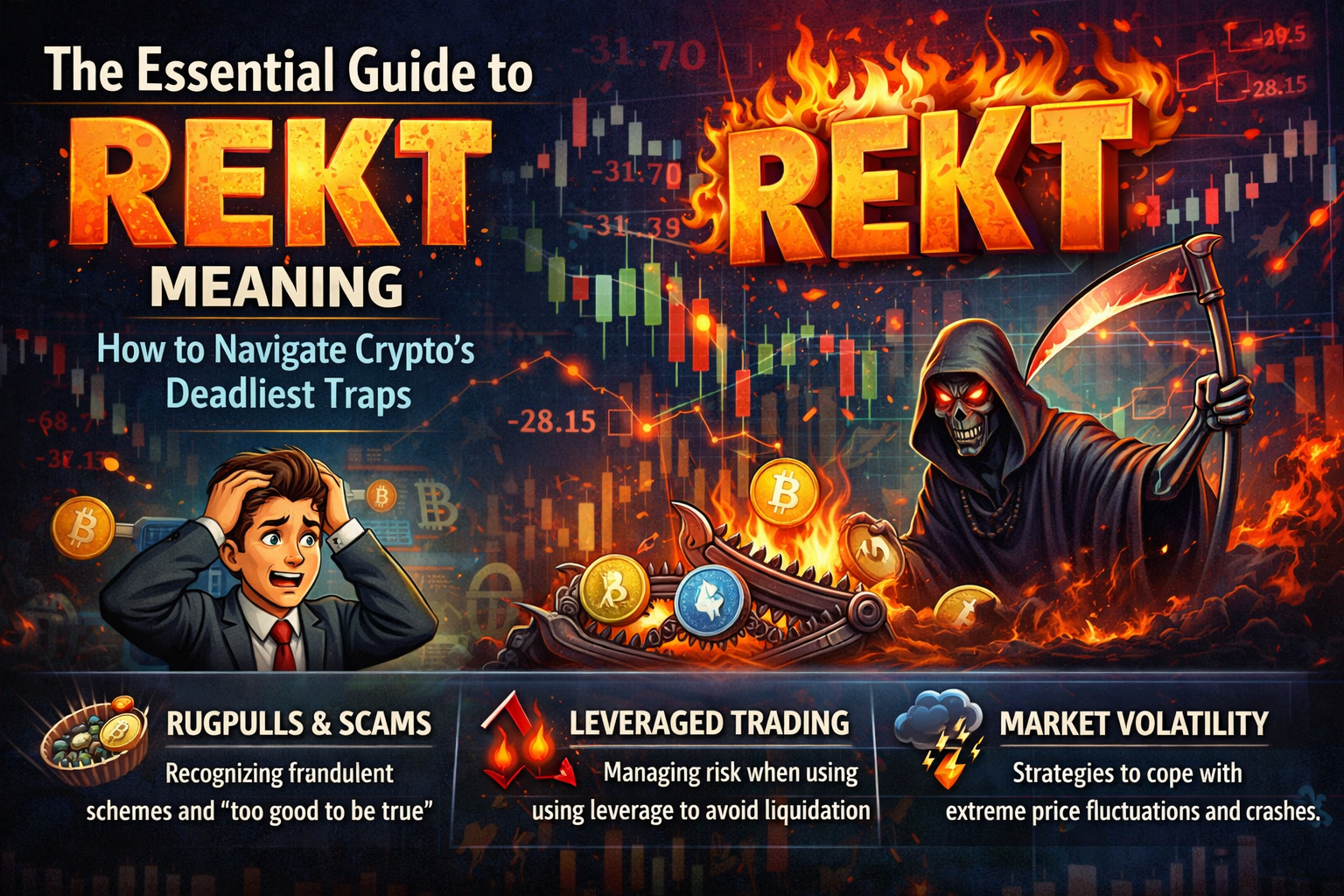
The cryptocurrency market is a high-octane environment where fortunes are made and lost in the blink of an eye, often leaving traders searching for the true rekt meaning. This term has become a cornerstone of digital asset culture, symbolizing the moment a trader’s portfolio faces total devastation due to a bad trade or a sudden, sharp market liquidation event.
As we dive into the mechanics of digital finance, understanding the rekt meaning and the secondary keywords associated with market failure is essential for any participant on a crypto exchange platform.
-
Definition: "Rekt" is slang for "wrecked," typically referring to a trader losing their entire investment or being liquidated.
-
Liquidation: This is the primary mechanism behind getting rekt, occurring when a leveraged position is forcibly closed.
-
Leverage Risks: While leverage can amplify gains, it significantly increases the "liquidation price" proximity.
-
Risk Management: Tools like stop-losses and proper position sizing are the only defense against becoming a "rekt" statistic.
-
Psychological Impact: Beyond financial loss, getting rekt often results in "revenge trading," which leads to further ruin.
The term rekt is a phonetic spelling of the word "wrecked." In the context of cryptocurrency trading, it refers to a severe financial loss that often results in the total depletion of a trader’s capital. While it originated in the online gaming community to describe a player who was utterly dominated, it transitioned into the crypto space during the early Bitcoin bull runs to describe those caught on the wrong side of massive price swings.
The Different Flavors of Being Rekt
Getting rekt isn’t always a one-size-fits-all experience. Depending on the scenario, it can manifest in several ways:
-
The Liquidation Rekt: The most common form, where a trader's margin account is wiped out by a price move.
-
The Rug Pull Rekt: When a project's developers vanish with investor funds, leaving the token value at zero.
-
The "Shitcoin" Rekt: Buying into a hyped-up asset at the peak (FOMO) only to watch it drop 99% in value.
-
The Hack Rekt: Losing assets due to a security breach on a DeFi protocol or a non-custodial wallet.
Why Slang Matters in SEO
For a crypto exchange, the rekt meaning is more than just a meme; it is a high-intent search term. Traders searching for this often seek to understand why they lost money or how to prevent it from happening again. By providing a clear definition, we bridge the gap between "internet speak" and professional financial education.
At its core, getting rekt is usually the result of liquidation. This is an automated process triggered by an exchange's risk management engine. When you trade with leverage, you are essentially borrowing money to increase your buying power. However, that borrowed money comes with strings attached: the "Maintenance Margin."
The Liquidation Process
When the market price of an asset moves against your position, your unrealized losses begin to eat into your initial collateral. If the price reaches your liquidation price, the exchange must sell your assets to ensure they can pay back the borrowed funds.
-
Step 1: Margin Decay: Your "Equity" falls as the price moves the wrong way.
-
Step 2: Margin Call: Some platforms send a notification (though in fast markets, this is rare).
-
Step 3: Forced Exit: The exchange’s engine executes a market order to close your position instantly.
Note: In a "flash crash," the price can drop so quickly that the liquidation engine sells at a much lower price than expected, often leaving the trader with a balance of zero.
Not every trader is equally susceptible to the rekt meaning. Usually, the "victims" of the market fall into specific psychological and strategic categories.
The "Degenerate" Gambler
These traders use 50x to 100x leverage on highly volatile meme coins. For them, a 1% move in the wrong direction results in a total loss. They prioritize "moon shots" over sustainable growth.
The FOMO Victim
"Fear Of Missing Out" drives traders to buy assets after they have already pumped 500%. When the "smart money" begins to take profits, these late-comers are the ones left holding the bag, eventually getting rekt as the price retraces to its mean.
The Emotionally Driven Trader
-
Revenge Traders: After a small loss, they increase leverage to "win it back" quickly.
-
Over-Traders: They feel they must be in a position at all times, leading to poor decision-making during low-liquidity periods.
To truly grasp the rekt meaning, one must understand the "Holy Trinity" of crypto risk: Leverage, Volatility, and the dreaded Margin Call.
-
Leverage: The Great Multiplier
Leverage allows you to control a large position with a small amount of capital. For example, with 10x leverage, a $1,000 deposit lets you trade $10,000 worth of Bitcoin. While this sounds great, the math of the rekt meaning is simple: if Bitcoin drops 10%, your $1,000 is gone.
-
Volatility: The Double-Edged Sword
Unlike traditional stock markets, crypto can move 20% in a single hour. This volatility is what makes the rekt meaning so prevalent in this industry. Assets with low "liquidity" (shallow order books) are especially dangerous, as a single large sell order can trigger a cascade of liquidations.
-
Margin Calls vs. Instant Liquidation
In traditional finance, you might get a phone call asking for more funds. In the world of crypto exchanges, things move too fast. Most platforms use Auto-Deleveraging (ADL) or instant liquidation to protect the exchange's solvency, meaning there is no "second chance" once the price hits the threshold.
The short answer is: No. High leverage is never "safe," but it can be used strategically by professionals. However, for the average user, high leverage is the fastest path to fulfilling the rekt meaning.
The Anatomy of a Flash Crash
A flash crash occurs when a large amount of sell orders hit the market simultaneously. This triggers stop-losses and liquidations, which creates more selling pressure.
-
Cascading Liquidations: Long positions getting rekt trigger more sells, which pushes the price lower, which rekts more longs.
-
Slippage: During a flash crash, there are no buyers. Your "stop-loss" at $60,000 might actually execute at $55,000 because of the lack of liquidity.
Leverage Ratios and Safety Zones
| Leverage Level | Price Move to Get Rekt | Risk Category |
| 2x | 50% | Moderate |
| 5x | 20% | High |
| 10x | 10% | Extreme |
| 50x | 2% | Gambling |
| 100x | 1% | Pure Luck |
A common mistake among beginners is confusing a "paper loss" with being "rekt." Understanding the difference is vital for maintaining emotional fortitude during market downturns.
Paper (Unrealized) Losses
If you buy Bitcoin at $70,000 and it drops to $60,000, you have a paper loss. You still own the same amount of Bitcoin. If you don't sell, and the price returns to $70,000, you haven't lost anything. You aren't "rekt" yet—you're just "underwater."
Realized Losses: The Point of No Return
You are officially rekt when that loss is realized. This happens when:
-
You Panic Sell: You sell your assets at the bottom because of fear.
-
You Get Liquidated: The exchange sells your assets for you.
Once a loss is realized, your capital is gone. You cannot "wait for the recovery" because you no longer hold the asset. This is the ultimate rekt meaning: the loss of the opportunity to recover.
Survival in the crypto market isn't about how much you can win; it's about how much you can not lose. Professional traders use specific frameworks to avoid the rekt meaning.
Developing a Trading Plan
Never enter a trade without knowing three things:
-
Entry Point: Why are you buying now?
-
Take Profit (TP): At what price will you be happy with your gains?
-
Stop-Loss (SL): At what price do you admit you were wrong?
The 1% Rule
A common strategy is to never risk more than 1% of your total account balance on a single trade. If you have $10,000, a single "rekt" trade should only cost you $100. This allows you to be wrong 100 times before you are truly out of the game.
If you want to avoid the rekt meaning, you must treat trading as a business, not a trip to the casino. Here are the practical steps to protect your portfolio.
-
Use Stop-Loss Orders
A stop-loss is an automated instruction to sell your asset if it hits a certain price. It is your "emergency exit." Even if you are sleeping, the exchange will close your position before it reaches the liquidation point.
-
Master Position Sizing
Instead of using high leverage on a small amount of money, use low leverage on a larger portion of your "available margin." This keeps your liquidation price far away from the current market price, giving the trade "room to breathe" during volatile spikes.
-
Isolated vs. Cross Margin
-
Isolated Margin: Limits the risk of a single trade to the amount you specifically allocated to it.
-
Cross Margin: Uses your entire account balance to prevent liquidation. While it provides more room, a single bad trade can get your entire account rekt.
Understanding the rekt meaning is a rite of passage for every crypto trader, but it doesn't have to be a permanent state of being. By recognizing that market volatility and leverage are tools rather than toys, you can navigate the deadliest traps of the digital asset space. The key to long-term success on a crypto exchange platform is capital preservation; as long as you have "chips" left to play with, you can always find another opportunity. Stay disciplined, use stop-losses, and never let the fear of missing out lead you into a liquidation event that could have been easily avoided with proper risk management.
What is the simple rekt meaning in crypto?
The term rekt is slang for "wrecked." It describes a situation where a trader suffers a catastrophic financial loss, typically resulting from a leveraged position being liquidated or an asset's price crashing to near zero.
How do I avoid getting rekt on an exchange?
To avoid the rekt meaning, traders should use low leverage, always set a stop-loss order, and practice proper position sizing. Never invest more than you can afford to lose and avoid chasing "hype" coins with no utility.
Does getting rekt only happen with leverage?
While the most common rekt meaning involves leverage and liquidation, you can also get rekt in spot trading. This happens if you buy a "rug pull" project or a token that loses 99% of its value, effectively wiping out your investment.
What is a liquidation price?
A liquidation price is the specific price point at which an exchange will forcibly close your leveraged position. If the market reaches this price, your collateral is used to cover the debt, and you are officially "rekt."
Is "paper loss" the same as being rekt?
No. A paper loss is an unrealized loss where the value of your asset has dropped, but you still hold it. You only fulfill the rekt meaning once you sell at a loss or the exchange liquidates your position.
Disclaimer: The information on this page may have been obtained from third parties and does not necessarily reflect the views or opinions of KuCoin. This content is provided for general informational purposes only, without any representation or warranty of any kind, nor shall it be construed as financial or investment advice. KuCoin shall not be liable for any errors or omissions, or for any outcomes resulting from the use of this information. Investments in digital assets can be risky. Please carefully evaluate the risks of a product and your risk tolerance based on your own financial circumstances. For more information, please refer to our Terms of Use and Risk Disclosure.