

May 2026 Inflation: How It Could Shape the Federal Reserve’s Next Rate Move
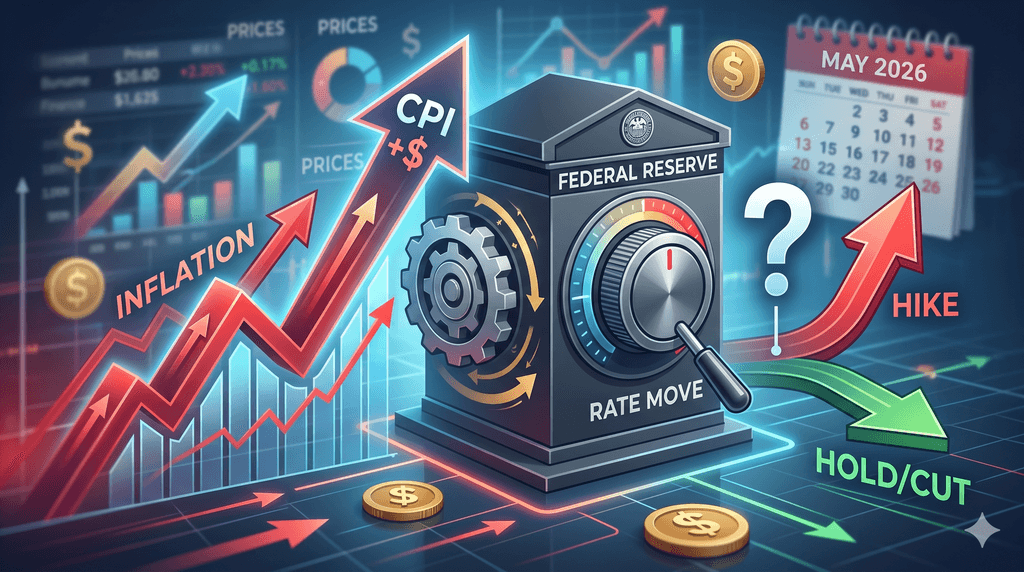
The financial world is standing on a knife-edge as we cross into late April 2026. With the Federal Open Market Committee (FOMC) meeting scheduled for April 28-29, the air is thick with anticipation. The central question dominating the minds of institutional traders and retail HODLers alike is no longer if inflation is back, but how aggressively the Federal Reserve will respond to it.
As of today, the macroeconomic landscape has shifted dramatically. Recent data shows the annual inflation rate in the U.S. jumped to 3.3% in March, the highest level since 2024. This surge, fueled by geopolitical instability and rising energy costs, has thrown a wrench into the Fed’s earlier plans for a "soft landing." For the cryptocurrency market—which has recently seen Bitcoin (BTC) hovering around the $78,000 mark—the Fed’s next move could either be the fuel for a new all-time high or the trigger for a significant correction.
In this deep dive, we analyze the current inflationary pressures, the Federal Reserve's likely trajectory, and the specific strategies crypto investors are using to navigate this high-stakes environment.
Key Takeaways: What You Need to Know Now
-
Inflation Spike: U.S. inflation hit 3.3% in March 2026, driven largely by a 12.5% increase in energy costs due to the ongoing conflict with Iran.
-
Fed Stance: The Federal Reserve is expected to hold rates steady at 3.5%–3.75% during the April meeting, taking a "wait-and-see" approach.
-
Market Sentiment: Markets have priced in a 99% probability of a rate pause, but the "dot plot" suggests only one potential rate cut for the remainder of 2026.
-
Crypto Impact: Bitcoin remains a "macro-driven" asset. Persistent inflation could strengthen the "digital gold" narrative, but higher-for-longer rates may dampen speculative liquidity.
-
Institutional Moves: Despite macro uncertainty, firms like Strategy (MSTR) continue massive acquisitions, recently buying $2.54 billion in Bitcoin.
The March Inflation Shock: Breaking Down the 3.3% Surge
The latest Consumer Price Index (CPI) report was a wake-up call for those who thought inflation was a ghost of the past. Moving from a steady 2.4% in early 2026 to a staggering 3.3% in March, the acceleration was swifter than most econometric models predicted.
The primary culprit? Energy. Gasoline prices have jumped 18.9%, and fuel oil has skyrocketed by 44.2%. This isn't just a domestic issue; the war with Iran has disrupted global supply chains, forcing energy inflation to hit 12.5% annually. While "core inflation" (excluding food and energy) remains slightly more anchored at 2.6%, the "headline" number is what grabs the headlines—and dictates the Fed's political and economic pressure.
For crypto enthusiasts, this is a double-edged sword. On one hand, rising costs erode the purchasing power of the dollar, historically a bullish catalyst for Bitcoin. On the other hand, it forces the Fed to keep the "liquidity tap" closed, which usually hurts risk assets.
The Federal Reserve’s Dilemma: Stability vs. Growth
Federal Reserve Chair Jerome Powell finds himself in a familiar, albeit more intense, "tightening" corner. The Fed funds rate currently sits between 3.5% and 3.75%. Before the Iranian conflict, the consensus was a series of rate cuts to stimulate a cooling economy. Now, that path is obscured.
The April 2026 FOMC Outlook
Market analysts and the CME FedWatch Tool are nearly unanimous: there will be no rate change in April. The Fed is navigating two competing risks:
-
Inflation Risk: If they cut too early, inflation could spiral toward the 4.2% forecast some analysts see for later this year.
-
Recession Risk: If they keep rates high for too long, the labor market (currently at 4.4% unemployment) could start to fracture.
The "Dot Plot"—a survey of Fed officials' expectations—now shows a divided house. Seven members see no cuts at all in 2026, while seven others hold out hope for a single 25-basis-point reduction.
Bitcoin as a Hedge: Can Digital Gold Outshine the Dollar?
In 2026, the correlation between Bitcoin and traditional macro indicators has never been more visible. Bitcoin is no longer an "alternative" asset; it is a liquidity barometer.
As inflation ticks up, we are seeing a resurgence of the "scarcity narrative." Unlike the U.S. Dollar, which is subject to the whims of geopolitical crises and Fed policy, Bitcoin’s supply remains fixed. This has led to massive institutional accumulation even in the face of high interest rates.
The recent $2.54 billion purchase by Strategy (formerly MicroStrategy) highlights this trend. By using preferred shares to fund Bitcoin buys, they are betting that the asset’s appreciation will outpace the 11.5% dividend burden they've taken on.
When the Fed speaks, the market moves—fast. During these periods of extreme volatility, the choice of trading platform becomes a strategic decision. While many exchanges struggle with liquidity gaps during flash crashes, KuCoin has emerged in 2026 as a preferred hub for those looking to capitalize on "Fed-induced" price swings.
What makes this particularly interesting right now is how KuCoin’s ecosystem handles these macro shifts. For example, their KuCoin Earn platform allows traders to park assets in stablecoins like USDC or USDT when the Fed’s tone turns hawkish, earning competitive yields that often outpace the very inflation the Fed is fighting. Conversely, for those who anticipate a "dovish" surprise (a hint at future rate cuts), KuCoin’s leverage and futures markets provide the deep liquidity needed to enter positions without the slippage seen on smaller platforms.
There is also a growing curiosity around KuCoin’s AI-driven trading bots. In a market where a single CPI print can move Bitcoin by $3,000 in minutes, manual trading is becoming a relic. These bots allow users to set "grid trading" parameters that profit from the volatility itself, regardless of whether the Fed moves rates up or down. If you’ve been watching the charts and wondering how to stay ahead of the next FOMC announcement, exploring these automated tools might be the edge you’ve been looking for.
-
Ethereum and the Layer-2 Expansion: A Different Kind of Hedge
While Bitcoin acts as the "macro-hedge," Ethereum (ETH) is carving out a role as the "utility-hedge." In April 2026, the focus for ETH has shifted to its Layer-2 (L2) ecosystems like Base, Arbitrum, and Morpho.
Coinbase’s recent expansion of crypto-backed loans in the UK is a prime example. Users can now use their ETH as collateral to borrow USDC without selling their core position. In an inflationary environment, this is a powerful tool:
-
Keep the Asset: You retain exposure to ETH’s potential upside.
-
Get Liquidity: You get cash (USDC) to pay for real-world costs or reinvest.
-
Tax Efficiency: Borrowing against assets is often not a taxable event, unlike selling.
This "on-chain" economy is becoming more resilient to the Federal Reserve’s decisions because it provides intrinsic value through decentralized lending and borrowing, which operates 24/7, independent of traditional bank holidays or Fed "blackout" periods.
2027 and Beyond: The Long-Term Inflation Forecast
Despite the current 3.3% spike, some analysts remain optimistic about the late-2020s. Projections suggest that while 2026 might see a peak of 4.2% inflation, the rate could cool significantly to 1.6% by 2027.
This "V-shaped" inflation curve suggests that the current pain is transitory—linked specifically to the energy crisis and war. If the Fed can successfully "pause" through the summer of 2026 without triggering a deep recession, the stage could be set for a massive "risk-on" rally in 2027. For the crypto market, this means the current period of "sticky" inflation is a test of patience. The winners will likely be those who can withstand the volatility of 2026 to reap the rewards of a more stable 2027.
Conclusion: Preparing for the Fed’s Next Move
The Federal Reserve's meeting on April 28-29 will be a defining moment for the first half of 2026. With inflation at 3.3% and energy prices volatile, the "wait-and-see" approach is the most likely outcome. However, the language the Fed uses is just as important as the rate itself. Any hint of a "hawkish pause" (threatening more hikes) could send crypto prices cooling, while any acknowledgment of a "neutral rate" could send Bitcoin past $80,000.
In this environment, information is your most valuable currency. Stay diversified, keep an eye on the energy markets, and ensure your trading toolkit—whether it's on-chain lending or exchange-based bots—is ready for the sudden shifts that May 2026 is sure to bring.
FAQs
Will the Fed raise interest rates in May 2026?
Current market data suggests a 99% chance that the Fed will hold rates steady at 3.5%–3.75% during the upcoming meeting. However, if inflation continues to climb toward 4%, a hike later in the summer remains possible.
Why is inflation rising if the Fed kept rates high?
The current inflation is "cost-push" inflation, primarily driven by energy supply shocks from the war with Iran. High interest rates are effective at cooling "demand," but they have limited power over global oil prices or geopolitical conflicts.
Is Bitcoin still a good inflation hedge in 2026?
Yes, but with a caveat. While Bitcoin’s fixed supply makes it a theoretical hedge, it is still sensitive to global liquidity. When the Fed stops printing money or keeps rates high, Bitcoin’s price often faces short-term pressure even if inflation is high.
What happens to Altcoins when the Fed pauses rates?
Historically, a Fed "pause" creates a period of stability that allows capital to flow from Bitcoin into higher-risk Altcoins. However, this depends on "core inflation" staying under control; if core inflation rises, Altcoins often suffer more than Bitcoin.
How do I protect my crypto portfolio from inflation?
Many investors are using a three-pronged approach:
-
HODLing Bitcoin for long-term scarcity.
-
Using Stablecoin Yields to generate "cash-like" returns.
-
Utilizing L2 Lending to access liquidity without selling assets.