

Gold Plunges: Is This the Trigger for a Crypto Bull Run?
2026/03/30 16:57:02

The financial markets of 2026 are currently navigating a historic paradox. For much of the past year, gold acted as the undisputed heavyweight champion of the "Anti-Fiat" trade, surging toward the $5,600 per ounce mark. However, a sudden and violent plunge has sent the precious metal reeling back into the $4,400–$4,500 range. Historically, a crash in gold might signal a broader retreat from all "hard assets," but current on-chain data, institutional sentiment, and macroeconomic flow-of-funds suggest something far more transformative is occurring: The Great Capital Rotation.
As gold liquidity is unlocked—often forcibly through margin calls or strategically through profit-taking—investors are increasingly viewing the "Digital Gold" narrative not just as a speculative hedge, but as a superior liquidity sponge. Bitcoin, having consolidated in a grueling sideways range while gold peaked, now stands as the most liquid, transparent, and accessible alternative for fleeing capital. In this comprehensive analysis, we explore whether the gold sell-off is the necessary "cleansing" of the old guard required to ignite a parabolic crypto bull run.
Key Takeaways
-
The Liquidity Paradox: Gold's crash is often a "liquidity event." When big players need cash to cover losses in other sectors (like energy or tech), they sell their most liquid winner: Gold. This creates a pool of sidelined cash ready for the next "Risk-On" cycle.
-
Structural Decoupling: In 2026, the 1:1 correlation between gold and Bitcoin has fractured. Bitcoin is increasingly behaving as a "High-Beta" version of global liquidity rather than a defensive commodity.
-
The Velocity of Digital Assets: Capital can move into and out of Bitcoin ETFs and on-chain protocols at a fraction of the time and cost required for physical gold, making it the preferred vehicle for "Nomadic Capital."
-
Post-Halving Scarcity: While gold’s annual supply remains steady, Bitcoin’s 2026 supply issuance is at an all-time low, meaning even a small rotation of gold’s $14 trillion market cap can cause a massive price appreciation in crypto.
-
The Bullish Threshold: A crypto bull run typically begins when the US Dollar Index (DXY) stabilizes following a gold crash, allowing rotated profits to flow into Bitcoin and Ethereum without the headwind of a surging greenback.
The Macroeconomic Context: Why Did Gold Drop?
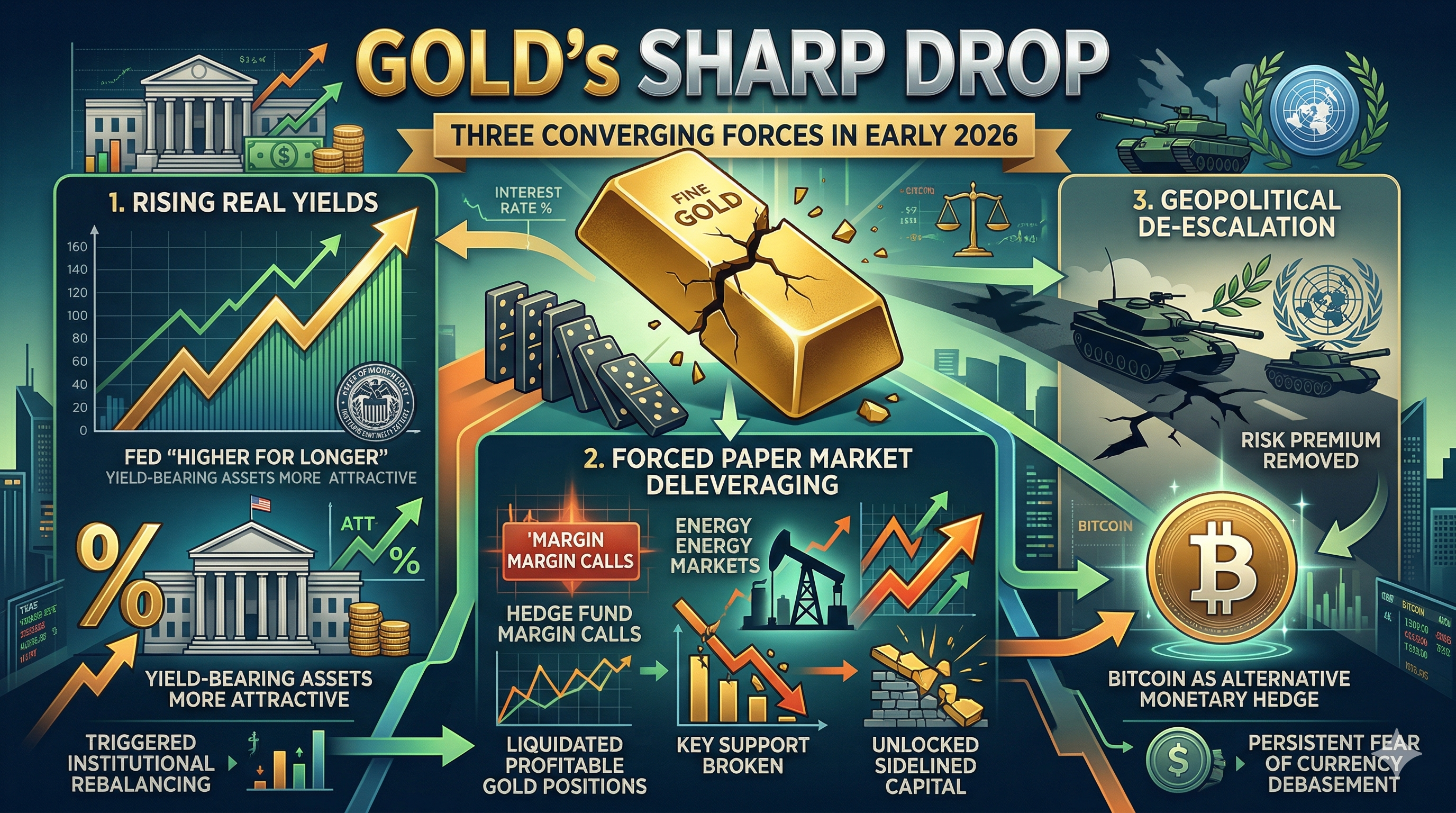
To understand the potential for a crypto surge, we must first accurately diagnose the "Gold Plunge." Gold’s decline from its January 2026 peak was not a slow fade; it was a systemic liquidation. Several macroeconomic factors converged to create a "perfect storm" for the yellow metal.
Rising Real Yields and the "Yield Trap"
Gold’s greatest fundamental enemy is an environment where "Real Yields" (the nominal interest rate minus inflation) are rising. In early 2026, despite sticky inflation figures, the Federal Reserve signaled a "Higher for Longer" stance on interest rates to combat soaring energy costs. When investors can earn a guaranteed 5% or 6% on inflation-protected U.S. Treasuries, the 0% yield of a gold bar becomes a liability.
Institutional portfolios, which operate on strict "Internal Rates of Return" (IRR), began a massive rebalancing act. As capital exited the "non-productive" gold sector, it created a vacuum. In previous decades, this money would have stayed in cash. In 2026, it is looking for "Yield-Bearing Digital Assets" like staked Ethereum or the high growth potential of Bitcoin.
The Paper Market Deleveraging and the Energy Link
It is a common misconception that the price of gold is set by people buying jewelry or coins. The price is set in the "Paper Market"—Futures, Options, and ETFs. In March 2026, a series of supply chain disruptions in the energy sector caused oil prices to spike. Large hedge funds that were "Long Energy" but "Short Volatility" found themselves underwater.
To meet margin calls, these funds were forced to sell their most "in-the-money" positions. Since gold had rallied nearly 40% over the previous 18 months, it was the primary source of emergency liquidity. This "forced selling" broke the $5,000 support level, triggering a cascade of stop-loss orders. This unlocked billions in sidelined USD, much of which is now looking for a new home as the energy crisis stabilizes.
Geopolitical De-escalation and the Risk Premium
Gold carries a "Geopolitical Risk Premium." Whenever there is a threat of conflict, gold prices rise. In the second quarter of 2026, unexpected diplomatic breakthroughs in key conflict zones led to a sudden reduction in this premium. As the "fear bid" evaporated, speculative traders exited gold en masse. However, while the fear of war decreased, the fear of "Currency Debasement" remained. This specific type of fear—monetary fear—is the primary driver for Bitcoin, not gold.
The Historical Correlation Between Gold and Bitcoin: A Tale of Two Hegemons
For over a decade, the crypto industry marketed Bitcoin as "Gold 2.0." The comparison was easy to digest: both have a fixed or limited supply, both are decentralized, and both represent an "exit" from the fiat system. However, the data from the 2024–2026 period shows that these two assets are moving into different stages of their life cycles.
The Fracture of the 2025 Correlation
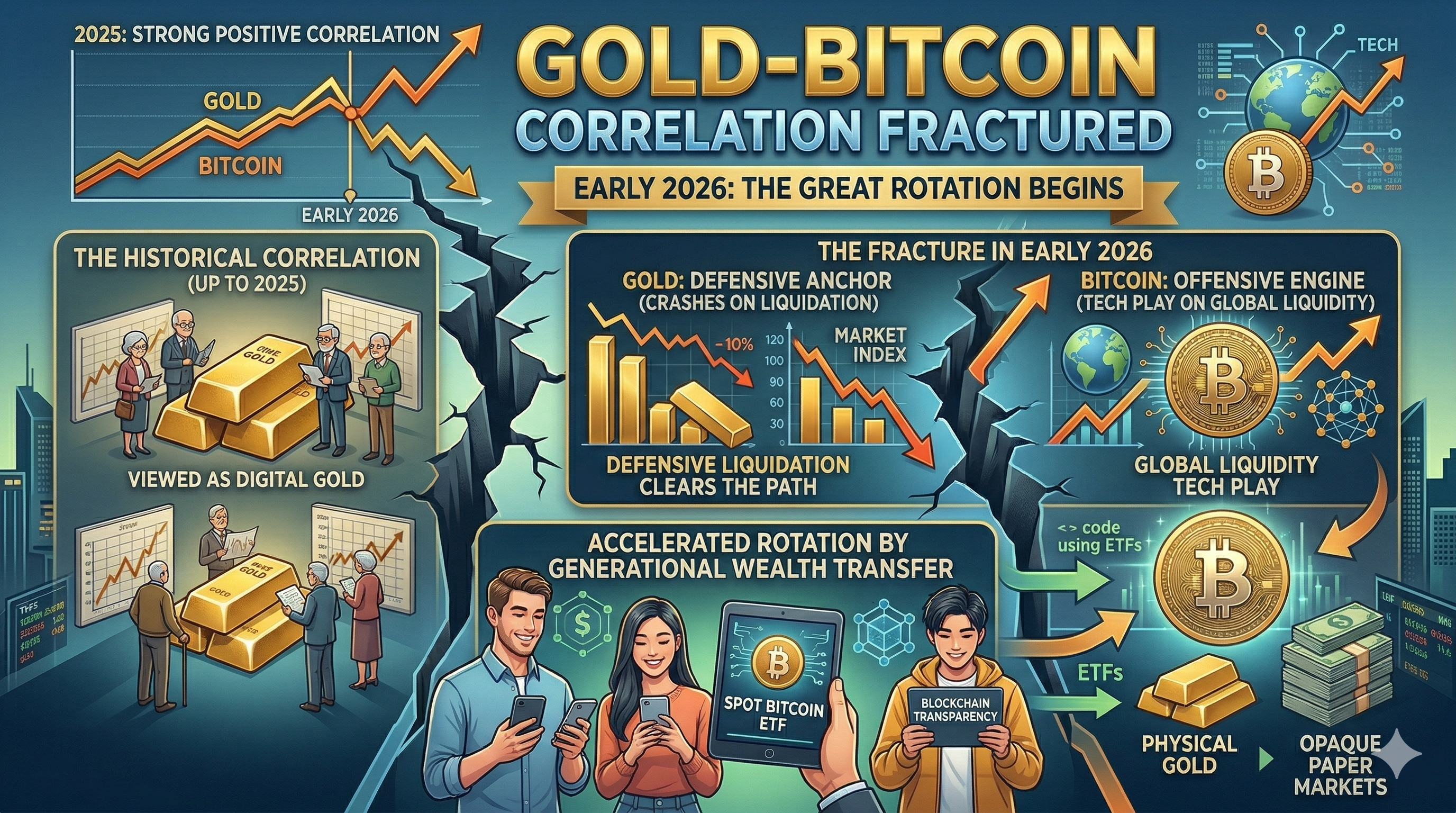
Throughout 2025, gold and Bitcoin moved in a high-degree positive correlation (0.75 or higher). If the dollar was weak, both rose. If the dollar was strong, both fell. But in early 2026, that correlation dropped to near zero, and at times, became negative.
This fracture is significant. It suggests that the market no longer views Bitcoin as just a "Digital Version of Gold," but as a "Technology Play on Global Liquidity." Gold is now seen as the "Defensive Anchor," while Bitcoin is the "Offensive Engine." When gold crashes because defensive positions are being liquidated, it often clears the way for the offensive engine to take over.
Portability and the "Millennial Wealth Transfer"
By 2026, the largest transfer of wealth in human history—from Baby Boomers to Millennials and Gen Z—reached its peak. This demographic shift has a profound impact on the gold-to-crypto rotation. Younger investors do not want to manage physical custody of gold, nor do they trust the opaque nature of paper gold markets. They prefer the "Verify, Don't Trust" nature of the blockchain. As inherited wealth moves out of gold-heavy trusts and into modern brokerage accounts, the natural destination is the Spot Bitcoin ETF or direct on-chain holdings.
The Capital Rotation Theory: From Safe Haven to Risk-On
The core of our bull run thesis is centered on Capital Rotation. In a closed financial system, capital is rarely "deleted"; it is simply reassigned. We are currently witnessing one of the most significant reassignments of the decade.
Profit-Taking: The Psychological Bridge
Imagine a mid-sized institutional fund that allocated 10% of its portfolio to gold in 2024 at $2,000/oz. By 2026, with gold hitting $5,500, that position has grown to nearly 25% of their total portfolio. To maintain their risk mandates, they must sell. This profit-taking isn't a sign of weakness; it's a sign of a successful trade.
Once that gold is sold, the fund manager is left with a pile of cash and a mandate to outperform inflation. As this 'nomadic capital' searches for entry points into the digital frontier, platforms like KuCoin provide the necessary infrastructure, offering a seamless bridge for those moving from traditional fiat-pegged assets into high-growth altcoins and Bitcoin.
The Digital Gold Catch-Up
There is a concept in market technicals known as "The Catch-Up Trade." Historically, one asset in a sector (Hard Money) will lead, and the other will follow with a lag. In late 2025, gold was the leader. In 2026, gold is exhausted. Bitcoin is the laggard that is now primed to "catch up" to the valuation multiples that gold recently enjoyed. For Bitcoin to reach a market cap parity with the private investment portion of gold, its price would need to exceed $450,000. Every dollar that leaves the gold market and enters the crypto market has a 10x "multiplier effect" on crypto's market cap due to the lack of available sell-side liquidity.
The Impact of the Halving Cycle and Supply Dynamics
We cannot discuss a crypto bull run without addressing the "Supply Shock" of 2026.
Dwindling Exchange Reserves
In 2026, the amount of Bitcoin held on centralized exchanges (Binance, Coinbase, Kraken) has hit a 10-year low. Most BTC is now locked in long-term cold storage or held by ETF providers who are not selling. When the "Gold Rotation" begins, and thousands of investors try to buy Bitcoin at once, they will find that there is very little "Ask" (supply) on the books.
This lack of supply means that even a moderate amount of capital flowing from the gold market can cause a "vertical" price move. Unlike gold, where higher prices lead to more mining and more supply hitting the market, Bitcoin’s supply is fixed. No matter how high the price goes, the network will not produce more than the scheduled amount. This makes the rotation from gold to crypto a "volatile upward" event.
The Role of Institutional ETFs
The introduction of Spot ETFs in 2024 was the bridge. By 2026, these ETFs have matured. They are now integrated into the model portfolios of major banks like Morgan Stanley and UBS. When a wealth manager decides to move 1% of their clients' "Commodity" allocation into "Digital Assets," it happens with the click of a button. The friction that once prevented gold-to-crypto rotation has been permanently removed.
Key Indicators to Watch for a Crypto Bull Run
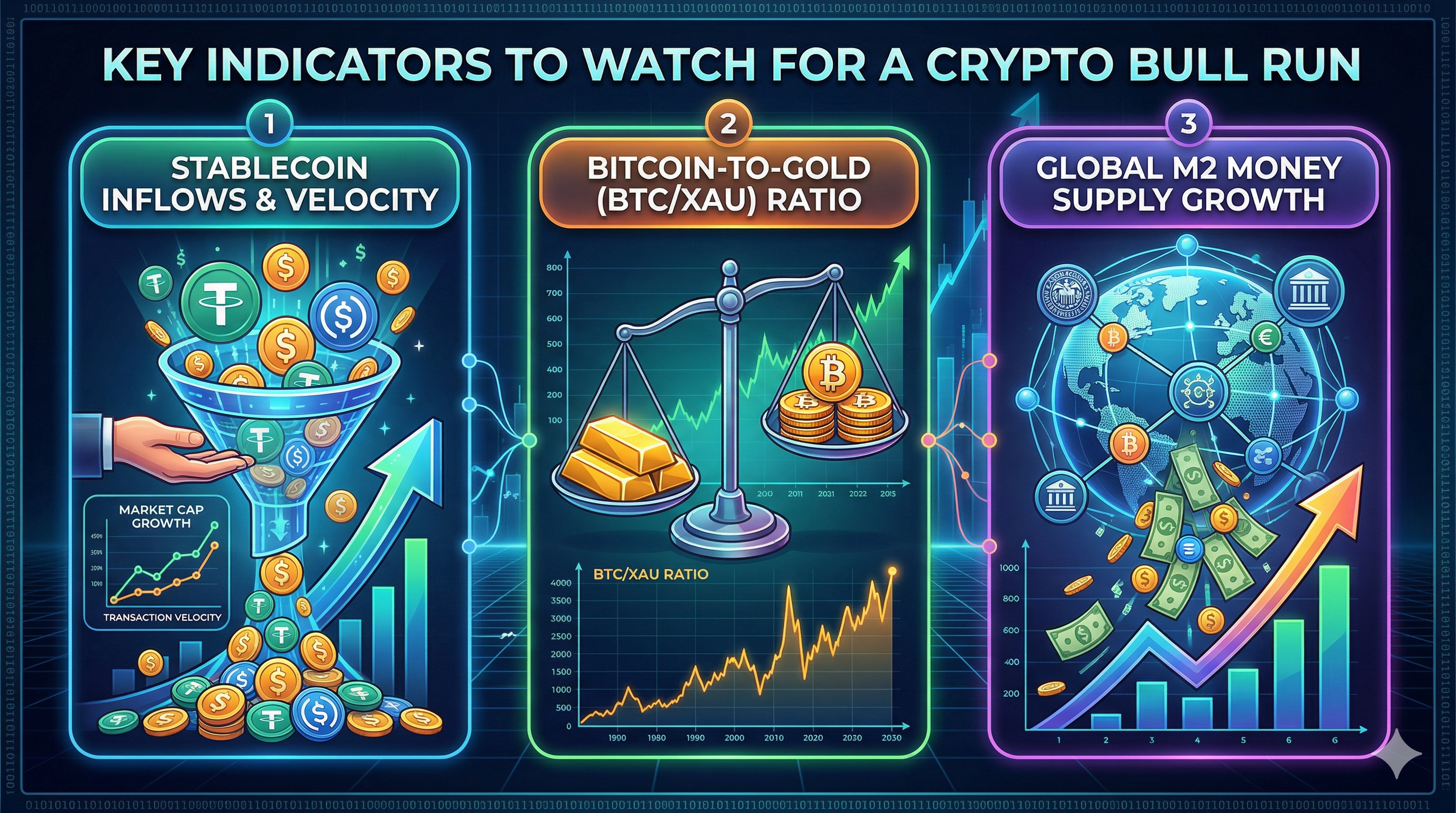
For the publisher and the active trader, monitoring the right data is the difference between catching the wave and being crushed by it. As gold plunges, keep these three high-signal indicators on your dashboard.
-
Stablecoin Inflows and Velocity
Stablecoins are the "Dry Powder" of the crypto ecosystem. We closely monitor the Market Cap of USDT (Tether) and USDC (Circle). If gold is crashing and the market cap of stablecoins is rising, it means investors are converting their gold/fiat into "Digital Dollars" to prepare for a crypto entry. Furthermore, we look at "Exchange Inflow Mean"—if huge amounts of stablecoins are moving onto exchanges while BTC is moving off, a massive pump is being prepared.
-
The Bitcoin-to-Gold (BTC/XAU) Ratio
This is the most important chart for 2026. The BTC/XAU ratio measures how many ounces of gold it takes to buy one Bitcoin. When this ratio breaks out of a long-term resistance, it signals that Bitcoin is officially outperforming gold as a store of value. A rising ratio during a gold crash is a "Buy" signal for the crypto bull market.
-
Global M2 Money Supply Growth
Bitcoin is essentially a "Barometer for Fiat Debasement." Even if gold is falling because of short-term yield spikes, we must look at the total amount of money in the global system. In 2026, with government debt levels at record highs, central banks are often forced to engage in "Shadow QE" (Quantitative Easing). If the global M2 supply is growing, Bitcoin will eventually follow.
The Role of Ethereum and Altcoins in the Rotation
While Bitcoin is the "Primary" beneficiary of the gold rotation, the "Secondary" effects on the broader crypto market are equally profound.
Ethereum as "Digital Oil"
If Bitcoin is the alternative to gold, Ethereum is the alternative to the broader commodity complex. As capital flows into the crypto space, it doesn't stop at Bitcoin. Investors seeking higher "Beta" (volatility-driven returns) often move into Ethereum, which provides the "utility" layer for the entire digital economy. The rotation from gold into "Digital Commodities" like ETH, SOL, and various DePIN (Decentralized Physical Infrastructure) tokens is a key feature of the 2026 bull run.
The Altcoin "Wealth Effect"
When the gold-to-BTC rotation causes Bitcoin to hit new all-time highs, it creates a "Wealth Effect." Early BTC adopters suddenly find themselves with excess capital, which they then "rotate" into smaller, high-growth altcoins. This is how a simple gold sell-off can eventually trigger a full-blown "Altseason," where 2026’s leading sectors—such as AI-crypto and Real World Assets (RWA)—see 10x to 50x returns.
Potential Risks: When Gold’s Crash Doesn’t Equal Crypto’s Gain
No analysis is complete without a "Steel Man" argument against the bull case. There are specific conditions where a gold crash is actually a "Warning Signal" for crypto.
The Liquidity Black Hole
If gold is crashing because of a systemic bank failure or a global "Margin Call" on the entire financial system (similar to the 2008 or March 2020 events), then Bitcoin will fall too. In a true "Liquidity Trap," investors sell everything—gold, crypto, stocks, and even their homes—just to get US Dollars. In this scenario, the "Rotation" is delayed until the central banks step in with a massive "Bailout" or "Stimulus" package.
The Strong Dollar "Wrecking Ball"
The US Dollar Index (DXY) is the "Wrecking Ball" of the financial world. If the DXY surges to 110 or 115 because of a collapse in the Euro or Yen, it puts immense downward pressure on everything priced in dollars. Gold and Bitcoin are both priced in USD. While Bitcoin might perform better than gold in relative terms, its "Price in Dollars" could still drop during a DXY vertical spike.
Regulatory "Black Swans"
As we move through 2026, the regulatory environment is still evolving. A sudden crackdown on stablecoin issuers or a restrictive new tax law for digital assets could divert the capital fleeing gold away from crypto and back into traditional "Safe Havens" like 2-year Treasury Notes.
Conclusion: The New Hierarchy of Assets
The "Gold Plunge" of 2026 is not merely a price correction; it is a signal of a "Changing of the Guard." For five thousand years, gold was the only way to store value outside of a centralized system. In the digital age, that monopoly has ended.
The current liquidation of gold positions is releasing billions of dollars in "Trapped Value." As this capital searches for a new home, it is finding a crypto market that is more mature, more liquid, and more institutionally accepted than ever before. The mechanics of the 2026 market—characterized by a post-halving supply shock and the existence of Spot ETFs—mean that Bitcoin is perfectly positioned to absorb this "Rotation Capital."
For the modern investor, the strategy is not to fear the gold crash, but to recognize it as the "Ignition Phase." While the transition may be volatile, the long-term trend is clear: Gold is providing the liquidity that will fuel the next great crypto bull market. As we look toward the second half of 2026, the question is no longer "Will crypto replace gold?" but "How quickly can gold's trillions migrate into the digital frontier?"
FAQs
Why does gold fall when there is a geopolitical crisis?
While gold is a "Safe Haven," it is also a "Liquidity Source." During an acute crisis (like the 2026 oil shocks), large institutions often face margin calls in their high-leverage positions. They sell gold—their most "profitable" and "liquid" asset—to raise the cash needed to survive. This "Forced Selling" often creates a temporary price crash even when the world feels "dangerous."
Is Bitcoin really "Digital Gold" in 2026?
The narrative has shifted. In 2026, Bitcoin is viewed as "Gold with an Engine." It shares the scarcity of gold but adds the "Utility" of a global, 24/7 payment network. Investors now use gold for "Capital Preservation" and Bitcoin for "Capital Appreciation" against fiat debasement.
How long does it take for money to rotate from gold into crypto?
Rotations usually happen in three phases:
-
Phase 1: The Liquidation (1-2 weeks): Gold crashes; crypto remains flat or dips slightly.
-
Phase 2: The Sideways Wait (2-4 weeks): Investors sit in cash/stablecoins watching for a bottom.
-
Phase 3: The Entry (Ongoing): Capital begins to flow into BTC ETFs and on-chain assets, sparking the bull run.
Which cryptocurrencies benefit most from a gold crash?
Bitcoin (BTC) is always the first beneficiary due to its "Hard Money" status. Following BTC, Ethereum (ETH) usually rallies as it is seen as the "Index" for the rest of the crypto economy. High-market-cap Layer 1s (like Solana) and "Real World Asset" (RWA) tokens also benefit as they represent the "Digitalization" of traditional finance.
Does a strong US Dollar kill the crypto bull run?
A strong dollar is a "Headwind," but not necessarily a "Killer." If Bitcoin’s "Network Adoption" and "Institutional Inflow" are stronger than the dollar's rise, Bitcoin can still go up in USD terms. We saw this several times in the 2024-2025 cycle.