

RWA Market Cap Surges 600% in One Year: Who are the Top 10 RWA Projects Leading the 2026 Bull Run?
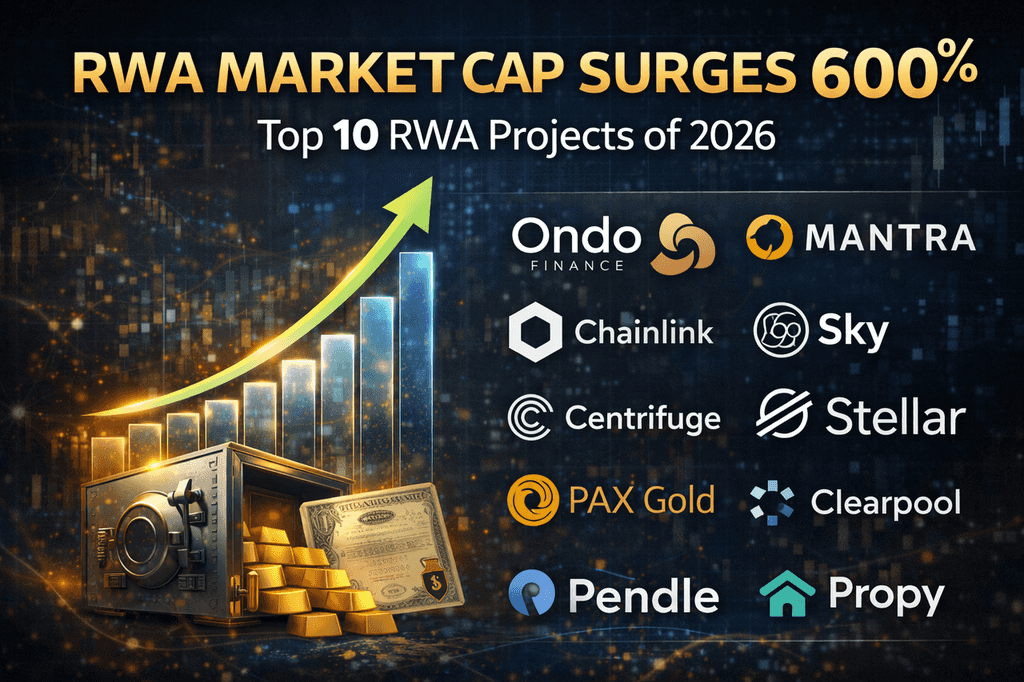
The landscape of digital finance has undergone a tectonic shift over the past twelve months. Real-World Assets (RWA) have transitioned from a niche experimental sector to a multi-billion-dollar cornerstone of the blockchain ecosystem, witnessing an unprecedented 600% surge in total market capitalization as institutional grade liquidity flows onto decentralized ledgers.
This comprehensive guide explores the explosive growth of on-chain assets and provides a deep dive into the Top 10 RWA projects currently defining the 2026 market cycle and institutional adoption.
Key Takeaways: The Massive Shift from Speculation to Utility
The current market cycle is fundamentally different from the "DeFi Summer" of 2020. While previous rallies were fueled by circular speculation and high-inflation "food tokens," the 2025–2026 RWA boom is built on tangible value and productive capital.
-
Productive Assets: Unlike speculative memecoins, RWA tokens represent ownership or yield rights to actual physical assets like US Treasuries, corporate debt, real estate, and gold.
-
Institutional Participation: Major financial entities, including BlackRock, Franklin Templeton, and Goldman Sachs, are no longer just observing; they are actively issuing assets on-chain.
-
Sustainability: By tapping into the $100 trillion global bond market and the $300 trillion real estate market, RWA projects provide a sustainable "Real Yield" that is decoupled from crypto market volatility.
Why RWA Market Cap Exploded: Analyzing the 600% Growth Metric
The 600% growth of the RWA sector is not an anomaly but the result of a "perfect storm" involving institutional validation, macroeconomic shifts, and technological maturity. As of early 2026, the total value locked (TVL) in RWA protocols has crossed significant milestones, outperforming almost every other sector in the crypto industry.
The BlackRock Effect: How the BUIDL Fund Institutionalized On-Chain Finance
The launch of the BlackRock USD Institutional Digital Liquidity Fund (BUIDL) served as the "starting gun" for the RWA race. By utilizing the Ethereum network to issue a fund that earns US dollar yield through T-bills and repo agreements, BlackRock signaled to the global financial elite that public blockchains are ready for institutional-grade settlement. This move bridged the trust gap, leading to a massive influx of capital into the Top 10 RWA projects that provide similar infrastructure.
High-Yield Hunger: Why Tokenized US Treasuries Became the 2025-2026 Safe Haven
Throughout 2025 and into 2026, global interest rates remained higher for longer than many anticipated. This created a unique opportunity where the "risk-free rate" of US Treasuries (around 4.5–5%) was significantly more attractive than the volatile and often unsustainable yields found in traditional DeFi lending pools. Tokenized Treasuries allow crypto-native firms and DAOs to keep their capital on-chain while earning traditional finance (TradFi) returns, creating a massive "yield bridge" that funneled billions into the RWA ecosystem.
Regulatory Clarity in 2026: The Role of MiCA and SEC Frameworks in Scaling RWA
The growth of RWA was historically hampered by legal ambiguity. However, the full implementation of the Markets in Crypto-Assets (MiCA) regulation in Europe and clearer, albeit strict, guidelines from the SEC regarding "Security Tokens" have provided a roadmap for compliant tokenization. This clarity has allowed the Top 10 RWA projects to build robust "Know Your Customer" (KYC) and "Anti-Money Laundering" (AML) layers directly into their smart contracts, making them palatable for pension funds and insurance companies.
The Top 10 RWA Projects Dominating the Landscape
Identifying the winners in this space requires looking beyond mere market cap. We must evaluate the quality of their underlying assets, the robustness of their legal structures, and their integration with both DeFi and TradFi.
1. Ondo Finance ($ONDO) – The King of Tokenized US Treasuries
Ondo Finance has established itself as the premier gateway for institutional-grade RWA. Its flagship products, such as OUSG (Tokenized US Treasuries) and USDY (a yield-bearing stablecoin alternative), have captured the lion's share of the T-bill on-chain market. By partnering with top-tier service providers like BlackRock and Morgan Stanley, Ondo provides a level of institutional comfort that few other protocols can match.
2. Mantra ($OM) – The Compliant Layer 1 for Institutional On-Ramping
Mantra is a specialized Layer 1 blockchain built on the Cosmos SDK, specifically designed for RWA. Unlike general-purpose chains, Mantra includes built-in compliance modules, identity verification, and decentralized tools to manage the lifecycle of regulated assets. Its focus on the Middle Eastern and Asian institutional markets has made it a top contender for sovereign wealth fund tokenization projects in 2026.
3. Chainlink ($LINK) – The Essential Oracle Infrastructure for RWA Data
While not an RWA issuer itself, Chainlink is the "invisible hand" behind the entire sector. Its Cross-Chain Interoperability Protocol (CCIP) and Proof of Reserve (PoR) are the industry standards for verifying that the off-chain collateral (like gold in a vault or cash in a bank) actually exists. Without Chainlink, the Top 10 RWA projects would struggle to maintain the transparency required by institutional investors.
4. MakerDAO / Sky ($MKR) – Leveraging Real-World Credit for Stablecoin Stability
MakerDAO (rebranding parts of its ecosystem to Sky) was an early pioneer in RWA. Today, a significant portion of the collateral backing the USDS (formerly DAI) stablecoin consists of RWA, including US Treasury bonds and corporate credit. This pivot has turned Maker into a highly profitable engine, using real-world interest to buy back and burn MKR tokens, effectively bridging TradFi profits to crypto holders.
5. Centrifuge ($CFG) – Bringing Private Equity and SME Loans to DeFi
Centrifuge focuses on the "private credit" side of RWA. It allows businesses to tokenize real-world assets like invoices, mortgages, and consumer credit to access liquidity from the DeFi ecosystem. By creating a decentralized marketplace for credit, Centrifuge provides SMEs (Small and Medium Enterprises) with cheaper financing while offering DeFi investors diversified, non-crypto-correlated returns.
6. Stellar ($XLM) – The Legacy Bridge for Institutional Asset Issuance
Stellar has long been the preferred blockchain for traditional financial institutions like Franklin Templeton. Its native support for asset issuance and compliance features makes it an ideal "on-ramp" for tokenized money market funds. In the 2026 bull run, Stellar’s role as a high-speed, low-cost settlement layer for RWA payments has cemented its position in the top tier.
7. PAX Gold ($PAXG) & Tether Gold ($XAUt) – Digital Gold in Uncertain Times
As geopolitical tensions persisted through 2025, tokenized gold became a staple for RWA portfolios. $PAXG and $XAUt allow investors to own fractional shares of physical London Good Delivery gold bars. These tokens provide the liquidity of a digital asset with the "safe haven" properties of bullion, making them essential for balanced RWA-heavy investment strategies.
8. Clearpool ($CPOOL) – Revolutionizing Uncollateralized Institutional Lending
Clearpool offers a decentralized capital markets ecosystem where institutional borrowers can access uncollateralized loans. In the RWA context, this allows for the creation of "credit pools" backed by the reputation and creditworthiness of real-world financial firms. It is a key player in the migration of the multi-trillion dollar commercial paper market to the blockchain.
9. Pendle ($PENDLE) – Maximizing Yield Efficiency for RWA Assets
Pendle has become the go-to protocol for "Yield Tokenization." By splitting RWA tokens into Principal Tokens (PT) and Yield Tokens (YT), Pendle allows users to hedge their bets on future interest rates or lock in fixed yields on their tokenized T-bills. This layer of financial engineering is crucial for the maturity of the RWA sector, providing tools that mirror the sophisticated derivatives markets of Wall Street.
10. Propy ($PRO) – The Frontier of On-Chain Real Estate Transactions
Real estate is the "Holy Grail" of RWA, and Propy is leading the charge. By integrating blockchain with legacy title registries, Propy enables the buying and selling of homes as NFTs or through tokenized LLCs. As property markets become more illiquid in the physical world, Propy’s 24/7 on-chain marketplace offers a glimpse into the future of real estate liquidity.
The Future Outlook: Will RWA Overtake Traditional DeFi by 2027?
The trajectory of the RWA sector suggests that the distinction between "DeFi" and "Finance" will continue to blur. By 2027, it is highly probable that the total value of tokenized real-world assets will eclipse the value of "crypto-native" DeFi assets. The reason is simple: scale. While crypto-native assets are limited by the total market cap of the crypto market itself, RWA projects tap into the global pool of all financial value.
We expect to see the "Top 10 RWA projects" evolve into vertically integrated platforms that handle everything from legal compliance and asset custody to secondary market trading and yield optimization. As the technology becomes "invisible," traditional investors will interact with these protocols not because they are "using blockchain," but because it is the most efficient, transparent, and cost-effective way to manage wealth.
Conclusion
The 600% surge in the RWA market cap is a clear indicator that the crypto industry has entered its "Utility Phase." By bridging the gap between the efficiency of blockchain and the stability of traditional assets, the Top 10 RWA projects such as Ondo, Mantra, and Chainlink are creating a more inclusive and liquid global financial system. For investors and users of our exchange platform, RWA represents a shift away from high-risk volatility toward productive, yield-generating digital assets. As we move deeper into the 2026 bull run, RWA will likely remain the primary driver of institutional capital and long-term ecosystem value.
FAQ:
What are the Top 10 RWA projects to watch in 2026?
The leading projects include Ondo Finance, Mantra, Chainlink, MakerDAO (Sky), Centrifuge, Stellar, PAX Gold, Clearpool, Pendle, and Propy. These projects cover various sectors including T-bills, gold, real estate, and private credit.
Why did the RWA market cap grow by 600%?
The growth was driven by institutional entry (like BlackRock's BUIDL fund), high interest rates making tokenized US Treasuries attractive, and improved regulatory frameworks like MiCA providing a legal path for tokenization.
Is investing in RWA safer than traditional DeFi?
RWA projects generally offer lower volatility as they are backed by tangible assets like bonds or gold. However, they carry "centralization risks" related to the physical custody of the underlying assets and regulatory changes.
How do tokenized US Treasuries work?
A protocol (like Ondo) buys actual US Treasury bonds and holds them in a regulated brokerage. They then issue a digital token on the blockchain that represents ownership of those bonds and the interest they accrue.
Can retail investors buy the Top 10 RWA projects?
Most utility tokens (like $ONDO, $OM, or $LINK) are available on exchange platforms. However, certain "security tokens" that represent direct ownership in a fund may require KYC verification and are sometimes restricted to accredited investors.