

DeFi United Raises $300 Million: Is the Market Repairing Confidence?
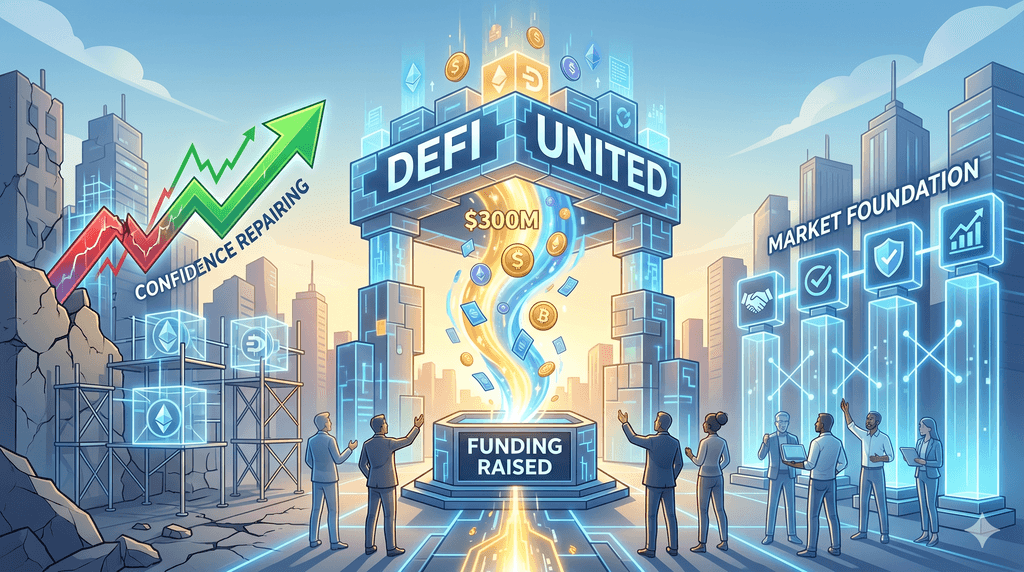
DeFi United’s reported $300 million recovery effort has become a major test for decentralized finance after the Kelp DAO rsETH exploit shook investor confidence. The campaign shows that leading DeFi players are willing to coordinate during a crisis, but it also raises a bigger question: is the market truly repairing trust, or simply relying on another emergency rescue? This article explores what the recovery effort means for DeFi, investor confidence, restaking risks, and the future of decentralized crisis management.
The Importance of DeFi United’s Recovery Effort
DeFi United’s $300 million raise is more than a response to the Kelp DAO exploit. It is a test of whether DeFi can protect investor confidence during a major crisis. By coordinating support across the ecosystem, the effort aims to restore trust, stabilize affected markets, and show that decentralized finance can respond collectively when systemic risk appears.
DeFi United Raises $300 Million in Major Crypto Recovery Effort
DeFi United’s $300 million recovery campaign has become one of the most significant rescue efforts in decentralized finance this year. The initiative was launched after the Kelp DAO rsETH exploit created a major shortfall and raised concerns about contagion across DeFi lending markets. What began as an emergency response quickly turned into a broader industry effort, with major protocols, investors, DAOs, and infrastructure companies moving to support the recovery.
The size of the raise is important because it shows that the crypto market is no longer treating large exploits as isolated failures. Instead, leading DeFi participants appear to understand that a major incident can damage confidence across the entire ecosystem. When a liquid restaking token loses backing or becomes connected to lending-market stress, the consequences can spread quickly. DeFi United’s purpose is therefore not only to help cover losses, but also to prevent a deeper confidence crisis.
The recovery effort also reflects a shift in how the DeFi industry handles emergencies. In earlier cycles, users often faced long periods of uncertainty after exploits, with unclear communication and limited recovery options. This time, the response has been more coordinated. By mobilizing hundreds of millions of dollars, DeFi United is attempting to show that decentralized markets can organize a serious backstop without relying on a government bailout or a centralized institution.
Still, the raise should be viewed as the beginning of the recovery process, not the end. The market will need to see whether all pledged funds are delivered, whether rsETH backing is restored transparently, and whether affected lending markets return to normal conditions. If the recovery is executed smoothly, DeFi United could become a major case study in decentralized crisis management. If delays, disputes, or unresolved losses remain, confidence could weaken again.
For now, the $300 million figure gives the market a reason to believe that the damage can be contained. It signals that major players are willing to defend the credibility of DeFi when systemic trust is at risk. That does not erase the exploit or the structural weaknesses it revealed, but it does show that the industry is trying to build a more mature response to failure.
The Crisis Behind DeFi United
-
DeFi United emerged after the Kelp DAO rsETH exploit raised concerns about a major shortfall.
-
The incident made investors question whether rsETH was safe to use as collateral in DeFi lending markets.
-
Because DeFi protocols are interconnected, risk from one token can quickly spread to lending pools, liquidity markets, and other protocols.
-
The exploit raised broader concerns about restaking assets, bridge security, collateral risk, and lending-market exposure.
-
In short, the crisis showed how fast confidence can weaken when one important DeFi asset becomes uncertain.
Why the Kelp DAO Exploit Shook the Market
The Kelp DAO incident hit at a sensitive moment for the DeFi market. Liquid restaking had become one of the most watched sectors in crypto, attracting users who wanted yield opportunities while keeping assets liquid. Restaking tokens like rsETH are designed to give users exposure to staking or restaking rewards while allowing them to use the token elsewhere in DeFi.
That model is powerful, but it also creates layered risk. A liquid restaking token depends not only on the value of the underlying assets, but also on smart contracts, liquidity, redemption mechanisms, bridges, oracles, and integrations with other protocols. When such a token is accepted as collateral in lending markets, those risks become part of the wider DeFi system.
The Kelp DAO exploit reminded investors that complex assets can create complex failure points. If rsETH backing is questioned, the issue is not limited to rsETH holders. It can also affect lending markets where rsETH is used as collateral, liquidity pools where it trades, and protocols that depend on its valuation.
This is why investor confidence was damaged. The exploit did not simply expose a technical flaw. It exposed how quickly confidence can break when multiple layers of DeFi depend on each other.
For many investors, the incident was a reminder that yield is never free. Restaking and liquid restaking products can improve capital efficiency, but they also add new assumptions. Users may be exposed to smart-contract risk, validator risk, slashing risk, liquidity risk, governance risk, bridge risk, and oracle risk. During calm markets, these risks can appear theoretical. During an exploit, they become immediate.
For readers who are newer to the space, KuCoin’s explainer on decentralized finance describes DeFi as peer-to-peer financial applications built on blockchain technology, including primitives such as lending, borrowing, payments, derivatives, and exchanges. That broad definition helps explain why one exploit can affect several markets at once: DeFi protocols are not isolated products, but connected financial building blocks.
The concern is not that liquid restaking has no future. The concern is that the market may have been moving faster than its risk systems. DeFi United is now attempting to repair the damage, but the exploit itself may force the industry to reassess how quickly complex assets should be integrated into lending markets.
Is the DeFi Market Repairing Investor Confidence After the Kelp DAO Exploit?
The Kelp DAO exploit did more than create a financial shortfall. It damaged investor confidence in some of DeFi’s most important growth areas: liquid restaking, cross-chain infrastructure, collateralized lending, and protocol composability. When a single exploit can affect multiple markets, investors are reminded that DeFi risk is rarely isolated. A weakness in one layer can quickly become a confidence problem for the wider ecosystem.
DeFi United’s $300 million recovery effort is therefore being watched as a test of whether the market can rebuild trust after a major shock. The size of the response suggests that leading DeFi players recognize the seriousness of the incident. By coordinating capital, public commitments, and recovery plans, the industry is trying to reassure investors that the damage can be contained and that affected markets can return to normal conditions.
For investors, the most encouraging sign is not only the amount raised, but the speed and coordination behind the effort. In a decentralized environment, there is no central authority that can force protocols, DAOs, investors, and infrastructure providers to contribute. The fact that major participants have stepped forward indicates that DeFi has developed stronger informal crisis-management capacity than in earlier market cycles.
However, confidence is not repaired by headlines alone. Investors will want to see proof that pledged funds are actually delivered, that rsETH backing is restored, and that lending markets such as Aave avoid lasting bad debt. They will also watch whether governance processes move efficiently or become delayed by disputes. If the recovery is slow, unclear, or incomplete, the market may treat the $300 million raise as a temporary sentiment boost rather than a true repair of confidence.
The exploit also forces investors to reprice risk in restaking and bridge-dependent assets. Liquid restaking tokens can offer capital efficiency and yield opportunities, but they also carry layered risks tied to smart contracts, cross-chain messaging, liquidity, and collateral valuation. After the Kelp DAO incident, investors are likely to demand stronger risk controls, more conservative collateral parameters, and clearer emergency plans before treating similar assets as safe building blocks.
So, is the DeFi market repairing investor confidence? Yes, but cautiously. DeFi United has helped shift the narrative from panic to recovery, showing that the ecosystem can mobilize serious capital when systemic trust is threatened. But full confidence will return only if the recovery is executed transparently and the industry proves it has learned from the weaknesses exposed by the exploit.
The $300 Million Raise and DeFi Confidence
The $300 million raise matters because it changes the market narrative around the Kelp DAO exploit. Without a serious recovery effort, the story would have remained focused on losses, contagion, and failure. With DeFi United, the narrative becomes more balanced: DeFi suffered a major shock, but the ecosystem is trying to contain the damage.
The size of the raise is important because it is large enough to be more than symbolic. It suggests that major DAOs, investors, protocols, and infrastructure companies now have the resources to coordinate a meaningful response during a crisis. In earlier DeFi cycles, many protocols were too small or fragmented to organize such a large recovery effort.
The raise also has a psychological impact. Crypto markets are highly sensitive to confidence, especially when users are unsure which assets or protocols are exposed.
Still, the raise should not be treated as a final victory. A headline number is not the same as a completed recovery. The market still needs to see whether pledged funds are delivered, whether losses are addressed, whether users are protected, and whether affected markets stabilize.
DeFi United also raises an important debate: is this a sign of maturity or a bailout? Supporters may argue that the effort shows DeFi is developing its own crisis-response system without relying on governments or banks. Critics may argue that if DeFi needs emergency rescues, then it is not as self-sufficient as advertised.
Both views have merit. DeFi United shows coordination and responsibility, but it also exposes the need for stronger safety systems. The industry should not have to improvise every time a major exploit happens. A more mature DeFi market would need insurance pools, risk reserves, stronger collateral rules, bridge-risk standards, emergency governance plans, and clearer recovery procedures.
The Kelp DAO Exploit, Lending Markets, and DeFi’s Future
The Kelp DAO exploit exposed how quickly risk can spread across decentralized finance. Aave is central to this story because it is one of DeFi’s most important lending protocols. Lending markets depend heavily on collateral quality. If a risky asset loses backing or liquidity, the protocol can face bad debt, liquidation stress, and withdrawal pressure.
For Aave and other lending markets, the incident may lead to stricter collateral standards. Not all yield-bearing or restaking tokens should be treated like simpler, highly liquid assets. Protocols may need to consider bridge dependencies, redemption mechanics, oracle design, smart-contract risk, liquidity depth, and governance controls before accepting complex assets as collateral.
Restaking tokens also face a major confidence test. Liquid restaking has become one of DeFi’s most exciting sectors because it offers yield and flexibility, but the Kelp DAO incident shows that these assets carry layered risks. KuCoin’s article on top liquid restaking protocols explains how liquid restaking can let users seek additional yield while keeping assets active in DeFi. That opportunity is powerful, but it also requires stronger risk controls when restaking assets are used across multiple protocols.
Bridge security is another major weakness. Cross-chain bridges are essential for moving assets between networks, but they can create hidden dependencies. If a bridge fails, assets that appeared fully backed can become questionable. In DeFi, those assets may already be used in lending pools, liquidity markets, and structured strategies, allowing risk to spread quickly.
Governance will also be tested. DeFi decisions are often made by DAOs, token holders, delegates, foundations, and protocol teams. This creates transparency, but it can slow emergency responses. DeFi United’s success will depend partly on whether governance can move quickly while remaining transparent and legitimate.
Investors should watch several things next: whether pledged funds are actually delivered, whether rsETH backing is restored, whether lending markets avoid lasting bad debt, whether liquidity returns, and whether protocols publish clear post-mortems explaining what failed and what will change.
The bigger lesson is that DeFi is becoming more like a real financial system. That is positive because the ecosystem now has deeper liquidity, stronger protocols, and the ability to coordinate large responses. But it also means DeFi needs stronger risk management. Transparency should not mean abandoning responsibility. Automation should not mean ignoring crisis planning. Composability should not mean unlimited contagion.
DeFi United may help repair confidence, but the recovery is not complete. The $300 million raise is an important step. The real test is whether DeFi can turn this crisis into lasting reforms that make lending markets, restaking tokens, bridges, and governance systems safer before the next exploit happens.
Conclusion: Confidence Is Repairing, but the Test Is Not Over
DeFi United’s $300 million recovery effort is a major moment for decentralized finance. It shows that the ecosystem can mobilize serious capital, coordinate across protocols, and respond to a crisis that threatens confidence in restaking assets and lending markets.
The raise has helped shift the narrative from panic to recovery. It gives investors a reason to believe that the Kelp DAO fallout can be contained. It also shows that major DeFi players are willing to protect the credibility of the broader ecosystem when systemic trust is at risk.
But confidence is not fully repaired yet. The market still needs to see whether pledged funds are delivered, whether rsETH backing is restored, whether Aave and other lending markets stabilize, and whether governance processes work smoothly.
More importantly, DeFi must prove that it has learned from the exploit. The industry needs stronger collateral standards, better bridge-risk controls, more transparent restaking frameworks, and clearer emergency-response systems.
So, is the market repairing confidence? Yes, but cautiously. DeFi United is a powerful step toward recovery, not a final solution. The $300 million raise shows that DeFi can respond to a major crisis. The next challenge is proving that it can prevent the same kind of crisis from happening again.
FAQs
What is DeFi United?
DeFi United is a coordinated crypto recovery effort formed after the Kelp DAO rsETH exploit raised concerns about a major shortfall and possible contagion across DeFi lending markets. Its goal is to support recovery, restore confidence, and help prevent the incident from becoming a broader market crisis.
Why did DeFi United raise $300 million?
The $300 million raise was designed to help address the financial damage connected to the Kelp DAO exploit and stabilize affected markets. The size of the raise matters because it signals that major DeFi participants are willing to coordinate when market trust is under pressure.
How did the Kelp DAO exploit affect investor confidence?
The exploit damaged confidence because it showed how risk in one protocol can spread into other areas of DeFi. Since rsETH was connected to liquid restaking and collateralized lending, the incident raised concerns about asset backing, bridge security, liquidation risk, and potential bad debt.
Is the DeFi market repairing confidence after the exploit?
Yes, but cautiously. DeFi United has helped shift the narrative from panic to recovery. However, full confidence will depend on whether pledged funds are delivered, rsETH backing is restored, and lending markets return to normal conditions.
Why are liquid restaking tokens important in this story?
Liquid restaking tokens are important because they are designed to give users yield exposure while remaining usable across DeFi. This makes them powerful but also complex. If a liquid restaking token loses backing or becomes difficult to value, the risk can spread to lending markets and liquidity pools.
What should investors watch next?
Investors should watch whether DeFi United’s pledged capital is actually deployed, whether rsETH backing is restored transparently, whether Aave and other lending markets stabilize, and whether DeFi protocols introduce stronger risk controls after the exploit.
Where can beginners learn more about DeFi and staking?
Beginners can use KuCoin’s DeFi learning hub to understand decentralized finance basics, including lending, borrowing, staking, yield farming, and decentralized trading. This type of background is useful for understanding why a single exploit can affect several parts of the crypto market.
Disclaimer: This article is for informational purposes only and is not financial advice. Always do your own research before buying or trading crypto.