

What is a Blockchain Fork? Hard vs. Soft Forks and Representative Projects
2026/03/30 14:45:02
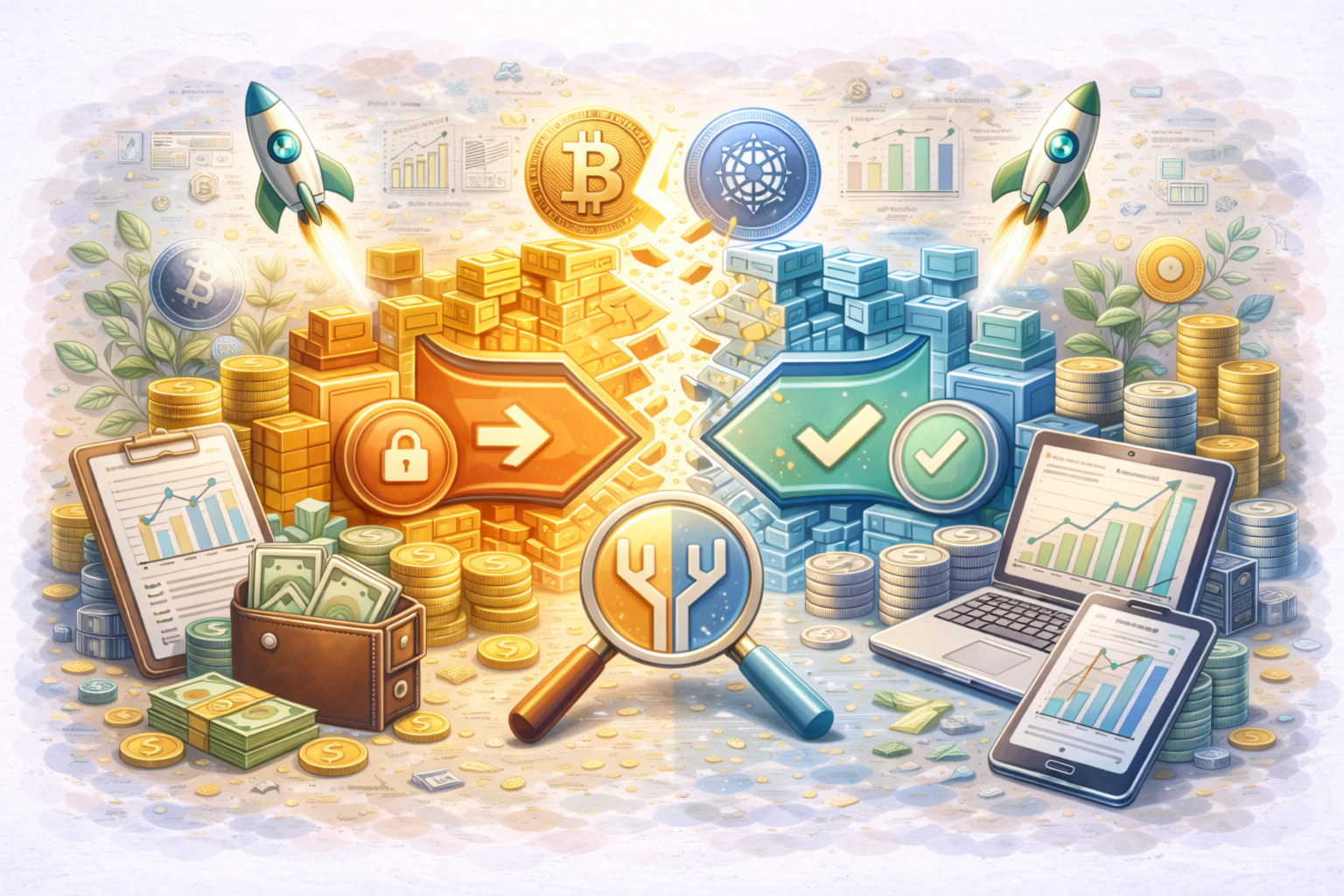
A blockchain fork occurs when a blockchain network's protocol undergoes a rule change that splits its transaction history or creates two diverging versions of the chain. Forks are a fundamental mechanism through which decentralized networks evolve — they determine how upgrades are implemented, how governance disputes are resolved, and in some cases, how entirely new cryptocurrencies come into existence. Understanding how forks work is essential for anyone interacting with blockchain-based assets.
This article explains what a blockchain fork is, how hard forks and soft forks differ in structure and consequence, and how representative crypto fork examples have shaped the assets traders interact with today.
Key Takeaways
-
A blockchain fork is a change to a network's protocol rules that causes nodes running different software versions to diverge in how they validate transactions.
-
A hard fork introduces rule changes that are incompatible with prior versions of the software, requiring all nodes to upgrade or be left on a separate chain.
-
A soft fork implements backward-compatible changes, allowing non-upgraded nodes to continue participating in the network without being split off.
-
Hard forks have historically produced new cryptocurrencies when significant portions of a network's participants refused to adopt the new rules and continued the original chain.
-
Forks are driven by a range of causes, including technical upgrades, security patches, scaling debates, and governance disagreements among developers, miners, and node operators.
-
The market behavior of forked assets on platforms like KuCoin — including price divergence between original and forked chains — reflects how market participants assign value to competing protocol choices.
What Is a Blockchain Fork?
A blockchain is a distributed ledger maintained by a network of nodes, each of which independently validates transactions according to a shared set of protocol rules. A fork occurs when those rules change. If different nodes are running different versions of the rules simultaneously, they may disagree about which transactions and blocks are valid — producing two diverging versions of the chain's history.
The term "fork" comes from software development, where a codebase that branches in two directions is said to have forked. In blockchain networks, the same concept applies to the living chain itself: after a fork event, the transaction history up to the fork point is shared, but the chains diverge from that point forward. Whether and how they diverge — and whether both persist — depends on the type of fork and how the network's participants respond to it.
Not all forks result in two separate chains. When adoption of a rule change is near-universal, the old chain simply dies off as nodes abandon it. When adoption is divided, both chains can persist independently, each carrying forward from the shared history at the fork block.
Hard Fork vs. Soft Fork: The Core Distinction
The difference between a hard fork and a soft fork comes down to backward compatibility — whether nodes running the old software can still participate in the network after the rule change takes effect.
Hard Fork
A hard fork introduces protocol changes that old nodes consider invalid. A block that is valid under the new rules will be rejected by any node still running the old software. This incompatibility means the network splits into two distinct chains: one running the new rules and one continuing under the old rules. For both chains to survive, they each need a sufficient network of nodes, miners (in proof-of-work networks), and economic participants to maintain them.
Hard forks require coordination. If the intent is to upgrade the entire network, developers must ensure that a supermajority of participants — particularly miners or validators and node operators — have updated their software before the fork block is reached. If coordination fails or a significant minority refuses to upgrade, a permanent chain split results.
Soft Fork
A soft fork introduces protocol changes that are backward compatible. Blocks valid under the new rules are also accepted as valid by old nodes, even if those old nodes do not understand the new rules being enforced. This means non-upgraded nodes can continue to participate in the network without being split off — they simply do not enforce the new rules themselves.
Soft forks are generally considered less disruptive because they do not require universal adoption to avoid a chain split. However, they are more constrained in the scope of changes they can implement: only changes that restrict or tighten what is considered valid can be deployed as soft forks. Expanding what is valid — allowing new transaction types that old nodes would reject — requires a hard fork.
Why Blockchain Forks Happen
Forks are initiated for a range of reasons, each reflecting a different kind of pressure or need within a blockchain network.
The most common drivers include:
-
Protocol upgrades — Developers propose improvements to network efficiency, security, or functionality. If the changes are compatible with existing rules, they can be deployed as soft forks; if not, a hard fork is required.
-
Security patches — A vulnerability in the protocol may require an urgent rule change to prevent exploitation. Depending on the nature of the fix, this may take the form of either fork type.
-
Scaling debates — Disagreements about how to increase a network's transaction throughput have historically been among the most contentious causes of hard forks, particularly in proof-of-work networks where block size determines throughput.
-
Governance disputes — When a network's participants hold fundamentally incompatible views about the direction of the protocol, a hard fork can be the mechanism by which the community formally splits into two separate projects.
-
Bug correction — In some cases, a hard fork has been used to reverse the effects of a critical bug or exploit that resulted in unintended state changes in the ledger.
Representative Crypto Fork Examples
The history of blockchain networks includes several fork events that created entirely new assets or fundamentally reshaped existing networks. These examples illustrate how the abstract mechanics of forks play out in practice.
Bitcoin and the Block Size Debate
Bitcoin's original protocol set a maximum block size of 1 megabyte, limiting the number of transactions that could be processed per block. As the network grew, debate emerged about whether this limit should be raised to increase throughput. The community divided into factions with incompatible positions, and in August 2017, a hard fork produced a separate chain. The forked chain implemented a larger block size and continued under a different name, while the original chain continued with its original block size limit and pursued alternative scaling solutions. Both assets subsequently traded independently. Holders of Bitcoin at the time of the fork received an equivalent balance on the new chain, a distribution mechanism common to contentious hard forks.
Ethereum's Response to the DAO Exploit
In 2016, a vulnerability in a prominent smart contract on the Ethereum network was exploited, resulting in the unauthorized transfer of a significant portion of the funds held in that contract. The Ethereum development community debated whether to implement a hard fork that would effectively reverse the exploit by rewriting a portion of the chain's history. The majority of the network adopted the fork, restoring the affected funds. A minority of participants objected on the grounds that blockchain immutability should not be violated under any circumstances and continued the original chain. Both chains have traded independently since the fork. Traders can observe price action between these forked assets on KuCoin's crypto market pairs to understand how the market has assigned relative value to each chain over time.
Soft Fork Upgrades in Bitcoin
Not all Bitcoin protocol changes have produced chain splits. Several significant upgrades have been deployed as soft forks, including Segregated Witness (SegWit), activated in August 2017. SegWit restructured how transaction data is stored within blocks, increasing effective capacity without changing the 1MB block size limit and enabling a second layer of payment infrastructure. Because SegWit was backward compatible, non-upgraded nodes could continue operating without being split off, and the upgrade was adopted without a permanent chain split.
How Forks Affect Traders and Market Behavior
Blockchain forks carry direct implications for traders holding assets at the time of a fork event and for those interpreting price action in the period surrounding a fork.
Airdrop of Forked Tokens
In a hard fork that produces a new chain, holders of the original asset at the fork block typically receive an equivalent balance on the new chain. This distribution is sometimes called an airdrop in the context of hard forks, though it differs from promotional airdrops in that it is an automatic consequence of the chain split rather than a deliberate distribution campaign. The market value of the new asset is determined by subsequent trading and reflects participants' collective assessment of the new chain's utility, security, and adoption.
Pre-Fork Price Behavior
Anticipated hard forks have historically produced observable price behavior in the periods preceding the fork block. Traders who expect to receive a new asset by holding the original may accumulate the original asset in advance of the fork, contributing to demand-side pressure. After the fork and the distribution of the new asset, some holders sell one or both assets, which can produce elevated volatility in both chains' trading pairs.
Post-Fork Chain Viability
The long-term survival of a forked chain depends on whether it maintains sufficient miner or validator participation, developer activity, and economic usage. Chains that fail to attract these elements lose security and utility and gradually decline in market activity. The KuCoin research blog covers how to evaluate on-chain metrics — including hash rate, active addresses, and transaction volume — that reflect a chain's network health over time.
Evaluating Fork Outcomes: What On-Chain Data Reveals
After a fork event, on-chain data provides the most direct evidence of how each resulting chain is performing relative to the other. These metrics are more informative than price alone for assessing a fork's outcome.
-
Hash rate or validator participation — In proof-of-work forks, the distribution of mining hash rate between the two chains determines their relative security. A chain with a small fraction of the total hash rate is more vulnerable to 51% attacks. In proof-of-stake forks, the distribution of staked value serves an analogous function.
-
Active addresses — The number of unique addresses transacting on each chain indicates actual usage rather than speculative holding. A chain with declining active addresses is losing its economic base regardless of its price performance.
-
Developer activity — The pace of code commits, protocol proposals, and infrastructure development on each chain reflects whether each has an active technical community maintaining and improving the protocol.
-
Exchange listing and trading volume — Once both chains' tokens are available for trading, relative volume across pairs reflects market participants' allocation decisions. Sustained high volume on one chain's trading pair against low volume on the other indicates market preference.
Monitoring these factors alongside price data on KuCoin's asset listings provides a fuller picture of how forked assets develop after the initial split.
Conclusion
A blockchain fork is the mechanism by which decentralized networks implement protocol changes, resolve governance disagreements, and in some cases, split into permanently independent chains. The distinction between hard forks and soft forks — backward-incompatible versus backward-compatible rule changes — determines whether a fork produces a chain split or a universal network upgrade. Crypto fork examples from Bitcoin's scaling dispute to Ethereum's response to an on-chain exploit illustrate how these mechanics produce real assets with independent market histories. For traders, understanding the technical and market dynamics of blockchain forks supports more informed interpretation of fork-related events as they occur.
Create a free KuCoin account to discover the next crypto gems and trade over 1,000 global digital assets today. Create Now!
FAQs
What is a blockchain fork in simple terms?
A blockchain fork is a change to a network's protocol rules. When the new rules are incompatible with the old ones (hard fork), the chain can split into two separate versions. When the new rules are backward compatible (soft fork), the network upgrades without splitting. Both types alter how transactions are validated going forward.
What is the difference between a hard fork and a soft fork?
A hard fork introduces changes that old nodes cannot accept, potentially splitting the chain in two. A soft fork makes changes that old nodes still consider valid, so the network can upgrade without a permanent split. Hard forks require broader coordination and carry higher risk of chain division.
Do I receive new tokens when a hard fork happens?
In most hard forks that produce a new chain, holders of the original asset at the fork block receive an equivalent balance of the new chain's token. The distribution is automatic and based on wallet balances at the fork block height. The market value of the new token is determined by subsequent trading.
What causes a blockchain to fork?
Blockchains fork for several reasons: planned protocol upgrades, security vulnerability patches, disagreements about scaling solutions, governance disputes among developers and miners, and in rare cases, to reverse the effects of an on-chain exploit. The cause of a fork influences how controversial it is and whether a permanent chain split results.
How can traders identify upcoming fork events?
Fork events are typically announced through a blockchain's official development channels, improvement proposal processes, and community forums well in advance of the fork block. Monitoring platform-level announcements, on-chain governance votes, and developer repositories provides the most direct access to fork-related information before it becomes widely publicized.
Further reading
Disclaimer: The information on this page may have been obtained from third parties and does not necessarily reflect the views or opinions of KuCoin. This content is provided for general informational purposes only, without any representation or warranty of any kind, nor shall it be construed as financial or investment advice. KuCoin shall not be liable for any errors or omissions, or for any outcomes resulting from the use of this information. Investments in digital assets can be risky. Please carefully evaluate the risks of a product and your risk tolerance based on your own financial circumstances. For more information, please refer to our Terms of Use and Risk Disclosure.