

Infinity Grid vs Margin Grid: Differences and Characteristics Explained for Crypto Trading in 2026
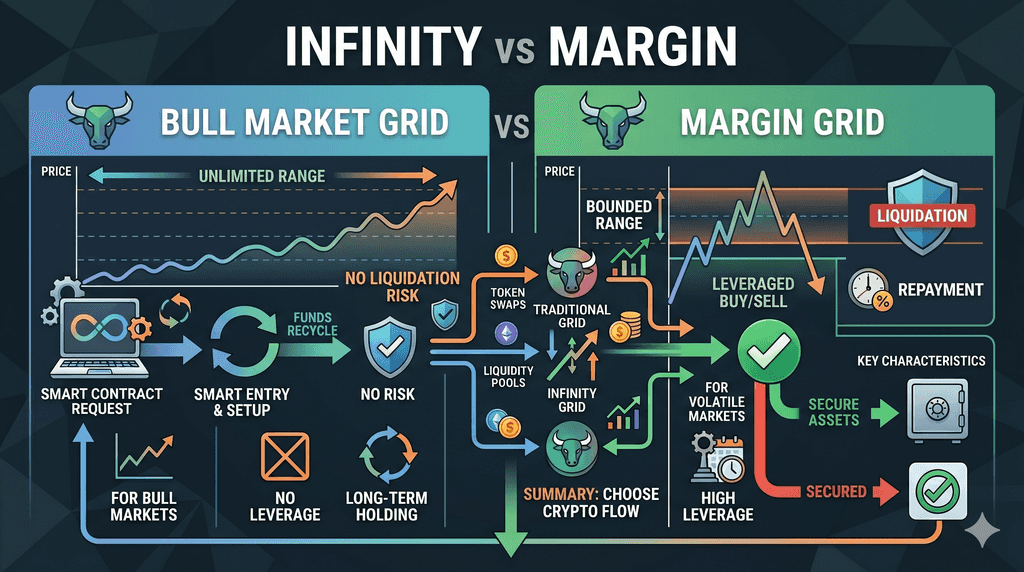
Grid trading has become a go-to method for navigating the nonstop price swings in cryptocurrency markets, where digital assets can surge or drop sharply within hours. As the crypto trading bot market grows to an estimated 54 billion dollars by 2035, with grid bots accounting for around 32 percent of deployments, advanced versions like Infinity Grid and Margin Grid stand out for their ability to automate buy-low and sell-high actions around the clock. These strategies remove much of the guesswork from timing the market while adapting to different price patterns. Infinity Grid shines in upward-moving conditions by operating without a ceiling on prices, and Margin Grid brings borrowed funds into the mix to scale up activity within set boundaries.
How Infinity Grid Breaks Free From Traditional Price Caps in Rising Markets
Infinity Grid takes grid trading to the next level by eliminating any upper price boundary, which lets the strategy keep generating trades indefinitely as long as the asset stays above a chosen lower trigger point. Traders set only a minimum price floor and a profit percentage per grid interval, typically between 0.2 percent and 10 percent, and then the system handles everything automatically. For instance, with a 20,000-dollar investment in Bitcoin priced at 20,000 dollars per coin, the bot starts holding one full Bitcoin.
If the price climbs to 20,200 dollars, the held Bitcoin becomes worth 20,200 dollars, so the system sells a small fraction worth exactly 200 dollars in profit while leaving holdings valued at the original 20,000 dollars. This process repeats with each upward step, shrinking the sold amount proportionally to keep the core value steady, even if Bitcoin rockets to 200,000 dollars or higher. Recent guides highlight how this adaptive sizing, inspired by taking progressively smaller portions as gains accumulate, prevents the common issue of running out of assets during strong rallies. The lower floor acts as a safety net, pausing new buys only if prices crash below it and resuming once they recover. In the 2026 market environment, where Bitcoin has hovered near 67,000 dollars amid ongoing volatility, this setup allows positions to ride multi-month uptrends without manual restarts.
Capital stays partially idle by design, often around 80 percent in wider configurations, which sounds inefficient at first but ensures the bot never exhausts its buying power during extreme moves. Overall, the approach turns sustained price climbs into layered profit opportunities while preserving exposure to further gains, making it a favorite for those expecting long-term growth in major cryptocurrencies.
The Leverage Engine That Powers Margin Grid's Expanded Trading Capacity
Margin Grid integrates borrowed funds directly into the grid framework, letting participants control larger positions than their initial capital would normally allow through collateralized borrowing. A user puts up one cryptocurrency as collateral and borrows another asset, such as using Ethereum to borrow USDT, then deploys the combined amount across multiple buy and sell orders spaced at fixed intervals within a chosen price range. Leverage levels commonly range from 1x to 5x, depending on the setup, which multiplies both potential returns and exposure. Suppose someone starts with 10,000 dollars worth of collateral and applies 3x leverage to run a grid on Bitcoin around 67,000 dollars; the effective trading power jumps to 30,000 dollars spread across grid levels, so each price oscillation triggers bigger trades and bigger profits per interval.
The system automatically executes buys on dips and sells on rises inside the range, with profits or losses adjusting the borrowed balance in real time. Interest on the borrowed portion gets deducted periodically, often from realized grid gains, and the strategy supports configurations that favor upward, downward, or sideways expectations. Educational resources describe how this borrowing mechanism boosts capital efficiency dramatically compared to unleveraged grids, turning modest volatility into meaningful income streams even in choppy periods where prices stay between clear support and resistance levels.
In practice, the grid lines stay active until the range boundaries get hit or parameters change, with the borrowed funds providing extra firepower for capturing small percentage moves that would otherwise yield tiny results. This setup fits markets showing repeated swings without strong directional bias, where the amplified size of each trade compounds over dozens or hundreds of cycles. Users monitor estimated liquidation prices upfront to stay aware of thresholds where rapid adverse moves could force position closure, yet the automated nature keeps everything running smoothly once launched.
Maintaining Fixed Asset Value as the Core of Infinity Grid Success
Infinity Grid lies a clever value-preservation rule that keeps the dollar equivalent of the held cryptocurrency constant regardless of price direction. The bot recalculates holdings after every trade so that the remaining coins always equal the initial investment amount in current market value, with any excess sold off as pure profit and any shortfall topped up by buying more on dips. Taking the earlier Bitcoin example at a 20,000 dollar starting value, a 1 percent grid move upward triggers a sale of roughly 0.0099 Bitcoin to pocket 200 dollars while the position resets to exactly $20,000 worth. On the way down to 19,800 dollars, the bot purchases about 0.0101 Bitcoin to restore the target value. This geometric adjustment ensures profitability on every completed cycle because sell prices always exceed the effective average buy price across the grid.
Sources from March 2026 emphasize that the percentage-based order sizing prevents the equilibrium from collapsing at extreme highs, where fixed-quantity grids might otherwise stall. Idle capital tends to sit higher than in standard setups, sometimes reserving 80 percent or more for potential deep corrections, which provides a buffer against sharp reversals. The result feels almost like owning a stable store of value that prints small profits on every oscillation while staying fully invested in the asset's upside.
For assets with strong fundamentals showing higher lows over months, this characteristic turns the strategy into a hands-off compounding machine. Parameters like the profit-per-grid rate get tuned based on historical volatility, with tighter 0.5 percent intervals suiting high-frequency environments and wider 2 to 3 percent grids working better for slower trends. The overall effect creates a portfolio that grows through realized gains without ever fully exiting the position, offering a balanced path between active arbitrage and long-term holding.
Directional Flexibility That Allows Margin Grid to Adapt to Market Trends
Margin Grid stands out for its built-in support of long, short, or neutral directions, which lets the same framework profit whether prices head higher, lower, or simply bounce inside a channel. In long mode, the bot leans bullish by placing more emphasis on accumulating during dips and selling during recoveries within the range, effectively riding upward momentum with leveraged size. Short mode reverses the logic, selling first on strength and buying back on weakness to capitalize on expected declines. Neutral mode ignores direction entirely and focuses purely on the spread between grid lines for pure arbitrage. With leverage applied across the chosen direction, a 10,000-dollar collateral position at 3x can control 30,000 dollars of notional exposure, so a 1 percent move per grid level generates three times the profit compared with spot-only trading.
Recent analyses note that this flexibility shines when markets show clear bias but still experience pullbacks, because the grid keeps filling orders automatically while the directional tilt amplifies the net effect. Interest charges on borrowed funds run continuously yet often get covered by the higher per-trade profits that leverage unlocks. Traders select grid spacing based on the asset's typical daily range, perhaps 0.8 percent for Bitcoin in calm weeks or 2 percent during heightened volatility periods seen in early 2026. The strategy includes visible liquidation price estimates before activation, helping users understand exactly where a wrong-way move could close positions. Because orders fill inside the predefined range only, the approach works best when prices respect support and resistance levels rather than breaking out sharply. Over repeated cycles, the directional bias can compound significantly, turning modest market moves into substantial account growth as long as the range holds and parameters stay optimized for the prevailing trend.
Dynamic Percentage-Based Orders Driving Infinity Grid Adaptability
Infinity Grid relies on percentage-driven order placement rather than fixed coin quantities, which creates a self-adjusting grid that scales naturally with price levels. Each interval uses the chosen profit margin, say 1 percent after fees, to determine exactly how much to buy or sell so the held value resets to the starting target. As prices climb higher, the sold amounts become smaller fractions of the total holding, ensuring the bot always has inventory left to sell at the next level, even after dozens of grids. Educational materials published in late March 2026 illustrate this with a hypothetical where an asset rises ten-thousand-fold, yet the position never depletes because the algorithm halves exposure incrementally with each big move. The lower price floor remains the only hard stop, below which buys pause, but the existing holdings stay intact.
This dynamic nature makes the strategy highly adaptable to sudden volatility spikes common in crypto, where a single news event can push prices 10 percent in minutes. Grid profit calculations stay straightforward: each completed buy-sell pair locks in the set percentage times the traded notional, and these gains accumulate independently of the unrealized value of the core position. Users often combine the setup with stop-loss features that automatically sell everything if prices drop too far below the floor, adding an extra layer of protection.
In 2026's maturing market, where algorithmic trading now accounts for a growing share of daily volume, this percentage method reduces the need for constant parameter tweaks compared with rigid grids. The result feels seamless, like a thermostat that constantly fine-tunes exposure to keep the portfolio balanced while harvesting spreads on every swing.
Collateral and Borrowing That Shape Margin Grid's Capital Efficiency
Margin Grid achieves higher capital efficiency by requiring only a fraction of the total trading power as collateral while borrowing the rest from available lending pools. Users deposit one asset, such as stablecoins or a major cryptocurrency, which serves as security for the borrowed portion used to fill the grid orders. With 3x leverage, the initial 10,000 dollars controls 30,000 dollars' worth of positions, spreading that notional across buy and sell levels inside the chosen range. Interest accrues on the borrowed amount at rates that fluctuate with market demand, yet the system often pulls these costs directly from grid profits before they hit the main balance. Real-world setups show that this structure can double or triple the number of active grid lines for the same starting capital, leading to more frequent profit-taking opportunities during sideways action. The collateral also determines the exact liquidation threshold, typically displayed as a price level where equity would drop below maintenance requirements, allowing precise risk calibration before launch. Because the borrowed funds stay tied to the grid range, the strategy avoids the open-ended exposure of perpetual futures while still delivering leveraged upside.
In volatile 2026 conditions, where many assets trade in 5 to 15 percent daily ranges, the extra size turns small oscillations into meaningful daily yields after fees. Users can adjust leverage downward if they prefer conservatism or push it higher during low-volatility phases to maximize returns. The borrowing mechanism, therefore, change limited personal funds into professional-scale trading power without requiring massive upfront commitments.
Capturing Continuous Profits as Prices Climb With Infinity Grid
Infinity Grid excels at stacking small profits layer upon layer as prices trend higher because the absence of an upper cap means the bot never runs out of sell orders. Each time the market hits a new grid level, the system sells just enough to realize the target profit percentage while resetting the held value to its baseline, effectively banking gains without reducing overall exposure. Historical examples from educational content show scenarios where Bitcoin climbing 124 percent generated over 70 percent profit for the grid strategy through repeated small sells, all while the position remained fully invested. The mechanism works especially well in bull phases characterized by higher lows, where dips still stay above the lower floor and allow fresh buys that feed the next upward cycle. Profit per grid compounds over time, and the total return includes both realized arbitrage and any unrealized appreciation of the core holding.
Traders often select wider profit margins, such as 2.5 to 3.5 percent, during strong trending periods to avoid over-trading on minor noise while still capturing the dominant move. Because the value-maintenance rule keeps the portfolio balanced, sudden reversals do not leave the position overexposed relative to the original investment size. In the current 2026 landscape of maturing crypto adoption, this continuous capture turns long-term optimism into steady income without forcing users to pick exact tops or bottoms. The strategy runs 24 hours a day, executing automatically even during overnight rallies, which removes emotional timing pressure entirely. Over months, the accumulated grid profits can significantly outpace simple buy-and-hold in moderately volatile uptrends, all while the core asset value stays protected at the entry level.
How Margin Grid Thrives in Range-Bound and Volatile Price Action
Margin Grid finds its sweet spot in markets that oscillate within clear boundaries, where leverage multiplies the profit from each back-and-forth move without the need for strong directional conviction. The predefined range keeps all orders contained, so repeated crossings of grid lines generate frequent fills that add up quickly when sized with borrowed capital. A typical setup might space grids at 1 percent intervals across a 10 percent price band, allowing dozens of profitable cycles per month if volatility cooperates. With leverage, the effective return on the collateral can reach multiples of what spot grids deliver, although interest and trading fees, often around 0.05 percent per fill, reduce the net slightly. Neutral configurations work particularly well here because they ignore the overall trend and simply harvest the spread, while long or short tilts add extra edge when a slight bias emerges inside the range. Monitoring tools display two potential liquidation prices upfront, giving users clear sightlines on risk before committing funds.
When several major assets traded in well-defined weekly ranges amid consolidation, strategies like this delivered consistent performance by turning chop into cash flow. The automated execution means the bot never misses a swing, even during high-volume news events, and profits automatically help service the borrowed interest. The approach maximizes activity in non-trending environments where pure directional bets might falter, offering a systematic way to monetize volatility itself.
Setting Lower Bounds: The Starting Point for Successful Infinity Grid Performance
Choosing the right lower price floor forms the foundation of any Infinity Grid because it defines the point below which the bot stops adding new positions while still protecting existing holdings. Users study historical support levels, technical indicators, or fundamental valuations to pick a floor they believe the asset is unlikely to breach for an extended period. Once set, the grid activates with an initial buy at or near the current price, then waits for the market to move the chosen profit percentage before triggering the first sell. The floor acts as an automatic circuit breaker: if prices fall beneath it, the bot halts further accumulation but keeps the current position intact for potential recovery. Recent resources stress testing various floor distances, noting that placing it 10 to 20 percent below entry often balances safety with opportunity in volatile assets.
Smaller profit grids pair well with closer floors for higher frequency trading, while larger margins suit deeper floors for bigger individual gains. This parameter directly influences how much capital stays reserved versus deployed, with conservative floors leaving more idle funds as a buffer. The floor rarely gets hit in trending markets, yet provides peace of mind during corrections. Adjusting it later remains possible if market structure shifts, though most users prefer to set it once and let the strategy run for weeks or months. The lower bound, therefore, functions as both risk control and strategic anchor, allowing the unlimited upside to unfold safely above it while preventing uncontrolled drawdowns below.
Collateral Choices That Determine Margin Grid Outcomes
The type and amount of collateral selected in Margin Grid directly influence everything from available leverage to liquidation risk and overall profitability. Depositing stable-value assets often provides the most stable borrowing terms because lenders view them as lower risk, whereas using volatile coins as collateral can lead to margin calls during sharp price drops in either asset. Higher collateral amounts relative to desired leverage reduce the chance of forced liquidation but tie up more personal capital. For example, committing 15,000 dollars worth of collateral at 2x leverage controls 30,000 dollars of grid exposure, spreading risk more evenly across the range. Interest rates vary with pool demand, yet the system typically deducts them from grid profits automatically, keeping the position self-sustaining as long as trades keep filling. Users review the displayed liquidation prices for both collateral and borrowed assets before confirming, which helps tailor the setup to current market conditions. In 2026's lending environment, the flexibility of collateral choice lets participants optimize for their specific holdings, turning existing portfolio assets into productive trading fuel. The result is a highly efficient use of capital that would otherwise sit idle, with the grid mechanics ensuring continuous activity within the range. Careful collateral selection, therefore, separates high-performing Margin Grid runs from those that encounter early stops due to adverse price action.
Profit Patterns That Set These Two Grid Approaches Apart
Profit generation follows fundamentally different patterns between the two strategies, even though both rely on grid intervals. Infinity Grid produces steady realized gains from each completed cycle plus any unrealized appreciation in the maintained core position, creating a compounding effect that accelerates during sustained uptrends. Margin Grid, by contrast, amplifies every grid fill through leverage so that the same 1 percent market move delivers several times the dollar profit, although interest and potential liquidation introduce variability. Real numbers illustrate the contrast: an infinity grid on Bitcoin might lock in 500 dollars per 1 percent grid from a 50,000 dollar base while keeping exposure constant, whereas a margin grid at 3x on the same move could generate 1,500 dollars per cycle but carries the cost of servicing borrowed funds.
Over time, Infinity Grid favors the accumulation of small wins in trending conditions, while Margin Grid excels at rapid income during oscillation phases where leverage multiplies frequency. Both add grid profits to any floating value changes, yet the maintenance rule in Infinity Grid keeps the floating portion more predictable. These patterns emerge clearly when back-testing different market regimes, showing how each strategy aligns with specific volatility profiles prevalent throughout 2026.
Risk Management Features Essential for Both Strategies in Prolonged Market Moves
Both Infinity Grid and Margin Grid incorporate built-in safeguards that help weather extended market phases without requiring constant monitoring. Infinity Grid uses its lower price floor and optional stop-loss to limit downside, automatically pausing accumulation if prices break support while preserving the core holding for eventual recovery. Margin Grid displays precise liquidation thresholds upfront and allows users to select conservative leverage or tighter ranges to reduce the chance of margin calls during prolonged adverse moves.
Automatic profit reinvestment or withdrawal options further stabilize both setups by letting users lock gains or adjust exposure mid-run. In drawn-out sideways markets, Margin Grid benefits from its range containment, which prevents positions from drifting too far, while Infinity Grid's value-maintenance rule caps unrealized losses relative to the starting investment. Regular parameter reviews, such as widening grids during high volatility or tightening them in calm periods, keep both strategies aligned with evolving conditions. The automated nature itself acts as a risk tool by removing emotional decisions during stressful price action. Together, these features allow the strategies to operate reliably for weeks or months, turning potential vulnerabilities into managed elements that support consistent performance across different market cycles.
Emerging Trends in Grid Trading as We Move Deeper Into 2026
As algorithmic participation expands deeper into 2026, grid-based strategies continue evolving toward greater automation and adaptability, with Infinity Grid and Margin Grid leading the way in handling both trending and ranging conditions. Developers refine percentage logic and dynamic leverage adjustments to respond faster to real-time volatility, while integration with broader portfolio tools lets users run multiple grids simultaneously across correlated assets. Market data shows grid bots capturing 5 to 15 percent monthly returns in optimal sideways environments, highlighting their growing role in diversified trading approaches.
The combination of value preservation in Infinity Grid and capital amplification in Margin Grid offers complementary tools that many participants now blend for balanced exposure. Lower barriers to entry through improved interfaces encourage wider adoption, pushing overall trading volume higher and creating more liquidity for these automated systems to exploit. Educational content published throughout the year underscores the importance of proper parameter selection and ongoing monitoring, even with hands-off designs. Looking ahead, these advanced grids appear set to play an even larger part in how investors interact with crypto volatility, providing systematic methods that scale with market maturity while delivering measurable results from price movements large and small.
FAQs
Q1: What exactly makes Infinity Grid different from a standard grid setup in practice?
Infinity Grid removes any upper price limit and focuses on keeping the held asset value constant by selling only the excess profit on each upward move and buying to replenish on dips, which lets the strategy continue indefinitely during rising markets instead of stopping once prices break a ceiling.
Q2: How does Margin Grid use leverage without turning every trade into high-stakes gambling?
Margin Grid applies leverage only within a clearly defined price range and uses collateral to borrow the extra funds, so the grid lines still execute automatically while the system monitors liquidation levels and often covers interest costs directly from realized profits.
Q3: Can someone run Infinity Grid during a strong bull market and still protect against sudden drops?
Yes, the strategy sets a lower price floor that halts new purchases if prices fall too far while leaving the existing position intact, and optional stop-loss features can close everything automatically if conditions worsen beyond a chosen threshold.
Q4: What role does collateral choice play when setting up Margin Grid?
Collateral determines how much can be borrowed, affects interest rates, and sets the exact liquidation prices displayed before launch, so selecting stable assets as collateral often leads to smoother operation and lower risk of forced closure during volatility.
Q5: Do these strategies require constant watching once they start running?
Both Infinity Grid and Margin Grid operate fully automatically after initial parameters are chosen, although periodic reviews of market conditions and minor adjustments to grid spacing or leverage help maintain optimal performance over long periods.
Q6: Which strategy tends to suit sideways markets better and why?
Margin Grid generally performs well in range-bound conditions because leverage multiplies the profit from repeated oscillations inside the set boundaries, while Infinity Grid shines more when prices show a sustained upward bias without a ceiling.
Disclaimer: This content is for informational purposes only and does not constitute investment advice. Cryptocurrency investments carry risk. Please do your own research (DYOR).