

XRP vs Bitcoin (2026): The Ultimate Comparison Guide
2026/04/07 17:25:00
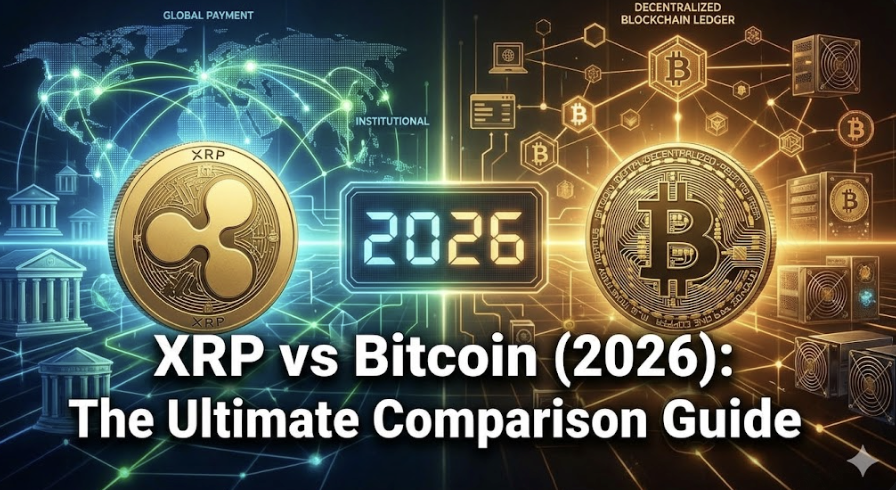
When exploring the cryptocurrency market, two names consistently dominate the conversation, yet they could not be more different in their design and purpose. The ongoing debate of xrp vs bitcoin is not just about which digital asset has the better price chart. It is a fundamental comparison between two completely different visions for the future of global finance. While retail investors often pit these two heavyweights against each other, they are actually solving entirely different problems.
In this comprehensive guide, we will break down the technology, tokenomics, and real-world use cases of both assets to help you navigate the crypto landscape with total confidence.
Key Takeaways
-
Bitcoin was created to be a decentralized, peer-to-peer digital currency and a global store of value."XRP was designed to facilitate fast, low-cost cross-border transactions specifically for traditional financial institutions.
-
Bitcoin relies on a Proof-of-Work (PoW) consensus mechanism, requiring massive computing power from miners to secure the network. XRP operates on the XRP Ledger Consensus Protocol, which uses a network of trusted validator nodes without the need for traditional mining.
-
Bitcoin features a hard-coded maximum supply of 21 million coins, which are slowly released through mining. Conversely, XRP has a maximum supply of 100 billion tokens, all of which were pre-mined prior to its launch.
-
Bitcoin transactions typically take 10 minutes to over an hour to confirm, with variable network fees. XRP transactions settle in just 3 to 5 seconds and cost a tiny fraction of a cent.
What is Bitcoin (BTC)?
Launched in 2009 by the pseudonymous creator Satoshi Nakamoto, Bitcoin (BTC) was born out of the ashes of the 2008 global financial crisis. It was introduced not as a company or a banking product, but as a revolutionary software protocol.
Originally designed as a peer-to-peer electronic cash system, Bitcoin allows two parties to transact directly with one another without the need for a trusted third party, such as a bank or payment processor. Over the years, however, its narrative has evolved. Today, institutional investors and retail traders alike primarily view Bitcoin as digital gold, the decentralized store of value.
The core principles that define Bitcoin
True Decentralization
Bitcoin has no CEO, no marketing department, and no central foundation that dictates its future. It is maintained by a globally distributed network of independent miners and thousands of individual nodes, making it incredibly resilient to single points of failure.
Absolute Scarcity
The protocol is hard-coded with a maximum supply of exactly 21 million coins. This fixed scarcity is Bitcoin’s greatest economic weapon, designed specifically to combat the infinite money-printing (inflation) of traditional fiat currencies.
Censorship Resistance
Because there is no central authority, no government, corporation, or bank can block a Bitcoin transaction, freeze a Bitcoin wallet, or reverse a finalized payment on the blockchain.
Proof-of-Work (PoW)
Bitcoin is secured by a highly energy-intensive process called mining. Miners use specialized computers to solve complex mathematical puzzles, securing the network and earning newly minted BTC as a reward.
What is XRP?
While Bitcoin was designed to completely bypass the traditional banking system, XRP was engineered specifically to partner with it. If Bitcoin is rebellion, XRP is corporate evolution.
Before diving into its mechanics, it is absolutely critical to clear up a common misconception: Ripple and XRP are not the same thing.
Ripple is a private, for-profit financial technology company based in the United States.
XRP is the independent digital token.
The XRP Ledger (XRPL) is the open-source, decentralized blockchain where the token lives.
Ripple utilizes XRP and the XRPL to build enterprise-grade payment solutions, but they do not control the network. So, why did developers create XRP in the first place? The answer lies in the massive inefficiencies of global money transfers.
For decades, banks have relied on the SWIFT system to send money across borders. This legacy system is notoriously slow, highly prone to errors, and extremely expensive due to the multiple intermediary banks involved. XRP was designed to solve this exact problem.
The core principles that define XRP
Cross-Border Efficiency
Instead of banks holding pre-funded accounts in destination countries, they can use XRP for On-Demand Liquidity . A bank converts local fiat into XRP, sends it instantly across the world, and converts it into the destination fia, eliminating friction and freeing up trapped capital.
Eco-Friendly and Pre-Mined
Unlike Bitcoin, there is absolutely no mining involved in XRP. The maximum supply of 100 billion tokens was completely pre-mined and created at genesis. This makes the XRP Ledger incredibly energy-efficient compared to Proof-of-Work networks.
Lightning-Fast Settlement
Because it does not rely on heavy computational mining, the XRP network can process and finalize transactions in just 3 to 5 seconds, at a cost of a tiny fraction of a cent.
Institutional Focus
While retail investors trade it daily, XRP’s true target audience is large-scale financial institutions, central banks, and global payment providers.
XRP vs Bitcoin: The 5 Key Differences Explained
How the Network is Secured
Bitcoin operates on a Proof-of-Work consensus. It relies on a global network of miners who use massive amounts of computing power to solve cryptographic puzzles, validate blocks, and secure the network.
XRP operates on the XRP Ledger Consensus Protocol. It does not use mining at all. Instead, it relies on a network of trusted validator nodes (known as a Unique Node List, or UNL) that compare transaction records and agree on the state of the ledger.
Transaction Speed and Cost
Because PoW is computationally heavy, Bitcoin prioritizes security over speed. A transaction typically takes about 10 minutes to confirm, and network fees can spike to several dollars (or more) during periods of high congestion.
Designed for high-frequency institutional use, the XRPL can settle transactions in just 3 to 5 seconds. Furthermore, the average transaction fee is incredibly cheap, typically costing a fraction of a cent ($0.0002), regardless of network traffic.
Maximum Supply and Token Issuance
Bitcoin has a hard-coded maximum supply of 21 million coins. These coins are not all in circulation yet; they are slowly issued to miners as rewards. This issuance rate is cut in half every four years until the final Bitcoin is mined around the year 2140.
XRP has a maximum supply of 100 billion tokens, and every single one was 100% pre-mined before the network launched. To prevent market flooding, Ripple placed the vast majority of its holdings into a cryptographically secured escrow account, releasing a predictable amount each month.
Centralization vs. Decentralization
Bitcoin is the gold standard of true decentralization. There is no central foundation, no CEO, and no single entity holds enough BTC or hashing power to dictate the rules of the network.
While the XRP Ledger itself is open-source and technically decentralized, the ecosystem is relatively centralized in terms of token distribution. Because Ripple Labs owns a massive portion of the total XRP supply and spearheads the network's business development, the token is heavily influenced by the company's actions and legal standing.
Primary Use Case and Philosophy
Bitcoin aims to be a decentralized Store of Value and an alternative macro-economic system that bypasses governments and central banks.
XRP aims to be a highly efficient Bridge Currency. It does not seek to replace fiat currencies but rather works with traditional financial institutions to move fiat money seamlessly across borders.
quick summary
| Feature | Bitcoin (BTC) | XRP (XRP) |
| Primary Goal | Decentralized Store of Value (Digital Gold) | Institutional Cross-Border Payments |
| Consensus Method | Proof-of-Work (Mining) | XRPL Consensus Protocol (Validators) |
| Max Supply | 21 Million | 100 Billion |
| Token Issuance | Mined slowly over time | 100% Pre-mined at genesis |
| Average Speed | 10 minutes | 3 to 5 seconds |
| Average Fee | High (Varies by network congestion) | Extremely Low (Fraction of a cent) |
| Decentralization | Extremely High | Moderate (Significant Ripple influence) |
Target Audience and Real-World Use Cases
Because Bitcoin and XRP are constantly compared in the media, newcomers often assume they are locked in a battle for the exact same market share. In reality, they are not direct competitors at all. They were designed to solve entirely different problems for entirely different groups of people.
Bitcoin was built for individuals and entities looking to protect their wealth from the vulnerabilities of the traditional fiat system.
The Target Audience:
Retail Investors: Everyday people using BTC as a long-term savings vehicle to protect against inflation and fiat currency devaluation.
Institutional Giants: With the massive success and maturation of spot Bitcoin ETFs, Wall Street hedge funds, pension funds, and publicly traded companies now use BTC as a core treasury asset.
Citizens in Hyperinflation Economies: People living in countries with failing local currencies use Bitcoin as a censorship-resistant lifeline to preserve their purchasing power.
Store of Value: Imagine you want to pass down $1 million to your grandchildren. If you hold it in fiat, inflation will severely erode its value over a decade. If you store it in Bitcoin, its absolute scarcity protects your purchasing power. Bitcoin is the impenetrable digital vault.
XRP is not trying to be a rebellious currency for the masses; it is a B2B utility token. It acts as the ultimate settlement layer for the traditional financial sector.
The Target Audience:
Commercial Banks: Financial institutions that need to move large volumes of capital internationally.
Payment Providers: Global remittance companies that facilitate cross-border transactions for migrant workers and international businesses.
Central Banks: Institutions exploring Central Bank Digital Currencies (CBDCs) that require a neutral bridge currency to interact with other national digital currencies.
On-Demand Liquidity: Under the old SWIFT system, if a bank in the US wanted to send money to a bank in Mexico, both banks had to hold pre-funded accounts in each other's currencies, trapping trillions of dollars in dormant capital. With XRP, the US bank can convert USD into XRP, send it instantly over the XRPL, and have it immediately converted into Mexican Pesos at the destination. The transaction settles in 3 seconds, costs a fraction of a cent, and frees up trapped liquidity.
XRP vs Bitcoin: Which is the Better Investment?
Because Bitcoin and XRP serve completely different purposes, comparing their investment potential is like comparing physical gold to shares in a high-speed telecommunications company.
There is no one-size-fits-all answer, but understanding how they behave in the market can help you make an informed decision based on your personal risk tolerance.
Bitcoin (BTC): The Foundational Anchor
Bitcoin dictates the macro trend of the entire industry. If Bitcoin enters a bull market, it pulls the rest of the market up with it.
With the massive success of Spot Bitcoin ETFs and its adoption as a corporate treasury asset by Wall Street, Bitcoin has achieved a level of mainstream financial legitimacy that no other coin has.()
Because of its massive market capitalization, Bitcoin generally experiences lower volatility compared to altcoins. It is widely viewed as the foundational anchor of a crypto portfolio, designed for steady, long-term wealth preservation.
XRP: The Utility and Growth Play
XRP, on the other hand, is a higher-risk, higher-reward asset whose value is tied to traditional financial adoption and regulatory environments.
For years, XRP’s price action was heavily suppressed by the SEC vs. Ripple lawsuit. However, with that legacy legal battle officially resolved, XRP now enjoys a rare level of regulatory clarity in the U.S. market, opening the floodgates for Spot XRP ETFs and renewed institutional momentum.
XRP’s price is largely driven by real-world adoption.As more banks, payment providers, and institutions use the XRPL for cross-border settlements and Real-World Asset tokenization, the underlying demand for XRP theoretically increases.
XRP appeals to investors who believe that the future of cryptocurrency lies in collaborating with banks, rather than destroying them. It offers potentially higher percentage returns than Bitcoin during altcoin seasons, but it also carries heavier volatility.
Professional investors rarely limit themselves to just one asset. A well-balanced portfolio often utilizes Bitcoin for foundational stability and long-term value storage, while allocating a percentage to XRP to capture the massive growth potential of the institutional cross-border payment sector.
Now that you understand the fundamental differences between the king of decentralization and the champion of cross-border payments, you might be ready to add one or both to your portfolio. Fortunately, accessing these foundational assets is incredibly simple and highly secure on a top-tier global exchange.
Whether you are a seasoned day trader looking for advanced charting tools, or a complete beginner who just wants to make a quick purchase, there are two primary ways to get started:
Option 1: KuCoin Spot Trading
If you want to set specific price targets, analyze candlestick charts, and utilize advanced order types (like Limit and Stop-Limit orders), the Spot Market is your best choice.
Head over to KuCoin Spot Trading to place your first order.
Option 2: KuCoin Convert
If you want to completely avoid complex order books and simply swap one asset for another with a single click, this is the easiest method available.
Try out the seamless zero-fee experience at KuCoin Convert.
A Quick Step-by-Step Guide
No matter which method you choose, the general process takes only a few minutes:
-
Create an Account: Sign up on the KuCoin app or website and complete standard identity verification (KYC) to unlock full trading limits and robust account security.
-
Fund Your Wallet: Deposit fiat currency via bank transfer or credit card, or deposit existing crypto from an external wallet.
-
Execute the Trade: Choose either Spot Trading for advanced control or Convert for instant, zero-fee swaps.
Conclusion
The debate between XRP and Bitcoin is not a zero-sum game. Rather than viewing them as bitter rivals, savvy investors recognize that they solve entirely different problems. Whether you are looking to anchor your portfolio with the absolute scarcity of Bitcoin or capitalize on the institutional utility of XRP, both assets offer unique, world-changing value. By utilizing a secure platform like KuCoin, you can easily diversify your holdings and participate in both visions of the financial future.
FAQs
Will XRP ever overtake Bitcoin?
It is highly unlikely that XRP will ever overtake Bitcoin in terms of total market capitalization or price per coin. Bitcoin possesses a massive first-mover advantage, unparalleled institutional adoption as a treasury asset, and true decentralization. However, XRP does not need to overtake Bitcoin to be successful; it simply needs to dominate the multi-trillion-dollar cross-border payment sector.
Can XRP reach $10,000 like Bitcoin?
No, this is mathematically impossible due to tokenomics. Bitcoin has a maximum supply of 21 million coins, allowing for a high price per coin. XRP has a massive maximum supply of 100 billion tokens. For XRP to reach $10,000 per token, its total market capitalization would need to be $1,000 trillion, which is significantly more than the total wealth of the entire planet.
Is XRP a Proof-of-Stake (PoS) or Proof-of-Work (PoW) crypto?
XRP is neither. While Bitcoin uses a highly energy-intensive Proof-of-Work (PoW) mining system, XRP uses its own unique system called the XRP Ledger Consensus Protocol. It relies on a network of trusted validator nodes to agree on the state of the ledger, which requires no mining and is incredibly energy-efficient.
Is XRP cheaper and faster to transfer than Bitcoin?
Yes, significantly. A standard Bitcoin transaction typically takes about 10 minutes to confirm, and network fees can fluctuate based on congestion. In contrast, an XRP transaction settles on the ledger in just 3 to 5 seconds, and the transaction fee is almost always a tiny fraction of a single cent.
Which is better for cross-border payments, BTC or XRP?
For high-frequency, institutional cross-border payments, XRP is objectively superior due to its on-demand liquidity (ODL), 3-second settlement time, and near-zero fees. Bitcoin is better suited for moving massive amounts of wealth in a completely censorship-resistant manner, where security is more important than speed.
Disclaimer This content is for informational purposes only and does not constitute investment advice. Cryptocurrency investments carry risk. Please do your own research (DYOR).