

Will China’s DUV Trigger Another DeepSeek Moment for US Chip Stocks?
2026/07/28 11:22:00
Introduction
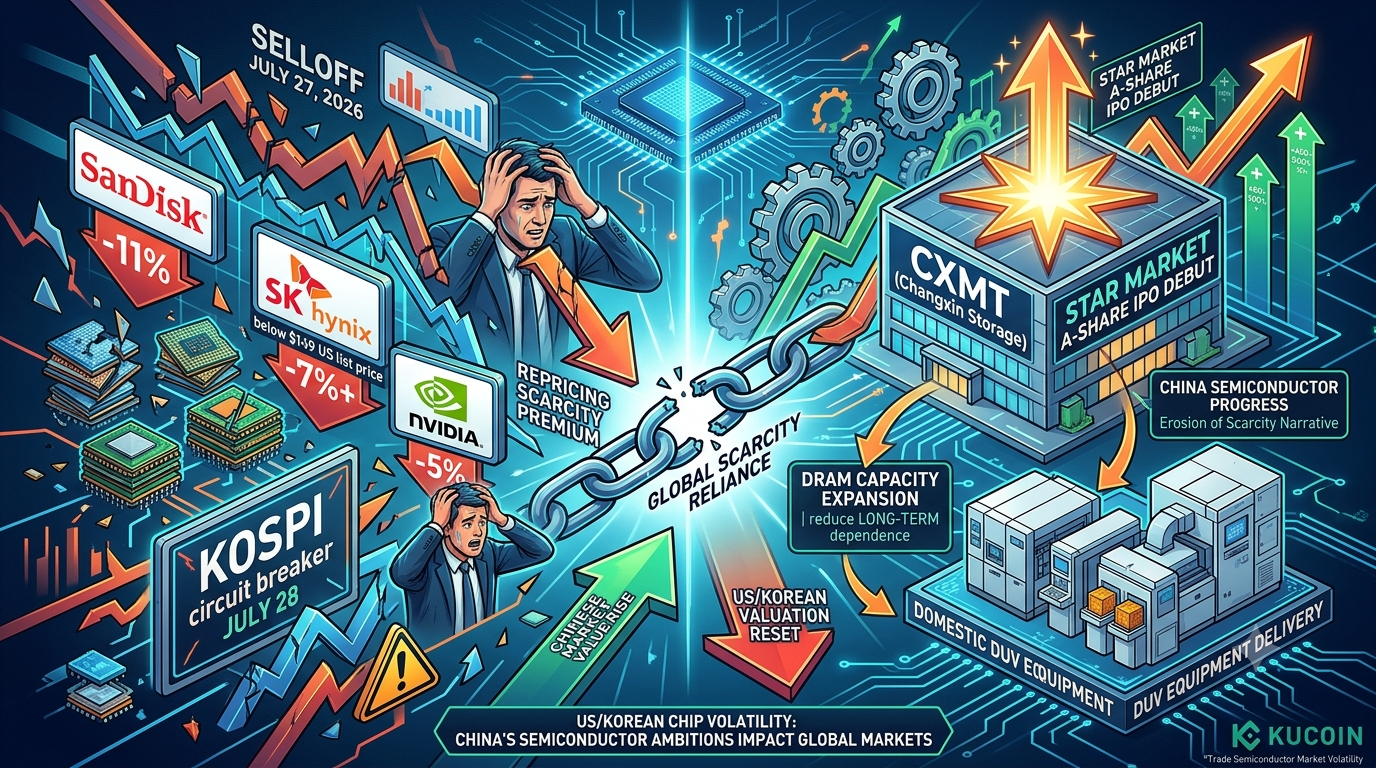
US chip stocks faced a sharp selloff on July 27, 2026, with SanDisk falling 11%, SK Hynix dropping more than 7% below its $149 US listing price, and Nvidia declining 5%. The catalyst was China’s progress in domestic semiconductor equipment and memory production, raising fears of a valuation reset similar to the earlier DeepSeek shock. Markets are now pricing in a potential shift where Chinese capacity expansion could erode the scarcity premium long enjoyed by global memory leaders.
This development does not mean China has achieved EUV or high-volume HBM mass production. It signals that domestic DUV tools may gradually reduce long-term dependence on imported lithography equipment, altering mid-term supply expectations for conventional DRAM and forcing investors to reassess pricing power across the sector.
What Triggered the Latest US Chip Stock Selloff?
The immediate trigger was the combination of Changxin Memory Technologies’ (CXMT) blockbuster A-share debut and reports of China’s first commercial domestic immersion DUV lithography machines heading to key fabs. According to market reports from July 27, 2026, SanDisk closed down approximately 11–12%, SK Hynix ADRs fell more than 7% and traded below the $149 IPO price set earlier in July, while Nvidia declined around 5%.
These moves reflected investor concern that Chinese memory expansion could increase mid-term supply of conventional DRAM. Previously, Micron, Samsung, and SK Hynix dominated high-end HBM, DRAM, and NAND markets. CXMT’s listing injected substantial capital into a domestic player already ranked as the world’s fourth-largest DRAM producer. The simultaneous news of domestic DUV equipment deliveries heightened the perception that China is narrowing the equipment gap that had constrained its capacity growth.
Korean markets amplified the reaction the following morning. The KOSPI triggered a circuit breaker on July 28, 2026, as Samsung Electronics and SK Hynix shares came under heavy pressure. US markets priced the risk first; Korean indexes followed with amplified volatility due to the heavy weighting of the two memory giants.
How Does Changxin Storage’s IPO Challenge Global Memory Giants?
CXMT’s July 27, 2026, STAR Market listing immediately made it the largest company by market capitalization on China’s A-share market. Shares surged more than 460–500% on debut, pushing the market value well above previous leaders according to contemporaneous reports. The company raised roughly $8.6 billion, providing significant funding for capacity expansion.
CXMT already held an estimated 7–8% global DRAM market share in early 2026. With fresh capital and potential access to domestic tools, the firm is positioned to accelerate production of mainstream DRAM. This does not instantly displace HBM leadership held by SK Hynix and Samsung. It does, however, threaten the scarcity narrative that supported elevated valuations across the memory complex. Once domestic expansion tools become reliable, the mid-term supply curve for ordinary DRAM can shift rightward, reducing the pricing power premium previously embedded in Korean and US memory stocks.
Can China’s Domestic DUV Equipment End the Lithography Monopoly?
China has not broken the EUV monopoly held by ASML, nor has it achieved high-volume advanced-node production with fully domestic tools. Reports from July 27, 2026, indicate that a state-backed Shanghai firm, linked to efforts involving Yuliangsheng Technology, has begun limited mass production of immersion DUV lithography machines. The first batch is scheduled for delivery this year to SMIC, Hua Hong Semiconductor, and CXMT, with targets of approximately five systems in 2026 and around 20 in 2027.
These tools primarily support nodes around 28 nm and related processes using single-exposure techniques. SMIC has already been evaluating a domestic immersion tool since late 2025. Most components are sourced domestically, though some critical parts remain imported. The volume is modest compared with ASML’s annual output, yet the market is reacting to the direction of travel rather than near-term volume. Once validated on production lines, domestic DUV capacity can support incremental expansion at Chinese memory and foundry sites without full reliance on restricted foreign equipment. This gradual change is enough to compress the long-term scarcity valuation of imported-tool-dependent competitors.
Why Are Korean Semiconductor Stocks Facing Circuit Breakers?
Korean indexes reacted more violently because Samsung Electronics and SK Hynix carry extremely high weights in the KOSPI. On July 28, 2026, the benchmark fell more than 7–8% at points, triggering sidecars and a market-wide circuit breaker. The move followed the prior day’s US declines and reflected both de-leveraging of concentrated positions and broader anxiety over Chinese capacity growth.
SK Hynix’s US-listed ADRs had already fallen below the $149 pricing of its July 2026 Nasdaq listing. The sequence of US pricing first and Korean catch-up selling is typical when global investors reassess the same risk factors across venues. High index concentration turns individual stock adjustments into systemic index moves, amplifying the sense of crisis even when the underlying technology gap remains substantial.
What Does This Mean for the Future Pricing Power of Samsung and SK Hynix?
The core risk is not an immediate loss of quarterly profits but the potential erosion of the “scarcity plus pricing power” premium. If CXMT gains reliable domestic expansion tools, conventional DRAM supply can expand more readily over the medium term. HBM demand driven by AI remains strong and is still dominated by the Korean leaders, yet investors are beginning to distinguish between high-end HBM and mainstream DRAM economics.
Markets will closely watch SK Hynix’s July 29, 2026, earnings for commentary on HBM4 orders, cash flow, and any signals on broader memory pricing. Parallel attention will focus on whether the new domestic DUV tools successfully pass customer validation and enable measurable capacity additions at CXMT. Successful validation would reinforce the narrative of rising Chinese mid-tier supply and further pressure valuations that previously assumed prolonged constraints on Chinese expansion.
Are Investors Shifting Away from Chip Stocks Toward Big Tech Giants?
While pure-play semiconductor names sold off, certain large-cap technology stocks showed relative resilience. Apple and Alphabet (Google) stabilized or posted modest gains during the same session. These companies have maintained more cautious approaches to AI capital expenditure, favoring leased compute capacity over aggressive self-built infrastructure. Investors appear to be rewarding balance-sheet discipline and diversified revenue streams at a moment when memory and equipment valuations face structural questions.
This rotation does not eliminate the long-term AI infrastructure thesis. It does highlight a preference for companies whose growth is less dependent on sustained scarcity pricing in the memory supply chain.
Should You Trade Semiconductor Market Volatility on KuCoin?
Semiconductor sector swings create both risk and opportunity across correlated digital assets and broader market sentiment. KuCoin provides a liquid platform for trading a wide range of cryptocurrencies, including tokens linked to AI & computing, storage, and decentralized infrastructure themes that often move with technology equity narratives. Users can access spot, futures, and other products with competitive fees and deep liquidity.
Join KuCoin 9th Anniversary Trading Campaign
KuCoin is celebrating its 9th anniversary with a special platform campaign filled with exclusive rewards, trading activities, and limited-time offers. Don’t miss the chance to participate and enjoy the benefits as the exchange marks nine years of growth and innovation. Visit the official campaign page now:
Conclusion
The July 2026 selloff in US and Korean chip stocks was driven by CXMT’s transformative IPO and credible reports of domestic Chinese immersion DUV lithography machines entering limited production for delivery to SMIC, Hua Hong, and CXMT. These events do not signify immediate parity in EUV or HBM capabilities. They do introduce a new variable: the possibility that China can expand conventional DRAM capacity with reduced long-term dependence on restricted foreign equipment.
As a result, markets are repricing the scarcity premium previously attached to Samsung, SK Hynix, and related US memory names. SK Hynix’s US ADRs trading below the $149 listing price and the KOSPI circuit breaker illustrate how quickly sentiment can shift when a structural constraint appears less permanent. Near-term catalysts include SK Hynix’s July 29 earnings and ongoing validation of the new domestic tools. Investors are already differentiating between pure-play memory names and more cautious large-cap technology companies. The episode underscores that semiconductor valuations now respond not only to AI demand but also to the evolving competitive landscape shaped by Chinese industrial policy and equipment localization.
FAQs
Will domestic Chinese DUV machines immediately compete with ASML’s most advanced tools?
No. The reported systems target immersion DUV processes primarily around 28 nm and related nodes. They do not replicate EUV capabilities required for the most advanced logic and HBM production.
Has CXMT already achieved high-volume HBM production?
No. CXMT is a significant DRAM producer, but leadership in high-bandwidth memory remains with SK Hynix and Samsung. The IPO funding and potential domestic tools mainly support mainstream DRAM expansion.
Are Apple and Google immune to semiconductor sector pressure?
They are not immune, but their more measured AI capital-expenditure strategies and diversified businesses have provided relative stability during the latest pure-play chip selloff.