

What is Dai (DAI)? Principles, Sky Ecosystem Upgrade & 2026 Status
2026/05/02 17:40:19
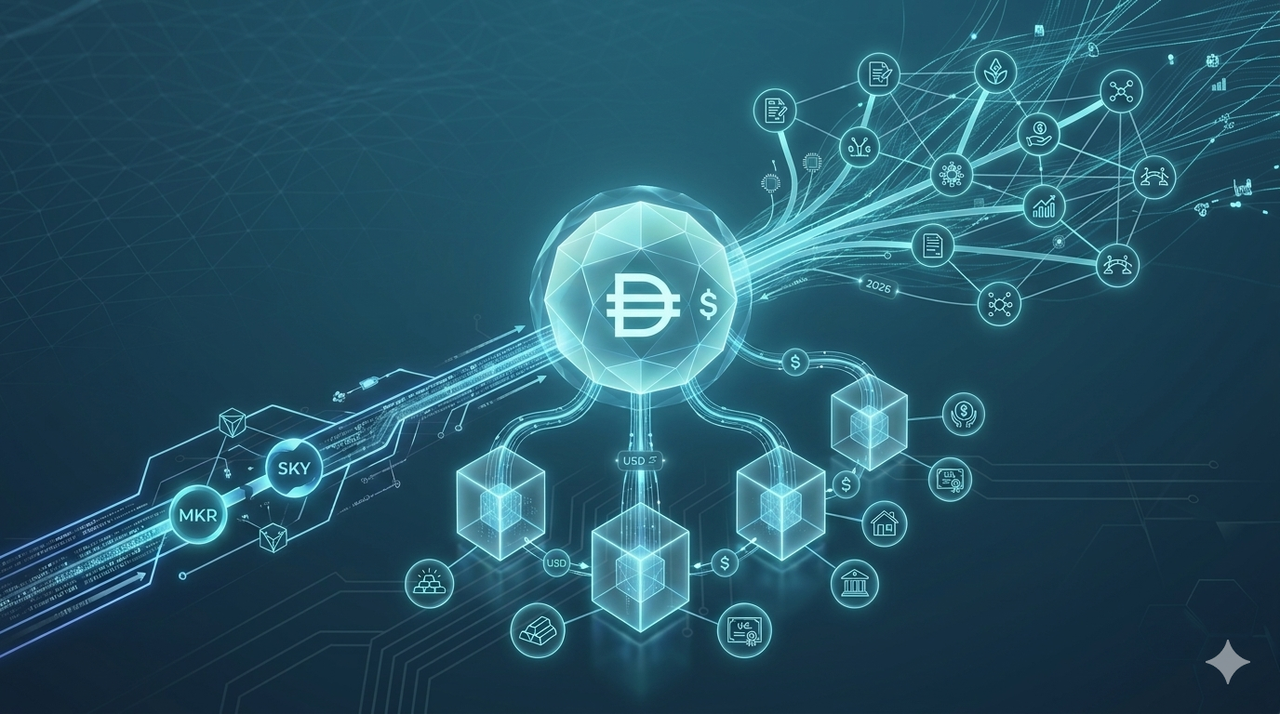
Most digital dollars rely heavily on legacy banking rails. Heavyweights in the space operate by hoarding physical fiat currency or equivalent traditional debt inside opaque bank accounts. They subsequently issue digital tokens to users as programmable receipts. While undeniably efficient for rapid trading, this fiat-backed model introduces a glaring single point of failure: a complete reliance on central custodians.
DAI takes a radically different and ideologically pure approach. It represents the earliest and most successful decentralized stablecoin in existence. It was painstakingly engineered to maintain a strict one-to-one peg with the US dollar without ever touching a traditional bank deposit. It derives its peg entirely through smart-contract-managed, on-chain asset collateralization.
By removing the need for a central issuer or permissioned custodian, the underlying protocol created a trustless financial instrument. This digital asset has actively absorbed some of the most violent market cycles in cryptocurrency history.
As we analyze the state of decentralized finance today, deeply understanding this token is an essential requirement for navigating the broader global economy.
Summary
This comprehensive guide explores Dai (DAI), the foundational decentralized stablecoin originally launched by the MakerDAO project on the Ethereum network. We will break down its unique over-collateralized lending mechanism, trace its historic evolution and massive rebranding into the Sky ecosystem, and deeply examine its strategic reliance on Real-World Assets (RWAs). Finally, we will objectively evaluate its technical advantages and inherent risks in the modern cryptocurrency market.
Thesis
The primary purpose of this article is to equip modern investors, blockchain developers, and crypto enthusiasts with a deep, technical, yet accessible understanding of what Dai (DAI) is, how its underlying principles mathematically guarantee its one-dollar peg, and what its project development status looks like today.
By mastering these core concepts, you will be uniquely positioned to make highly informed capital allocation decisions within the rapidly evolving decentralized finance sector.
What is Dai (DAI)? The Pioneer of Decentralized Stablecoins
DAI is a fully decentralized, unbiased, collateral-backed cryptocurrency explicitly engineered to maintain a strict soft peg to the United States Dollar. It is a monumental paradigm shift in how we conceive of stable digital money. The asset operates completely outside the legacy banking infrastructure and its associated permissioned gatekeepers.
When you purchase or mint this decentralized stablecoin, you are interacting with a complex monetary system built fundamentally on the Ethereum blockchain. It is governed entirely by open-source smart contracts rather than a corporate board of directors. Every single fraction of a cent backing the circulating supply is mathematically verifiable on the public blockchain twenty-four hours a day.
Since its public inception, the overarching goal of the protocol has been to provide an unshakeable medium of exchange and a highly secure store of value. It has successfully become the fundamental building block for hundreds of automated lending protocols, privacy-focused decentralized exchanges, and complex yield farming strategies.
Core Principles: The Over-Collateralization Engine Explained
The underlying mathematical engine that keeps this decentralized currency permanently pegged to the US dollar is known as over-collateralization.
To truly grasp this financial concept, it is helpful to conceptualize the governing smart contract protocol as a highly efficient, automated digital pawn shop.
This protocol operates flawlessly without human intervention or emotional bias. Users do not simply buy these tokens directly from a central treasury. Instead, they must actively generate them by locking up highly liquid digital assets within specialized smart contracts, historically known as Vaults.
When an investor wants to access stable liquid capital but refuses to sell their valuable cryptocurrency holdings, they interact with these Vaults. They deposit assets like Ethereum (ETH) or Wrapped Bitcoin (WBTC) directly into the protocol. This allows them to avoid immediate taxable events while retaining future price appreciation on their collateral.
The Mechanics of the Stability Buffer
However, the system enforces a strict mathematical rule to account for the notorious, violent volatility of the cryptocurrency market. You cannot deposit one hundred dollars worth of Ethereum and borrow one hundred DAI. The protocol typically demands a collateral ratio exceeding 150 percent, depending on the asset's specific risk profile.
For instance, depositing one hundred and fifty dollars worth of Ethereum will empower you to borrow a maximum of one hundred DAI. That excess fifty dollars acts as an aggressive, mathematically enforced volatility buffer.
If the broader cryptocurrency market crashes and the value of your locked Ethereum plummets dangerously close to a predefined safety threshold—such as 130 percent—the smart contract instantly triggers an automated liquidation sequence.
Price Monitoring: Decentralized oracles constantly feed real-time market prices to the governing smart contract.
Automated Seizure: If the collateral value drops too low, the Vault is frozen and the assets are mathematically seized.
Keeper Auctions: Automated bots called "Keepers" aggressively bid on the seized collateral to repay the outstanding debt.
Liquidation Penalty: A heavy fee is extracted from the borrower for failing to properly manage their margin risk.
Capital Return: Any remaining collateral left over after the debt and penalties are paid is returned to the original borrower's wallet.
ruthless, code-driven mechanism ensures that the total value of collateral held by the protocol always vastly exceeds the total value of circulating debt.
Furthermore, the system heavily regulates market supply and demand through monetary levers like the DAI Savings Rate (DSR). This mechanism pays yield to users who lock up their stablecoins, helping to automatically balance the peg when it drifts.
MakerDAO's Historic Evolution into the Sky Ecosystem
Recognizing that the original architecture needed to scale, the project origins shifted significantly: formerly known as MakerDAO, the entire ecosystem rebranded to the Sky Protocol.
To reach mainstream global adoption, the system needed a more accessible interface, highly rewarding tokenomics, and an infrastructure capable of handling immense institutional liquidity.
At the center of this transformation is the newly deployed SKY token. Under the Sky upgrade, the token functions were completely revamped to offer dynamic utility across the entire decentralized landscape.
The primary functions of the new SKY token are organized into three core pillars:
Governance: The SKY token is directly used for voting on all major decisions regarding the Sky Protocol. It entirely replaces the original MKR token as the ultimate source of decentralized voting power over system parameters, collateral types, and treasury management.
Incentives: Holders can actively earn rewards by staking their SKY tokens or by providing vital liquidity to the broader ecosystem. This directly incentivizes long-term holding and active community participation.
Linked Assets: The SKY token is closely linked to the USDS stablecoin. Together, they form the updated Sky stablecoin ecosystem, creating a symbiotic relationship where decentralized governance and stable purchasing power work in tandem.
MKR tokens were converted at a strict ratio of 1 MKR to 24,000 SKY. This deliberate fractionalization significantly increased the total token supply, effectively eliminating the high unit bias of the old MKR token and making it far more psychologically accessible to average retail investors.
For those looking to diversify their entry points, exploring how to buy SKY on KuCoin also provides a highly secure gateway to access the broader ecosystem's assets.
Real-World Assets (RWA) and the SubDAO Revolution
Securing the long-term solvency of a decentralized dollar required protocol engineers to look far beyond the volatile confines of traditional cryptocurrencies. The ecosystem boldly pioneered the large-scale integration of Real-World Assets (RWAs).
By allocating billions of dollars from its massive idle reserves into tokenized United States Treasury bonds and structured corporate credit products, the protocol transformed its underlying risk profile. This aggressive RWA strategy provides the system with a highly predictable, low-risk, fixed-income revenue stream.
This specific revenue generation model operates entirely independently of cryptocurrency market sentiment. When decentralized borrowing demand inevitably stagnates during bear markets, the consistent interest payments generated from these sovereign bonds provide essential capital. It heavily funds the Savings Rate, subsidizes ongoing developer operations, and executes massive governance token buybacks.
The Power of Stars (SubDAOs)
This structural maturation elevated the project from a purely experimental algorithmic currency into a hybrid financial leviathan.
It is now indirectly backed by the sovereign credit of the United States government while maintaining its completely decentralized execution layer on the blockchain.
Simultaneously, the Sky upgrade decentralized the protocol's operational mechanics by introducing Stars, formerly conceptualized as SubDAOs. The original monolithic MakerDAO governance structure forced token holders to vote on absolutely everything, causing severe voter fatigue and bureaucratic gridlock.
The Star model solves this by modularizing the ecosystem and splitting it into multiple independent subsidiaries. Entities like the Spark Protocol, specializing specifically in lending markets, operate as autonomous divisions with their own distinct governance tokens, dedicated corporate treasuries, and specialized engineering teams.
This improves the efficiency of decentralized decision-making exponentially. It drives rapid innovation within specific financial niches while continuously funneling generated revenue directly back to the core smart contracts.
Analyzing the Advantages and Inherent Risks of the DAI Protocol
Objectively evaluating this digital asset requires a highly nuanced understanding of its distinct technical strengths alongside its deeply embedded systemic vulnerabilities.
Core Advantages of the Protocol:
Absolute Decentralization: Holding this asset does not require blind faith in a centralized corporate entity or the solvency of a traditional commercial bank. Your funds cannot be arbitrarily frozen, seized, or restricted by a rogue jurisdiction or overzealous regulator.
On-Chain Transparency: The precise location, health, and value of all collateral assets are mathematically verifiable on the public blockchain in real-time.
Censorship Resistance: Unlike fiat-backed alternatives that rely heavily on permissioned bank accounts, the legacy token operates strictly via immutable, open-source smart contracts. This drastically reduces the systemic single points of failure that plague highly centralized corporate stablecoins.
Inherent Risks and Vulnerabilities:
Collateral Volatility and Cascading Liquidations: The most prominent danger stems directly from the sheer volatility of the digital assets functioning as collateral inside the Vaults.
During periods of extreme, unprecedented market panic, a massive and instantaneous crash in the price of Ethereum or Bitcoin could theoretically trigger large-scale cascading liquidations.
Network Congestion Threats: If severe blockchain network congestion prevents the automated liquidation bots (known as Keepers) from efficiently executing their protective trades during a market flash crash, the overarching system could technically become temporarily under-collateralized.
Steep Learning Curve for Beginners: The overarching complexity of the system presents a massive barrier to entry for retail beginners. Understanding the intricate mechanics of over-collateralized lending, dynamic stability fees, and harsh liquidation penalties is undeniably more difficult than simply swapping fiat for a centralized stablecoin on a basic retail exchange application.
Dilution via Centralized Assets: Vocal critics within crypto space argue that the aggressive integration of centralized assets severely dilutes the asset's decentralized purity. The protocol relies heavily on USDC and tokenized US Treasury bonds within the collateral vaults.
Because these specific underlying assets can technically be frozen by their real-world issuers, purists firmly believe the protocol has traded a degree of true censorship resistance for enhanced short-term financial stability.
The Future Outlook for DAI in the 2026 Crypto Economy
As we navigate the highly regulated and rapidly institutionalizing cryptocurrency landscape, the legacy stablecoin and its compliant counterpart occupy a heavily defended position.
They hold a highly strategic wedge within the global digital economy. The controversial dual-token strategy executed during the MakerDAO to Sky upgrade is actively paying massive dividends today.
The broader ecosystem is successfully capturing staggering institutional capital inflows through the compliant USDS asset. Simultaneously, it is empowering decentralized purists to maintain their ideological ground with the original, unfreezable legacy stablecoin. This ensures that capital from all corners of the market flows into the same underlying architecture.
Current on-chain metrics point to a remarkably healthy, maturing, and deeply entrenched protocol. The legacy asset continues to command a multi-billion dollar market capitalization. It remains heavily utilized across complex decentralized lending markets, privacy-focused decentralized exchanges, and advanced cross-chain yield farming strategies.
Scaling Through Layer-Two Networks
Looking directly at the immediate development roadmap, the core engineering teams are focusing intensely on deepening native integrations. They are expanding advanced layer-two scaling solutions across the wider Ethereum ecosystem, including Base, Arbitrum, and various zero-knowledge rollups.
By ensuring seamless, near-zero-cost cryptographic transfers of the decentralized stablecoin across these networks, the protocol aggressively intends to cement its dominant position. It aims to be the default routing asset for the next massive wave of decentralized global commerce.
Conclusion
The historic evolution of Dai from a highly experimental, niche developer project into a multi-billion dollar foundational pillar of global decentralized finance is a testament to the sheer power of open-source engineering. By successfully pioneering and battle-testing the over-collateralization vault mechanism, the overarching protocol definitively proved that extreme currency stability could be achieved entirely on-chain without ever relying on opaque traditional banking rails.
The transition into the Sky ecosystem, the implementation of dual-token architecture with USDS, and the aggressive integration of real-world assets highlight a highly pragmatic willingness to evolve alongside 2026 regulatory realities. A deep, comprehensive understanding of this decentralized stablecoin and its underlying principles remains absolutely essential for anyone looking to safely and successfully navigate the borderless financial future.
FAQs
What exactly is Dai (DAI)?
DAI is a decentralized, collateral-backed cryptocurrency designed to maintain a 1:1 soft peg with the US Dollar, operating entirely via open-source smart contracts without relying on traditional legacy banks.
How does over-collateralization guarantee the $1 peg?
Users must deposit significantly more digital asset collateral than the stablecoin value they borrow. This massive safety buffer mathematically ensures the circulating debt remains fully covered despite crypto market volatility.
What happens if the value of my deposited collateral drops too low?
If collateral value drops below the required safety threshold, smart contracts automatically trigger liquidation. Your assets are forcefully auctioned to repay the debt alongside a penalty, keeping the system solvent.
What was the historic MakerDAO to Sky upgrade?
In late 2024, MakerDAO officially rebranded to the Sky Protocol to drive DeFi adoption. This transition introduced the USDS stablecoin, modular governance, and upgraded the legacy MKR token to SKY.
How does the new SKY token function compared to MKR?
SKY fully replaces MKR for decentralized network governance. It offers heavy incentives for staking and liquidity provision, and is intricately linked to the USDS stablecoin to balance the upgraded ecosystem.
What was the conversion ratio for the old MKR tokens?
During the rebranding, legacy MKR tokens were mathematically converted at a strict 1:24,000 ratio to SKY. This strategic split successfully eliminated unit bias, making governance significantly more accessible for retail.
Why does the protocol heavily use Real-World Assets (RWAs) like US Treasury bonds?
Tokenized Treasury bonds provide predictable, low-risk interest income independent of crypto volatility. This strategic diversification makes the overarching stablecoin significantly more solvent and robust during severe, prolonged digital asset bear markets.
What are the main risks associated with holding this decentralized stablecoin?
Primary risks include extreme collateral volatility triggering cascading flash crash liquidations, the inherent complexity of vault mechanics for beginners, and a growing reliance on centralized assets that could dilute decentralization.
Disclaimer:This content is for informational purposes only and does not constitute investment advice. Cryptocurrency investments carry risk. Please do your own research (DYOR).