

December 2025 Bitcoin Price Prediction: Key Drivers and Potential Challenges for a Breakthrough Beyond $110,000
2025/11/07 16:57:02
I. Long-Term Outlook: Analysis of Core Data for the December 2025 Bitcoin Price Forecast

Following a year marked by market volatility and continuous institutional capital infusion throughout 2024, cryptocurrency experts have issued a remarkably optimistic and firm forecast for the price of Bitcoin (BTC) by the close of 2025. This prediction is the result of synthesizing complex macroeconomic models, historical halving cycle effects, and the accelerating rate of institutional adoption.
1.1 Predictive Metrics and the Implied Breakthrough

BTC Price|Source: Kucoin
Experts, through careful analysis of the BTC price range across 2024 and consideration of market liquidity and sentiment indicators, have locked in the Bitcoin price range for December 2025 between $110,067.72 and $111,028.38.
| Price Metric | Forecasted Value (USD) | Interpretation |
| Maximum Trading Value (Maximum) | $111,028.38 | Marks the predicted peak for the month, potentially defining the top resistance of the current bull cycle phase. |
| Minimum Trading Value (Minimum) | $110,067.72 | Indicates a strong psychological and technical support level, suggesting rapid buying interest and firm resistance during pullbacks. |
| Average Cost (Average) | $110,548.05 | Reflects the market's consensus on BTC's value, providing an anchor point for institutional and long-term holders. |
The core highlight of this forecast is not just the anticipation of breaching the significant $100,000 psychological milestone, but maintaining the average price above the $110,000 mark. This expectation of high-level stability signals a critical progression in Bitcoin's asset status, moving from a "high-risk speculative asset" towards a globally accepted "store of value."
1.2 Three Key Factors Supporting the Long-Term Forecast
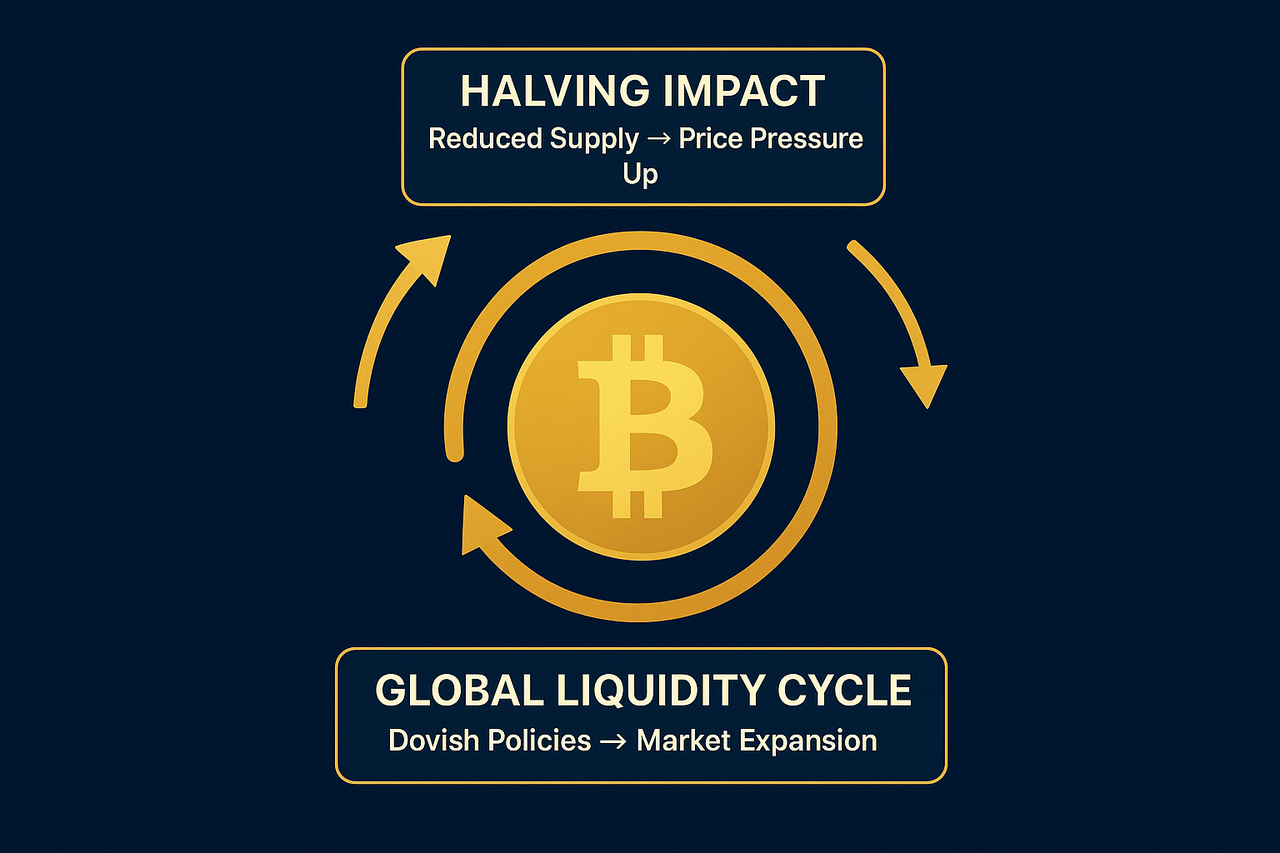
Achieving and sustaining this elevated price level is largely dependent on the following three major drivers:
-
The Halving Effect's Lagging Impact: While the Bitcoin Halving event typically occurs in 2024, its most potent price impact usually materializes within the subsequent 12-18 months, covering the end of 2025 and early 2026. The rigid constriction of supply serves as the foundational impetus for price appreciation.
-
Sustained Institutional Capital Inflow: The introduction of spot ETFs has significantly streamlined the process for traditional financial institutions and retail investors to gain exposure to Bitcoin. In 2025, an increasing number of pension funds, sovereign wealth funds, and large asset management firms are expected to incorporate Bitcoin into their portfolios, bringing potentially hundreds of billions in incremental capital.
-
Cyclical Release of Global Liquidity: As global central banks potentially shift towards more dovish monetary policies in late 2024 or early 2025, global liquidity is projected to become more abundant. As a representative high-beta risk asset, Bitcoin is poised to benefit substantially from this surplus liquidity, accelerating its upward trend.
II. Recent Dynamics and Short-Term Challenges: Market Performance Under Macroeconomic Pressure
Despite the strong long-term optimism, the crypto market is not without immediate friction. Recent market dynamics reveal the short-term macroeconomic pressures and liquidity challenges that investors must navigate.
2.1 Analysis of the Crypto Market's Correlation with US Equities
Impact Assessment: As long as global macroeconomic uncertainty (related to inflation, interest rates, etc.) persists, this correlation will endure. The recent 1.56% drop in market capitalization is a stark reminder that the path toward $110,000+ will be subject to volatility, necessitating vigilance against sudden external macro shocks.
2.2 Bitcoin's Short-Term Retracement and the Battle for Support
"Bitcoin failed to sustain the previous day’s rebound, retracting to find support near $100k."
Observation and Analysis: Bitcoin's retracement towards the $100,000 level is a significant technical and psychological event:
-
From a Technical Perspective: $100,000 functions as a powerful, large-integer support level. Finding support here suggests strong underlying demand and buying interest, which successfully limits the scope of any deeper short-term fall.
-
From a Market Sentiment Perspective: The failure of the prior rebound is often attributed to insufficient long-side pressure to overcome overhead selling, or potential profit-taking by large whales and institutional investors at key resistance zones.
-
Underlying Factor: A potential temporary cooling or slowdown in institutional spot ETF inflows could also be contributing to the lack of upward momentum, as some major entities may be consolidating positions after an accumulation phase.
2.3 The "Anomalous Activity" in Altcoins
"Altcoin trading remained relatively active during the overall downtrend."
Observation and Analysis: The comparative activity in altcoin trading amidst a large-cap decline suggests a structural divergence, which can be interpreted in two ways:
-
"Speculation in Desperation": Some high-risk capital may be rotating away from macro-sensitive assets like BTC/ETH and into smaller-cap altcoins, seeking outsized returns from short-term plays. This pattern often emerges when broader market sentiment is bearish but liquidity has not entirely dried up, with volatility—rather than a stable uptrend—becoming the primary target for capital.
-
"Narrative Rotation": Capital may be focusing on specific, emerging sectoral narratives, such as new AI-Crypto integration projects, DeFi innovations, or Layer 2 scaling solutions. This represents a structural shift in market hot spots, demonstrating the ongoing innovation and internal vitality within the crypto ecosystem.
III. Conclusion and Investment Strategy Recommendations

This article clearly contrasts the long-term potential with the short-term challenges facing the Bitcoin market.
-
Long-Term Strategy (Focused on the $110,548.05 Average Target for Dec 2025): Investors should maintain long-term optimism, anchored by the halving cycle and the trend of institutionalization. Short-term pullbacks, particularly as the price approaches crucial support levels like $100,000, should be viewed as opportunities to accumulate or strengthen long-term positions.
-
Short-Term Tactics (Addressing Current Macro Correlation and Retracement): Investors must heighten risk awareness, hedging against the transmission effects of US stock and global monetary policies on the crypto market. Strict control of leverage is essential to avoid forced liquidations during macro-driven market "crashes."
Future Outlook: Only when Bitcoin begins to exhibit a decisive "de-coupling" from traditional assets (like US equities) and sustains a new high price floor will its status as a mainstream store of value be fully confirmed, allowing it to march steadily toward the anticipated peak of $111,028.38 in December 2025.