

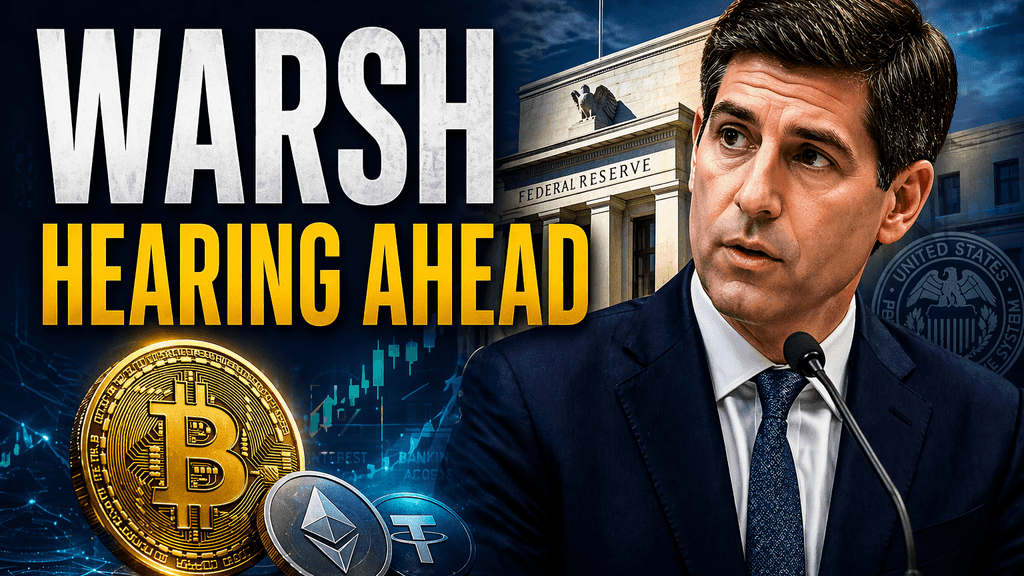
Warsh Hearing Ahead: How the Next Fed Chair May Shape Crypto
Key takeaways
-
The next Fed chair could shape crypto through interest rates, liquidity, and bank supervision.
-
Warsh’s hearing has drawn extra attention because of his reported ties to crypto-linked investments.
-
Traders want to know whether he would signal easier policy, tighter policy, or a different tone toward digital assets.
-
Crypto could benefit from a more predictable regulatory and banking environment, but not necessarily from tighter monetary policy.
-
The biggest issues to watch are rates, Fed independence, banking access, and ethics.
Introduction
Kevin Warsh’s Senate hearing is not just a Fed story. It is a crypto story too, because the next Federal Reserve chair will help shape the two forces that matter most to digital assets in the United States: the price of money and the rules of access to the financial system. Warsh appeared before the Senate Banking Committee as the nominee to be both a member and chair of the Board of Governors, while Jerome Powell’s current term as chair is set to end on May 15, 2026. Powell remains a governor through January 31, 2028, but the chair still carries the strongest influence over Fed messaging, market expectations, and the central bank’s tone toward risk, liquidity, and financial innovation.
That matters to crypto because bitcoin and the wider digital-asset market now trade much more like macro-sensitive assets than they did a few years ago. When markets reprice rate cuts, inflation risk, or dollar liquidity, crypto usually reacts fast. Ahead of Warsh’s hearing, market coverage explicitly flagged the event as something that could sway expectations for interest-rate policy and broader asset prices, with bitcoin trading near a technically important level as traders waited for clues.
What makes Warsh more relevant than a typical Fed nominee is that his nomination comes with a direct crypto angle. CoinDesk reported that his financial disclosure showed exposure to multiple crypto-linked positions, including bets tied to DeFi protocols, Ethereum scaling, and bitcoin-related infrastructure. That does not automatically make him bullish for the sector, but it does mean markets are looking at a nominee who appears more familiar with digital assets than most recent central-bank leaders.
Crypto traders care who runs the Fed
The Fed does not regulate crypto in the same direct way that the SEC, CFTC, or Congress can. But it still shapes the environment crypto lives in. Interest-rate policy affects how much investors are willing to pay for risk. Balance-sheet policy influences liquidity conditions across markets. Fed supervision also affects how comfortable banks are with serving crypto firms, stablecoin issuers, custodians, and payment businesses. So even when the Fed is not writing crypto rules line by line, it still sets the background conditions that determine whether digital-asset markets feel loose, tight, accessible, or constrained.
For bitcoin, this link is especially important. Bitcoin is still marketed as an alternative monetary asset, but in real trading it also behaves as a high-volatility, macro-sensitive instrument. When rate expectations fall and liquidity looks easier, traders often become more willing to own speculative assets. When inflation risk rises or policy looks tighter for longer, that appetite tends to weaken. A Fed chair hearing can therefore move crypto without anyone needing to mention bitcoin directly. Markets listen for clues on inflation, independence, balance-sheet policy, and the likely path of future cuts.
That is why Warsh’s hearing drew attention beyond bond desks and policy watchers. Crypto investors wanted to know whether he would sound more dovish than Powell, more hawkish than Powell, or simply different in ways that could change sentiment toward the sector. The answer so far is more complicated than a simple bullish or bearish label.
The hearing put independence at the center
One of the biggest themes in Warsh’s hearing was Fed independence. He said he would be an independent actor rather than a political instrument, pushing back against attacks that he could become too closely aligned with White House rate demands. At the same time, live hearing coverage noted concerns from some observers that he was careful not to antagonize President Trump, which kept questions alive about how much independence he would actually maintain under pressure.
For crypto, independence matters more than it may first appear. If markets start to believe the Fed’s decisions are being bent by politics, the result can be volatility across Treasurys, equities, the dollar, and inflation expectations. Crypto sits downstream from all of that. A weaker sense of Fed credibility can initially help some anti-establishment narratives around bitcoin, but in real market terms it can also create a messier macro backdrop that hurts speculative assets. Digital assets do not benefit simply because traditional policy institutions look unstable. More often, they get caught in the crossfire of uncertainty.
This is one reason the hearing matters even beyond policy specifics. The next Fed chair will not just decide meetings and statements. He will also help determine how credible the institution looks at a time when markets are unusually sensitive to political pressure on monetary policy.
Warsh’s crypto exposure changes the conversation
-
The nomination becomes more than a rates story
Most Fed chair hearings focus almost entirely on inflation, employment, and interest rates. Warsh’s hearing adds another layer because his reported exposure to crypto-linked investments brings digital assets directly into the discussion. -
Markets are asking whether familiarity is an advantage
Instead of only asking whether Warsh understands crypto, investors are also asking whether his background gives him a more informed view of the sector. Supporters may see that as a strength in an area where policymakers have often treated very different parts of crypto as if they were the same thing. -
A better-informed Fed could mean more precise oversight
Crypto policy has often suffered when officials failed to distinguish between trading tokens, stablecoin infrastructure, custody, payment systems, DeFi protocols, and bank-facing blockchain services. A chair with more direct familiarity may be better positioned to separate legitimate financial innovation from genuine risk. -
The same familiarity also raises conflict concerns
Warsh’s crypto-linked holdings have also created a clear ethics question. A Fed chair nominee with exposure to sector-related assets will naturally face scrutiny over whether those ties could influence decision-making or undermine confidence in the institution. -
Divestment matters as much as expertise
During the hearing, Warsh said he would divest relevant holdings and comply with ethics requirements. That matters because any perception that the Fed chair could personally benefit from decisions affecting crypto would quickly damage credibility, no matter how knowledgeable he is about the sector. -
The crypto impact depends on whether he clears the ethics test
Warsh’s familiarity with digital assets could help the industry only if markets and lawmakers are convinced that his judgment would remain independent. In other words, expertise may be useful, but only if it comes without unresolved questions about bias or personal interest.
A crypto-aware Fed is not automatically a bullish Fed
This is the most important distinction in the whole story. Even if Warsh is more crypto-literate than recent Fed leaders, that does not mean crypto prices should rally on his nomination alone. Crypto benefits most from easier liquidity, lower real yields, softer dollar conditions, and healthier risk appetite. Those are macro outcomes, not personality traits. A chair can understand crypto perfectly well and still run a policy stance that is tough on speculative assets.
Recent coverage has already hinted at that tension. CoinDesk highlighted that Warsh’s hearing could sway expectations for interest-rate policy, while separate CoinDesk analysis argued he could even be bearish for bitcoin despite his past crypto openness because markets may see him as more hawkish on monetary discipline. The basic point is that crypto traders should not confuse sector familiarity with easy money.
That tension is likely to define the market’s reaction over the next several weeks. If investors conclude Warsh would favor faster easing, bitcoin and other high-beta crypto assets could benefit. If instead they conclude he is serious about keeping policy restrictive until inflation is clearly under control, then a better-informed Fed might still be a tougher Fed from the market’s point of view. That is why the hearing’s macro content matters more than any single crypto headline.
Four ways the next Fed chair could shape crypto
1. Rate expectations and risk appetite
This is still the clearest transmission channel. Markets price crypto partly through their view of future rates and liquidity. If Warsh begins to sound like someone who sees room for easier policy, traders may respond by pushing up risk assets broadly, including bitcoin and crypto-linked equities. If he sounds more cautious on inflation and more willing to hold firm, then crypto may struggle in the same way other speculative assets would. His comments during the hearing that the underlying inflation trend is improving were notable, but they do not amount to a promise of easier money.
2. Balance-sheet policy and dollar liquidity
Warsh also said he would work with Treasury Secretary Scott Bessent to shrink the Fed’s balance sheet slowly and deliberately. That matters because balance-sheet policy affects market liquidity and the broader monetary environment. Crypto has historically been highly sensitive to shifts in liquidity conditions. A smaller balance sheet can mean a different backdrop for leveraged trading, funding conditions, and the willingness of investors to move into volatile assets. Whether traders see that as healthy normalization or an additional headwind will depend on how the details evolve.
3. Banking access for crypto firms
This may be the biggest long-run issue for the industry. Crypto businesses still rely on traditional financial rails for deposits, settlements, payroll, custody interfaces, and stablecoin reserves. The Fed has major influence over the supervisory climate in which banks decide how much exposure they are willing to take. A chair who supports more predictable, case-by-case supervision rather than blanket hostility could make a real difference for crypto firms even without any dramatic public announcement. This would likely show up first in tone and access, not in splashy headline policy.
4. Stablecoins and digital-dollar infrastructure
Stablecoins are increasingly part of the broader financial conversation because they touch payments, reserves, settlement, and the international role of the dollar. A Fed chair who understands how stablecoins fit into financial plumbing could influence the seriousness and quality of the central bank’s engagement with the sector. That does not mean approval of every issuer or model. It means the conversation could become more specific and more grounded in system design rather than general suspicion. For crypto markets, that would matter because stablecoins sit at the core of trading, liquidity, and cross-border movement. Warsh’s background does not guarantee that outcome, but it makes the issue harder to dismiss as fringe.
What traders should watch after the hearing
The first thing to watch is whether Warsh’s messaging becomes clearer on rates. Confirmation hearings are usually cautious by design, so one hearing rarely settles the entire policy picture. But markets will keep re-reading his comments alongside incoming inflation and labor data to decide whether he looks more dovish, more hawkish, or simply more willing to communicate differently than Powell.
The second is whether independence concerns fade or deepen. If investors become comfortable that Warsh can resist political pressure, markets may treat his nomination as a manageable transition. If they continue to worry that the White House could shape Fed decisions indirectly, then the uncertainty premium across markets could stay elevated. Crypto would not be isolated from that.
The third is whether crypto-specific narratives begin to shift inside the banking system. The market often reacts before formal policy changes happen. If banks, payment firms, and institutional investors begin to think the Fed under Warsh would be less reflexively defensive toward lawful crypto activity, sentiment could improve well before any public framework changes. This is one area where a change in tone alone could have outsized importance.
The fourth is whether ethics questions remain central. If the story stays focused on Warsh’s holdings and divestment commitments, the crypto angle could become politically toxic rather than constructive. If he clears that hurdle cleanly, then the market may feel freer to focus on what his policy leadership could actually mean.
The things traders should watch after the hearing
-
Whether Warsh’s message on rates becomes clearer
Confirmation hearings are usually cautious, so one appearance rarely settles the full policy picture. Still, markets will keep studying Warsh’s remarks alongside inflation and labor data to decide whether he looks more dovish, more hawkish, or simply different from Powell in how he signals policy. -
Whether independence concerns fade or grow
If investors become convinced that Warsh can resist political pressure, markets may treat his nomination as a manageable leadership transition. If doubts remain about White House influence over Fed decisions, uncertainty across markets could stay elevated, and crypto would likely feel that pressure too. -
Whether sentiment shifts inside the banking system
Markets often move before formal policy changes happen. If banks, payment firms, and institutional investors start to believe the Fed under Warsh would be less defensive toward lawful crypto activity, sentiment around the sector could improve well before any official framework changes. -
Whether ethics questions keep dominating the story
If the focus stays on Warsh’s holdings and divestment plans, the crypto angle could become politically damaging rather than constructive. If he clears that issue convincingly, markets may pay less attention to the conflict narrative and more attention to what his actual policy leadership could mean for crypto.
What this means for bitcoin, altcoins, and the wider market
For bitcoin, the hearing is mostly about macro. Bitcoin’s biggest sensitivity is still to real rates, the dollar, and overall risk appetite. A Warsh Fed that markets interpret as easier could support the asset. A Warsh Fed that looks disciplined and restrictive could weigh on it. The crypto-specific part of the story matters, but it does not replace the macro part.
For altcoins, the effects could be even more pronounced. Many altcoins depend more heavily on speculative flows, venture funding, exchange liquidity, and retail enthusiasm than bitcoin does. That makes them especially sensitive to any shift in financial conditions. If Warsh is seen as helping create a friendlier environment for risk, smaller digital assets could respond more dramatically than bitcoin. If not, they could also underperform more sharply in a tighter-policy scenario. This is an inference from how altcoins typically behave relative to bitcoin in changing liquidity environments, rather than something Warsh has stated directly.
For stablecoin issuers, custodians, and crypto infrastructure firms, the more important question is institutional access. The next Fed chair may shape whether the sector moves closer to mainstream finance or remains stuck at arm’s length. That issue may not show up in price charts as immediately as rate expectations do, but over time it could matter just as much as a few basis points on the fed-funds path.
The bottom line
Warsh’s hearing matters because it forces crypto markets to think about more than slogans. The next Fed chair could shape digital assets through rates, liquidity, supervision, and the overall climate for financial innovation. Warsh is unusual because he appears to bring real crypto familiarity into the process, but that creates both opportunity and scrutiny.
The main takeaway is simple: a more crypto-aware chair is not necessarily a more crypto-friendly chair in market terms. What will matter most is whether Warsh changes the expected path of monetary policy, how he handles Fed independence, whether he influences banking access for the sector, and whether his leadership produces a more predictable framework for digital-dollar infrastructure. Those are the channels that could truly reshape crypto in the next Fed era.
FAQs
Why does the next Fed chair matter for crypto?
The next Fed chair matters because the Federal Reserve influences interest rates, liquidity, and the broader financial environment. Those factors often shape risk appetite across markets, including bitcoin and other digital assets.
Is Kevin Warsh considered pro-crypto?
Not necessarily. Warsh has drawn attention because of reported crypto-linked exposure and familiarity with digital assets, but that does not automatically mean he would support policies that boost crypto prices or take a soft stance on the sector.
Could a new Fed chair directly regulate crypto?
Not in the same way as the SEC or CFTC. The Fed does not write most crypto-specific rules, but it still influences the sector through monetary policy, bank supervision, payment systems, and its role in the broader financial system.
Would a more crypto-aware Fed be bullish for bitcoin?
Not always. A Fed chair can understand crypto well and still support tighter monetary policy. Bitcoin and the wider crypto market often respond more to rates, liquidity, and macro conditions than to general pro-innovation language.
What should crypto traders watch most after Warsh’s hearing?
The main things to watch are his stance on rates, how independent he appears from political pressure, whether bank sentiment toward crypto begins to shift, and whether ethics questions around his holdings remain a major issue.
How could Warsh affect crypto banking access?
If the Fed under Warsh were seen as less defensive toward lawful crypto activity, banks and payment firms might feel more comfortable working with crypto businesses. That could improve access to financial services even without a major policy announcement.
Do Fed hearings move bitcoin prices?
They can. Markets often react to hearings when traders think they may reveal clues about future interest-rate policy, inflation concerns, or the broader direction of financial conditions.
What is the biggest risk for crypto if Warsh becomes Fed chair?
The biggest risk is that markets may expect a more crypto-aware leadership style, but still get tighter policy, slower easing, or ongoing pressure on risk assets. In that case, better understanding of crypto would not necessarily translate into stronger market performance.
Could Warsh’s ethics disclosures become a problem?
Yes. Because of his reported crypto-linked holdings, ethics and conflict-of-interest questions have become part of the story. That is why his divestment commitments and compliance with ethics rules are being watched closely.
What is the main takeaway for crypto investors?
The key point is that the next Fed chair could shape crypto indirectly through macro policy, liquidity, supervision, and financial access. The real impact will depend less on headlines and more on whether policy under new leadership turns easier, tighter, or simply more predictable.
Disclaimer: The information in this article is provided for general information only and does not constitute investment advice, financial advice, or a recommendation to buy, sell, or hold any digital asset. Crypto assets involve risk and may not be suitable for all users. Readers should independently verify all information, assess their own risk tolerance, and consult qualified professionals where appropriate before making any financial decisions.