

VEST by Anubis Labs: Real Assets & Digital Capital Platform Opens Registration May 20
2026/05/25 14:18:09
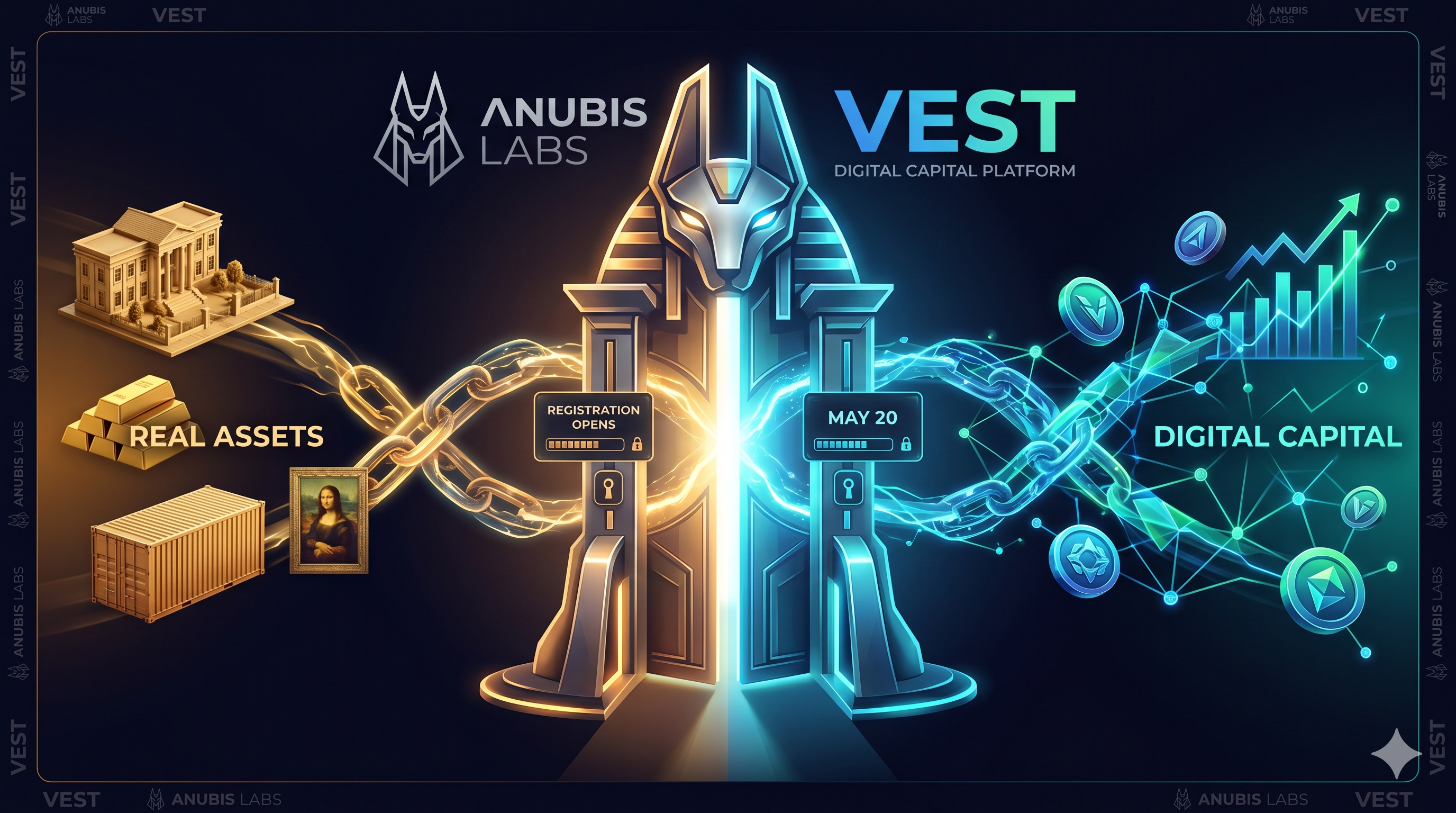
VEST, the digital capital platform incubated by Anubis Labs, is set to open global registration on May 20, marking an important milestone in the development of real-world asset integration and digital capital infrastructure. Built on Anubis Chain, VEST is positioned as a new platform designed to connect real assets, liquidity co-building, digital rights, and community governance through an algorithmic adaptive balanced minting protocol.
As the blockchain industry continues to evolve beyond speculative trading and isolated token economies, real-world assets have become one of the most important directions for Web3 growth. KuCoin has also highlighted the rise of real-world asset tokenization as a key development in the crypto sector, showing how blockchain technology can unlock liquidity and improve access to traditionally illiquid assets.
VEST enters this market with a clear focus: to create a bridge between tangible asset value and decentralized digital capital networks. Through its registration opening, the platform aims to provide global users with access to a new model of asset participation, value circulation, and ecosystem governance.
The launch of VEST reflects the broader strategic vision of Anubis Labs, which has been building around Web3 infrastructure, capital coordination, and project incubation. As part of the Anubis ecosystem, VEST represents a step toward combining real-world value with on-chain financial mechanisms, offering a framework that may support asset digitization, liquidity construction, and community-driven participation.
💡 Tips: New to crypto? KuCoin's Knowledge Base has everything you need to get started.
VEST Opens Global Registration on May 20
A Key Launch Moment for the Anubis Ecosystem
VEST will open registration on May 20, giving global users the opportunity to participate in a platform centered on real assets and digital capital. The opening of registration is more than a simple user-access event. It represents the beginning of VEST’s broader ecosystem expansion and its move toward building a new financial infrastructure layer within the Anubis Chain environment.
The timing of the launch comes as real-world asset tokenization continues to gain attention across the blockchain sector. In recent years, the crypto industry has increasingly moved from purely digital-native assets toward models that connect blockchain technology with physical assets, financial rights, revenue streams, and real economic value. This shift has created strong demand for platforms capable of connecting off-chain assets with on-chain liquidity in a structured and transparent way.
Early Access for Global Users
The opening of registration allows users to enter the VEST ecosystem at an early stage. For global participants, this may serve as a gateway into Anubis Labs’ developing real-asset infrastructure. The platform’s positioning suggests that users will not only interact with a single product, but with a broader ecosystem designed around asset activation, capital coordination, and digital ownership.
At the center of VEST’s model is the idea that real-world assets can be represented, circulated, and governed through blockchain-based systems. By using Anubis Chain as its infrastructure foundation, VEST aims to support a more efficient connection between asset value and digital capital. This approach reflects a growing belief in the Web3 industry that blockchain networks can become more than speculative markets; they can become settlement, coordination, and governance layers for real economic activity.
Why the Registration Opening Matters
The registration opening also signals Anubis Labs’ intention to expand its ecosystem beyond infrastructure and incubation into a more direct platform model. With VEST, Anubis Labs is introducing a digital capital platform that could become a central part of its strategy in the real-world asset sector. The platform combines ecosystem incubation, technology infrastructure, and capital participation into one unified narrative.
For users, VEST’s registration launch may provide early access to a system designed around liquidity co-building. This means the platform is not only focused on asset representation, but also on how users, communities, and ecosystem participants can help construct liquidity around those assets. In traditional finance, liquidity is often controlled by centralized institutions and market makers. In the Web3 model, platforms such as VEST aim to explore more open and participatory methods of liquidity creation.
This is one of the key reasons the platform’s May 20 registration opening is significant. It gives the market a first look at how Anubis Labs intends to combine real assets with digital capital mechanisms. It also gives users an opportunity to participate in the early stage of a platform that is being positioned as a gateway between real-world value and decentralized finance.
A Gateway Into Asset-Backed Web3 Infrastructure
As Web3 continues to search for stronger connections to real economic utility, platforms like VEST are likely to attract attention from users interested in asset-backed ecosystems, digital rights, and decentralized capital models. The launch may also strengthen Anubis Chain’s role as an infrastructure layer for applications that go beyond ordinary DeFi and move toward broader financial use cases.
VEST’s global registration opening can therefore be understood as both a product milestone and an ecosystem milestone. It is a product milestone because it allows users to begin joining the platform. It is an ecosystem milestone because it reflects the Anubis ecosystem’s movement toward real assets, capital infrastructure, and community-based governance.
Anubis Labs Bridges Real Assets and Digital Capital
Connecting Blockchain Markets With Real-World Value
Anubis Labs has positioned VEST as a digital capital platform that bridges real-world assets with digital financial infrastructure. This bridge is important because one of the biggest challenges in Web3 has been connecting blockchain-based markets with sustainable real-world value. While many blockchain projects have focused on token economies, trading incentives, and speculative activity, the next phase of growth is increasingly expected to come from asset-backed models and real economic applications.
VEST’s focus on real assets places it within this larger transformation. Real-world assets can include physical assets, financial assets, income-generating assets, ownership rights, or other forms of value that exist outside the blockchain but can be represented digitally. By bringing these assets into an on-chain environment, platforms can potentially improve transparency, accessibility, liquidity, and participation.
The Role of Digital Capital
The concept of digital capital is central to VEST’s positioning. Digital capital refers not only to tokens or cryptocurrencies, but to a broader system of value that can move, interact, and be governed through digital networks. In this sense, VEST is not simply presenting itself as another crypto platform. It is presenting itself as a capital infrastructure platform designed to organize asset value within a Web3 framework.
KuCoin’s analysis of Real-World Assets crypto growth in 2026 also points to the growing market focus on tokenization, asset-backed digital finance, and the shift from experimental RWA models toward more standardized blockchain-based products.
Anubis Labs plays a key role in this vision. As an incubator and ecosystem builder, Anubis Labs provides the strategic environment for VEST’s development. Its broader focus on Web3 infrastructure, ecosystem coordination, and capital support gives VEST a foundation that extends beyond a single application. The platform can be seen as one of Anubis Labs’ major efforts to bring real asset narratives into the Anubis Chain ecosystem.
Built on Anubis Chain
The relationship between VEST and Anubis Chain is also important. Built on Anubis Chain, VEST benefits from an underlying blockchain infrastructure designed to support digital asset interactions and ecosystem applications. This infrastructure layer is intended to provide the technical base for asset digitization, transaction execution, governance participation, and liquidity-related functions.
KuCoin previously reported that ANUBIS Chain mainnet launched as an EVM-based privacy finance blockchain designed to support RWA tokenization and institutional payments. This broader infrastructure narrative strengthens the context around VEST’s positioning as a real assets and digital capital platform.
By combining Anubis Labs’ incubation capabilities with Anubis Chain’s infrastructure, VEST aims to create a more complete environment for digital capital development. This includes not only the technical ability to represent assets on-chain, but also the ecosystem structure needed to support user participation, capital movement, and governance coordination.
Moving Beyond Speculative Token Economies
The real-world asset sector has become one of the most discussed areas in blockchain because it addresses a major limitation of earlier crypto markets: the lack of direct connection to real economic productivity. Many token ecosystems depend heavily on market sentiment, liquidity incentives, or speculative demand. Real-world asset platforms attempt to introduce value sources that are more closely linked to tangible assets or financial rights.
VEST’s model reflects this shift. By emphasizing real assets and digital rights, the platform is aiming to create an environment where users can participate in asset-backed value systems. Digital rights may include forms of access, participation, governance, or ownership representation within the platform. These rights can help create a more structured relationship between users and the assets or capital systems they interact with.
Liquidity Co-Building as a Core Model
Another major element of VEST’s approach is liquidity co-building. In traditional markets, liquidity is often created by institutions, exchanges, or large capital providers. In decentralized systems, liquidity can be created by users and communities through participation mechanisms. VEST appears to place this idea at the center of its platform by encouraging the construction of liquidity as part of the ecosystem’s growth process.
This approach aligns with the broader Web3 principle of community participation. Instead of users acting only as customers or investors, they may become contributors to the platform’s capital and governance structure. This can create a more open and flexible system where value creation is distributed across a broader group of participants.
An Integrated Ecosystem Direction
For Anubis Labs, VEST may also serve as a demonstration of how its ecosystem can support more advanced financial applications. If Anubis Chain is the infrastructure layer and Anubis Labs is the incubation engine, then VEST becomes a platform that shows how these components can work together in the real asset sector. It helps transform the ecosystem’s vision into a practical application focused on digital capital.
The platform’s positioning also reflects a growing trend in Web3: the movement from isolated products toward integrated ecosystems. In earlier stages of the crypto market, projects often launched as standalone tokens, exchanges, or DeFi protocols. Today, many successful platforms are built as ecosystems that combine infrastructure, applications, community governance, liquidity, and asset networks. VEST appears to follow this integrated direction.
By bridging real assets and digital capital, VEST is attempting to address several important market needs at once. It seeks to make asset value more accessible, create new liquidity channels, support digital rights, and provide a governance framework for community participation. This combination gives the platform a broader role than a typical asset platform or DeFi product.
Algorithmic Minting and Community Governance Power the VEST Ecosystem
Adaptive Balanced Minting as a Key Mechanism
One of the most important features in VEST’s platform narrative is its algorithmic adaptive balanced minting protocol. This mechanism is presented as a key part of how the platform connects real assets, digital capital, liquidity construction, and ecosystem participation. While many blockchain platforms use minting mechanisms to issue tokens or digital assets, VEST’s model appears to focus on creating a more adaptive and balanced relationship between asset value and digital capital generation.
The idea of algorithmic minting suggests that the platform uses rules, formulas, or system-based logic to support the creation of digital assets or capital units. The word “adaptive” indicates that the mechanism may be designed to respond to changing conditions within the ecosystem, such as user participation, liquidity status, asset demand, or other platform variables. The word “balanced” suggests that the system aims to avoid uncontrolled issuance and instead maintain a more sustainable relationship between growth and value.
Supporting Sustainable Ecosystem Growth
This is important because minting mechanisms can strongly influence the health of a digital asset ecosystem. If minting is too aggressive, it may create inflationary pressure and weaken value stability. If minting is too restrictive, it may limit participation and liquidity. A balanced minting model seeks to create a middle path where ecosystem growth can be supported without undermining the platform’s long-term sustainability.
For VEST, this mechanism may be especially important because the platform is connected to real-world assets. Asset-backed platforms require careful coordination between digital representation and underlying value. The digital capital created within the ecosystem must be structured in a way that supports user confidence, liquidity, and asset integrity. An adaptive balanced protocol could help create this structure by aligning minting activity with broader ecosystem conditions.
Community Governance and User Participation
Beyond minting, VEST’s emphasis on community governance is another major part of its model. Community governance is one of the defining ideas of Web3. It gives users and participants a role in shaping the direction of a platform, rather than leaving all decisions to centralized operators. In the context of VEST, governance may help support decision-making around ecosystem development, asset participation, liquidity models, and future platform growth.
Community governance is especially important for real asset and digital capital platforms because these systems depend on trust. Users need to understand how assets are represented, how digital rights are managed, and how platform mechanisms operate. A governance model can provide a structure for transparency and participation, allowing the community to have a voice in key ecosystem matters.
A Dual Structure: Protocol Rules and Community Direction
VEST’s combination of algorithmic minting and governance creates a dual structure. On one side, the algorithmic protocol provides system-based rules for capital and asset interaction. On the other side, community governance provides a participatory layer where users can influence the direction and development of the ecosystem. Together, these elements create a platform model that is both technically structured and socially participatory.
This combination also reflects the broader evolution of decentralized finance. Early DeFi platforms often focused on basic financial functions such as swapping, lending, staking, and yield generation. More advanced platforms are now trying to integrate governance, asset backing, compliance awareness, liquidity management, and real-world utility. VEST’s model belongs to this more advanced stage of Web3 financial development.
Digital Rights Within the VEST Framework
The platform’s focus on digital rights adds another layer to this structure. Digital rights can give users defined roles or claims within the ecosystem. These rights may relate to participation, access, governance, rewards, asset interaction, or other platform functions. By connecting digital rights with real assets and minting mechanisms, VEST aims to create a more complete digital capital environment.
Liquidity co-building also plays a central role in this ecosystem. Liquidity is the foundation of any capital market. Without liquidity, assets cannot move efficiently, users cannot enter or exit positions easily, and value discovery becomes difficult. By encouraging liquidity construction as a shared ecosystem activity, VEST is positioning itself as a platform where users help build the market environment rather than simply consume it.
Unlocking Capital Efficiency for Real Assets
VEST’s platform structure also highlights the importance of capital efficiency. Real-world assets often suffer from limited liquidity, high access barriers, and fragmented ownership systems. Digital capital platforms can potentially reduce these frictions by creating programmable, transferable, and more accessible forms of asset participation. Through blockchain infrastructure, assets can be represented in ways that are easier to distribute, govern, and exchange.
KuCoin’s overview of RWA tokenization in crypto explains how tokenized real-world assets can help connect traditional value with blockchain-based liquidity, giving market participants new ways to access assets such as tokenized treasuries, gold-backed tokens, and fractional real estate.
However, the success of such platforms depends on execution, transparency, and ecosystem trust. VEST’s registration opening is the first step in introducing its model to users, but long-term growth will depend on how effectively the platform delivers its infrastructure, governance, and asset mechanisms. The market will likely pay attention to how VEST develops after registration, what functions become available, and how its real asset strategy is implemented.
Early Community Formation
As global users enter the platform through registration, VEST may begin building the community foundation needed for its governance and liquidity models. Early participants often play an important role in shaping Web3 ecosystems because they help test mechanisms, provide feedback, create liquidity, and spread awareness. For VEST, this early stage may be especially important because its model depends heavily on community participation and ecosystem coordination.
The broader significance of VEST lies in its attempt to merge several major Web3 narratives into one platform. These narratives include real-world assets, digital capital, decentralized governance, algorithmic mechanisms, liquidity co-building, and ecosystem incubation. Each of these areas has attracted attention individually, but VEST’s approach is to bring them together within the Anubis Chain environment.
Conclusion
VEST’s registration opening on May 20 marks an important step for Anubis Labs as it expands into real assets and digital capital infrastructure. Built on Anubis Chain, the platform aims to connect real-world assets, liquidity co-building, digital rights, and community governance through an adaptive minting model. As interest in RWA tokenization continues to grow, VEST positions itself as a new gateway for users seeking access to asset-backed Web3 participation.
FAQs
What is VEST by Anubis Labs?
VEST is a digital capital platform incubated by Anubis Labs. It is designed to connect real-world assets with blockchain-based digital capital infrastructure, allowing users to participate in asset digitization, liquidity co-building, digital rights, and community governance.
When does VEST open registration?
VEST opens global registration on May 20. The launch gives users early access to the platform and marks an important step in Anubis Labs’ expansion into real-world assets and digital capital infrastructure.
Is VEST built on Anubis Chain?
Yes, VEST is built on Anubis Chain. Anubis Labs describes itself as part of the wider ANUBIS ecosystem focused on Web3 project incubation, capital coordination, and infrastructure growth.
What is the purpose of VEST?
The purpose of VEST is to bridge real-world assets and digital capital. The platform aims to create a Web3 framework where real assets can be represented, activated, and connected with blockchain-based liquidity and governance mechanisms.
What is real-world asset tokenization?
Real-world asset tokenization is the process of representing physical or traditional financial assets on a blockchain. These assets may include real estate, commodities, financial rights, income-generating assets, or other forms of real economic value.
How does VEST support community governance?
VEST supports community governance by positioning users and ecosystem participants as part of the platform’s long-term development. Through governance participation, users may help shape decisions related to ecosystem growth, liquidity models, digital rights, and platform direction.
Why is VEST important for Web3 and RWA growth?
VEST is important because it focuses on connecting real-world value with decentralized financial infrastructure. As Web3 moves beyond speculative token economies, platforms like VEST aim to support asset-backed participation, liquidity creation, and more practical blockchain use cases.
Disclaimer: This article is for informational purposes only and is not financial advice. Always do your own research before buying or trading crypto.