

Silver Price Forecast for the Rest of 2026: Why Precious Metals Matter to Crypto Traders
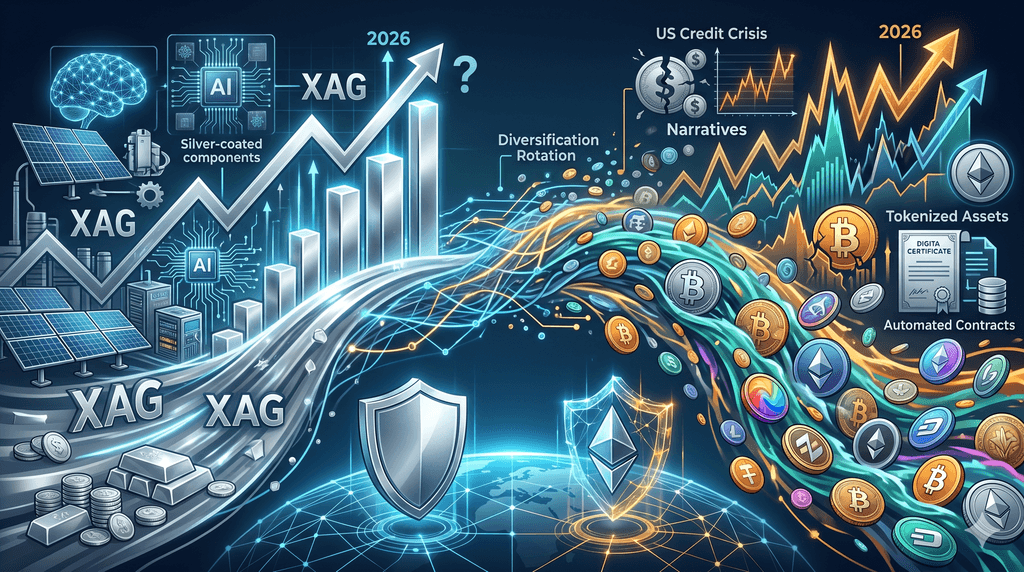
In the high-velocity world of cryptocurrency, a 5% move is just a Tuesday. But in 2026, the "boring" precious metals market has started behaving with a volatility and upside potential that would make even a seasoned "degens" take notice. As of late April 2026, silver is trading near $79–$80/oz, after hitting an eye-watering nominal all-time high of $121.60 in January.
For the modern crypto trader, silver is no longer just a "boomer rock." It has transformed into a high-beta industrial play on the energy transition, a hedge against the ongoing Iran-related geopolitical tensions, and a strategic partner to Bitcoin's scarcity narrative. This article explores the silver price forecast for the remainder of 2026 and explains why your portfolio needs a "white metal" strategy to survive the current macro storm.
Key Takeaways:
-
The 2026 Price Range: Analysts project silver to settle between $81 and $95/oz by year-end, with "black swan" targets as high as $135 if physical deficits worsen.
-
The Industrial Engine: Solar photovoltaics, EVs, and AI data centers now account for a record portion of demand, making silver more of a "tech play" than a traditional commodity.
-
The Safe Haven Rotation: As Bitcoin faces headwinds from a de-risking cycle in Q2, capital is rotating into tokenized silver as a more stable alternative to cash.
-
The Gold-Silver Ratio (GSR): Currently hovering near 75:1, signaling that silver is historically undervalued compared to gold's nearly $4,860 price point.
-
24/7 Access: Modern exchanges like KuCoin have bridged the gap, allowing crypto traders to swap USDT for silver-linked contracts without leaving the digital ecosystem.
The 2026 Silver Landscape: A Story of Six Consecutive Deficits
The primary driver for silver in 2026 isn't just inflation—it’s a physical shortage. We are currently entering the sixth consecutive year of a structural silver deficit.
According to the latest April 15, 2026, report from the Silver Institute, the global shortfall is expected to widen by 15% this year, reaching a deficit of 46.3 million ounces. This widening occurs even as total industrial demand is forecast to dip slightly due to global growth concerns. The paradox? Supply is shrinking even faster than demand.
As miners struggle with rising energy costs and a lack of new primary silver projects, the market is forced to rely on above-ground stock drawdowns. For crypto traders used to "Proof of Reserve" audits, the silver market is facing its own transparency crisis: there simply isn't enough physical metal to satisfy the world's appetite for solar panels and satellite electronics.
Silver as "Tech-Gold": The AI and Solar Connection
In 2026, the distinction between "industrial metal" and "tech asset" has blurred. Silver is the most conductive element on Earth, making it irreplaceable for the infrastructure powering the digital age.
The Solar Mandate
Beginning in early 2026, the European Union's mandate for solar energy integration in new buildings has sent demand for photovoltaic cells into overdrive. Solar manufacturing is on track to consume nearly 20% of the global silver supply by 2030.
The AI Data Center Surge
The hidden driver of 2026 is the power requirement for Generative AI. Data centers are popping up globally, each requiring massive electrical infrastructure. Furthermore, as governments turn to small modular nuclear reactors to power these centers, silver’s role as a neutron absorber in control rods adds another layer of demand. Every nuclear reactor commissioned in 2026 uses approximately 56,000 ounces of silver.
The Gold-to-Silver Ratio: Why Smart Money is "Long Silver"
For crypto traders who use technical indicators like the RSI or MACD, the Gold-to-Silver Ratio (GSR) is the ultimate macro oscillator. It measures how many ounces of silver it takes to buy one ounce of gold.
-
Historical Average: 50:1 to 65:1
-
April 2026 Level: 75:1
With gold trading near $4,859 in the wake of the latest Middle East energy shocks, silver at $79 looks mathematically "cheap." Historically, when the ratio stays above 70, it signals a massive buying opportunity for silver relative to gold. If the ratio mean-reverts to 60 by December 2026, and gold stays stable, silver would need to climb to $81 just to keep pace—or much higher if gold continues its geopolitical climb.
Bridging the Gap: Why KuCoin is the Modern Trader’s Choice for Metals
The biggest barrier to precious metals for crypto natives used to be the "clutter." Buying physical bars involves shipping, insurance, and vaults. Buying ETFs requires a legacy brokerage account that closes on weekends.
This is where the 2026 evolution of KuCoin becomes a game-changer. Rather than forcing you to choose between Bitcoin or Silver, the platform has integrated them into a single, high-liquidity environment. Through XAG/USDT perpetual contracts, you can trade silver with the same 24/7 availability and leverage you use for ETH or SOL.
What’s truly fascinating about the current KuCoin interface is the rise of Real-World Asset (RWA) tokens. Projects like GoldFinger (GF), which launched on KuCoin in March 2026, allow users to gain exposure to metal-backed yields. This means your "safe haven" silver position can actually generate a Web3-style yield while you wait for the next price breakout. For the trader who values capital efficiency, the ability to use Cross Margin to balance a "Short BTC" hedge with a "Long Silver" macro play—all under one dashboard—provides a level of sophistication that was impossible just a few years ago.
Geopolitics and De-risking: The Silver vs. Bitcoin Battle
In 2026, the narrative of Bitcoin as "Digital Gold" has faced a rigorous stress test. During the April 2026 "De-risking Cycle," Bitcoin saw a 25% drawdown from its yearly highs as institutional investors fled to cash and government bonds amid escalating tensions in the Middle East.
Conversely, silver and gold have seen safe-haven inflows. When global oil markets are volatile and energy prices fuel inflation, investors gravitate toward assets with no counterparty risk and tangible industrial value.
-
Bitcoin remains a play on liquidity and global adoption.
-
Silver has become a play on geopolitical stability and the physical energy transition.
By holding both, crypto traders create a "barbell" strategy: the explosive upside of digital assets paired with the structural floor of the world's most essential industrial metal.
Price Forecast: What to Expect in H2 2026
Where does the "white metal" go from here? We’ve merged insights from J.P. Morgan, the LBMA consensus, and on-chain sentiment to build three scenarios for the rest of 2026.
The Bull Case: $95 - $135/oz
If the Federal Reserve initiates its long-awaited rate cuts in the second half of 2026, the US Dollar will likely weaken. A falling DXY combined with a deepening silver deficit could trigger a "short squeeze" in the futures market, mirroring the January rally and pushing silver toward triple digits.
The Base Case: $81 - $88/oz
The market enters a period of healthy consolidation. Silver tracks gold’s slow ascent, supported by steady solar demand and a Gold-Silver Ratio that slowly compresses toward 68:1.
The Bear Case: $60 - $65/oz
If global growth slows significantly due to high energy prices (the "stagflation" scenario), industrial demand for silver could drop 10–15%. In this case, silver might retreat to test the mid-$60s support levels before the next structural bull cycle begins in 2027.
Conclusion: The New Macro Diversification
The rest of 2026 is shaping up to be a masterclass in macro-economics. For the cryptocurrency publisher and investor, the lesson is clear: volatility is a tool, but scarcity is the prize. Silver offers a unique "triple-threat" value proposition—it is a tech component, an energy essential, and a monetary safe haven.
Whether you are long on the energy transition or just looking for a way to hedge your Bitcoin exposure during geopolitical unrest, the silver market in 2026 is no longer an optional "extra"—it is a core component of the modern trader’s arsenal.
FAQs
Is silver a better investment than Bitcoin in 2026?
It depends on your goal. Bitcoin offers higher theoretical growth but is currently reacting as a "risk-on" asset. Silver acts as a "risk-off" industrial hedge. Many pro traders in 2026 hold both in a 70/30 (Crypto/Metal) split.
How can I trade silver 24/7 without a bank account?
You can use crypto exchanges like KuCoin to trade XAG/USDT futures or hold tokenized silver (like XAUT or PAXG for gold, and similar silver-linked RWAs).
Why did silver crash from $121 to $79 in early 2026?
This was largely due to "producer hedging" and a normalization of the massive speculative surge from 2025. It is considered a standard "correction in a bull market" by most commodity analysts.
Does silver have a halving like Bitcoin?
No, but it has something similar: supply depletion. As ore grades decline and mining costs rise, the "cost of production" for new silver effectively creates a rising price floor, currently estimated near $28–$35/oz for most miners.
Disclaimer: This article is for informational purposes only and does not constitute financial advice. Cryptocurrency and commodity trading involve significant risk.