

Beyond Gold: How the American Reserve Modernization Act (ARMA) is Redefining the U.S. Balance Sheet
2026/05/17 16:16:45
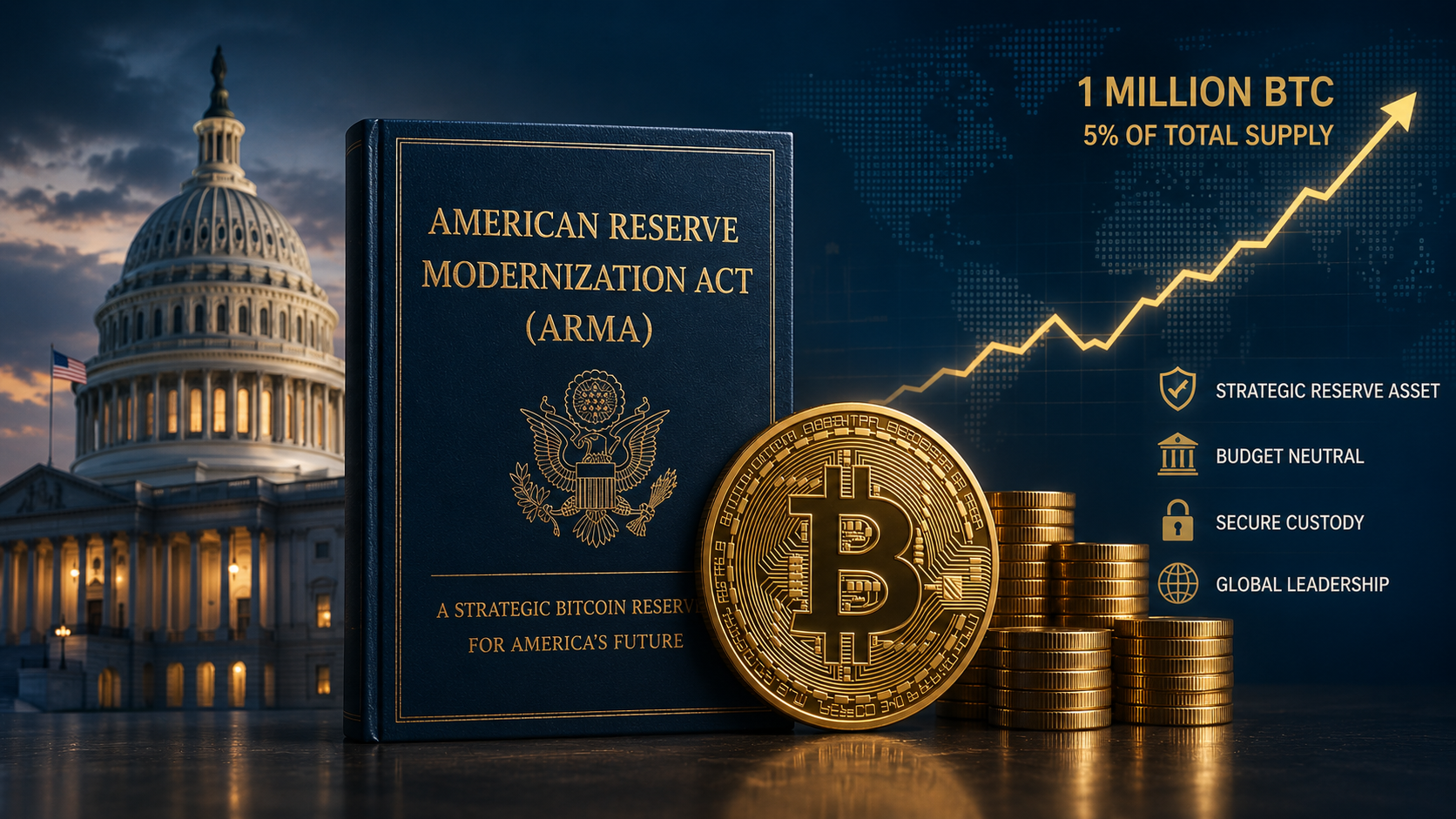
The global financial landscape is witnessing a seismic shift as the United States formalizes its transition into the digital era. With the introduction of the American Reserve Modernization Act (ARMA), the federal government is moving beyond traditional fiat and bullion to embrace decentralized scarcity. This landmark legislation represents the most significant update to the nation's fiscal architecture since the 1970s.
In this comprehensive guide, we explore the intricacies of the American Reserve Modernization Act (ARMA) and how this strategic Bitcoin reserve policy is reshaping global market dynamics and institutional crypto adoption.
Key Takeaways:
-
Strategic Transformation: The ARMA officially reclassifies Bitcoin from a confiscated commodity to a "Tier 1" national reserve asset.
-
The 1 Million BTC Goal: The U.S. Treasury is authorized to acquire 5% of the total Bitcoin supply over five years.
-
Budget Neutrality: Funding is derived from revaluing Federal Reserve gold certificates, avoiding new taxpayer debt.
-
Regulatory Synergy: ARMA works in tandem with the CLARITY Act to provide a unified legal framework for digital assets.
-
Institutional Catalyst: The act has sparked a "Sovereign Hashwar," with other G20 nations now evaluating their own digital reserves.
What is American Reserve Modernization Act? Breaking Down the Legislative Architecture
The American Reserve Modernization Act (ARMA) is a definitive piece of legislation designed to integrate Bitcoin into the United States' Strategic Reserve. Unlike previous ad-hoc executive orders, ARMA provides a statutory mandate for the Treasury to hold, manage, and acquire digital assets. It essentially treats Bitcoin with the same level of strategic importance as gold or foreign currency reserves, aiming to hedge against the long-term debasement of the dollar.
The Definition: Defining Bitcoin as a "Tier 1" Strategic Reserve Asset
Under ARMA, Bitcoin is legally defined as a "Tier 1" Strategic Reserve Asset. This classification is critical for several reasons:
-
Liquidity and Stability: It recognizes Bitcoin's deep global liquidity as sufficient for national security needs.
-
Accounting Standards: It allows the Treasury to mark-to-market its holdings, potentially strengthening the national balance sheet during crypto bull cycles.
-
Permanent Status: By designating it Tier 1, the asset is shielded from erratic political shifts that might otherwise lead to sudden liquidations.
From BITCOIN Act to ARMA: Why the Rebranding Matters for Global Adoption
The transition from the initial "BITCOIN Act" (proposed by Senator Cynthia Lummis) to the American Reserve Modernization Act was a calculated move to garner bipartisan support. The "Modernization" label frames the move as a necessary evolution of the financial system rather than a speculative bet. This branding has softened opposition from traditional banking circles, positioning the U.S. as a pioneer in financial technology rather than just a participant in a volatile market.
The Path to 1 Million BTC: Analyzing the Acquisition Framework
The most ambitious component of ARMA is the mandate for the U.S. Treasury to accumulate 1 million BTC. This target would make the United States the largest sovereign holder of Bitcoin, representing nearly 5% of the total 21 million supply. Achieving this requires a sophisticated, non-disruptive buying strategy.
The Five-Year Plan: Scheduled Purchases and Market Impact Mitigation
To prevent massive price spikes that would harm ordinary investors, ARMA outlines a five-year accumulation schedule:
-
Annual Quotas: The Treasury will purchase approximately 200,000 BTC per year.
-
Time-Weighted Average Price (TWAP): Executions will likely occur through specialized institutional desks using algorithmic trading to minimize "slippage."
-
Strategic Diversification: While the focus is Bitcoin, the act allows for the inclusion of other assets under the "U.S. Digital Asset Stockpile" if they meet rigorous decentralization benchmarks.
Budget-Neutral Funding: Revaluing Gold Certificates vs. Treasury Reallocation
Critics of the bill often ask: Who pays for this? ARMA proposes a "budget-neutral" solution. The Federal Reserve currently holds gold certificates valued at the 1973 statutory price of $42.22 per ounce. By revaluing these certificates to current market prices—which have climbed significantly by 2026—the Treasury can realize an accounting "profit" of hundreds of billions of dollars. This paper gain is then used to fund the Bitcoin purchases without increasing the national deficit.
Operational Overhaul: Moving from Seizure to Sovereign Custody
Historically, the U.S. government was one of the largest "sellers" of Bitcoin, as the Department of Justice (DOJ) routinely auctioned off assets seized from darknet markets and cybercriminals. ARMA ends this practice entirely, shifting the government’s stance from an accidental liquidator to a deliberate "HODLer."
Ending the "Auction Era": Why the U.S. Marshals No Longer Sell BTC
Before the American Reserve Modernization Act, the U.S. Marshals Service treated Bitcoin as a "decaying" asset that needed to be converted to cash immediately. ARMA mandates that all future seizures are transferred directly to the Strategic Reserve. This change:
-
Reduces downward pressure on the market.
-
Ensures that the state benefits from the long-term appreciation of these digital assets.
-
Consolidates various fragmented holdings into a single, audited national ledger.
Post-2026 Security Protocols: Implementing Institutional-Grade Cold Storage for the Nation
With billions of dollars at stake, security is paramount. ARMA establishes the National Digital Asset Custody Office (NDACO). This office is tasked with:
-
Geographic Distribution: Storing private keys across multiple top-secret, air-gapped facilities within the U.S.
-
Multi-Signature Governance: Requiring simultaneous authorization from the Treasury, the Fed, and a third independent agency to move funds.
-
Quantum Resistance: Investing in cryptographic upgrades to protect the reserve against future quantum computing threats.
The "Warsh Fed" Era: A Catalyst for ARMA’s Implementation
The implementation of ARMA coincided with a major shift at the Federal Reserve. The confirmation of Kevin Warsh as Fed Chair in May 2026 has been described as the "tipping point" for the U.S. Bitcoin reserve. Warsh’s background as a reformer makes him the ideal candidate to oversee the integration of decentralized assets into a centralized monetary system.
Kevin Warsh’s Vision: Integrating Digital Assets into the Federal Reserve System
Chair Warsh has long argued that the Fed must innovate to stay relevant. His vision for ARMA implementation involves:
-
Digital Collateral: Allowing banks to use Bitcoin as collateral for certain liquidity facilities.
-
Open Market Operations: Eventually using Bitcoin as a tool to manage the money supply, similar to how the Fed uses Treasury bonds today.
-
Modernizing the Dollar: Using the reserve to back a "Digital Dollar" that maintains the privacy and peer-to-peer nature of Bitcoin.
The End of Monetary Tightening? How a Crypto-Friendly Fed Influences Reserve Assets
The "Warsh Fed" has signaled a move away from the aggressive interest rate hikes of the early 2020s. By recognizing Bitcoin as a strategic asset, the Fed can afford to be more flexible with traditional monetary policy. This "crypto-friendly" stance has lowered the risk premium for digital assets, encouraging institutions to front-run the government’s own buying schedule under ARMA.
Legislative Synergy: How the CLARITY Act Paved the Way for ARMA
ARMA does not exist in a vacuum. Its success is heavily dependent on the CLARITY Act, which was passed just weeks prior. While ARMA focuses on the government's assets, the CLARITY Act focuses on the private sector's rights, creating a holistic ecosystem for digital finance.
Regulatory Certainty: Defining "Qualified Custodians" for National Reserves
The CLARITY Act provides the legal definitions that ARMA relies on. Specifically, it defines what constitutes a "Qualified Custodian," allowing the government to partner with private-sector exchanges and custodians to manage the Strategic Reserve's technical infrastructure. This ensures that the government isn't building a siloed system but is instead integrated with the broader crypto industry.
The July 4th Deadline: Expectations for the Presidential Signing Ceremony
The political world is currently eyeing the upcoming July 4th, 2026 signing ceremony. Passing ARMA by Independence Day is a symbolic gesture, intended to represent "Financial Independence." The market has already begun "pricing in" this event, with volatility expected to spike as the deadline approaches and the first official Treasury purchase orders are prepared.
Global Implications: Is the ARMA Sparking a Sovereign "Hashwar"?
The American Reserve Modernization Act (ARMA) has triggered what game theorists call a "Sovereign Hashwar." As the U.S. moves to corner 5% of the supply, other nations are realizing that waiting too long will make it prohibitively expensive to build their own reserves.
Game Theory in Action: How Other G20 Nations are Reacting to the U.S. Move
-
Europe: The EU is reportedly reconsidering its "MiCA 2" framework to include provisions for national BTC reserves.
-
Asia: Several Southeast Asian nations have already begun small-scale "pilot" reserves following the ARMA announcement.
-
Global South: Nations with high inflation are viewing ARMA as a green light to bypass the traditional IMF/World Bank system in favor of a Bitcoin-backed treasury.
The U.S. Digital Asset Stockpile: Will ETH and SOL Join the National Reserve?
While Bitcoin is the primary focus, ARMA includes language for a broader Digital Asset Stockpile. This allows the Treasury to hold other major protocols like Ethereum (ETH) and Solana (SOL) if they are deemed essential to the "digital infrastructure" of the U.S. economy. For now, the government will likely hold seized ETH and SOL rather than actively purchasing them, but the legislative door is wide open.
Risk Assessment: Challenges Facing the Strategic Bitcoin Reserve
Despite the euphoria, the American Reserve Modernization Act faces significant hurdles. A policy this radical is naturally prone to political and economic friction.
Political Volatility: The 2026 Mid-term Elections and Policy Continuity
The 2026 mid-term elections pose a risk to ARMA's longevity. If the opposition party gains control of Congress, they could attempt to defund the acquisition program or mandate a sell-off. However, supporters argue that once the reserve is established, the "wealth effect" created by Bitcoin’s price appreciation will make it politically impossible to dismantle.
Market Liquidity Concerns: Can the Treasury Buy 1M BTC Without Squeezing the Market?
There is a legitimate concern that a 1-million-BTC buy order will create a "supply shock."
-
Exchange Reserves: Current exchange balances are at multi-year lows.
-
Long-term Holders: Over 70% of Bitcoin hasn't moved in over a year.
-
The Treasury will have to be incredibly surgical in its execution to avoid a "God candle" that makes the asset unaffordable for its own citizens.
Price Prediction & Market Sentiment: The Road to $100,000
The sentiment surrounding ARMA has pushed Bitcoin into a new price discovery phase. After breaking through the $80,000 resistance following the CLARITY Act news, the market is now fixated on the psychological $100,000 barrier.
Institutional FOMO: Why Public Companies are Mirroring the ARMA Strategy
The ARMA hasn't just impacted governments; it has validated the "MicroStrategy model" for every Fortune 500 company. If the U.S. Treasury deems Bitcoin a "Tier 1" asset, corporate treasurers feel they are "failing their fiduciary duty" by not holding at least a 1-3% allocation. We are seeing a massive wave of 10-K filings mentioning Bitcoin as a treasury reserve asset.
Technical Resistance Levels: Decoding the Post-ARMA Rally to $83,000
Technical analysts are currently watching the $83,000 to $85,000 range. This area represents the "pre-announcement" high. If Bitcoin can consolidate above this level ahead of the July 4th signing, the path to $100,000 becomes a matter of "when," not "if."
Conclusion:
The American Reserve Modernization Act (ARMA) marks the end of an era and the beginning of a new monetary standard. By integrating Bitcoin into the national balance sheet, the United States is attempting to fuse the stability of the dollar with the immutable scarcity of digital code. While risks remain, the act serves as a powerful signal that digital assets are no longer a fringe experiment but a fundamental pillar of 21st-century statecraft. Ultimately, ARMA may be remembered as the legislation that saved the U.S. economy by embracing the very technology many thought would disrupt it.
FAQ:
Q: What exactly is the American Reserve Modernization Act (ARMA)? A: The American Reserve Modernization Act (ARMA) is a 2026 legislative framework that authorizes the U.S. Treasury to establish a strategic Bitcoin reserve, aiming to acquire 1 million BTC over five years.
Q: How is the Bitcoin purchase funded under ARMA? A: Funding for the American Reserve Modernization Act (ARMA) is budget-neutral, primarily utilizing the revaluation of Federal Reserve gold certificates to current market prices rather than using new taxpayer funds.
Q: Will the U.S. government still sell seized Bitcoin? A: No, under the American Reserve Modernization Act (ARMA), the "auction era" ends. Seized digital assets are transferred directly to the Strategic Bitcoin Reserve rather than being sold.
Q: What is the connection between ARMA and the CLARITY Act? A: The CLARITY Act provides the regulatory definitions and custody standards that the American Reserve Modernization Act (ARMA) requires to function within the broader U.S. financial system.
Q: Can ARMA lead to the purchase of other cryptos like ETH? A: While Bitcoin is the priority, the American Reserve Modernization Act (ARMA) establishes a "Digital Asset Stockpile" that allows the government to retain and manage other major assets like Ethereum.