

In what ways do rising oil prices increase Bitcoin mining costs and dampen crypto volatility?
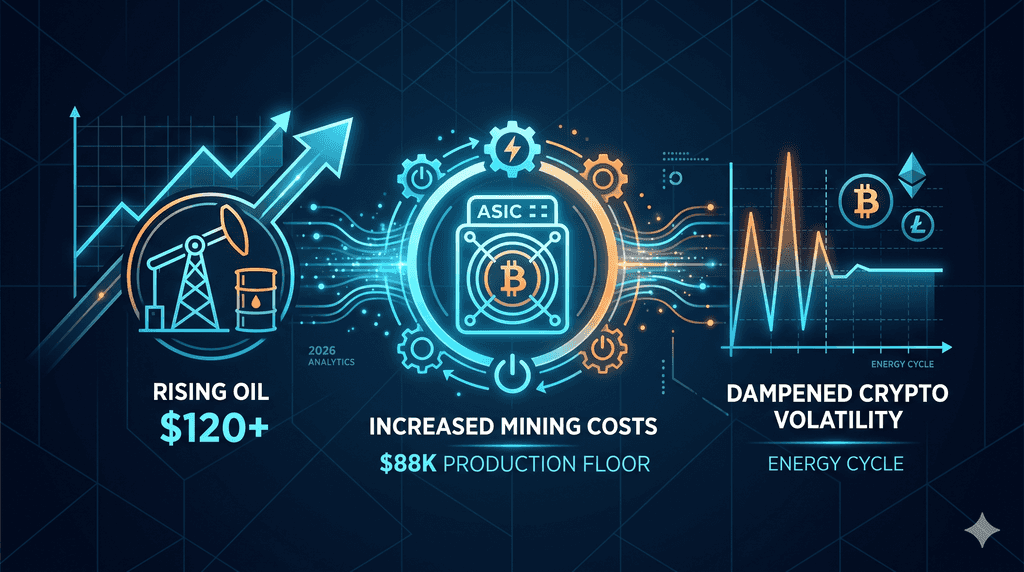
As Brent crude surges past $120 per barrel following the recent Strait of Hormuz crisis, the cryptocurrency market is feeling the heat, but not in the way many expected. While the immediate focus often lands on the operational struggles of miners, the deeper story is one of market maturation.
Rising energy costs are currently acting as a great filter, forcing the industry to shed its speculative skin. In this environment, Bitcoin is increasingly behaving less like a volatile tech stock and more like a macro-sensitive energy commodity.
By analyzing the intersection of rising extraction costs and the resulting deleveraging, we can see how high oil prices are paradoxically creating a more stable, albeit pressured, digital asset landscape.
Key Takeaways
-
With global oil prices at a multi-year high, the average Bitcoin production cost has surged to approximately $88,000.
-
The 2026 energy shock has forced an estimated 10–15% of the global hashrate offline. This has triggered a migration toward energy-sovereign hubs.
-
High oil prices act as a volatility dampener. The resulting inflationary pressure has triggered a Great Leverage Flush, where speculative "long" positions are cleared from the market.
-
Financial giant Nomura has warned that unprecedented energy risks may force the Bank of Japan (BoJ) to delay interest rate hikes.
-
As mining becomes more expensive, the cost of production is establishing a "hard floor" for Bitcoin's value.
How Oil Inflates the Kilowatt-Hour?
In April 2026, the global energy landscape is undergoing its most significant stress test in decades. Following the closure of the Strait of Hormuz on March 4, 2026, Brent crude surged past $120 per barrel.
Direct vs. Indirect Energy Transmission
The relationship between oil prices and Bitcoin mining is often misunderstood as a simple 1:1 correlation. However, the impact is divided into two distinct channels:
The Gulf Sensitivity (Direct): Approximately 6–10% of the global hashrate is located in Middle Eastern nations (primarily Oman, UAE, and Qatar). In these regions, electricity markets are highly sensitive to crude prices. The maritime blockade stranded LNG and oil exports, causing localized industrial power tariffs to spike by over 40% in just three weeks.
The Global Grid Ripple (Indirect): For the remaining 90% of the network, the impact is felt through marginal electricity costs. As oil prices skyrocket, global demand shifts toward natural gas and coal, driving up wholesale electricity prices. In major mining hubs like Texas and Norway, miners on spot-priced energy contracts have seen their operating expenses (OPEX) climb by an average of 22% since January.
Hashprice All-Time Lows: The 16% Drop
The immediate casualty of this energy surge was the Hashprice, a measure of the expected value of 1 TH/s of hashing power per day. In March 2026, the combination of rising power costs and stagnant Bitcoin prices pushed Hashprice to an all-time low of $27.89 PH/s/day.
This profitability floor was breached for many, resulting in a 16% drop in global hashrate from the 2025 peak. Inefficient miners using older hardware have been forced into an "AI Pivot," repurposing their cooling infrastructure and data centers for AI High-Performance Computing (HPC), which currently offers a higher margin per kilowatt than Bitcoin mining.
The "Production Cost Floor" Theory ($88,000)
One of the most debated concepts in the April 2026 market is Bitcoin Production Cost. As of this month, analysts estimate the average cost to mine a single Bitcoin has spiked to approximately $88,000 due to the energy crisis.
"When the cost of production exceeds the spot price, we don't necessarily see a crash; we see a structural floor. Miners are incentivized to hold their rewards rather than sell at a loss, while institutional buyers view this $88k mark as the 'fair value' anchor for the network." — Digital Assets Research Institute, 2026 Report
This theory suggests that while oil prices are crushing margins, they are also hardening Bitcoin’s price support. With the $88,000 floor acting as a psychological and technical anchor, the market is beginning to treat BTC less like a tech stock and more like a physical commodity that requires a specific, and expensive, amount of energy to create.
Dampening Volatility
Deleveraging
When Brent crude surged to $120+ per barrel, it sent a clear "Risk-Off" signal across global trading desks.
The Long Flush: High energy-driven inflation (US CPI near 4.2%) led to a sharp repricing of interest rate expectations. Traders who were "long and levered" at the $85,000 level were systematically flushed out in February and March.
Reduced "Gap" Risk: By early April, the Fear & Greed Index collapsed to a historic low of 9/100. With leverage levels at multi-year lows, the market lacked fuel for violent, cascading liquidations that typically drive extreme volatility.
The $7.9B Options Buffer: As of late April, the $7.9 billion in open interest for the upcoming options expiry has anchored the price near the $75,000 max pain level. This concentration of derivatives further compressing volatility as market makers hedge their delta exposure in a tight range.
Institutional Absorption
The most significant shift is the role of institutional Price-Insensitive buyers. Unlike retail traders who panic-sell during energy spikes, the new class of Bitcoin holders views volatility as an entry point.
ETF Inflows: During the peak of the Hormuz crisis, US Spot Bitcoin ETFs recorded net inflows of +$1.7 billion. BlackRock’s IBIT alone acted as a systematic buffer, absorbing the selling pressure from capitulating miners who needed to cover their $88,000 production costs.
Corporate Treasury Anchors: Entities like MicroStrategy and Bitmine continued their accumulation plans, adding nearly $8.3 billion in total BTC holdings during the Q1 energy shock. This Institutional Floor has prevented the price from breaking below critical support levels, even as oil remained in the triple digits.
Independent Pricing Architecture
While the Nasdaq remained stagnant and Gold retreated 2% during the energy-induced liquidity crunch of early 2026, Bitcoin delivered a solid 7% gain.
This decoupling suggests that in a world where access to energy is uncertain and fiat currencies (like the Yen) face extreme fiscal pressure, Bitcoin has become a macro-sensitive energy-dependent system that absorbs risk-off pressure without breaking its long-term trend.
Inflation, Rates, and Nomura’s Warning
The "Higher for Longer" Fed Trap
As of April 2026, the Fed Funds Rate remains steady at a target range of 3.5%–3.75%.
With the US CPI hitting 4.2% in early 2026, the hope for rate cuts has vanished. High oil prices are feeding directly into core inflation through transportation and manufacturing costs.
High energy prices support the US Dollar as a safe-haven, but they also tighten global liquidity. This "liquidity squeeze" is what has forced speculative leverage out of crypto, leading to the compressed volatility we see today.
The Nomura Warning
The most critical macro signal comes from Nomura economists, who have issued a stark warning regarding the Bank of Japan (BoJ). As a nation that imports over 90% of its crude oil, Japan is structurally vulnerable to the current Strait of Hormuz disruption.
Nomura indicates that unprecedented energy risks will likely force the BoJ to delay its anticipated interest rate normalization. While the market expected a hike to defend the Yen, the BoJ is now trapped: raising rates into an energy shock could trigger a severe domestic recession.
Nomura’s analysts highlight that higher oil costs act as a regressive tax on Japanese households. With Governor Kazuo Ueda shifting to a "wait-and-see" approach, the BoJ is increasingly willing to tolerate a weaker Yen to avoid a total economic contraction.
From Grid-Dependency to Energy Sovereignty
The 2026 energy shock has accelerated the migration of hashrate toward regions that are entirely insulated from global oil and gas supply chains. This sovereign mining model focuses on energy that cannot be easily exported, effectively making Bitcoin the "buyer of last resort" for local surplus power.
Bhutan and El Salvador: These nations have become the gold standard for Vertical Integration. By utilizing state-owned hydroelectric (Bhutan) and geothermal/volcanic (El Salvador) resources, these operations maintain a production cost that remains static regardless of the turmoil in the Strait of Hormuz.
Iceland and the Nordics: Iceland continues to attract large-scale institutional miners due to its 100% renewable grid and natural free cooling. In April 2026, Nordic-based hashrate reached an all-time high, as it serves as a "green safe haven" for ESG-compliant Bitcoin ETFs.
Insulation from the Spike: While grid-dependent miners in the US and Europe are paying over $0.12/kWh, sovereign hubs are operating at an effective cost of $0.03–$0.05/kWh, creating a massive profitability gap that is driving the next wave of industry consolidation.
For publicly listed mining companies, the $120 oil price has made traditional Bitcoin mining a zero-margin game for their older fleets. This has triggered a massive repurposing of infrastructure.
The High-Performance Computing (HPC) Shift: In March 2026, reports indicated that listed miners were losing approximately $19,000 for every Bitcoin mined on fossil-fuel-dependent grids. To survive, companies like Core Scientific, TeraWulf, and Hut 8 are rapidly retrofitting their facilities.
Revenue Diversification: By the end of 2026, it is estimated that 70% of the revenue for major public mining firms will come from AI hosting and HPC contracts. These firms are using their existing power envelopes, cooling systems, and high-voltage transformers to host H100 and B200 GPU clusters.
This pivot allows miners to survive the energy-induced "crypto winter" by generating steady, fiat-denominated revenue from the AI boom. As one CEO recently noted: "We are no longer just miners; we are energy-arbitrage data centers that can toggle between securing the network and training the next LLM based on whichever offers the highest yield per kilowatt."
Trading the Energy Cycle on KuCoin
Strategies for the Compressed Volatility Regime
With Bitcoin trading in a tight, energy-capped range, the focus has shifted from chasing breakouts to capturing the "Volatility Reset."
Hedging Miner Capitulation: As inefficient miners liquidate holdings to cover electricity bills, short-term "wicks" below support are common. Professional traders are using KuCoin Futures to open protective hedges or low-leverage longs near the $70,000 psychological support, anticipating institutional absorption from Spot ETFs.
Capitalizing on the Yen/BTC Divergence: Following the Nomura warning regarding the Bank of Japan, the JPY/BTC pair has seen record volume. Japanese users and global macro traders are rotating out of the weakening Yen and into BTC before the next anticipated energy supply update.
Maximizing Yield During the Sideways Market
If the energy shock keeps the market in a horizontal trend, time in the market is maximized through automated yield products.
Hold to Earn: KuCoin’s Hold to Earn feature is particularly effective in April 2026. It allows you to earn a base APY on your BTC and ETH while keeping them liquid, essential for reacting to sudden breakthroughs in the CLARITY Act or shifts in the Strait of Hormuz situation.
Dual Investment for Range-Bound Profit: Many traders use Dual Investment to Sell High or Buy Low at specific price targets, earning enhanced rewards while the market waits for energy prices to stabilize.
Conclusion
While rising oil prices have placed immense pressure on the mining sector, they have also purged the market of excessive leverage and speculative froth. By anchoring Bitcoin’s value to the physical reality of global energy costs and the macro-instability of traditional fiat, the current cycle has created a more mature, institutional-grade asset class. Whether you are hedging against miner capitulation or accumulating JPY-devaluation hedges, the tools available in 2026 ensure that the Energy Squeeze is merely a stepping stone to the next phase of market growth.
FAQs
Why does high oil price cause Bitcoin miners to sell?
Energy is the primary operating cost for miners. When oil prices drive up global electricity tariffs, miners must sell a larger portion of their BTC rewards to cover their monthly power bills, especially those on "spot" energy contracts.
How does the "Nomura oil warning" affect my portfolio?
Nomura’s warning suggests that high energy costs will keep the Bank of Japan from raising interest rates. This weakens the Yen, making Bitcoin an attractive "safe haven" for those looking to protect their purchasing power from currency debasement.
What is the Bitcoin Production Cost in April 2026?
Current estimates place the global average at approximately $88,000 per BTC. While this is higher than the current spot price, it acts as a structural "hard floor" as miners become reluctant to sell below the cost of creation.
Why is crypto volatility so low right now?
The high-energy environment triggered the Great Leverage Flush, removing the speculative leverage that usually fuels 20% price swings. Additionally, the presence of Spot ETFs acts as a shock absorber, stabilizing the price even during geopolitical crises.
Which miners are surviving the 2026 energy shock?
Miners with sovereign energy access (hydro, geothermal, or flare gas) and those that have diversified into AI High-Performance Computing are the most resilient in the current market.
Disclaimer:This content is for informational purposes only and does not constitute investment advice. Cryptocurrency investments carry risk. Please do your own research (DYOR).