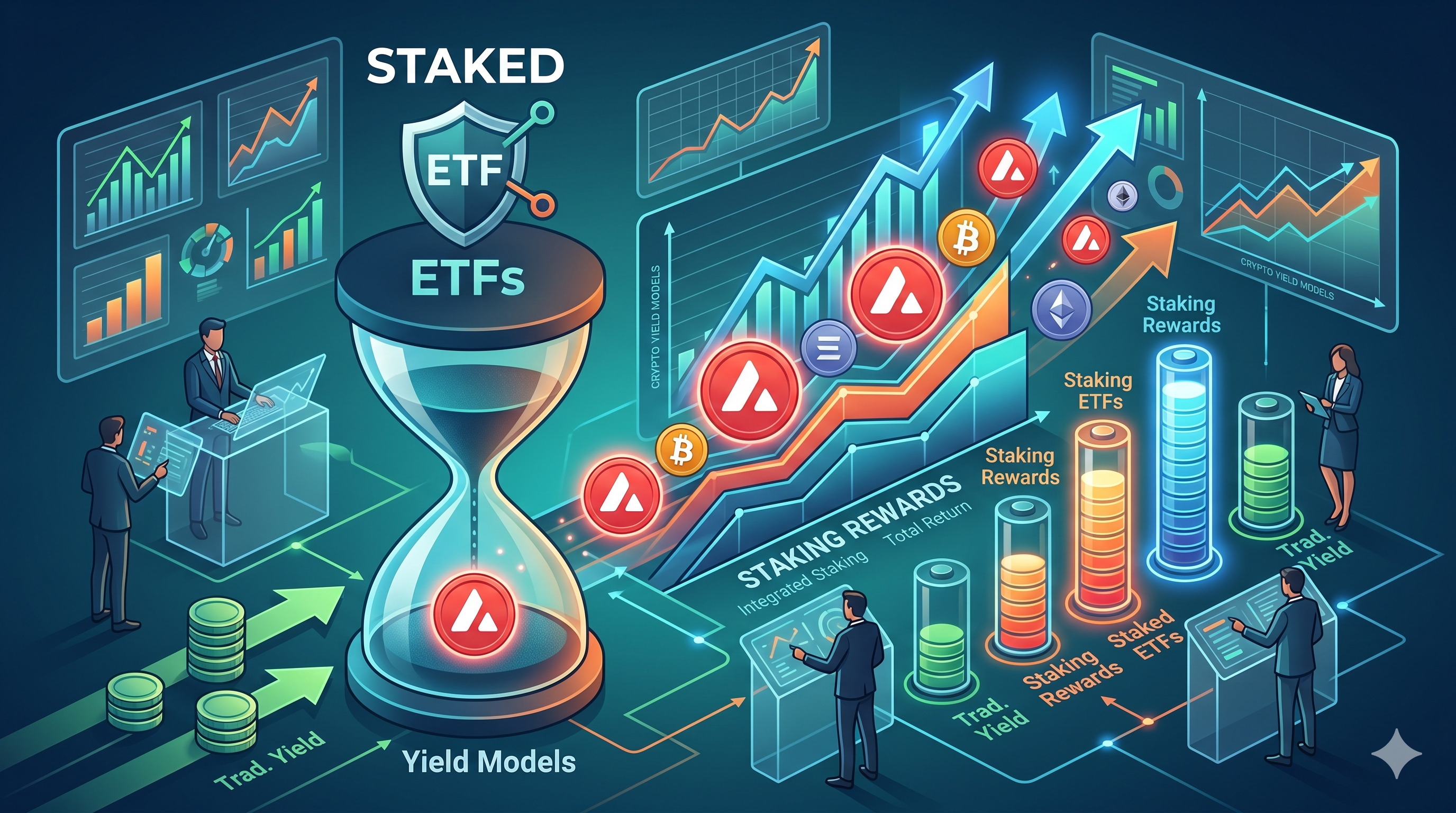
Staking ETFs Are Here: How AVAX Changes Yield Models
Staking ETFs Are Here: How AVAX Changes Yield Models
Thesis statement
The arrival of staking ETFs for Avalanche marks a turning point where old investors can now tap into both the price of AVAX and the network's built-in rewards without handling wallets or validators themselves. Grayscale launched its Avalanche Staking ETF (GAVA) on NASDAQ in March 2026, followed quickly by Bitwise's BAVA on the NYSE in April. These products hold actual AVAX tokens and stake a large portion of them to earn rewards that boost the fund's value over time.
Staking ETFs for AVAX changes yield models by packaging network participation into simple, tradable shares, delivering compounded returns from staking alongside price exposure while reducing supply pressure on the open market and drawing fresh capital into the Avalanche ecosystem.
Grayscale Drops GAVA and Sparks Immediate Market Buzz
Grayscale showed its Avalanche Staking ETF under ticker GAVA on March 12, 2026, giving investors a direct way to own AVAX through a familiar stock exchange listing. As of mid-April 2026, the fund stakes about 86.57% of its holdings and reports gross staking rewards of around 5.52%, with net figures landing near 4.22% after costs. This structure means rewards compound inside the fund by increasing its net asset value rather than paying out cash dividends.
The launch created real excitement across trading desks. AVAX climbed roughly 4% in the days surrounding the debut, pushing toward the $10 level as traders bet on institutional inflows. Grayscale, already a heavyweight in digital asset products, positioned GAVA to reflect both spot AVAX performance and the rewards from securing the network. Early trading volumes reflected steady interest from advisors seeking diversified exposure without the hassle of direct crypto custody. The product builds on Grayscale's experience with other trusts, but the staking element adds a fresh layer that ties investor returns more closely to Avalanche's actual usage and security.
Inside the fund, AVAX gets locked into the protocol's validator system. Stakers help validate transactions across Avalanche's high-speed subnets, and in return, they collect new AVAX tokens issued as incentives. By handling this process at scale, Grayscale shields everyday buyers from technical setup, slashing events, or choosing the right delegation partners. Data from the fund's site shows consistent staking participation, which helps stabilize the product's performance even during short-term price swings. Market watchers noted how the ETF quickly became a talking point in portfolio meetings, especially among teams already comfortable with Grayscale's Bitcoin and Ethereum offerings.
This debut also highlighted broader momentum. Avalanche saw daily transactions spike to a 2026 high of 3.5 million shortly after the launch, with active addresses climbing from around 100,000 to a new baseline between 500,000 and 700,000. Analysts pointed to the ETF as one key driver linking Wall Street money to on-chain activity. The product does not just sit on the sidelines; it actively participates in the network, turning passive holdings into productive assets that contribute to Avalanche's security and speed.
Bitwise Enters the Ring with BAVA and In-House Staking Edge
Bitwise Asset Management launched its Avalanche ETF, ticker BAVA, on the NYSE on April 15, 2026, positioning it as the latest option for yield-seeking investors. The fund plans to stake roughly 70% of its AVAX holdings through its internal Bitwise Onchain Solutions team while keeping 30% in a liquidity reserve to handle redemptions smoothly. It targets an average staking reward of about 5.4%, reflecting current network rates. The in-house approach stands out because Bitwise manages the staking operations directly rather than outsourcing everything. This setup aims for tighter control over validator selection and quicker adjustments to maintain liquidity. The sponsor fee starts at 0.34% but gets waived entirely for the first month on the initial $500 million in assets, making early entry especially attractive for larger allocators. Within hours of trading, BAVA recorded noticeable volume as brokers added it to watchlists.
Bitwise's move follows its earlier success with staking products in other assets, bringing proven operational know-how to AVAX. The fund focuses on Avalanche's strengths in real-world applications, from tokenizing assets to supporting fast, low-cost transactions. By staking internally, the team can optimize for both yield and risk management, such as spreading delegations across a diverse set of validators to avoid concentration issues. Traders observed how BAVA's debut added to the positive sentiment around AVAX, even if immediate inflows remained modest.
The product's design emphasizes transparency, with regular updates on staked percentages and reward accrual. This level of detail helps build confidence among institutional buyers who need clear reporting for their compliance teams. Early feedback from market participants suggests the in-house model could become a benchmark for future yield-focused ETFs in the space. Avalanche's network benefits directly when large funds like BAVA lock up tokens. Higher staking ratios strengthen security and can influence token economics by removing supply from active trading. Bitwise executives highlighted how the ETF opens Avalanche to capital that previously stayed on the sidelines due to operational complexity.
Inside the Numbers: What Real AVAX Staking Yields Look Like Today
Current AVAX staking delivers meaningful returns for participants. Network-wide figures show average rewards hovering in the mid-single digits, with on-chain delegators often seeing between 6.5% and 7.2%, depending on the validator chosen and lock-up period. Validator nodes running full hardware can push toward 7.5% to 8.5% when they attract delegations and set competitive fees. ETFs capture a slice of these rewards after their own costs. Grayscale's reported gross yield near 5.52% in mid-April reflects the portion earned on staked assets, while Bitwise eyes 5.4% as its target.
These numbers come from the protocol's inflation schedule and transaction fee burns, which together create incentives for securing the chain. Yields adjust dynamically based on total staked supply, currently around 48-50% of eligible tokens, so higher participation can gradually compress rates over time. For context, direct staking on platforms like Bitget or Binance offers a range from 6% to 8.5% with varying minimums and lock periods. Liquid staking options provide similar yields without locking assets, letting users keep flexibility. ETFs simplify this further by bundling everything into one share price that rises with both AVAX value and accumulated rewards.
Real-world calculations show the power of compounding. An investor holding shares in a staking ETF over a full year could see total returns combine price appreciation with the embedded yield. If AVAX stays flat but the fund earns 5% net, the NAV grows steadily. In stronger market conditions, the dual effect amplifies gains. Daily reward accrual means small advantages compound quickly at an institutional scale. These yields stem from Avalanche's design. The network uses a proof-of-stake system where staked AVAX helps reach consensus rapidly across its primary chain and custom subnets. Rewards come from newly minted tokens plus a share of fees, creating a self-sustaining loop that ties investor income to network health.
Why Avalanche's Tech Makes Staking Rewards Especially Attractive
Avalanche stands out for its speed and scalability, processing thousands of transactions per second while keeping fees low. This performance comes from its unique architecture of multiple interoperable chains secured by a shared validator set. Stakers secure all of it at once, earning rewards that reflect the broad utility of the platform. Subnets allow companies and projects to spin up their own customized blockchains that inherit security from the main network. Each new subnet requires AVAX for validators, adding demand for staking.
As more real-world applications launch, from tokenized assets to enterprise pilots, the need for secure, high-throughput infrastructure grows. Staking ETFs let investors participate in this expansion indirectly through yield. The protocol burns all transaction fees, creating deflationary pressure that can support token value as activity rises. Combined with staking that locks supply, this mechanic creates a balanced economic model. ETFs amplify the effect by directing large pools of capital into staking rather than leaving tokens idle in custody.
Avalanche's focus on real-world use cases adds another layer. Institutions explore the network for asset tokenization and efficient settlement. When ETFs bring more AVAX into staking, they help maintain the robust validator set needed for these high-value applications. The result is a flywheel where usage drives fees and security, which in turn supports rewards and attracts further participation. Developers praise the platform's developer-friendly tools and low barriers for launching subnets. This environment encourages innovation that keeps the network active, sustaining the conditions for steady staking income.
How Staking ETFs Lock Up Supply and Influence AVAX Price Dynamics
When ETFs stake the majority of their holdings, they remove AVAX from the circulating supply available for immediate trading. Grayscale's 86% staking rate and Bitwise's 70% target mean hundreds of thousands of tokens stay committed to the network for set periods. This reduction in liquid supply can create upward pressure during periods of steady or rising demand. Market data after the GAVA launch showed AVAX testing higher levels as traders anticipated institutional buying. Even modest inflows into staking products contribute to this dynamic because the tokens do not hit exchanges right away. Over time, consistent staking across multiple funds could tighten the float and support price floors.
The effect extends beyond short-term trading. Locked AVAX supports network security, which builds long-term confidence and encourages more projects to build on Avalanche. Higher security and activity can draw additional users and capital, feeding back into demand for the token. ETFs also introduce a new buyer base. Pension funds, wealth managers, and retail investors through brokerage accounts can now allocate to AVAX without learning seed phrases or managing nodes.
This broadens the demand pool and potentially smooths out volatility compared to pure spot holdings. Analysts track staking ratios closely because they signal commitment from large holders. As ETFs grow assets under management, the percentage of total supply under staking could climb, altering the token's supply-demand balance in lasting ways.
Comparing AVAX Staking ETFs to Traditional Yield Products
AVAX staking ETFs sit between pure crypto plays and conventional income investments. A 5% net yield from staking exceeds many government bond rates in low-interest environments while offering upside from AVAX price moves. Traditional bond ETFs deliver fixed coupons but lack growth potential tied to a growing technology platform. Compared to dividend stocks, the yield here comes from protocol incentives rather than corporate profits. This makes returns more directly linked to network usage and security demands. However, yields can fluctuate with staking participation levels, unlike fixed-rate products. Money market funds or high-yield savings offer stability but minimal returns in the current climate. Staking ETFs add volatility from the underlying token but compensate with the potential for higher total returns when AVAX performs well.
Within crypto, liquid staking tokens provide similar yields with more flexibility but require users to manage wallets and smart contract risks. ETFs wrap everything in a regulated wrapper traded during stock market hours, appealing to those preferring familiar infrastructure. The key difference lies in accessibility. Someone with a standard brokerage account can buy shares in minutes, receive statements, and include the position in retirement accounts in many cases. This opens yield opportunities to a much wider audience than direct staking ever could.
The Role of Liquid Staking and How ETFs Fit Alongside It
Liquid staking derivatives let users stake AVAX and receive a tradable token representing their position, keeping capital flexible for other uses. Projects like Ankr or Treehouse offer these solutions with yields often in the 5-7% range. ETFs complement rather than replace them by providing an even simpler entry point for those avoiding decentralized finance entirely. Some funds may explore combining approaches, such as holding liquid staking tokens inside the ETF structure. This could blend the best of both worlds, yield plus liquidity management. For now, most staking ETFs focus on native protocol staking for simplicity and direct network participation.
The coexistence benefits the ecosystem. Liquid staking keeps capital nimble for DeFi activities on Avalanche subnets, while ETF staking provides steady, large-scale security. Together, they strengthen the overall staking ratio without forcing users into one model. Investors can mix strategies: hold ETF shares for core exposure and use liquid staking for tactical moves. This flexibility reflects the maturing infrastructure around AVAX.
Avalanche Network Activity Surges After ETF Launches
On-chain metrics improved noticeably following the GAVA debut. Daily transactions reached 3.5 million, a yearly high, while non-sybil active users climbed significantly. The ETF acted as a bridge, channeling institutional interest into measurable network growth. Higher activity means more fees burned and more demand for block space, which supports the economic incentives for stakers. ETFs contribute by keeping tokens committed long-term, reducing sell pressure from new inflows.
Subnets dedicated to specific industries see increased experimentation as awareness grows. Government and enterprise pilots gain credibility when backed by visible institutional products. The flywheel of adoption, activity, and yield continues to spin. Data providers like Nansen track these trends, showing real user growth rather than temporary hype. The staking ETFs appear to anchor some of this momentum by providing a stable capital base.
Potential for More AVAX ETF Products and Competition
VanEck filed for its own Avalanche ETF with staking features earlier, signaling strong interest from multiple managers. Bitwise and Grayscale set early benchmarks, but the field could expand with variations in fees, staking percentages, or focus areas. Competition often drives innovation, such as better liquidity management or integration with other Avalanche tools. Investors gain from tighter spreads and improved product features over time.
New entrants might target specific use cases, like ETFs focused on subnets or real-world asset tokenization themes. The core staking mechanic remains central because it directly ties the product to Avalanche's value proposition. This proliferation could accelerate capital formation for the network while offering investors more choices tailored to risk and return preferences.
What Rising Staking Ratios Mean for Long-Term AVAX Holders
As more AVAX moves into staking through ETFs and other channels, the circulating supply available for trading shrinks. This dynamic can support price stability and create conditions for appreciation if demand holds or grows. Long-term holders benefit from both potential price effects and the knowledge that their network stays well-secured. Higher staking participation reduces the risk of attacks and improves overall reliability, which attracts more builders and users.
The tokenomics reinforce this. Fee burns remove supply permanently, while staking locks tokens temporarily. ETFs magnify both effects at scale. Holders should monitor staking ratio trends and reward rates. A balanced increase in both activity and staking tends to create positive conditions for the ecosystem.
Challenges and Realities of Yield in Volatile Markets
Staking yields provide a buffer during flat or down markets, but they do not eliminate price risk. AVAX can still swing based on broader crypto sentiment, macroeconomic factors, or sector rotations. The yield helps compound holdings over time, but short-term NAV can move with the token price. Operational factors matter too. Validator performance, network upgrades, and reward schedule changes can influence actual returns. ETFs aim to manage these through professional oversight, yet no yield is completely guaranteed.
Investors need to view staking ETFs as part of a diversified approach rather than a risk-free income source. The combination of yield and growth potential suits those comfortable with crypto volatility. Education remains key. Understanding how rewards accrue inside the fund helps set realistic expectations about total returns.
How to Get Started with AVAX Staking ETFs Right Now
Getting involved feels surprisingly straightforward for anyone who has read about GAVA and BAVA and wants to try them without touching wallets or running nodes. Open a standard brokerage account that supports NASDAQ and NYSE listings; most major platforms like Fidelity, Charles Schwab, E*TRADE, or Interactive Brokers already offer access to these tickers. Search for GAVA or BAVA exactly as you would any stock, review the current share price and recent performance data on the fund’s official pages, then place a buy order during regular market hours.
Start small if you are testing the waters: many investors begin with a few hundred dollars to see how the share price moves with both AVAX value and the daily compounding of staking rewards. Once the position appears in your portfolio, you can track staking percentages and reward accrual through the fund’s monthly or daily updates posted on Grayscale’s or Bitwise’s sites. No seed phrases, no validator selection, and no worry about slashing events; the fund managers handle everything behind the scenes.
For those already holding AVAX directly, the ETFs provide a regulated complement that adds yield without selling existing tokens. As April 2026 continues, early users report that the process takes minutes from decision to ownership, opening Avalanche’s staking economy to everyday investors who previously found direct participation too technical or time-consuming. Monitor your brokerage statements for the combined effect of price changes and embedded yield, and consider dollar-cost averaging if you plan to build the position gradually. This low-friction entry point turns curiosity into real exposure quickly and safely within familiar investment tools. (248 words)
Staking ETFs as a Gateway for Mainstream Crypto Adoption
The success of AVAX staking ETFs could pave the way for similar products across other proof-of-stake networks. They demonstrate that yield from network participation can fit inside regulated wrappers, making crypto more approachable for traditional finance. Avalanche positions itself well with its speed, subnets, and real-world focus. Continued growth in transactions and institutional pilots would reinforce the case for staking as a core return driver.
Over time, these products may evolve to include more sophisticated features, such as automated rebalancing or integration with broader portfolios. The foundation laid by GAVA and BAVA sets a practical example of how to deliver blockchain yield to a mass audience. The shift represents more than new tickers; it changes how people think about owning digital assets. Yield becomes a standard feature rather than an advanced strategy, potentially accelerating capital allocation to high-quality networks like Avalanche.
FAQs
How do staking rewards work inside AVAX ETFs like GAVA and BAVA?
The funds hold actual AVAX and delegate it to validators on the Avalanche network. Rewards earned from securing the chain increase the fund's net asset value over time instead of being paid as cash. This means your share price reflects both the token's market value and the accumulated staking income after fees.
What yields can investors expect from these new AVAX staking ETFs?
Recent figures show gross staking rewards around 5-5.5%, depending on the fund and current network conditions. Net yields come in slightly lower after management costs. Actual results vary with overall staking participation and protocol rules, so they are not fixed guarantees.
Do I need a crypto wallet to benefit from AVAX staking through ETFs?
No. You buy and sell the ETF shares just like any stock through a regular brokerage account. The fund managers handle all the staking, custody, and technical details behind the scenes.
How do these ETFs affect the Avalanche network overall?
By staking large amounts of AVAX, the funds help secure the blockchain and reduce the available supply for trading. This can support network health and contribute to higher on-chain activity as more capital connects to Avalanche.
Can staking ETFs lose money even with positive yields?
Yes. The share price tracks AVAX market movements, so downturns in the token's value can offset or exceed staking gains in the short term. The yield provides some cushion through compounding, but does not remove price volatility.
Are more AVAX staking ETFs likely to launch soon?
Interest from managers like VanEck suggests additional products could appear. Competition may bring variations in fees, staking approaches, and features as the category develops.
Disclaimer: This content is for informational purposes only and does not constitute investment advice. Cryptocurrency investments carry risk. Please do your own research (DYOR).