

The Impact of the Three Historical Oil Crises and the 2026 Fourth Oil Crisis on Ordinary People
2026/06/02 18:14:00
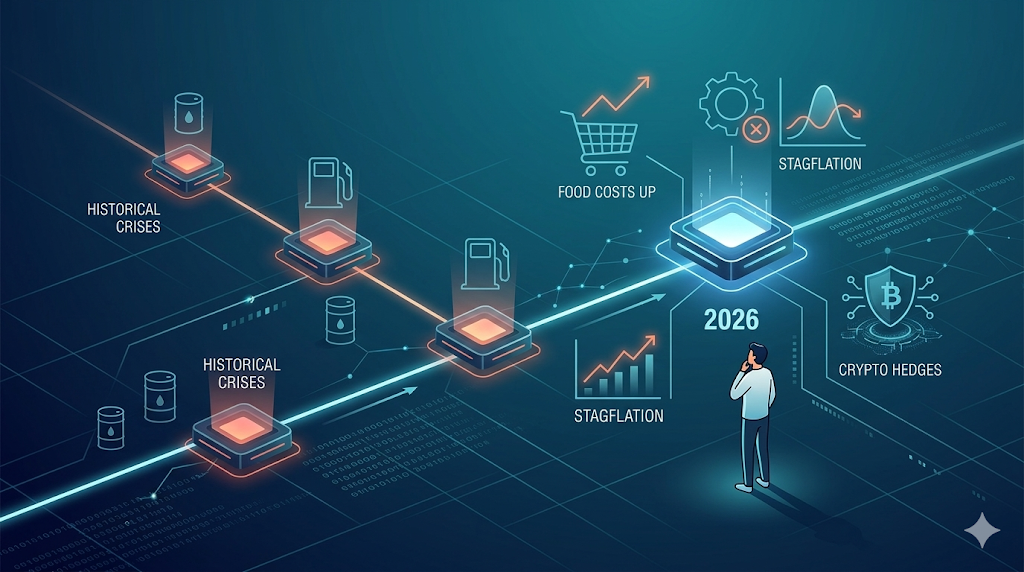
Did you know the April 2026 Strait of Hormuz blockade disrupted twenty percent of global oil trade, triggering the worst energy shock in history? Oil crises immediately devastate ordinary people through skyrocketing inflation, severe fuel shortages, and economic stagnation. The historical shocks of 1973, 1979, and 1990 eroded purchasing power dramatically for consumers worldwide.
Today, the 2026 fourth oil crisis is repeating this cycle, forcing everyday citizens to face record-high prices for food, fuel, and electricity. Investors are rapidly turning to digital assets to protect their wealth from rapid currency devaluation.
The Core Mechanics of Global Oil Shocks and Inflation
Supply Disruptions Drive Immediate Consumer Costs
Supply disruptions directly and immediately transfer massive costs to everyday consumers. When geopolitical conflicts restrict the flow of crude oil, global markets instantly price in the scarcity, causing gasoline and heating costs to surge. Ordinary people feel this impact at the gas pump long before official inflation data is published. Because energy is the foundational input for all economic activity, these sudden price spikes actively destroy household discretionary income worldwide.
The Domino Effect on Global Supply Chains
Higher energy prices trigger a devastating domino effect across every global supply chain. Transporting goods becomes exponentially more expensive, forcing logistics companies to pass these increased operating costs directly to retail shoppers. Grocery prices rise because agricultural machinery, fertilizer production, and delivery trucks all rely entirely on petroleum products. Consequently, a crisis that begins in the oil sector inevitably transforms into a comprehensive cost-of-living crisis for ordinary working families.
Central Banks and the Threat of Stagflation
Stagflation occurs when high inflation collides with stagnant economic growth, creating a nightmare scenario for ordinary workers. Central banks typically combat rising prices by increasing interest rates, which intentionally slows down corporate borrowing and hiring. During an oil crisis, this monetary policy forces everyday people to navigate soaring living costs while simultaneously facing severe job insecurity. History proves that energy-driven inflation is exceptionally difficult for governments to control without causing a recession.
The 1973 First Oil Crisis: The Era of Artificial Scarcity
The Embargo That Paralyzed Western Economies
The 1973 oil crisis paralyzed Western economies when major Middle Eastern producers imposed a deliberate embargo on specific nations. This political weaponization of energy exports caused global oil prices to quadruple almost overnight, fundamentally shocking the post-war economic system. Ordinary citizens, accustomed to cheap and abundant fuel, suddenly found themselves trapped in a severe economic contraction. The embargo demonstrated exactly how vulnerable modern domestic economies were to foreign energy dependencies.
Rationing and the Shift in Consumer Behavior
Fuel rationing became a daily reality for millions of drivers during the 1973 crisis. Governments implemented strict policies, such as allowing consumers to purchase gasoline only on alternating days based on their license plate numbers. Long, frustrating lines at gas stations defined the era, forcing ordinary people to drastically alter their daily commuting habits. This intense scarcity ultimately forced consumers to abandon massive, inefficient vehicles in favor of smaller, fuel-efficient imported cars.
The 1979 Second Oil Crisis: Revolution and Market Panic
The Sudden Collapse of Regional Production
The 1979 oil crisis devastated global markets following a massive revolution that completely halted Iranian oil production. Although the actual reduction in global oil supply was relatively small, the sudden instability triggered massive speculative panic across financial sectors. Traders and corporations hoarded oil aggressively, artificially exacerbating the shortage and driving prices to unprecedented historical highs. Ordinary people bore the brunt of this financial panic as retail energy prices doubled within a single year.
Psychological Panic Driving Prices Higher
Psychological panic played a massive role in driving retail prices higher during the 1979 energy shock. Consumers, remembering the severe shortages of 1973, rushed to top off their gas tanks continuously out of profound fear. This irrational hoarding behavior drained local gas stations faster than supply trucks could refill them, creating self-fulfilling regional shortages. The crisis proved that human psychology directly amplifies the financial suffering experienced by ordinary citizens during commodity shocks.
Skyrocketing Interest Rates and Mass Unemployment
Skyrocketing interest rates defined the brutal macroeconomic aftermath of the 1979 oil crisis. To crush the resulting double-digit inflation, central banks raised borrowing costs to historically unprecedented levels, deliberately inducing a severe economic recession. Ordinary people found it completely impossible to secure affordable mortgages or auto loans, devastating the housing and manufacturing sectors. This aggressive monetary response led to mass unemployment, financially crippling working-class families for several difficult years.
The 1990 Third Oil Crisis: Geopolitical War and Uncertainty
The Gulf War Price Spike
The 1990 oil crisis triggered a violent, immediate price spike following the sudden invasion of Kuwait. Global markets panicked over the potential destruction of massive Middle Eastern oil fields, causing crude prices to double in less than three months. For ordinary citizens, this meant an immediate surge in the cost of commuting and home heating just as winter approached. The sudden geopolitical conflict completely erased the era of cheap oil that defined the late 1980s.
The Brief But Severe Global Recession
The resulting economic recession of the early 1990s was brief but inflicted severe financial pain on ordinary workers globally. Consumer confidence plummeted as everyday people watched their disposable income vanish directly into their gas tanks. Retail spending collapsed, forcing massive corporate layoffs across the global manufacturing and service sectors. Families were forced to strictly budget their remaining capital, proving once again that energy volatility directly dictates the financial health of the working class.
The 2026 Fourth Oil Crisis: The Strait of Hormuz Blockade
The Largest Supply Disruption in Modern History
The 2026 Iran war fuel crisis is officially the largest supply disruption in the history of the global oil market. According to the International Energy Agency in April 2026, the blockade of the Strait of Hormuz disrupted twenty percent of global oil supplies. This catastrophic logistical failure stranded millions of barrels of crude oil and liquefied natural gas. Ordinary people are currently facing the most severe energy shortage recorded in modern economic history.
Energy Prices Surging to Unprecedented Levels
Energy prices have surged to entirely unprecedented levels, devastating household budgets worldwide. Based on the World Bank Group Commodity Markets Outlook in April 2026, global energy prices are projected to surge by 24 percent this year. Brent crude oil spiked violently, remaining consistently elevated and pushing retail gasoline prices toward absolute record highs. Everyday commuters are spending a disproportionate percentage of their monthly salaries simply to drive to their workplaces.
Global Governments Enacting Emergency Conservation Mandates
Global governments are currently enacting strict emergency conservation mandates to prevent complete electrical grid failures. According to the World Economic Forum in April 2026, countries like Bangladesh, Thailand, and Pakistan have implemented strict air conditioning limits in public buildings. Many nations have also mandated remote work days and shortened school weeks to drastically reduce commuter fuel consumption. Ordinary citizens are forced to radically alter their daily routines to comply with these severe national energy restrictions.
How the 2026 Energy Shock Impacts Ordinary People Today
Surging Transportation and Basic Commuting Costs
Surging transportation costs are currently destroying the financial stability of the global working class. Everyday commuters face exorbitant gasoline prices, making private vehicle travel mathematically impossible for low-income families. Furthermore, the massive spike in aviation fuel has completely grounded thousands of commercial flights, devastating the global tourism and hospitality industries. Ordinary people are abandoning summer travel plans entirely as the cost of basic mobility becomes an unaffordable luxury expense for most households.
The Unavoidable Rise in Global Food Prices
The unavoidable rise in global food prices represents the most dangerous threat to ordinary citizens in 2026. Based on World Bank data from April 2026, fertilizer prices are projected to increase by 31 percent this year due to supply chain disruptions. This massive agricultural cost is passed directly to supermarket shoppers, making basic groceries entirely unaffordable for vulnerable populations. Families are drastically reducing their consumption of expensive proteins just to survive the inflationary environment.
Remote Work Mandates and Rolling Blackouts
Remote work mandates and rolling blackouts are fundamentally altering how ordinary people live and work in 2026. To conserve national energy grids, corporations are forcing employees to work from home, shifting the burden of electricity costs directly onto the consumer. In regions heavily dependent on imported coal and gas, citizens face unpredictable, daily power outages. These severe infrastructure failures prevent children from studying and destroy refrigerated food supplies in residential homes globally.
The 2026 global energy crisis has rewritten the rules of wealth preservation. As geopolitical volatility restricts supply chains and devalues fiat currencies, traditional savings mechanisms are failing to outpace record-high living costs. For everyday investors, turning to decentralized networks and digital assets is no longer just a tech-forward trend—it has become a strategic necessity for financial resilience.
Bitcoin as a Decentralized Macroeconomic Hedge
Bitcoin operates as a powerful algorithmic hedge for individuals facing severe fiat currency inflation.
-
Algorithmic Scarcity: Unlike traditional currencies subject to panicked central bank interventions and quantitative easing, Bitcoin features a hard-capped supply of 21 million tokens.
-
Inflation Protection: As the 2026 oil shock erodes the purchasing power of legacy bank accounts, Bitcoin offers a transparent monetary policy that cannot be debased by government printing.
-
Global Liquidity: Retail investors are increasingly allocating capital into this borderless asset to shield their core wealth from localized systemic economic failures.
Tokenized Commodities: Direct Market Access for Retail Tranches
Real-World Asset (RWA) tokenization has democratized commodity trading during periods of intense market scarcity.
-
Breaking Institutional Barriers: Historically, trading crude oil, natural gas, or spot metals required complex brokerage infrastructure and massive institutional capital.
-
Fractional Ownership: Through secure blockchain protocols, everyday market participants can now purchase asset-backed tokens representing physical energy reserves.
-
Hedging Cost of Living: This structural innovation allows retail users to capture the upside of rising global energy prices, directly offsetting the inflating costs of their daily consumer goods.
Deploying Decentralized Finance (DeFi) for Sustainable Yield
Decentralized Finance provides a critical alternative for yield generation as legacy banking interest rates lag behind inflation.
-
Optimized Interest Rates: While traditional savings accounts offer negative real returns in the current macroeconomic climate, DeFi lending protocols offer highly competitive APYs on verified digital stablecoins.
-
Algorithmic Trust: By utilizing audited smart contracts, users can lend, borrow, and stake assets globally without relying on centralized intermediaries.
-
Financial Sovereignty: Transitioning a portion of fiat capital into stable, yield-bearing decentralized networks empowers families to mitigate cost-of-living volatility and maintain financial autonomy.
Comparing the Economic Impact of Global Oil Crises
| Crisis Era | Primary Geopolitical Catalyst | Global Supply Disruption | Inflationary Impact |
| 1973 First Crisis | OAPEC Oil Embargo | Regional targeted cuts | Quadrupled oil prices globally |
| 1979 Second Crisis | Iranian Revolution | Sudden production halt | Massive speculative price spikes |
| 1990 Third Crisis | Gulf War Conflict | Destruction of key oil fields | Brief but severe global recession |
| 2026 Fourth Crisis | Strait of Hormuz Blockade | 20 percent of global trade | Worst energy shock in history |
| Consumer Hardship | 1970s Crises | 2026 Fourth Crisis |
| Commuting Impact | License plate rationing lines | Strict remote work mandates globally |
| Agricultural Cost | Moderate food price increases | 31 percent spike in fertilizer costs |
| Financial Refuge | Gold and precious metals | Physical Gold, Bitcoin, and Tokenized Commodities (RWA) |
How to trade on KuCoin digital assets?
Trading digital assets on KuCoin provides an alternative diversification strategy for retail participants looking to manage geopolitical risk during the 2026 oil crisis. By utilizing this advanced cryptocurrency exchange, retail investors can instantly bypass the restrictive barriers of traditional financial institutions. KuCoin allows you to directly trade macroeconomic volatility currently disrupting global energy markets.
You must initially register and securely verify your KuCoin account to ensure complete compliance with international regulations. After depositing fiat currency or stablecoins into your digital wallet, navigate directly to the Spot Market interface. Here, you can search for top-tier decentralized finance tokens, tokenized commodities, and leading cryptocurrencies perfectly suited for inflation protection.
KuCoin provides professional-grade trading tools, including automated grid bots and precise limit orders, to meticulously manage your investment strategy. Open your KuCoin account today to seamlessly incorporate digital assets into a well-balanced risk management framework into your portfolio and survive the ongoing global energy shock.
Conclusion
The devastating impact of historical oil crises completely reshaped global economics, proving that energy supply disruptions brutally penalize ordinary people. The shocks of 1973, 1979, and 1990 destroyed consumer purchasing power, forced daily fuel rationing, and triggered severe recessions. Today, the 2026 fourth oil crisis is repeating this tragic cycle on an unprecedented scale. The blockade of the Strait of Hormuz has created the largest supply disruption in history, sending food and fuel prices skyrocketing globally.
For everyday citizens, navigating this extreme inflationary environment requires immediate financial adaptation. Remote work mandates, rolling electrical blackouts, and unaffordable basic goods currently define the consumer experience in 2026. To safeguard capital under such turbulent conditions, traditional assets like physical gold remain highly sought after; however, modern investors possess the revolutionary ability to utilize decentralized blockchain networks. By strategically diversifying into Bitcoin, stablecoins, and tokenized real-world assets, ordinary people can complement their savings framework against fiat currency devaluation. As energy markets remain highly unstable, the integration of robust digital assets serves as a highly versatile financial component for modern macroeconomic risk management.
FAQs
What exactly caused the 2026 fourth oil crisis?
The 2026 fourth oil crisis was caused directly by a massive geopolitical conflict that resulted in the severe blockade of the Strait of Hormuz. Because approximately twenty percent of the world's global oil trade passes through this narrow maritime chokepoint, the closure immediately stranded millions of barrels of crude oil. This sudden logistical failure triggered unprecedented supply shortages and massive global price spikes.
How does an oil crisis directly cause inflation?
An oil crisis directly causes inflation because crude oil is the foundational energy source for global manufacturing, agriculture, and transportation. When the price of fuel increases, logistics companies must charge more to deliver basic goods to retail supermarkets. These massive operational costs are aggressively passed down to ordinary consumers, instantly raising the price of everything from groceries to household electronics.
Why are fertilizer prices rising during the 2026 crisis?
Fertilizer prices are rising violently during the 2026 crisis because natural gas is a primary raw ingredient required to manufacture agricultural chemicals. Based on World Bank data from April 2026, supply chain disruptions have heavily restricted natural gas availability, causing fertilizer costs to spike by over thirty percent. This immediately threatens global crop yields and makes farming exponentially more expensive.
How can Bitcoin protect my wealth during an energy shock?
Bitcoin protects your wealth during an energy shock by serving as a strictly decentralized, algorithmically scarce digital asset. When central banks attempt to fix economic crises by aggressively printing fiat currency, traditional savings accounts rapidly lose their purchasing power. Bitcoin cannot be inflated or manipulated by governments, making it an excellent long-term hedge against systemic economic instability and rapid inflation.
What are tokenized energy commodities?
Tokenized energy commodities are digital blockchain tokens that legally and mathematically represent fractional ownership of physical energy reserves, like crude oil. They allow retail investors to easily trade the price movements of global energy markets without utilizing complex traditional brokerage accounts. These assets provide unprecedented accessibility for everyday people looking to profit directly from global supply shocks.
Disclaimer:This content is for informational purposes only and does not constitute investment advice. Cryptocurrency investments carry risk. Please do your own research (DYOR).