

Semiconductor Memory Stocks Continue Surging: Is It Time to Go All-In on the AI Memory Boom?
2026/07/22 11:50:00
Introduction
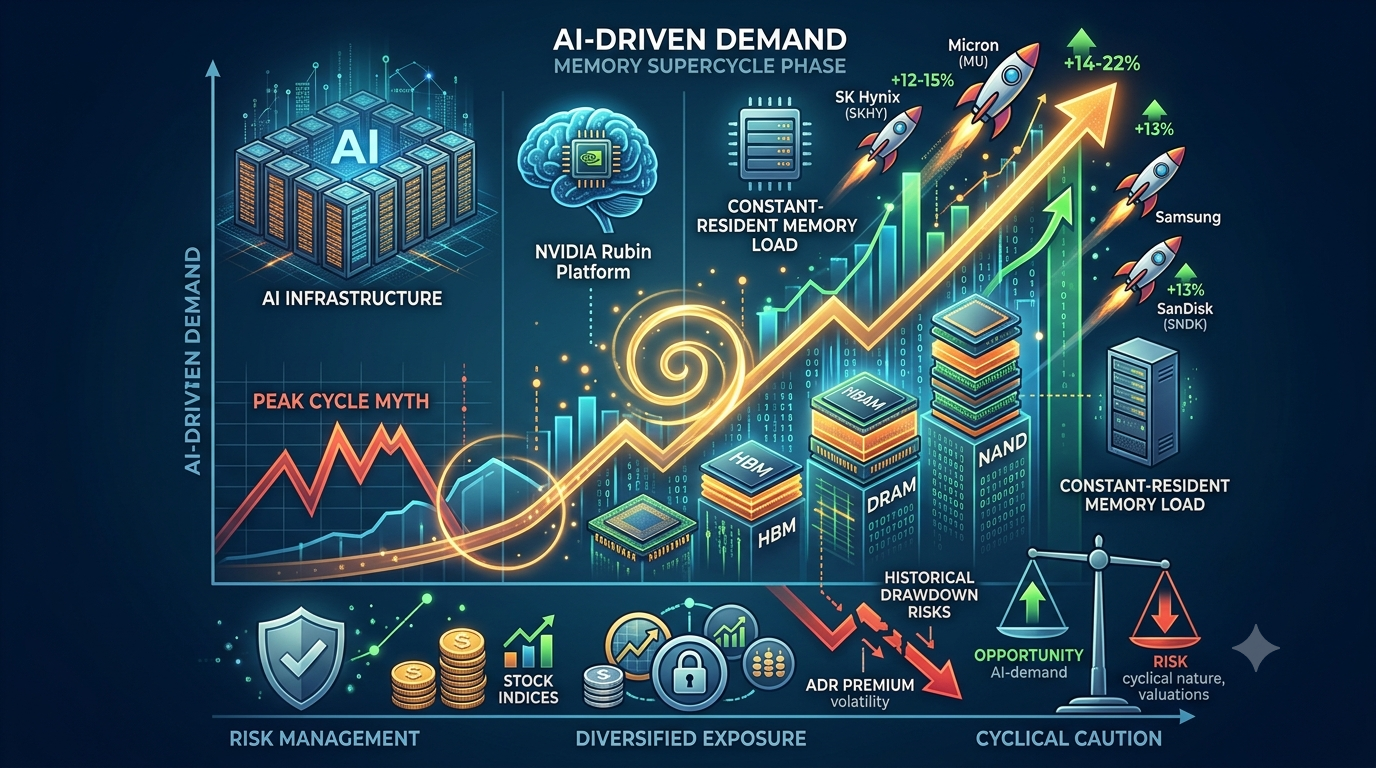
Semiconductor memory stocks delivered meme-like gains overnight as Micron Technology soared on blockbuster earnings, with rivals like Micron up over 12-15%, SanDisk around 14-22%, and Western Digital also climbing sharply. This surge shattered the recent market consensus that the memory cycle had peaked, reigniting optimism around AI-driven demand for DRAM and HBM chips.
The answer is clear: the memory supercycle is entering a powerful new phase driven by structural AI infrastructure needs, but it remains a cyclical sector with significant downside risks. Investors should approach with caution rather than rushing to all-in positions, focusing instead on diversified exposure and risk management.
What Is Driving the Latest Semiconductor Memory Rally?
The recent surge in memory chip stocks stems from renewed acceleration in storage demand tied directly to AI expansion. Nvidia's Vera Rubin platform has entered full production with customer shipments ramping in Q3 2026, pushing memory requirements far beyond GPU-only spending. Large language models now demand massive constant-resident memory loads, making HBM, DRAM, and NAND essential "second tickets" to AI participation.
Micron's fiscal Q3 2026 results (ended May 2026) exemplify this momentum. Revenue hit $41.46 billion, up 345% year-over-year and beating estimates of around $35-36 billion, while adjusted EPS reached $25.11 against consensus near $20.49. The company guided Q4 revenue to approximately $50 billion and highlighted $22 billion in customer commitments for supply lock-ins. HBM supply remains sold out through 2026 and into 2027, with tight conditions expected to persist beyond 2027.
Korean giants followed suit. SK Hynix shares jumped 13% and Samsung Electronics rose over 5% on June 25, 2026, following Micron's report. Industry analysts raised price targets rapidly, reflecting expectations of sustained profit momentum amid memory shortages.
How Strong Is AI Demand for HBM and DRAM Right Now?
AI demand for high-bandwidth memory and advanced DRAM far outstrips supply, creating structural tightness that supports elevated pricing through 2027 and potentially 2028. Major cloud providers have booked long-term agreements (LTAs) for HBM4 capacity well into 2027, with negotiations already advancing for 2028 allocations.
Nvidia confirmed all three primary suppliers—SK Hynix (dominant share ~60-70%), Samsung (~25-30%), and Micron—are in HBM4 production for Vera Rubin. Per-wafer revenue for HBM now exceeds traditional DRAM, incentivizing capacity shifts. HBM4 capacity per AI chip is rising sharply, with Rubin Ultra expected to demand even more in 2027.
Server DRAM and HBM are projected to represent up to 57% of total DRAM shipments in 2026 while generating around 65% of industry revenue. DRAM contract prices surged dramatically in recent quarters, with some reports citing 58-63% QoQ gains, while NAND rose 70-75%. This pricing power stems from deliberate capacity reallocation toward AI rather than commodity products.
Industry Leaders Are Expanding Aggressively — Not Contracting
Memory manufacturers are investing heavily to capture the supercycle, signaling confidence in multi-year demand. SK Hynix is in talks to acquire Intel's Ohio semiconductor campus for U.S.-based memory production, aligning with geopolitical needs while expanding capacity. The company also announced a KRW 100 trillion investment in Cheongju, South Korea, for new NAND fab M17 and advanced packaging.
Samsung and SK Hynix executives met with Nvidia's Jensen Huang and other AI leaders in Silicon Valley, underscoring the elevated status of memory in the AI stack. Micron's long-term supply agreements and customer deposits further validate this expansion phase.
This coordinated push across GPU, memory, and model developers marks a re-rating of memory's role from cyclical commodity to critical AI infrastructure component.
Risks and Cyclical Nature: Why Caution Is Essential
Even in a super-cycle downswing, semiconductor memory remains inherently cyclical, with historical tops often followed by 30-50% drawdowns. No one can precisely time the peak, but current valuations reflect aggressive optimism after massive year-to-date gains (SK Hynix up over 300% in some periods, Micron tripling).
A key near-term risk involves SK Hynix's ADR listing. The U.S. ADR (SKHY) has traded at a significant premium—around 20-30% in recent reports—to the Korean shares. With arbitrage windows opening (e.g., around late July 2026 in some contexts), convergence could pressure the ADR price even if underlying fundamentals hold, creating downside for high-entry buyers.
Supply responses will eventually arrive, though delayed by the complexity of HBM production. Over-allocation to AI could crowd out other segments temporarily, but any demand softening in hyperscaler capex would amplify volatility.
Should You Trade or Invest in Semiconductor Memory on KuCoin?
Semiconductor memory exposure fits well in a diversified portfolio for traders seeking AI-beta plays, but avoid all-in bets—use KuCoin's tools for risk-managed positions. KuCoin offers access to related crypto-AI narratives, spot/futures trading on correlated tokens, and leveraged products for tactical entries around earnings or sector news.
-
If you worry about the recent volatility, you may resort to KuCoin's copytrading hub or TraderPro campaign, to follow other lead traders' strategies, or register as the lead traders.

Conclusion
The semiconductor memory rally reflects genuine structural shifts: exploding AI demand from Vera Rubin and beyond, sold-out HBM capacity through 2027, aggressive industry expansion, and re-pricing of memory's strategic importance. Micron's record results and Korean peers' gains confirm the cycle's strength, with pricing power and margins at historic levels.
However, this is still a cyclical industry. Brilliant near-term momentum does not eliminate the risk of sharp pullbacks as supply catches up or sentiment shifts. The ADR premium dynamics add another layer of tradable volatility.
Smart investors treat this as an opportunity for selective, risk-aware participation rather than unchecked all-in enthusiasm. By staying informed on supply-demand balances, corporate expansions, and macro AI capex trends, traders can navigate the supercycle's upside while protecting against inevitable corrections. On platforms like KuCoin, disciplined approaches to this high-conviction but volatile sector can deliver strong results over the coming quarters.
FAQs
What is the difference between HBM and standard DRAM?
HBM is a specialized high-bandwidth form of DRAM stacked for massive parallel data throughput in AI accelerators, while standard DRAM serves broader computing needs with lower bandwidth per chip.
How long could the memory shortage last?
Analysts project tightness persisting into 2027-2028 due to slow capacity ramps for advanced HBM and sustained hyperscaler demand.
Should retail investors buy memory stocks at current highs?
Consider dollar-cost averaging and position sizing rather than lump-sum entries, given cyclical risks and elevated valuations after strong 2026 runs.