

Pump.fun Launches Frictionless Multi-Chain Trading: Trade Ethereum, Base & BNB Chain with One Wallet
2026/06/06 08:00:00
Thesis Statement
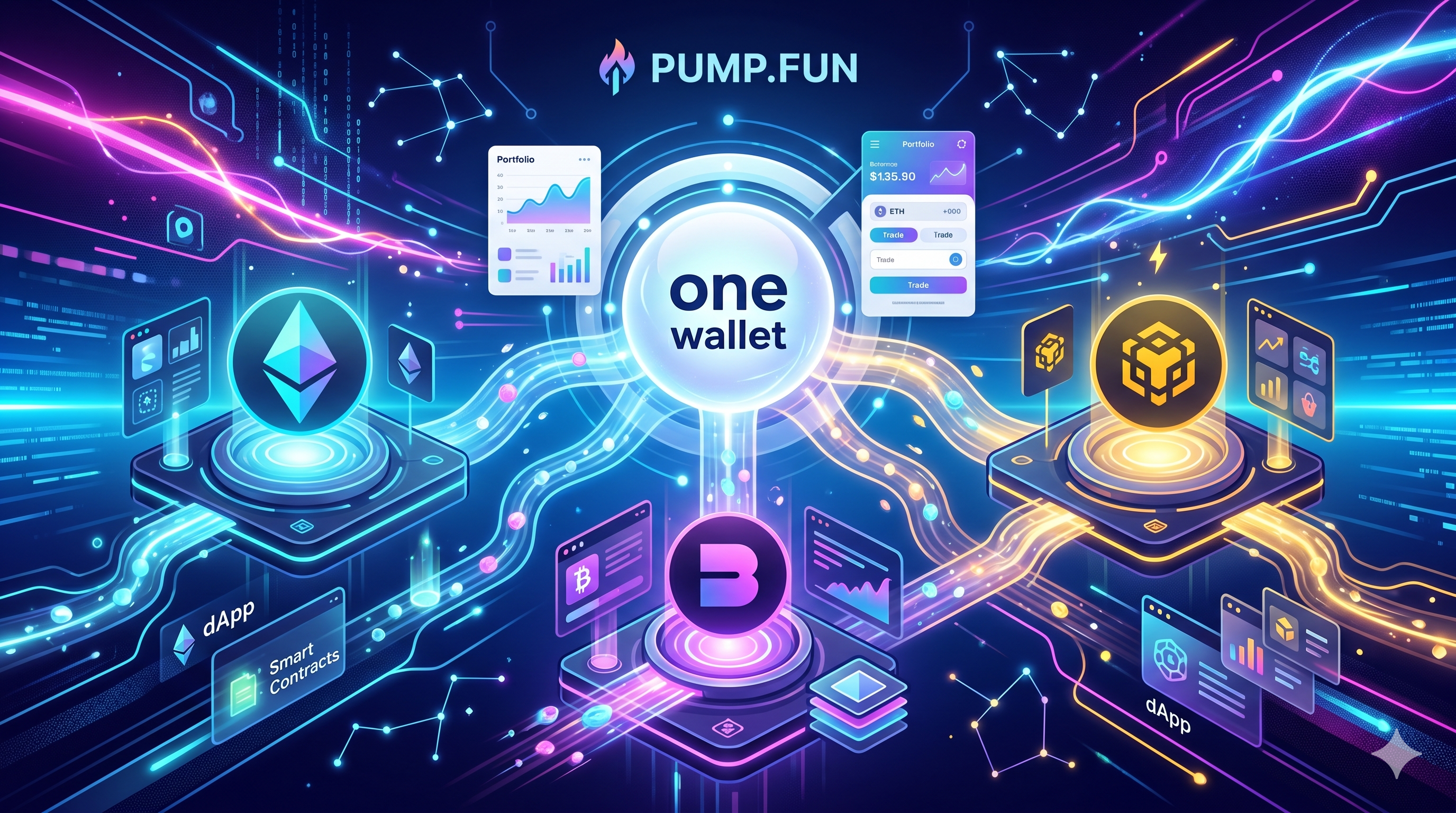
Pump.fun, the prominent Solana-based memecoin launchpad, announced a significant app upgrade on May 26, 2026, introducing frictionless multi-chain trading. Users can now trade assets across Ethereum, Base, BNB Chain, and other EVM-compatible networks directly within the platform using one wallet. The system eliminates traditional barriers like asset bridging and the need to hold native gas tokens for each chain.
This development marks an important move for Pump.fun from a Solana-centric platform toward a unified multi-chain trading hub, leveraging Solana as the settlement and gas subsidy layer while automatically generating wallets for EVM ecosystems. It streamlines access to diverse liquidity pools and market opportunities, potentially broadening user participation in fragmented blockchain environments.
Technical Architecture Enabling One-Wallet Multi-Chain Operations
The core of Pump.fun’s new frictionless multi-chain trading relies on sophisticated backend infrastructure that abstracts away the complexities of interacting with multiple blockchains. When users initiate a trade on an EVM chain like Ethereum or Base, the platform handles the underlying transactions through automated processes. Solana serves as the primary settlement layer, allowing users to pay with SOL while the system manages equivalent executions on target chains. This setup includes sponsored gas fees, where Pump.fun covers the costs on EVM networks, removing the common pain point of maintaining separate token balances for gas. Automatic multi-chain wallet generation further simplifies the process. Upon connecting a primary Solana wallet, the app creates and manages corresponding addresses on supported EVM chains without requiring manual setup or seed phrase management from the user.
This unified experience relies on secure key derivation and session management techniques that maintain isolation between chains while providing seamless asset visibility. Integration with existing DEX liquidity on these chains ensures trades execute against real market depth rather than isolated pools. Industry observers note that this architecture addresses longstanding interoperability challenges in crypto. Traditional cross-chain trading often involves multiple steps, high slippage from bridging, and exposure to bridge vulnerabilities. Pump.fun’s approach minimizes these by centralizing control within its app, using Solana’s high throughput for final confirmation. Early data post-launch indicates faster trade execution times compared to manual bridging workflows, which can take minutes or incur significant fees.
The upgrade builds on prior infrastructure work, including subdomain registrations for Ethereum, Base, and BNB Chain observed earlier in 2026. By positioning Solana as the unifying currency and settlement mechanism, Pump.fun creates an efficient hub that aggregates opportunities across ecosystems. This technical foundation not only enhances usability but also positions the platform to capture volume from traders seeking exposure to diverse assets without leaving a single interface. For those exploring broader crypto markets, checking real-time prices like Bitcoin on KuCoin provides valuable context for multi-chain positioning strategies.
User Experience Improvements Through Unified Wallet Access
Single wallet access represents one of the most user-friendly advancements in Pump.fun’s multi-chain rollout. Traders no longer need to juggle separate wallets or browser extensions for different chains, a common source of frustration and security risks. The platform’s app now presents a consolidated portfolio view, displaying holdings and trading options across Ethereum, Base, BNB Chain, and Solana in one place. This design reduces cognitive load and operational errors that frequently occur during manual cross-chain transfers. Practical examples highlight the difference. Traders interested in a new token on Base can execute the purchase using their SOL balance, with the system handling conversion and execution transparently.
No separate ETH for gas or bridging approvals is required. The automatic wallet generation ensures compatibility while maintaining user control through the primary Solana interface. Feedback from early users points to the need for quicker onboarding for those new to EVM chains, particularly in regions with growing crypto interest, such as emerging markets. This unified approach aligns with broader industry trends toward abstracted blockchain interactions. As crypto adoption grows, platforms that hide technical complexities tend to attract larger and more diverse user bases.
Pump.fun’s implementation includes real-time balance syncing and transaction status updates across chains, providing clarity that standalone wallets often lack. Security remains a priority, with the system employing best practices for key management to prevent unauthorized access. The feature also supports practical trading workflows, such as arbitrage between chains or diversified memecoin exposure. Traders can respond faster to opportunities appearing on the Ethereum mainnet or Base without setup delays. In competitive environments, speed and simplicity translate directly to better outcomes. Regarding market insights and trading pairs, users often reference established exchanges; exploring Ethereum trading options on KuCoin can complement multi-chain strategies by offering centralized liquidity benchmarks.
Solana’s Central Role in Cross-Chain Settlement and Gas Subsidies
Solana functions as the backbone for Pump.fun’s multi-chain trading by handling settlement and subsidizing gas fees on EVM networks. Users fund activities with SOL, and the platform routes transactions accordingly, abstracting the details. This design capitalizes on Solana’s strengths in speed and low costs for confirmation while extending reach to higher-value ecosystems on Ethereum and Base. Gas subsidies eliminate the need for users to acquire small amounts of ETH, BNB, or other native tokens solely for transaction fees. Pump.fun absorbs these costs as part of the service, making sporadic or small-volume trades more viable.
Settlement on Solana ensures finality with the platform’s established security model, reducing reliance on potentially slower or more expensive EVM finality in certain scenarios. This hybrid model has implications for capital efficiency. Traders maintain fewer idle assets across chains, freeing liquidity for actual positions rather than fee reserves. In volatile markets, avoiding bridge delays and associated risks preserves value. Pump.fun’s revenue model, which has generated substantial fees historically, exceeding $1 billion cumulatively by early 2026, supports such subsidies through efficient operations. Analysts view this as a strategic use of Solana’s infrastructure advantages to bridge ecosystem gaps.
It encourages Solana users to explore EVM opportunities and vice versa without full migration. The approach may influence other platforms considering similar expansions, emphasizing unified settlement layers over pure native execution. For users monitoring broader market dynamics, platforms like KuCoin offer comprehensive charts and tools that align well with multi-chain portfolio management, providing Solana price tracking alongside EVM assets. Implementation details suggest robust backend orchestration, with automatic routing that optimizes for cost and speed. This setup not only improves day-to-day trading but also supports larger strategic moves across chains.
Unlocking New Market Opportunities on Ethereum and Base Networks
Access to Ethereum and Base through Pump.fun opens significant trading avenues previously less accessible to Solana-native users. Ethereum remains the cornerstone for established DeFi protocols and high-profile tokens, while Base offers growing liquidity with prominent backing and lower fees. The frictionless integration allows seamless participation in both. Traders can now snipe launches or engage in established markets on these chains without leaving the Pump.fun app. This capability is particularly valuable during periods of divergent market narratives, where opportunities arise faster than users can traditionally switch ecosystems.
Base’s rapid growth in 2025-2026 has attracted substantial developer and user activity, creating memecoin and DeFi plays that complement Solana’s ecosystem. Practical benefits include diversified risk exposure. A portfolio focused solely on Solana faces concentration risks; multi-chain access mitigates this by tapping into Ethereum’s deep liquidity and Base’s innovative projects. Automated wallet features ensure users can act immediately when signals emerge across networks. Market data underscores the potential. Ethereum consistently ranks among the top chains by TVL and volume, while Base has seen explosive growth in user metrics.
Pump.fun’s entry facilitates easier capital flow toward these areas, potentially increasing overall platform volume. The unified SOL payment simplifies calculations and position sizing across environments. This expansion also benefits creators on EVM chains by exposing their tokens to Pump.fun’s established user base. Cross-pollination of liquidity and attention could strengthen interconnected market dynamics and additional trading venues; checking Base network tokens on KuCoin offers supplements.
BNB Chain Integration and Benefits for Global Trading Communities
BNB Chain integration expands Pump.fun’s reach into ecosystems popular in Asia and emerging markets, where Binance Smart Chain derivatives have long held strong adoption. Users gain direct access to BNB Chain assets using the same SOL-powered workflow, broadening appeal for traders in regions with high BNB Chain activity. The chain’s low fees and fast confirmations pair well with Pump.fun’s subsidized model, creating efficient trading conditions for high-frequency or smaller accounts. BNB Chain hosts significant DeFi and memecoin activity, providing opportunities that align with Pump.fun’s core strengths.
This integration supports practical use cases like hedging or arbitrage involving BNB Chain-specific tokens. The single-wallet system reduces barriers for users transitioning from centralized exchanges familiar with BNB ecosystems. Automatic generation of compatible addresses streamlines entry for those new to the chain. Broader implications include enhanced inclusivity. Emerging market participants often prefer chains with accessible fees and strong local communities; BNB Chain fits this profile. Pump.fun’s move could drive incremental user growth from these demographics, diversifying the platform’s base beyond Solana enthusiasts.
Liquidity considerations remain positive, as BNB Chain maintains robust DEX volumes. The frictionless entry point encourages experimentation and larger commitments. Combined with Ethereum and Base support, it creates a comprehensive EVM gateway. Monitoring related assets through established venues like KuCoin’s BNB trading page can provide additional market context and execution alternatives for sophisticated strategies.
How the Update Reduces Traditional Cross-Chain Trading Complexities
Pump.fun’s frictionless system directly tackles pain points in conventional cross-chain trading by removing bridging requirements entirely. Users avoid smart contract approvals, slippage from bridge aggregators, and waiting periods that expose positions to market shifts. Trades route through the app’s optimized paths with Solana settlement providing reliability. This reduction in steps leads to measurable efficiency gains. Transaction times decrease, costs stabilize via subsidies, and error rates from manual processes drop. For active traders, these improvements compound into better risk management and higher throughput. The automated nature also lowers the technical knowledge threshold, inviting more participants into multi-chain activities.
Industry context shows cross-chain volume has grown but remains hindered by complexity. Solutions that abstract these layers tend to see higher engagement. Pump.fun applies this principle at scale, leveraging its existing user base for fast adoption. Security audits and transparent mechanics build confidence in the new workflows. Practical trading examples demonstrate value during volatile periods, where quick repositioning across chains preserves capital. The system’s design prioritizes user control while handling backend logistics.
As more assets become available, the platform evolves into a comprehensive trading terminal rather than a single-chain tool. This move shows maturing infrastructure priorities in crypto, focusing on accessibility over raw decentralization tradeoffs. For supplementary analysis, traders frequently consult centralized resources such as multi-chain price aggregators to cross-verify opportunities discovered in the Pump.fun app. The net effect is a more fluid trading environment that encourages exploration without penalty.
Expansion Effects on the Broader Memecoin and DeFi Ecosystem
The multi-chain launch extends Pump.fun’s influence beyond Solana’s memecoin dominance into EVM territories. Memecoins on Ethereum, Base, and BNB Chain now gain easier visibility and trading flow from Pump.fun users, fostering greater ecosystem synergy. This connectivity could accelerate innovation cycles, as creators launch across chains knowing a unified audience awaits. Liquidity fragmentation lessens when platforms aggregate access points, potentially leading to healthier price discovery and sustained interest. DeFi protocols on target chains may see indirect benefits through increased user inflows. Pump.fun’s history of driving volume on Solana suggests similar potential elsewhere. Past revenue peaks tied to memecoin cycles demonstrate the platform’s ability to concentrate activity.
Extending this multi-chain model diversifies revenue streams and reduces dependency on single-network sentiment. Users benefit from richer selection without added effort. Solana memecoin traders can now pivot to promising EVM projects seamlessly. This fluidity supports portfolio strategies blending narratives across ecosystems. Long-term, it contributes to a more interconnected crypto market less prone to isolated booms and busts. The development aligns with trends toward chain-agnostic applications. As infrastructure improves, user behavior shifts toward convenience hubs. Pump.fun capitalizes on this by maintaining its core simplicity while expanding scope.
Gas Fee Management Innovations and User Cost Savings
Innovative gas management stands out in the upgrade, with Pump.fun subsidizing EVM fees and settling via SOL. Users avoid acquiring multiple small token balances, reducing overhead and complexity. This model delivers predictable costs focused on the trade itself rather than ancillary fees. Savings accumulate, especially for frequent traders or those executing smaller positions. Traditional workflows often incur disproportionate gas burdens on chains like Ethereum during congestion. Subsidies and automation mitigate this, improving net returns.
The approach demonstrates thoughtful resource allocation, balancing user incentives with platform sustainability. It draws from lessons in high-fee environments where hidden costs deter participation. By centralizing management, Pump.fun creates a more equitable trading field. Implementation includes safeguards to prevent abuse while maintaining service quality. Users experience consistent performance regardless of underlying chain conditions. This reliability builds trust and encourages habitual use. In comparison to standalone tools, the integrated solution offers superior convenience. Cost efficiencies can influence trading frequency and size positively. Broader adoption of similar models could reshape expectations for cross-chain interactions industry-wide.
Security and Risk Management in Automated Multi-Chain Systems
Security in Pump.fun’s multi-chain implementation centers on isolated wallet generation and controlled execution environments. Automated processes undergo rigorous checks to prevent unauthorized actions or key compromises. Users retain oversight through primary wallet approvals. Risk management includes limiting exposure scopes and transparent transaction logging. By avoiding user-managed bridges, the system reduces common attack vectors associated with cross-chain bridges. Ongoing monitoring and updates address emerging threats in multi-chain contexts.
Best practices from Solana’s ecosystem combine with EVM compatibility standards to create layered protections. Users benefit from reduced personal management of multiple keys, lowering phishing and error risks. While no system is risk-free, the design prioritizes user asset safety alongside functionality. Audits and iterative improvements support long-term confidence. Education on best practices remains important for participants. The approach balances innovation with prudence, setting a benchmark for similar platforms. As multi-chain usage grows, robust security will differentiate sustainable solutions.
Strategic Implications for Pump.fun in Competitive Crypto Markets
Pump.fun’s multi-chain expansion strategically positions it as a versatile trading destination amid intensifying competition. By aggregating access to major EVM chains, the platform differentiates through convenience rather than competing solely on native features. This move capitalizes on existing strengths in user experience and memecoin facilitation while addressing market demands for interoperability. It potentially captures share from fragmented tools and complex aggregators. Long-term, it supports evolution into a comprehensive crypto terminal.
Competitive dynamics favor platforms that lower barriers and expand utility. Pump.fun’s revenue track record provides resources for continued development and user incentives. Market share gains could follow as awareness of the features increases. The strategy reflects foresight in infrastructure trends, where unified experiences drive adoption. Positioning remains strong for both retail and more active traders seeking efficiency. Future enhancements may further solidify leadership.
FAQs
How does Pump.fun's frictionless multi-chain trading actually works for someone new to EVM chains?
The system allows users to connect their Solana wallet and automatically handles interactions with Ethereum, Base, or BNB Chain behind the scenes. SOL covers payments and gas subsidies, while trades execute on the target chain's liquidity. This means beginners can participate without learning separate wallet setups or bridge processes, making cross-ecosystem trading approachable through a familiar interface. The automation includes balance syncing and clear confirmations to build confidence.
What advantages does using SOL for multi-chain trades on Pump.fun provided compared to native tokens?
Paying with SOL centralizes costs and eliminates the need to hold small amounts of ETH or BNB purely for fees. Subsidies further reduce expenses, and Solana's settlement adds speed advantages. This efficiency helps users allocate more capital to actual positions rather than reserves, improving overall trading economics, especially for active participants across multiple networks.
Are there any limitations to the assets available through Pump.fun's new multi-chain feature?
The feature focuses on supported EVM chains and their DEX liquidity pools, covering a wide range of tokens but not every possible asset instantly. Popular and liquid tokens see the best execution. Users should verify specific availability within the app, as the platform continues expanding supported opportunities based on demand and integration feasibility.
How might this update affect trading strategies for memecoin enthusiasts?
Traders gain the ability to follow narratives and launches across ecosystems without switching apps or wallets. This enables faster reactions to opportunities on Base or Ethereum while retaining Solana familiarity. Diversification becomes simpler, potentially leading to more balanced exposure and reduced timing risks associated with a single-chain focus.
What should users consider regarding security when using the automated wallet features?
Rely on the platform's built-in protections and avoid sharing credentials. Monitor transactions carefully through the app and enable any available security options. While the system is designed for safety, standard crypto practices like using hardware wallets for larger amounts and staying updated on announcements remain essential.
How could ongoing multi-chain developments influence Pump.fun's position in the industry?
By lowering barriers between major networks, the platform attracts broader participation and sustains activity levels. This adaptability supports resilience against market shifts and positions it as a go-to hub for efficient trading. Continued innovation will likely reinforce its role as users seek convenient ways to navigate fragmented blockchain spaces.
Disclaimer: This content is for informational purposes only and does not constitute investment advice. Cryptocurrency investments carry risk. Please do your own research (DYOR).