

Magnificent 7 Plunge on AI Cash Burn While Memory Chip Stocks Rise
2026/07/24 10:39:00
Introduction
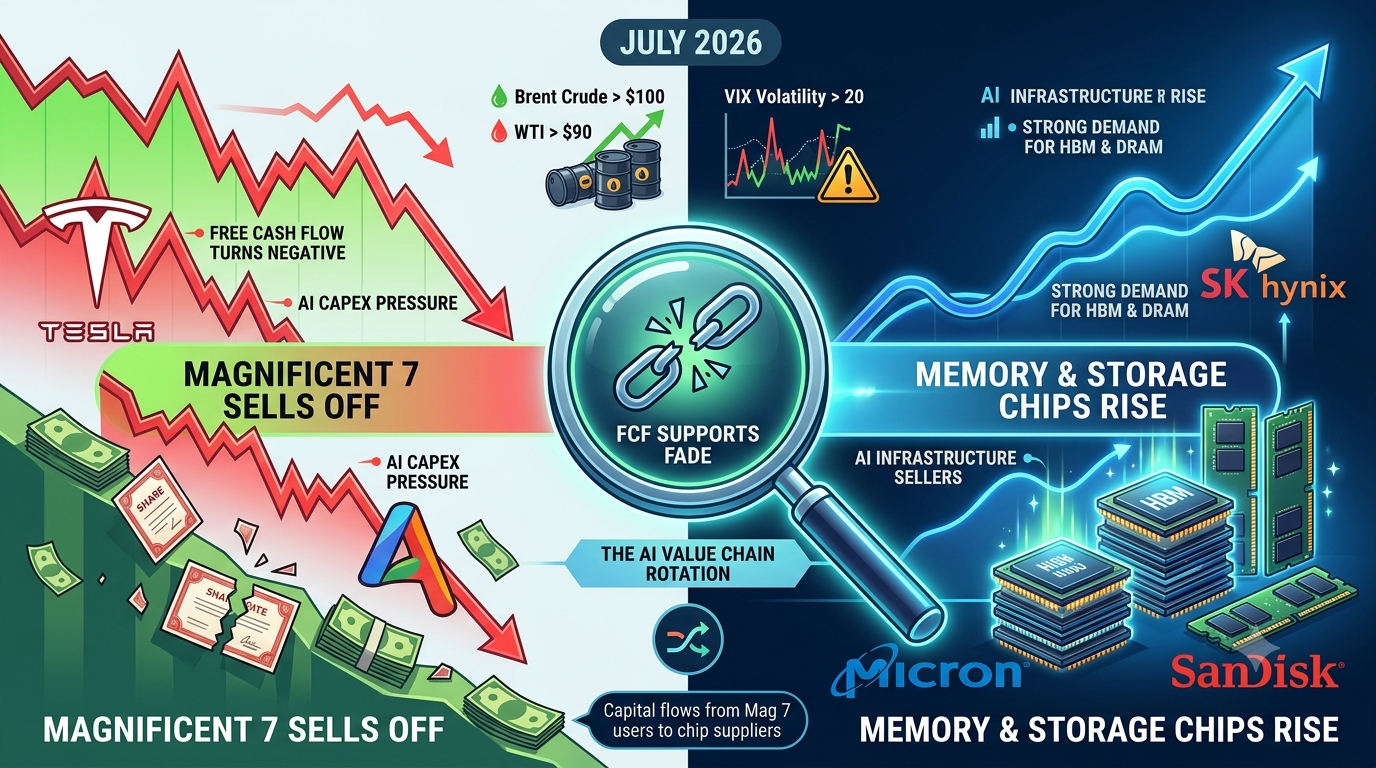
Did the market just punish Big Tech for betting too hard on artificial intelligence? Overnight, the Magnificent 7 saw collective market value evaporate across the board. Tesla dropped more than 14 percent, Alphabet (Google) fell over 7 percent, Amazon declined about 4 percent, and the remaining names lost between 1 and 3 percent. The immediate trigger came from Tesla and Alphabet’s latest earnings, which showed free cash flow turning negative as both companies poured capital into AI infrastructure. Markets still embrace the AI story, yet they no longer welcome an AI narrative built on unrestricted spending that pushes free cash flow into the red.
Free cash flow has served as a quiet engine of the multi-decade U.S. equity bull market. Companies used surplus cash to repurchase shares and support valuations. When that flow turns negative, one of the traditional price supports disappears, and investors react accordingly. Even as the Magnificent 7 sacrificed market capitalization, storage and memory chip names such as SK Hynix, Micron, and Sandisk closed higher, showing almost no contagion from the tech giants’ declines. The divergence is not a sign of a fully healthy market, and no one can say how long it will last—perhaps until the next Federal Reserve meeting, the next inflation print, or the midterm elections. Meanwhile, the VIX volatility index rose roughly 12 percent in 24 hours and briefly exceeded 20, while Brent crude climbed above $100 and WTI moved past $90, underscoring rising inflation risk and shaky confidence.
Why Did the Magnificent 7 Stocks Fall So Sharply?
The Magnificent 7 stocks fell sharply because Tesla and Google reported free cash flow turning negative after heavy AI capital expenditures. According to company filings released in July 2026, Tesla posted a free-cash-flow deficit of $1.1 billion in the second quarter after capital spending reached $5.8 billion. Alphabet recorded negative free cash flow of approximately $5.9 billion in the same period as capital expenditures hit $44.9 billion, with management raising full-year 2026 capex guidance to as high as $205 billion.
These results confirmed that the hyperscalers and AI-focused giants are shifting from asset-light, high-cash-flow models to balance-sheet-intensive ones. Free cash flow historically funded share buybacks that supported stock prices. Its absence removes that support and forces investors to reassess near-term returns on AI investments. Other Magnificent 7 members experienced more modest declines of 1–3 percent as the broader group absorbed the sentiment hit. The sell-off reflects discomfort with spending that has already driven free cash flow negative rather than rejection of artificial intelligence itself.
How Does Negative Free Cash Flow Affect Mag 7 Valuations?
Negative free cash flow weakens Mag 7 valuations by eliminating a key historical driver of share-price support. For decades, U.S. large-cap technology companies generated substantial free cash flow and returned it to shareholders through buybacks. That mechanism helped sustain elevated multiples. When free cash flow turns negative, companies must either raise debt, issue equity, or slow capital returns—none of which markets currently favor.
Recent data show the pattern is not isolated. Hyperscaler free cash flow has compressed as AI-related capital expenditures accelerated. Tesla’s swing from positive free cash flow in prior quarters to a $1.1 billion deficit and Alphabet’s $5.9 billion shortfall illustrate the shift in real time. Investors now price these stocks with greater emphasis on the timeline for AI monetization rather than current cash generation. The result is multiple compression and heightened sensitivity to any further guidance increases on spending.
Why Are Memory Chip Stocks Rising Amid the Mag 7 Sell-Off?
Memory chip stocks are rising because the same AI infrastructure spending that pressures Mag 7 free cash flow creates direct demand for high-bandwidth memory and storage. SK Hynix, Micron, and Sandisk closed higher on the session that saw the Magnificent 7 decline, according to market closes in late July 2026. These companies supply the DRAM, HBM, and NAND products essential for AI servers and data centers.
The divergence is logical: the Mag 7 are the buyers of the chips, while the memory makers are the sellers. Elevated capital expenditure by the tech giants translates into tighter supply and stronger pricing power for memory producers. Even as broader semiconductor indices have experienced volatility earlier in the month, the latest session showed memory names decoupling from the Mag 7 weakness. This pattern is not sustainable indefinitely, yet it currently reflects the flow of capital from software and platform companies into hardware suppliers.
What Role Does AI Infrastructure Spending Play in This Divergence?
AI infrastructure spending is the central driver of both the Mag 7 cash-flow pressure and the memory-chip strength. Companies are racing to build data-center capacity, secure advanced chips, and expand high-bandwidth memory inventories. That race requires outsized capital outlays today for expected revenue and efficiency gains tomorrow.
The spending has already pushed free cash flow negative at Tesla and Alphabet. At the same time, it has tightened the memory market and supported elevated prices for the products that SK Hynix, Micron, and Sandisk produce. The market is therefore rotating capital within the AI value chain—from the end users of the technology toward the component suppliers. This rotation can persist as long as AI demand remains robust and memory supply stays constrained, but it also raises questions about the pace of returns on the original capital investments.
How Are Rising Oil Prices and VIX Affecting Market Confidence?
Rising oil prices and a higher VIX are amplifying market caution even while memory chips hold gains. Brent crude moved above $100 per barrel and WTI exceeded $90 in late July 2026. Simultaneously, the VIX rose about 12 percent within 24 hours and briefly traded above 20. These moves signal heightened inflation risk and reduced near-term confidence.
Higher energy costs can feed into broader inflation readings and complicate Federal Reserve policy. An elevated VIX reflects investor hedging against further equity volatility. Together they create an environment in which selective strength in memory chips coexists with broader caution. The combination suggests the current divergence between Mag 7 weakness and memory-chip resilience may prove temporary pending clearer signals on inflation, interest rates, or AI monetization timelines.
Join KuCoin’s 9th Anniversary Trading Campaign
KuCoin is celebrating its 9th anniversary with a special platform campaign filled with exclusive rewards, trading activities, and limited-time offers. Don’t miss the chance to participate and enjoy the benefits as the exchange marks nine years of growth and innovation. Visit the official campaign page now:

Conclusion
The overnight decline in the Magnificent 7—led by Tesla’s more than 14 percent drop and Alphabet’s more than 7 percent decline—stemmed directly from free cash flow turning negative after aggressive AI capital spending. Markets still support the long-term AI narrative but reject the near-term cash-burn intensity that removes a traditional valuation support. In parallel, memory and storage chip stocks such as SK Hynix, Micron, and Sandisk advanced, illustrating a clear rotation within the AI value chain from spenders to suppliers.
This divergence is not a sign of overall market health. Rising oil prices above key psychological levels and a VIX that climbed roughly 12 percent and briefly exceeded 20 underscore growing caution around inflation and volatility. The current setup may persist until the next major policy or data catalyst, yet it already demonstrates how AI investment is reshaping capital flows. Investors and traders should monitor free-cash-flow trends, memory pricing, and macroeconomic indicators closely as the next chapter of the AI cycle unfolds.
FAQs
What is free cash flow and why does it matter for Mag 7 stocks?
Free cash flow is the cash a company generates after capital expenditures. It has historically funded share buybacks that supported Mag 7 valuations; its recent turn negative removes that support.
How high did the VIX rise during this market move?
The VIX increased approximately 12 percent within 24 hours and briefly traded above the 20 level, signaling elevated near-term uncertainty.
Why are oil prices relevant to tech stocks right now?
Brent crude above $100 and WTI above $90 raise inflation concerns that can influence Federal Reserve policy and overall risk appetite for high-valuation technology names.