

SUI Three-Year Unlock Ends: VC and Team Vesting Complete, Inflation Pressure Eases in 2026
Introduction
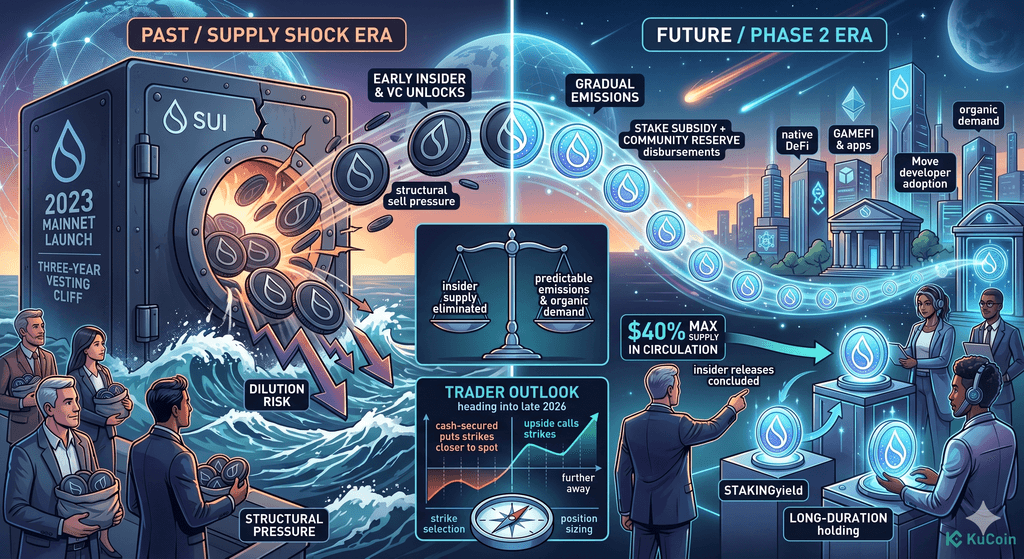
Sui (SUI) just crossed one of the most anticipated supply milestones in its short history. As of May 2026, the three-year vesting schedule covering early contributors, venture investors, and the core Mysten Labs team has officially concluded, removing the single largest source of structural sell pressure that has weighed on SUI blockchain since its 2023 mainnet launch. With roughly 40% of the 10 billion maximum supply now in circulation — up sharply from earlier quarters — the token enters a new phase where future emissions are dominated by long-term community reserves and staking rewards rather than concentrated insider unlocks.
For traders, this shifts the central question from “when does the next cliff hit?” to “can organic demand absorb a more gradual, predictable supply curve?” The answer matters for strike selection, spot accumulation, and derivatives positioning across the next several quarters.
What Exactly Ended in SUI’s Three-Year Unlock?
The three-year unlock event marks the completion of cliff and linear vesting for SUI’s earliest stakeholders — Series A and B venture investors, the founding team at Mysten Labs, and early contributors who received allocations at genesis. According to the Sui Foundation’s published tokenomics framework, these cohorts collectively held a significant portion of the original 10 billion SUI maximum supply, with most allocations following a one-year cliff and 24-month linear release.
That release pattern has now run its course. The remaining unlocked balances from these groups are either already liquid or have been distributed to wallets that are no longer governed by smart-contract-enforced lockups.
Which Allocations Are Now Fully Vested?
Three categories have completed their primary vesting:
-
Early contributors: Individuals and advisors who received pre-mainnet allocations.
-
Series A and B investors: Venture firms that participated in Sui’s 2021 and 2022 funding rounds.
-
Mysten Labs core team: Founders and employees whose allocations followed the standard 4-year vesting with a 1-year cliff, with the three-year mark capturing the bulk of cliff-plus-linear releases.
What Remains Locked?
Roughly 60% of the maximum supply remains outside circulation, but the composition has changed materially. The remaining locked balance is now concentrated in the Community Reserve and Stake Subsidy programs, both controlled by the Sui Foundation and released on schedules tied to ecosystem grants, validator subsidies, and long-horizon community incentives rather than investor liquidity events.
Why Does the End of Insider Vesting Matter for SUI Price?
The end of insider vesting matters because it eliminates the most predictable and concentrated form of sell pressure in any token’s lifecycle. Venture investors and team members typically have the lowest cost basis and the strongest incentive to realize gains as soon as lockups expire — a dynamic that has historically pressured every major Layer-1 token through its first 24 to 36 months.
With those tranches now distributed, the marginal seller is no longer a fund rebalancing a 2022-vintage position. The marginal seller becomes either a community participant who already bought at market or a validator receiving staking rewards — both of which are smaller, more diffuse, and far less synchronized than scheduled cliff unlocks.
How Has Circulating Supply Changed?
Circulating supply has expanded to approximately 40% of the 10 billion maximum, based on Sui Foundation disclosures referenced across major data aggregators in Q2 2026. That expansion reflects the cumulative effect of three years of monthly unlocks, but the rate of new insider supply hitting the market is now sharply lower than during the 2024–2025 peak unlock window.
What Replaces VC Unlocks as the Main Supply Source?
Future supply growth will come primarily from two predictable, programmatic streams:
-
Stake Subsidy emissions — declining annual subsidies paid to validators and delegators, designed to bootstrap network security and taper over time.
-
Community Reserve disbursements — foundation-controlled grants released for ecosystem development, typically with their own short vesting schedules attached.
Both streams are smaller per month than peak insider unlocks and are arguably more aligned with on-chain activity, since stake subsidies flow to participants who are actively locking tokens to secure the network.
Bullish Case: Why Traders Are Positioning Long on SUI
The bullish case rests on the idea that the market has already priced in the worst of SUI’s inflation pressure and that demand-side strength is now meeting a slower supply curve. Sui’s ecosystem has continued to expand across DeFi, gaming, and consumer applications, and on-chain metrics — including stablecoin supply on Sui, DEX volume, and active addresses — have trended higher into the unlock milestone rather than weakening into it.
Has Selling Pressure Already Been Absorbed?
Selling pressure appears to have been largely absorbed during the heaviest unlock months of 2024 and 2025. SUI rebounded after several of its largest scheduled releases, a pattern that suggests OTC desks and structured liquidity providers have been working through insider supply rather than dumping it on spot order books.
The float expansion to roughly 40% of max supply, paired with growing staking participation, indicates that a meaningful share of newly unlocked tokens is being re-locked into validator delegations rather than rotated out to exit liquidity.
What Drives Demand From Here?
Three demand drivers stand out for the bull case:
-
Ecosystem TVL growth in Sui-native DeFi protocols.
-
Move-language developer adoption continuing to attract teams building consumer-facing applications.
-
Staking yield that remains competitive relative to other Layer-1s, encouraging long-duration holding rather than immediate sale.
If these drivers persist, the reduction in scheduled insider supply could create a constructive setup for spot accumulation and a tighter realized volatility profile heading into late 2026.
Bearish Case: What Risks Remain After the Unlock?
The bearish case is straightforward: 60% of max supply is still locked, and dilution risk does not disappear simply because the highest-profile cohort has finished vesting. Community Reserve and Stake Subsidy emissions will continue to expand circulating supply on a multi-year schedule, and any softening in demand could amplify the price impact of even modest new supply.
Could Foundation and Treasury Distributions Create New Sell Pressure?
Foundation-controlled distributions can absolutely create sell pressure, particularly when grants are awarded to teams or contributors who need to convert SUI into stablecoins to fund operations. Unlike insider unlocks, which follow a published schedule, ecosystem grant outflows are less predictable in timing and size, which can make them harder for the market to discount in advance.
Is On-Chain Transparency Sufficient?
On-chain transparency around remaining locked balances is partial. A meaningful share of unlock and distribution data is maintained in foundation-side databases rather than enforced exclusively by on-chain smart contracts, which means traders rely on periodic disclosures rather than continuous, verifiable on-chain accounting. That information asymmetry is a real risk if macro conditions deteriorate and large holders move ahead of public reporting.
What Macro Risks Should SUI Traders Watch?
Three macro factors could amplify residual unlock risk:
-
Liquidity contraction in broader crypto markets, which historically hits high-beta Layer-1 tokens hardest.
-
Bitcoin dominance spikes that pull capital out of altcoins regardless of project-specific fundamentals.
-
Regulatory shifts affecting U.S. or European venture-held token positions, which could accelerate residual insider distributions.
How Does SUI’s Post-Unlock Supply Compare to Other Layer-1s?
SUI’s post-unlock supply profile is now structurally similar to other major Layer-1s that have crossed their three-year milestones, with the bulk of remaining emissions tied to network security rather than investor liquidity. The table below illustrates where SUI sits relative to circulating-to-max-supply ratios at comparable points in their lifecycles.
|
Token
|
Approx. Circulating / Max Supply
|
Primary Remaining Emission Source
|
|
SUI
|
~40%
|
Stake Subsidy + Community Reserve
|
|
APT
|
~55%
|
Staking rewards + ecosystem reserve
|
|
SOL
|
~85%
|
Inflation schedule (declining)
|
|
AVAX
|
~60%
|
Staking emissions
|
The comparison underscores that SUI still has more nominal supply expansion ahead than more mature peers, but the cliff-driven sell pressure profile has converged toward the steadier, emissions-driven profile typical of established proof-of-stake networks.
What Does This Mean for SUI Options and Derivatives Traders?
For derivatives traders, the end of insider vesting compresses one of the structural tail risks that has been embedded in SUI implied volatility. Premium sellers — those writing calls and puts to harvest IV — can now underwrite a supply environment where the dominant risk is gradual emissions and macro beta, not lumpy unlock events that historically spiked realized vol in the days surrounding cliff dates.
How Should Strike Selection Adjust?
Strike selection should account for a tighter expected range on the supply side and a wider range on the demand side. With insider sell pressure muted, downside strikes can be placed somewhat closer to spot for cash-secured puts, while upside call strikes should reflect the potential for demand-driven breakouts as float quality improves.
What Should Premium Sellers Watch?
Premium sellers should monitor three signals:
-
Weekly net staking flows as a proxy for whether newly liquid SUI is being re-locked.
-
Foundation distribution announcements that could front-run grant outflows.
-
Funding rates on perpetuals, which often telegraph positioning shifts before spot moves.
How to Trade SUI on KuCoin
KuCoin offers a full stack for trading SUI across spot, margin, futures, and options markets, giving traders multiple ways to express views on the post-unlock setup. Spot pairs allow direct accumulation against USDT and other quote assets, while SUI perpetual futures provide leveraged exposure with deep liquidity for both directional and hedging strategies.
To get started:
-
Create or log in to your KuCoin account and complete identity verification.
-
Deposit funds via crypto transfer or supported fiat on-ramps.
-
Navigate to the SUI/USDT market for spot trading, or open the futures interface for perpetual contracts.
-
Set position sizing and risk parameters based on your view of the post-unlock supply curve.
-
Consider staking any spot holdings to capture native yield while waiting for directional setups to develop.
New users can now register at KuCoin and Get Up to 11,000 USDT in New User Rewards.
Conclusion
The completion of SUI’s three-year unlock is a genuine structural shift, not just a calendar event. Early contributors, venture investors, and the Mysten Labs team have finished their primary vesting, and the marginal source of new supply is now community reserves and staking subsidies — flows that are smaller per month, more predictable, and arguably better aligned with on-chain participation than concentrated insider releases.
The bullish read is that demand-side strength has already absorbed the heaviest selling and that a 40% float, paired with growing ecosystem activity, sets up a constructive 2026. The bearish read is that 60% of max supply still sits in foundation-controlled programs, on-chain transparency around those balances is partial, and any macro deterioration could amplify the impact of even modest new emissions.
For traders, the practical takeaway is that SUI has graduated from cliff-driven volatility into a more conventional emissions-driven supply profile — a regime that rewards disciplined position sizing, attention to staking and grant flows, and patience around demand-side catalysts.
FAQs
1. When did SUI’s mainnet launch and why is the three-year mark significant?
SUI mainnet launched in May 2023. The three-year mark is significant because most insider allocations followed a standard 1-year cliff plus 24-month linear vesting structure, which means the three-year anniversary captures the completion of the largest scheduled insider releases.
2. How much SUI is staked, and does staking reduce effective sell pressure?
A meaningful share of circulating SUI is delegated to validators, and staked tokens are subject to an unbonding period before they can be sold. This reduces effective float available for immediate sale and can blunt the price impact of new emissions, though staked tokens are not permanently removed from supply.
3. Does SUI have a token burn mechanism?
SUI uses a portion of transaction fees to fund storage rebates and validator rewards rather than a pure burn mechanism. Net supply change depends on the balance between new emissions and any deflationary fee components, so SUI should not be modeled as a deflationary asset by default.
4. How can I verify SUI unlock data independently?
Traders can cross-reference Sui Foundation disclosures with third-party trackers that monitor large wallet movements and scheduled unlock calendars. Because some unlock accounting is maintained off-chain, combining multiple sources is more reliable than depending on any single dashboard.
5. What is the difference between Community Reserve and Stake Subsidy emissions?
Community Reserve is a foundation-controlled pool used for ecosystem grants, partnerships, and long-term community incentives, released at the foundation’s discretion. Stake Subsidy is a programmatic emission paid to validators and delegators to bootstrap network security, with a predefined declining schedule. The two serve different purposes and have different release dynamics.